Capital One Power Day Interview Guide: Case, Technical, and Behavioral Rounds
Quick Overview
Capital One Power Day is a final interview loop that may include coding, system design, a technical or business case, and behavioral or job-fit interviews. This guide explains what each round may test, how the format varies by role and seniority, and how software engineers can prepare with a focused 7-day plan. Use PracHub to practice real interview questions, company-specific prompts, system design, and behavioral stories before the full loop.
A Capital One Power Day can require several kinds of reasoning in quick succession. For a software role, prepare coding and project discussion, then confirm whether your schedule includes design, a case or other role-specific assessments. A case answer needs a defensible decision: calculate the benefit, expose the assumptions and revise the answer when a constraint changes.
Use behavioral and leadership practice to prepare your own project stories alongside the cache decision case below.

What Power Day means for your role
Capital One's student interview guidance describes a set of interviews whose contents depend on the position. Its case guidance explains structured business problem solving, but it does not make one mini-case format mandatory for every software engineer. Check the invitation for the number, length and focus of your sessions. Capital One interview overview, case guidance.
Treat the worked case as an original engineering exercise. The numbers are invented for practice. You are deciding whether a cache is worth building under stated correctness and operating constraints, not predicting the company’s interview prompt.
Keep a short reset between sessions: identify the next question, clarify its contract and begin again. A difficult coding question should not make you rush the following behavioral answer. Have water, a tested environment and a copy of the schedule ready so you can spend attention on the work.
A worked software-engineering case: should we cache a status endpoint?
This is an original practice case, not a Capital One question. Try it in 25 minutes. A mobile app polls an application-status endpoint two million times a day. Each uncached request costs an assumed $0.0008 in compute and downstream work. A proposed cache costs $12,000 to build and $120 a day to operate. It could serve 80% of requests without calling the origin. Status changes must become visible within 30 seconds. Some fields are customer-specific.
Your task is to recommend whether to build it, choose a safe first release and state what evidence could reverse your decision. Start by clarifying whether the cost estimate includes everything the cache would avoid, whether the hit rate has been measured, and which status transitions are sensitive to staleness. Do not begin with a technology name.
| Supplied input | Value | Why it matters |
|---|---|---|
| Daily requests | 2,000,000 | Cost and traffic baseline |
| Avoidable origin cost per request | $0.0008 | Benefit of a genuine cache hit |
| Expected hit rate | 80% | An assumption to test |
| Cache operating cost | $120/day | Recurring cost |
| Build cost | $12,000 | One-time cost |
| Maximum tolerated staleness | 30 seconds | A correctness constraint |
Work the baseline before defending the design
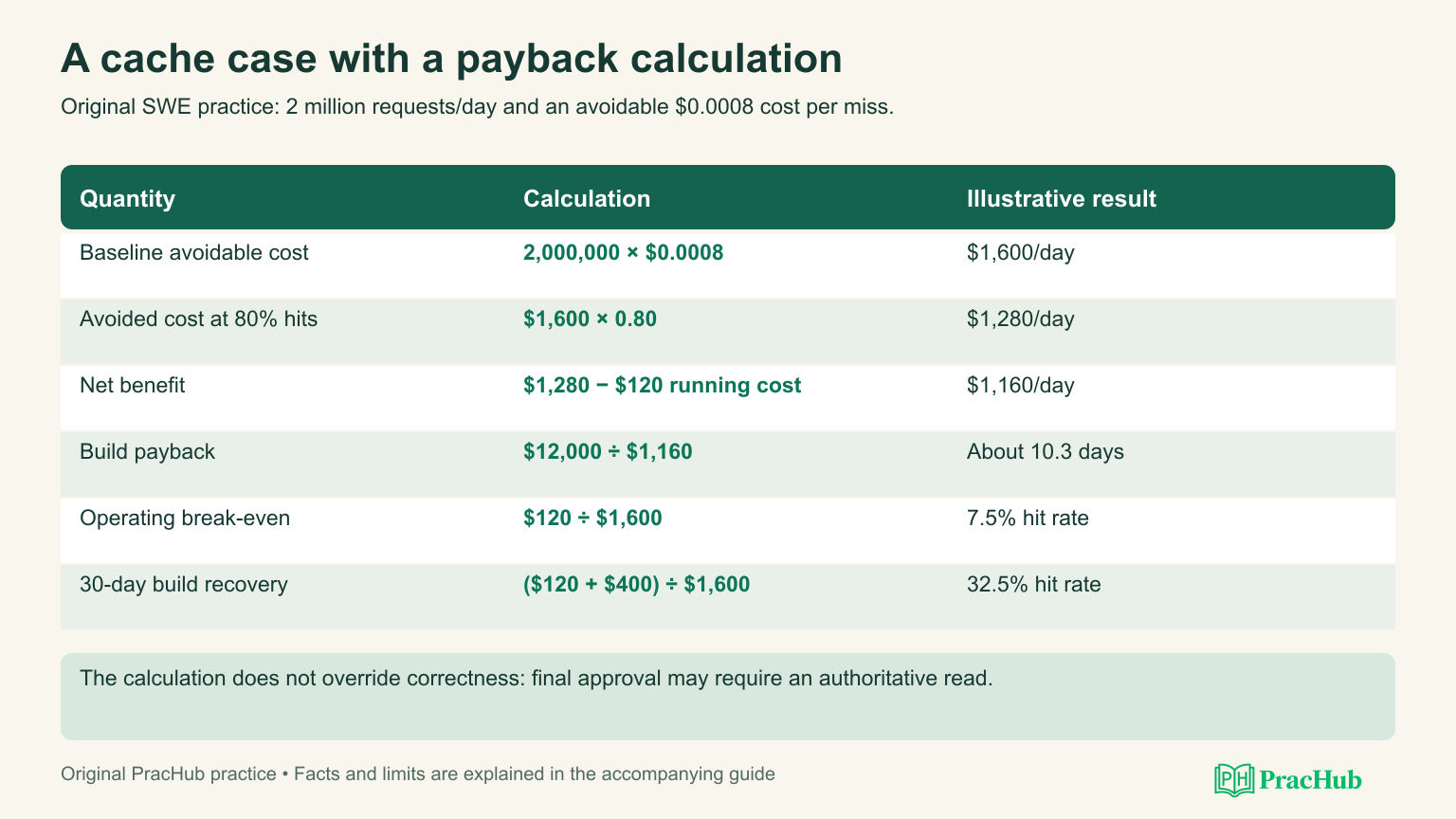
Today’s modeled origin cost is 2,000,000 × $0.0008 = $1,600/day. At an 80% hit rate, avoided origin cost is $1,280/day. Subtracting the cache’s $120/day gives $1,160/day in net operating savings. The simple build-cost payback is 12,000 / 1,160 ≈ 10.3 days. These are hypothetical engineering-case figures, not financial advice or Capital One cost data. The model excludes engineering opportunity cost, support, security review and demand changes.
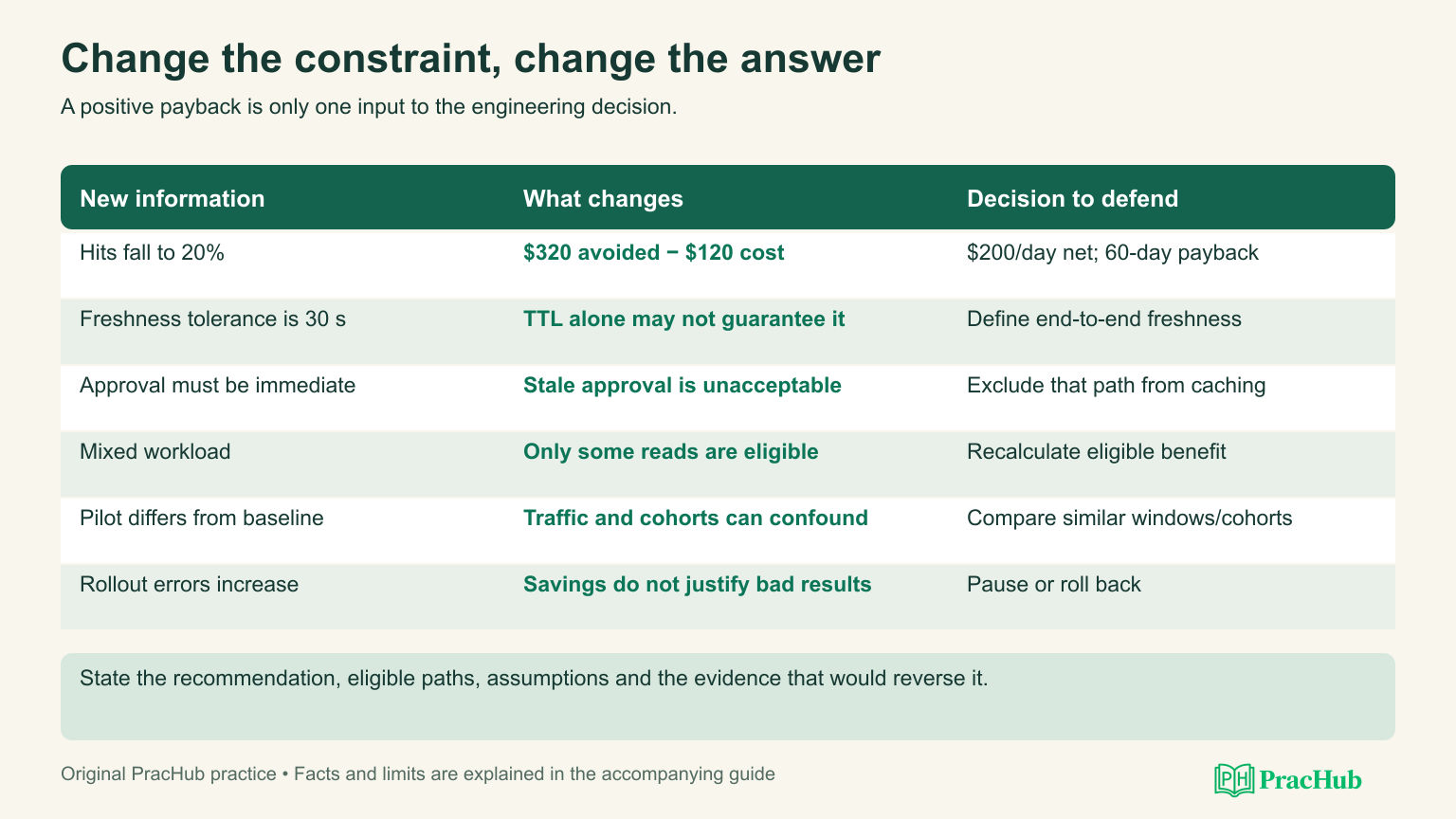
The ongoing break-even hit rate is 120 / (2,000,000 × 0.0008) = 7.5%. If the business wants to recover the build cost within 30 days, include $400/day of build-cost recovery: the required hit rate becomes (120 + 400) / 1,600 = 32.5%. At a measured 20% hit rate, savings would be $200/day and simple payback 60 days. The recommendation changes if a 30-day payback is mandatory.
Make the correctness boundary explicit
Use a key that includes the authenticated customer and application identity. Authorize the request before returning a cached value. A cache keyed only by application status or a client-supplied user ID can disclose another customer’s data. Treat permission changes and final decisions differently from harmless progress labels; confirm the required behavior with the product owner.
A 30-second TTL is a ceiling on one cached object’s freshness under specific assumptions, not a universal guarantee that every client sees a change within 30 seconds. Origin replication lag, stale-serving policies and a client’s own cache can extend the delay. Measure end-to-end update visibility. If the origin has an event on status change, invalidate or version the relevant key, while retaining a TTL as a recovery mechanism for missed events.
Roll out to one low-risk cohort. Compare origin traffic, hit rate, p95/p99 latency, authorization failures and update-visibility delay with a control cohort. Put a bound on simultaneous refreshes so expiration does not create a stampede. Bypass the cache if freshness or isolation checks fail; if bypass overloads the origin, use admission controls or a safe degraded response instead of silently returning stale sensitive data.
A defensible recommendation, followed by a changed constraint
“I would test the cache with a small cohort before funding a broad rollout. The initial assumptions imply $1,160/day of operating savings and about 10 days to recover the build cost. I would require customer-isolation tests and a measured update-visibility delay within the product’s limit. The hit rate and truly avoidable origin cost are the largest uncertainties.”
Now the interviewer says that final approval status must be immediately current. Do not just reduce the TTL and repeat the recommendation. Route that transition through the authoritative path, or use versioned reads tied to a confirmed update. Cache only the fields and states where a bounded delay is acceptable. Recalculate savings for the smaller eligible request set.
Review your attempt against six editorial checks: decision clarified; units and arithmetic correct; break-even sensitivity shown; privacy boundary identified; rollback and verification defined; recommendation revised when the constraint changed. A polished answer that ignores the new requirement misses the case’s main signal.
This section is for software-engineering candidates. Product-manager cases may require more time on customer discovery, prioritization and business outcomes. Use your recruiter’s role-specific case material to set the emphasis.
The Coding and Technical Round
The coding round is not only about reaching a correct answer. Interviewers also need to see how you clarify requirements, choose a data structure, manage edge cases, and respond when your first approach needs improvement.
Use a five-step coding loop
Begin by restating the problem and confirming input constraints. Walk through a small example, explain the simplest workable approach, then discuss complexity before implementing. After the code is complete, test normal, empty, duplicate, and boundary cases out loud.
Practice in the language you plan to use. Timed repetition matters, but explanation quality matters too. A useful drill is to solve a question once, compare it with a written solution, and answer the same prompt again without looking.
The System Design Round
If design is part of your confirmed assessment, match its depth to the role. Start with clear boundaries and data flow; prepare deeper scale and failure trade-offs when the role requires them.
Use the same sequence every time: clarify the users and requirements, estimate scale only when it affects the design, define APIs and data models, draw the high-level components, then explore the most important bottleneck. PracHub's system design questions are useful for practicing that sequence on unfamiliar prompts.
Because Capital One operates in a regulated financial environment, it is reasonable to discuss security, privacy, auditability, consistency, and failure recovery when they are relevant. Do not force banking terminology into every answer. Tie each concern to a requirement.
The Behavioral and Job-Fit Round
Capital One says behavioral questions often begin with "Tell me about a time when..." and may assess competencies such as problem solving, influence, or results focus. Prepare stories that reveal your contribution rather than only describing what the team did.
Choose six flexible examples: a difficult technical decision, a conflict, a failure, an ambiguous project, an ownership moment, and a time you influenced without authority. Keep the situation brief, spend most of the answer on your actions, and finish with a measurable result or clear lesson.
Use PracHub's behavioral and leadership interview practice to turn raw memories into concise stories. Then rehearse likely follow-ups: What would you change? How did you measure success? What did you personally own?
Power Day Mistakes to Avoid
Do not let one difficult round follow you into the next. Treat every interview as a fresh evaluation. Avoid silently coding, designing before clarifying the goal, forcing a memorized case framework, or giving behavioral answers with no personal action.
Also avoid overfitting to anonymous question lists. Prompts change. A reusable process, real interview practice, and clear communication travel much better than memorized answers.
A focused week before Power Day
| Session | Rehearsal | Finish with |
|---|---|---|
| 1 | Read the invitation and ask about unclear assessments | A role-specific schedule, including permitted tools |
| 2 | Solve an array or dictionary problem in your allowed language | Running code, complexity and empty/duplicate/boundary tests |
| 3 | Explain an API or service you designed | Requirements, data flow, permission boundary and one failure trace |
| 4 | Attempt the cache case before reading its answer | Arithmetic, a recommendation and the assumption that matters most |
| 5 | Rehearse two real project stories with interruptions | Personal decisions, alternatives and honest outcomes |
| 6 | Run a sequence of coding, case and behavioral practice | A defect log rather than a guessed hiring score |
| 7 | Repeat the weakest exercise and check logistics | A corrected answer and a working interview setup |
What if the case has more than one reasonable answer?
Explain which objective your recommendation optimizes and what would make you change it. In the cache case, a favorable payback does not justify serving an incorrect approval decision. A sound alternative can be to cache only eligible read paths or defer the project until the freshness contract is clear.
Does every software role have system design?
Do not assume that. Ask about the role and level. Preparing to explain your own systems is useful even when there is no standalone design session.
What if I cannot remember a precise project metric?
Use an honest observable result: a migration completed, a failure mode removed, an operation made repeatable, or a customer issue resolved. Do not invent a percentage. Explain how you established the outcome and what you could not measure.
Sources and Further Reading
Editorial revision: 8 October 2026. Worked fixtures and practice rubrics are original PracHub material. Current hiring details remain role-specific; unavailable source pages and unverified timings are identified in the text.
Comments (0)