Capital One Software Engineer Interview Guide 2026: CodeSignal, Power Day, Case Interviews, and Timeline
Quick Overview
An evidence-aware Capital One Software Engineer interview guide covering the reported CodeSignal screen, Power Day technical and case work, behavioral signals, and timeline uncertainty.
Prepare for a Capital One software engineer interview in two modes: complete a correct coding task under time pressure, then explain a state model, technical decision or case recommendation aloud. Your assessment invitation and recruiting schedule determine which formats apply. Public guidance cannot establish one universal SWE loop or cutoff.
Start with PracHub's Capital One software engineer questions. This guide connects that coding practice to a complete original virtual-card case, including funnel arithmetic, expected losses, implementation costs and a changed assumption that reverses the recommendation.

Keep Process Evidence Separate From Practice
Capital One's official interview overview describes a process that varies by position and a Power Day series that can include job-fit, behavioral and case work. Its students-and-graduates framing should not be treated as a schedule for every experienced software engineer. Confirm the role, technical coverage, tools and timing with recruiting.
The company's case guidance describes a hypothetical objective, an open discussion and a recommendation supported by reasoning and data. It also asks candidates to explain complex ideas plainly. That supports practicing a complete decision; it does not establish that every SWE candidate will receive a virtual-card case.
| Evidence type | What it supports | Limit |
|---|---|---|
| Capital One public guidance | Position-dependent process and possible interview formats | No universal SWE round count or test cutoff |
| Assessment provider documentation | Rules for the named assessment product | Does not establish which product your employer selected |
| Your invitation and recruiter | Your scheduled format, tools and next step | Clarify ambiguous wording before the event |
| This guide's examples | Reviewable coding, state and case practice | Original exercises, not leaked prompts or hiring criteria |
CodeSignal: Confirm the Named Assessment
CodeSignal's current General Coding Assessment documentation describes four questions and 70 minutes, with all questions available during the test and coding in the assessment environment. Its setup page notes that a company can configure a different duration. Those facts apply to a named GCA; the CodeSignal brand alone does not identify your assessment type.
The GCA rules distinguish syntax references from outside help with solution logic and prohibit AI use, including AI syntax searches. Read your event's rules and supported language choices before starting. Practice in an environment that matches the invitation so your first interaction with submission controls happens before the real timer.
For a timed drill, inspect the input contract and pick a correct baseline. Write down ordering, duplicates, invalid inputs, mutation and maximum size. Run an empty case, one ordinary example and a boundary that distinguishes the implementation from a plausible wrong one. If you optimize, explain which cost you are removing and retest the same contract.
Afterward, review the first assumption that caused trouble. A missed boundary in a matrix traversal or a duplicate operation in a stateful task can become an applied follow-up. Keep an error log with the input, mistaken assumption and repair; it is more actionable than a list of topics you have “covered.”
Applied Coding: Make State and Failure Behavior Explicit
Use a small banking model as original practice. Specify balances in integer minor units, one currency per operation, authorized account access, positive amounts and no overdraft for the exercise. A transfer must debit and credit together. An unsuccessful operation leaves both balances unchanged.
For a single-process model, an idempotency record can bind an operation key to the account scope, request payload and stored result. The same key and payload returns the same result; the same key with a different amount conflicts. That record needs an atomic relationship with the balance update. Checking a dictionary before a later mutation does not solve concurrent requests.
| Test | Expected behavior | Follow-up |
|---|---|---|
| A has 100, transfers 30 to B with 20 | A is 70; B is 50 | Total remains 120 |
| Same operation repeats | Return prior result; balances stay 70 and 50 | Key must belong to the same authorized scope |
| Same key, amount changes to 40 | Conflict; balances unchanged | Store a canonical request fingerprint |
| A tries to transfer 80 afterward | Insufficient funds; no mutation | Failure behavior is inspectable |
| Credit step fails | Neither debit nor credit commits | Use one transaction or an explicit recovery protocol |
Ask whether the interviewer wants this bounded model or a distributed payment flow. Remote effects introduce pending states and reconciliation; a local database rollback cannot undo a remote operation that already committed. Add complexity only when the requirements make it necessary.
Solved Case: Expand, Pause or Add Targeted Validation?
A fictional virtual-card feature improves checkout completion, but fraud alerts rise. Compare the current flow, broad expansion and targeted validation. Every value below is an original teaching assumption. These are preparation figures, not Capital One operating data or fraud rules.
Use a fixed cohort of 100,000 eligible checkout attempts per month. Approval rate is approvals divided by attempts. Completion rate is completed purchases divided by approvals. Contribution is $1.50 per completed purchase before the fraud losses and additional operating costs listed here. Fraud rate is confirmed fraudulent purchases divided by completed purchases; loss is $120 per fraudulent purchase on average. Alerts are not counted as confirmed fraud.
| Assumption | Current flow | Broad expansion | Targeted validation |
|---|---|---|---|
| Approval rate | 90% | 92% | 92% |
| Completion after approval | 90% | 94% | 93% |
| Confirmed fraud per completion | 0.040% | 0.120% | 0.035% |
| Extra monthly operating cost | $0 | $10,000 | $4,500 |
| One-time build cost | $0 | $8,000 | $15,000 |
Assume these rates stay constant for twelve months, volume does not grow, loss estimates are comparable, and other costs are already reflected in the contribution figure. Ignore discounting and tax for this bounded exercise. In a real decision, challenge each simplification before treating the model as a forecast.
Carry the denominators through the arithmetic
Completed purchases equal attempts × approval rate × completion-after-approval rate. Expected losses equal completions × fraud rate × average loss. Monthly net contribution equals completions × $1.50 minus expected loss and extra monthly operating cost.
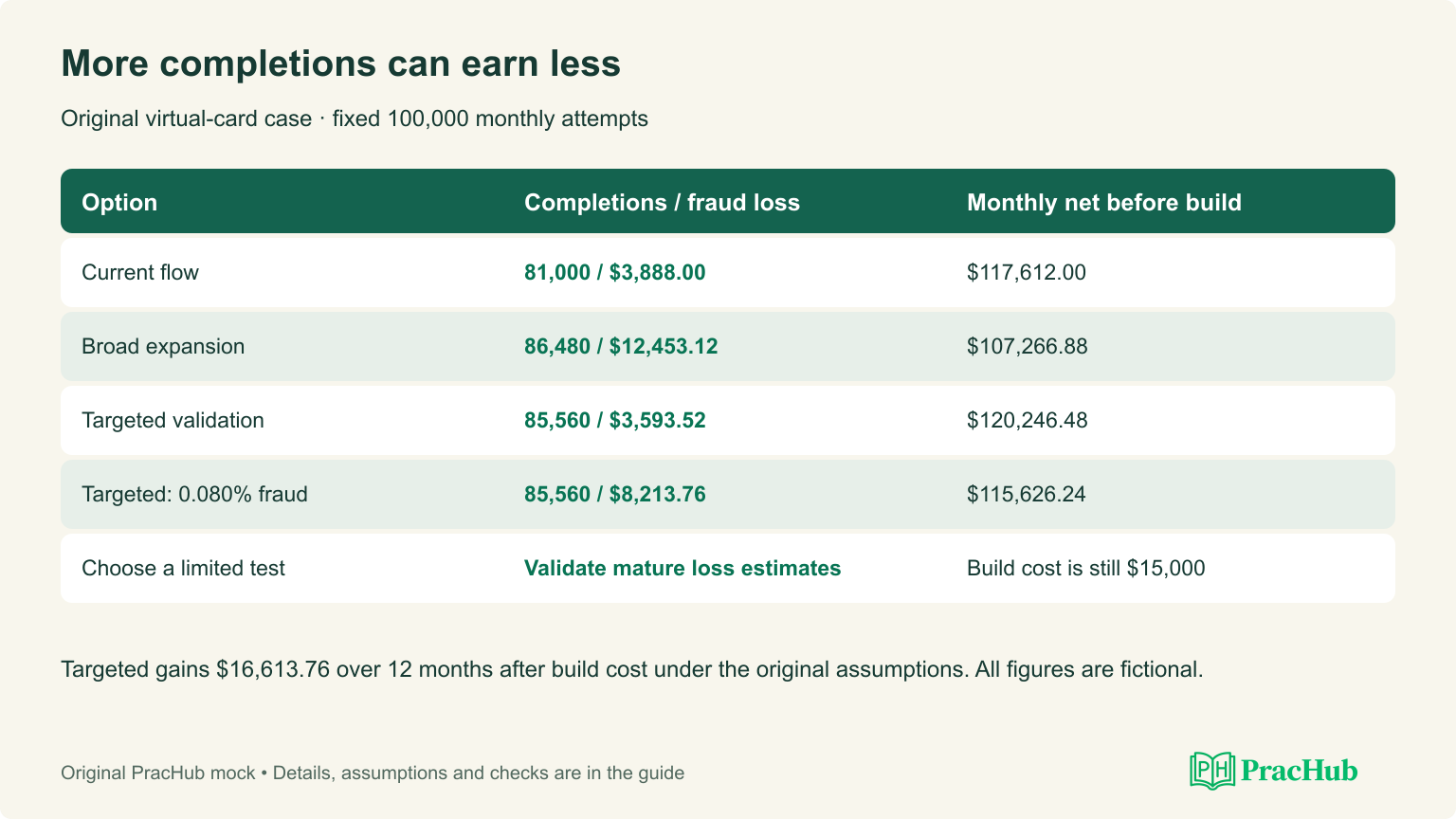
For the current flow, 100,000 × 0.90 × 0.90 = 81,000 completions. Gross contribution is $121,500. Expected loss is 81,000 × 0.00040 × $120 = $3,888. Monthly net is $117,612.
Broad expansion produces 100,000 × 0.92 × 0.94 = 86,480 completions. Gross contribution is $129,720, but expected loss reaches $12,453.12. After $10,000 operating cost, monthly net is $107,266.88, which is $10,345.12 below the current flow despite 5,480 additional completions.
Targeted validation produces 85,560 completions and $128,340 gross contribution. Expected loss is $3,593.52. After $4,500 operating cost, monthly net is $120,246.48, or $2,634.48 above the current flow.
Expected fraudulent purchase counts can be fractional: 29.946 for targeted validation, for example. That is an expectation across comparable cohorts, not a claim that a fraction of a transaction occurred. Keep sufficient precision during calculation and round monetary totals at the end.
| Result | Current flow | Broad expansion | Targeted validation |
|---|---|---|---|
| Completed purchases/month | 81,000 | 86,480 | 85,560 |
| Expected fraud loss/month | $3,888.00 | $12,453.12 | $3,593.52 |
| Net/month before build cost | $117,612.00 | $107,266.88 | $120,246.48 |
| Twelve-month net after build cost | $1,411,344.00 | $1,279,202.56 | $1,427,957.76 |
| Twelve-month change vs current | $0 | −$132,141.44 | +$16,613.76 |
Recommend a test and explain the build cost
Choose a limited test of targeted validation. Under the assumptions, it has the strongest twelve-month contribution. Broad expansion should wait: more completed purchases do not offset its assumed losses and cost.
Targeted validation's first month is $120,246.48 − $15,000 = $105,246.48, below the current flow. Its build cost takes about $15,000 / $2,634.48 = 5.69 months of the assumed incremental monthly contribution to recover. If the useful lifetime is shorter, or the team needs the investment returned sooner, the recommendation changes. The twelve-month comparison does not make the first month profitable relative to baseline.
Present the decision plainly: “I would test the targeted flow because its modeled annual gain is about $16,614 after build cost. I would retain the current flow while checking whether the predicted fraud rate and completion rate hold. I would not expand broadly on completion rate alone.”
Change one assumption and reverse the decision
Suppose targeted validation's confirmed fraud rate is 0.080%, with every other assumption unchanged. Loss becomes 85,560 × 0.00080 × $120 = $8,213.76. Monthly net falls to $115,626.24, below the current flow by $1,985.76 even before build cost. Its twelve-month total after build cost is $1,372,514.88, or $38,829.12 below baseline. Retain the current flow under that scenario.
The targeted option's monthly operating break-even fraud rate is:
(128,340 − 4,500 − 117,612) / (85,560 × 120) = 0.060659%
To beat baseline over twelve months after its $15,000 build cost, the threshold is lower: subtract another $1,250 per month in the numerator, giving about 0.048484%. The original 0.035% assumption passes both; 0.080% passes neither. Label which horizon you are using instead of calling one number “the break-even point.”
Connect the Case to a Technical Rollout
Randomly assign a stable eligible account cohort to current or targeted flow, with a fixed version of the validation policy. Keep assignments stable across retries so the same customer's requests do not switch treatment mid-operation. Capture attempt, approval, completion, later confirmed fraud, realized loss, policy version and idempotency outcome using privacy-appropriate identifiers.
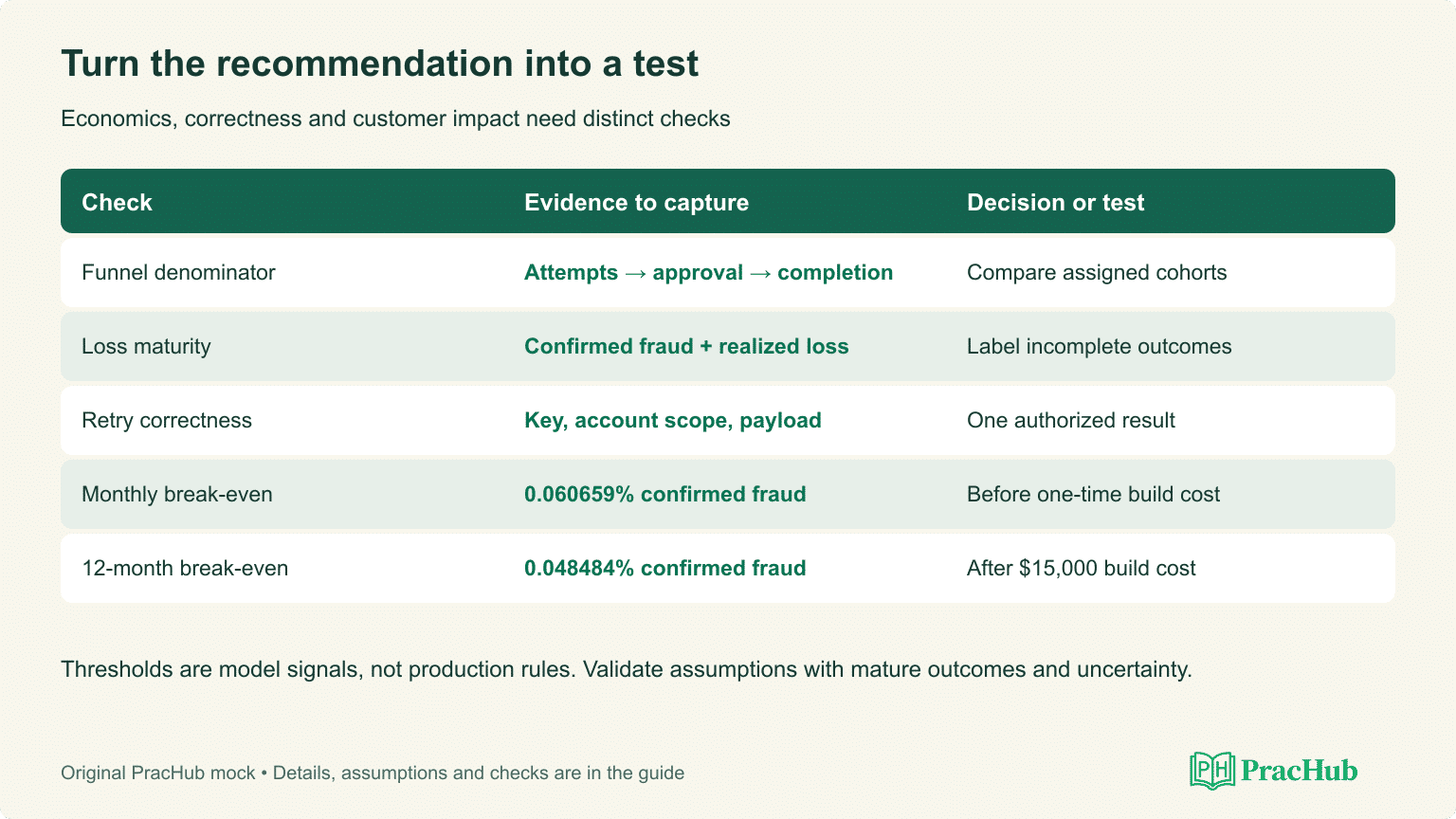
Measure the full funnel by assigned cohort. Comparing only approved customers changes the population and can hide rejected attempts. Wait for a defined fraud-outcome observation window before estimating the loss rate; label immature cohorts rather than treating missing labels as zero loss. Choose the window using the actual reporting process, not a timer invented for this exercise.
Use correctness and customer-impact guardrails alongside contribution. Duplicate authorized writes must resolve to one operation. A changed payload with the same idempotency key must conflict. Test a response lost after commit, authorization expiry and a validation-service timeout. Specify the fallback policy before rollout; allowing an unchecked transaction on timeout changes the risk assumptions used in the case.
Use the modeled fraud thresholds as planning signals, with confidence intervals and mature losses. A low early point estimate is not enough evidence to scale. Pause immediately for a correctness or authorization incident; for economic results, follow a pre-agreed experiment analysis rather than repeatedly stopping on noisy daily changes.
Behavioral Evidence and a Five-Day Transition Plan
Prepare real stories about a technical decision, disagreement, failure, ambiguous task, ownership and influence. Name your action, the alternative, the evidence and the result. Give actual denominators where available. Explain a measured before-and-after result without implying that it proves causation.
For job fit, connect your interest to the work in the actual posting. Explain why the customer problem or engineering constraints interest you and which experience supports that interest. A case is a place to demonstrate reasoning; reserve unrelated résumé details for a conversation that asks for them.
| Day | Reviewable output |
|---|---|
| 1 | Timed coding attempt, contract notes and error log |
| 2 | Stateful model with duplicate, failure and concurrency tests |
| 3 | Solved case and one assumption that reverses it |
| 4 | Six truthful stories with personal action and limits |
| 5 | Coding-to-design-to-case mock, followed by focused review |
Use practice topics such as concentric matrix traversal, a banking activity ranking, deposit/withdraw/transfer modeling, virtual-card validation and account-balance reliability. For each, add one follow-up: duplicate request, failed update, changed constraint or economic assumption. Track what you can produce and explain, not just what you have read.
Frequently Asked Questions
Does every Capital One SWE candidate take the same CodeSignal test?
The official material reviewed does not establish that. Match provider documentation to the assessment named in your invitation.
Is Power Day a fixed set of rounds?
Capital One describes position-dependent interviews. Confirm your scheduled technical, case, behavioral and job-fit coverage with recruiting.
Are the virtual-card figures real company data?
No. They are original teaching assumptions. The arithmetic is locally checked; the rates are not empirical estimates.
Why not choose the option with the most completions?
The mock objective includes contribution, expected losses and costs. Broad expansion's additional completions are outweighed by its assumed losses and operating cost.
What happens after the interview?
Use the next step and update date stated by your coordinator. Public guidance reviewed does not establish one universal decision timeline. A delay alone does not reveal the outcome.
Sources and Further Reading
- Capital One: what to expect during interviews
- Capital One: case interview tips
- CodeSignal: General Coding Assessment structure
- CodeSignal: GCA rules and setup
Editorial review: October 8, 2026. The transaction model, case data, recommendation and rollout exercise are original preparation material. No actual Capital One assessment, private rubric or production experiment is claimed.
Comments (0)