Chan Zuckerberg Initiative Software Engineer Interview Guide 2026: Coding, Systems, and Mission Fit
Quick Overview
Prepare for CZI software engineer interviews with official coding guidance, system design exercises, mission-fit examples, and dated 2026 candidate reports.
A Chan Zuckerberg Initiative software engineer interview in 2026 calls for more than a convincing answer to “Why this mission?” Prepare to write working code, defend system decisions, and explain how your work helps a specific team serve its users. CZI publishes unusually useful engineering interview guidance, so start there before relying on a collection of remembered questions.
This guide combines official interview materials, candidate reports published in 2026, and original preparation exercises. Use Software Engineer practice questions to diagnose your fundamentals, then adapt your preparation to the team and interview format in your invitation.
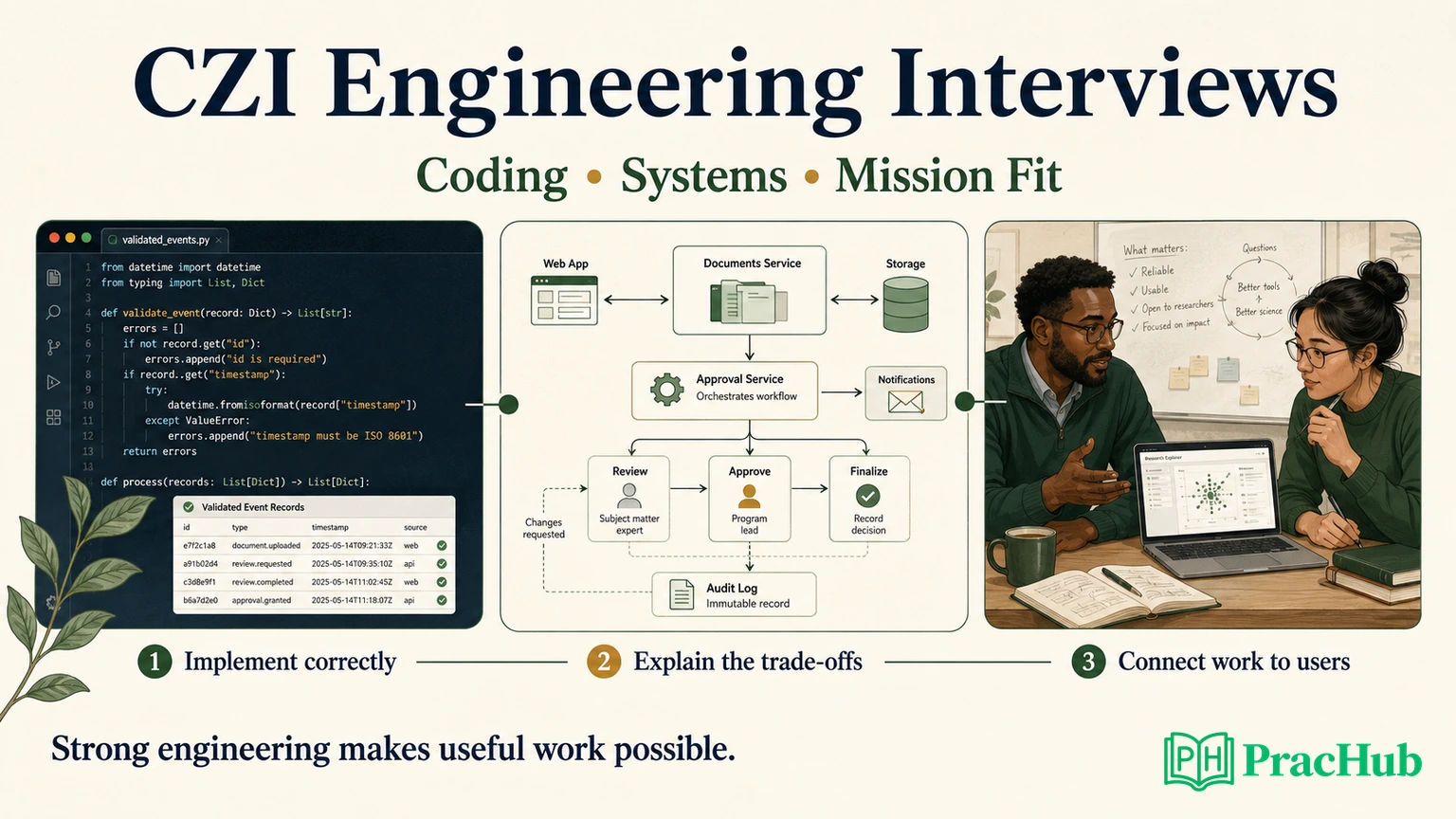
The official interview guide gives you a starting point
Official guidance, checked September 7, 2026: CZI's Candidate Journey separates application review, an initial assessment, team interviews, an offer decision, and onboarding. It explicitly says assessments and interviews vary by role. A hiring-manager conversation or technical screen can be part of the initial assessment; the word “assessment” does not automatically mean a timed online coding test. Candidate Journey
The Engineering Interview Guide currently linked from that page describes four or five 60-minute interviews and an additional 30-minute AMA. Likely interview types include two Code Pair rounds, Systems Design, and Career & Competencies.
For Code Pair, it describes writing and running code in a chosen language through HackerRank, discussing the approach, and testing examples. Frontend candidates have separate optional preparation and environment guidance. Systems Design emphasizes requirements, stakeholder trade-offs, difficult cases, and scale; Career & Competencies uses concrete experiences, including failures.
The guide prohibits generative AI during technical interviews while separately allowing resourceful lookup of language or library information. Treat those as different permissions. Confirm your invitation's exact environment and lookup rules, and disable AI assistance for the interview. Official Engineering Interview Guide
The PDF's URL contains a 2025 directory, although CZI still links it publicly. It is a useful official baseline, not proof that every team follows an identical newly issued 2026 schedule. Save the instructions your recruiter sends and resolve differences before interview day.
What recent candidate reports add—and what they cannot prove
Candidate report published April 8, 2026: a Senior Software Engineer, Data applicant described SQL Code Pair, another Code Pair, software system design, AMA, and Career & Competencies. The account reported roughly two weeks from the initial call to an offer.
A separate Senior Software Engineer report published March 30, 2026 described recruiter and hiring-manager discussions, a VP conversation, three technical rounds, and an AMA. It mentioned Python, SQL, system design, projects, and handling conflict. CZI candidate reports
These are two senior engineering accounts, one explicitly data-focused. Their publication dates do not establish the actual interview dates. They broadly support preparing for technical depth and collaboration, but neither makes SQL mandatory for every SWE opening or guarantees a two-week turnaround. Use the reports to generate recruiter questions rather than a rigid calendar.
Match the preparation to the current team
Official current role context: CZI's careers page directs applicants separately to central openings, Biohub science opportunities, and Learning Commons education opportunities. Identify which organization and product your interview concerns. A scientific application, an educational platform, and an internal business tool have different users and constraints. Career opportunities
For example, the current Senior Software Engineer, Internal Tools posting describes end-to-end application ownership, production LLM applications, and enterprise integrations involving authentication, rate limits, schema changes, and failures. It asks for five or more years building production systems as a senior individual contributor. Its application also asks about an internal tool's stakeholders, implementation, users, and impact. Those requirements belong to this role, not all CZI engineering jobs. Internal Tools role
Preparation inference: candidates for that opening should bring an example of a tool people actually relied on, including what happened when an integration broke. A polished prototype alone leaves questions about adoption, ownership, and recovery unanswered. For another opening, replace that emphasis with the responsibilities in its actual listing.
Code Pair practice: distinguish a duplicate from a correction
Original exercise, not a reported CZI question: implement a reconciler for internal service-request events. Each event contains an organization ID, request ID, revision number, and status. Return the latest accepted status for each organization/request pair, plus conflicts requiring review.
Set the contract first. A higher revision replaces a lower one. An identical event at the same revision is a duplicate. Different statuses at the same revision form a conflict; do not silently let arrival order decide the answer. For this exercise, keep the last unambiguous revision as the usable state until the conflict is resolved.
Consider the following events for organization A, request 17:
| Incoming event | Expected result | Reason |
|---|---|---|
| Revision 1: open | Accept revision 1 | First valid state |
| Revision 2: approved | Accept revision 2 | A newer correction |
| Revision 2: approved | No state change | Identical delivery repeated |
| Revision 1: open | No state change | Older revision arrives late |
| Revision 2: rejected | Flag revision 2; usable state returns to revision 1 | Equal revision has contradictory values |
The final row changes the data-structure discussion. A map holding only the newest value cannot recover revision 1 after discovering the conflict. One simple approach groups statuses by revision for each request, then selects the highest revision with exactly one distinct status. Preserve conflict records separately. In this exercise, a higher unambiguous revision can supersede a disputed one, but the conflict record remains available for review. If no unambiguous revision exists, return no usable state.
For a batch of n events, hash-based grouping takes expected linear time and storage proportional to retained events or distinct values. Finding each request's highest unambiguous revision by scanning its groups remains linear overall. Sorting all revisions adds unnecessary work unless the output requires ordered history. For a streaming variant, explain how you maintain or recover the next eligible revision when the current one becomes disputed.
Test organization isolation, missing identifiers, invalid revisions, an empty batch, and a request with only conflicting revisions. Define whether malformed events are rejected individually or fail the whole batch. Do not mutate the input while normalizing it. A strong explanation separates those interface decisions from the data structure implementing them.
Now practice a small follow-up: count requests by usable status. If two retries produce three rows, the request still counts once. If your invitation includes SQL, rehearse expressing that same distinction between an event row and a business entity with grouping and joins. This is a targeted extension, not a claim about the exact SQL task CZI will ask.
Systems practice: build an internal assistant that can stop safely
Original design scenario inspired by the Internal Tools role: an employee asks an assistant to prepare a software-access request using enterprise documents and a ticketing service. It can gather information and propose an action, but an authorized person must approve the final request before execution. This is a practice system, not CZI's internal architecture.
Begin with a narrow outcome: reduce the time spent assembling complete requests while preserving correct access decisions. Identify the requester, approver, system owner, and support team. Then define which system owns identities, permissions, request status, and policy documents. A search index is a derived view; it should not become the authority for granting access.

Trace one request. Authenticate the user, retrieve only information they are entitled to access, and construct a proposal with references to its source records. Bind approval to the exact proposal version. Before executing, verify that approval, relevant permissions, and critical source data remain valid. If the proposal changes, require a fresh decision rather than transferring approval automatically.
Introduce a realistic race: the employee's team changes between proposal creation and approval. The old proposal might still be well-formed, yet its justification is stale. Reject or regenerate it according to the stated policy. This is where system design becomes more useful than drawing an LLM connected to a database: the candidate has identified a condition that makes a previously reasonable action invalid.
Next, the ticketing API times out after accepting the request. An immediate retry could create a duplicate. Reuse an idempotency key if the service supports that contract, or reconcile against a durable external identifier before trying again. Do not promise exactly-once execution merely because your own database has a unique key; the external side effect must participate in the recovery design.
For schema changes, validate connector responses at the boundary and alert on unexpected required fields. For rate limits, bound concurrency and make queueing visible. For unavailable dependencies, retain a clear pending or failed state with an owner and recovery action. Avoid exposing an ambiguous timeout as a confident success message.
Finally, choose measurements that test the stated outcome: median completion time, incomplete-request rate, incorrect access decisions, duplicate tickets, and support effort. A larger volume of generated proposals is not necessarily improvement. Compare the assisted path with the existing workflow and investigate whether reviewers are spending more time correcting drafts than they previously spent writing requests.
Mission fit should change your engineering answer
Official mission context: CZI's science page describes Biohub's work combining AI and biology to help researchers understand cells and disease. Its education page describes Learning Commons' open, research-informed infrastructure for teaching and learning. These are distinct areas of work; connect your motivation to the actual team. Science, Education
Preparation recommendation: organize a mission-fit answer around four connections: a particular user, a costly bottleneck, an engineering decision, and evidence that the decision helped. You do not need to claim expertise in biology or teaching that you do not have. You do need to show how you would learn from the people using the system.
For a science-facing role, a useful hypothetical discussion might concern a researcher unable to reproduce an analysis after a dataset changes. Versioned inputs, provenance, and clear error reporting then become part of scientific usefulness. For education, consider a teacher deciding whether a tool's recommendation matches the lesson's purpose. Explain what evidence and controls would make that judgment possible. Neither scenario is a claim about an existing CZI product defect.
For the internal-tools opening, the connection can be less dramatic and still credible. Fewer unreliable handoffs may give operational colleagues more time to support their partners. Show the chain of benefit without claiming that every saved minute directly produces a scientific discovery or learning gain.
Use an authentic project for the behavioral discussion. Explain whose needs initially conflicted, what you misunderstood, which evidence changed your view, and what you personally did. If the result disappointed you, separate the technical output from the user outcome. A service can meet its latency target and still fail because the workflow solves the wrong problem.
Five questions to turn the guide into practice
These are cross-company PracHub exercises selected for the skills above, not a CZI question list or a prediction of your interview. Choose a coding exercise and one discussion prompt, then explain your solution aloud before reading further material.
| Practice question | What to demonstrate |
|---|---|
| Filter Invalid Data Events | State the validation contract and preserve correct behavior when individual records fail. |
| Count Customers Who Visited on Multiple Dates | Distinguish repeated rows from distinct entities and dates before aggregating. |
| Design an Enterprise Tool-Using Agent | Define permission boundaries, tool contracts, approval, and recoverable actions. |
| Design load balancing, caching, and idempotent APIs | Explain retries and consistency across service boundaries. |
| Discuss Feedback, User Needs, Influence, Deadlines, and Learning | Use concrete collaboration evidence rather than a generic mission statement. |
Use the AMA to test your understanding of the work
Prepare questions that expose a real engineering decision. Which internal workflow is most expensive to support today? How does the team decide whether to build, buy, or retire a tool? What happens when a researcher, educator, or operational partner disagrees with the team's proposed solution? Which outcomes would make the first six months successful?
These are original suggestions for a two-way discussion, not an official scoring rubric. Listen for the user, constraint, and ownership boundary in the answer. Follow up on one detail rather than reading through a memorized list. The conversation should help you decide whether your experience and interests match the work.
Before the interview, confirm the stage names, coding language or framework, screen-sharing setup, permitted resources, breaks, and next scheduling window. Do one final rehearsal in the expected environment, including running tests and explaining a correction. Start with the Software Engineer practice collection, then spend your remaining preparation time on the specific gap your rehearsal reveals.
Sources and Further Reading
- CZI Candidate Journey and role-specific interview materials
- CZI Engineering Interview Guide, currently linked PDF
- Glassdoor: dated CZI candidate interview reports
- CZI current career opportunities
- CZI Senior Software Engineer, Internal Tools
- CZI science: Biohub and AI-powered biology
- CZI education: Learning Commons
Comments (0)