Chan Zuckerberg Initiative TPM Interview: Explain a System and Its Delivery Risks
Quick Overview
Prepare for CZI TPM interviews with its published guide, an original system boundary map and a delivery-risk timeline with owners and exit conditions. Primary references, original examples and explicit evidence limits support focused preparation.
For a Chan Zuckerberg Initiative TPM interview, prepare a recent system you can explain technically and connect its architecture to execution risks, ownership and decisions. CZI's published TPM guide explicitly distinguishes this discussion from writing code. Confirm the current role and schedule with your recruiter before treating the public guide as your exact interview itinerary.
The original dataset-release case below shows how a system boundary map can become a delivery argument. PracHub's project leadership deep dive is a useful rehearsal prompt. The case is fictional practice material, not CZI's architecture, a reported interview question or experience you should present as your own.
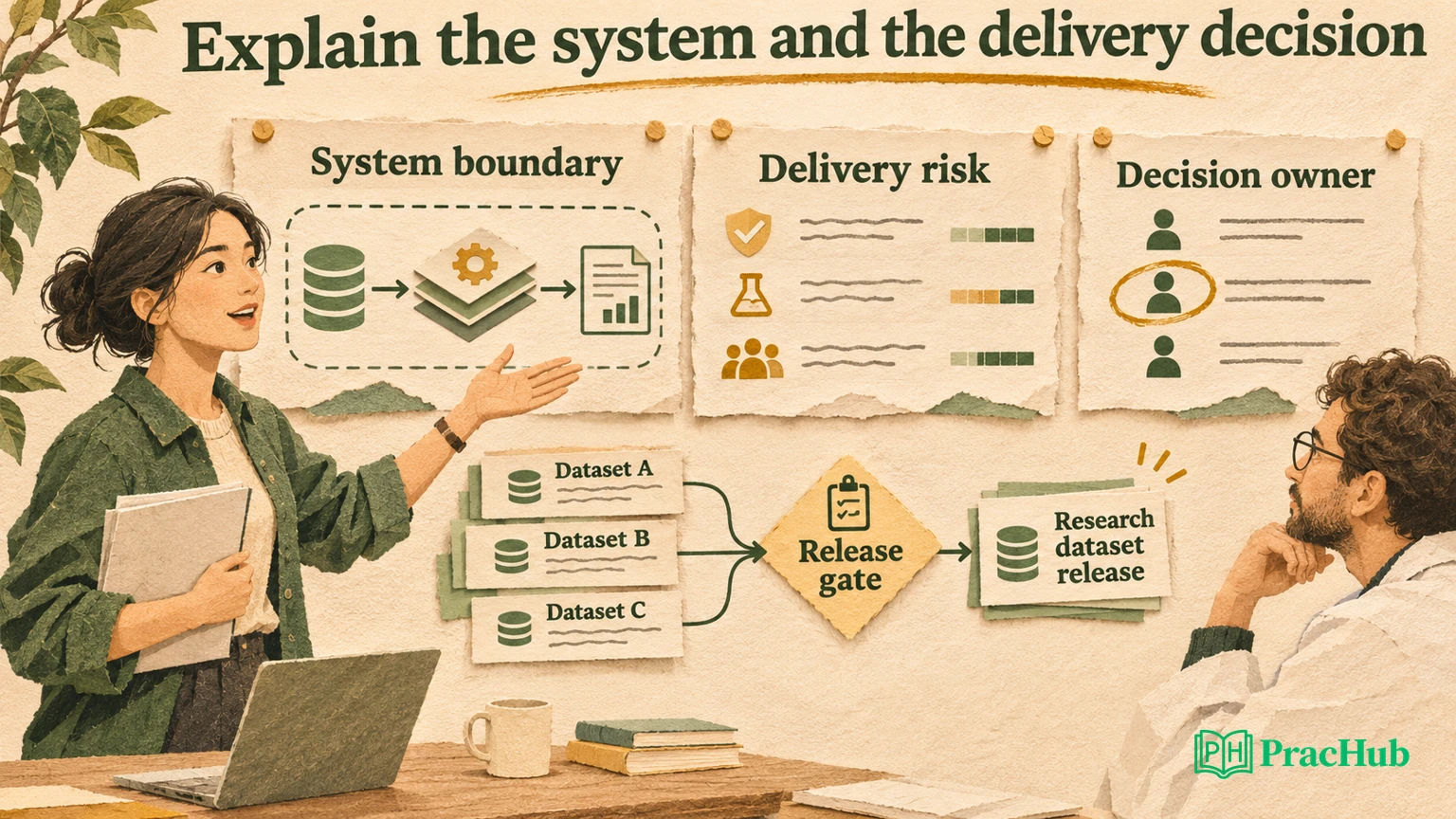
Official guidance, candidate reports and preparation inference are separate evidence classes. We found the official TPM guide but did not verify two independent same-cycle TPM candidate reports. The article therefore concentrates on that published guidance and original preparation assets; it does not infer current TPM stages from software-engineer reports.
Read the TPM guide as a role-specific baseline
Official guidance, checked November 3, 2026: CZI's public Candidate Journey says assessments and interviews vary by role. The TPM PDF currently linked there describes four or five hour-long interviews and a half-hour AMA. It names execution, career/competencies, technical aptitude/systems design, cross-functional leadership and domain knowledge. Candidate Journey · TPM interview guide
For the technical discussion, the guide asks candidates to walk through a recently used system, explain design trade-offs and communicate with partners; it says TPMs are not expected to write code in that interview. That is a statement about the published technical discussion, not a universal exemption from every possible assessment.
The PDF's path contains 2025. Its continued public availability does not prove a newly issued, identical 2026 loop for every opening. Ask which interview types apply to your invitation, which domain the role covers and whether there is a presentation or screen-sharing requirement.
Preparation inference: build an evidence packet that supports several discussions without repeating the same story at the same depth. A technical boundary map, an execution decision and a collaboration example can come from one authentic project, but each should answer the question actually asked.
Choose a system with decisions you can defend
Choose a recent project where you can explain the user, main data path, ownership boundaries and at least one difficult decision. A famous or enormous system is less useful than a smaller one whose failure behavior you understand.
Distinguish what you designed, what you influenced and what another engineer owned. A TPM can demonstrate technical depth through a well-reasoned interface decision without claiming to have implemented every service. Equally, saying “engineering handled that” should not replace understanding a dependency that determined the delivery plan.
For our original case, a research organization releases versioned datasets to external users. Producers upload files and schema descriptions; validation checks completeness and compatibility; a publication service promotes an approved manifest. Consumers access the manifest and retrieve its referenced objects.
The fictional TPM owns coordination of the release contract and rollout decision. Data producers own input correctness, platform engineers own storage and publication, and a domain lead approves scientific usability. Those boundaries give the case technical and cross-functional substance without asserting that CZI uses this architecture.
Draw a boundary map that explains one release
Start with a narrow operation: publish dataset version V2 without making an incomplete or internally inconsistent version appear current. Define what the manifest contains, which service owns the current-version pointer and what makes a dataset eligible for publication.
In this practice design, files are written under immutable versioned identifiers. A candidate manifest references the exact files, schema version and validation result. The publication service changes the current pointer only after the required checks and approvals match that manifest version.
| Boundary | Owner in the fictional case | Failure to explain | Contract or evidence |
|---|---|---|---|
| Producer to staging | Dataset producer | Missing file or wrong schema version | Declared inventory and schema identity |
| Staging to validation | Validation team | Checks run against a different manifest | Manifest/version bound to results |
| Validation to publication | Platform team and approver | Approval becomes stale after a change | Approval for the exact candidate version |
| Publication to consumers | Publication service | Current pointer exposes incomplete data | Atomic pointer change and retrievable objects |
Walk one request through those boundaries. Do not draw a database icon merely because an architecture diagram usually contains one. Explain which record is authoritative and why a consumer can distinguish “V2 exists in staging” from “V2 is the current approved release.”
Now introduce a change: a producer replaces a file after validation. In this design, that must create a new immutable object reference and a changed candidate manifest. Reusing an old approval would break the relationship between reviewed evidence and published contents. The TPM consequence is another validation/approval step, not merely a refreshed progress percentage.
Turn an architecture risk into a delivery decision
Use the risk register to change a delivery decision. “Schema mismatch: high impact” is a label. Name the evidence triggering action, the accountable owner and the condition for moving forward.
In the original case, two producers deliver different schema versions. Most files validate, but a downstream consumer cannot interpret one required field consistently. Shipping on the planned date would make the release look complete while violating the agreed consumer contract.
A defensible recommendation is to hold external promotion while allowing unaffected internal validation to continue. The exit condition is a resolved schema contract, regenerated compatible artifacts and validation tied to the exact candidate manifest. The domain approver confirms usability; the platform owner confirms publication readiness.
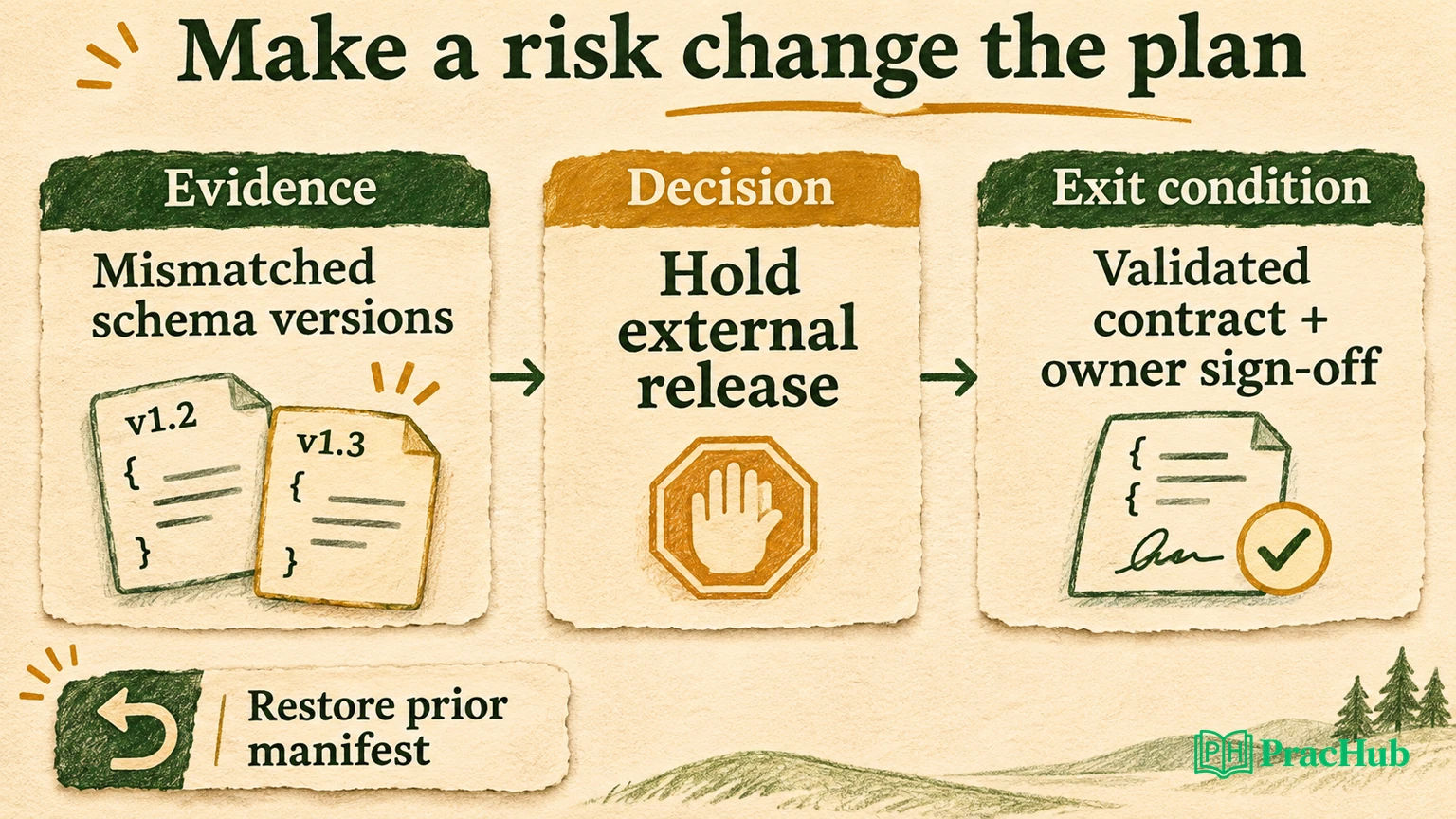
This does not mean every incompatibility deserves a complete release stop. Ask whether the field is required, whether a documented compatible representation exists and which consumers are affected. A smaller scope or separate version may be viable, but only if the owners agree on its meaning and limitations.
The TPM's technical contribution is understanding why the mismatch changes the release contract. The program contribution is making the consequence visible early enough for a decision, with owners and alternatives. “Escalate to leadership” is incomplete unless you state what decision leadership must make.
Build a risk-to-decision timeline
Use this original timeline as a rehearsal artifact. The dates are relative planning points, not CZI's hiring or delivery schedule. Each row should connect new evidence to a changed action rather than simply list meetings held.
| Planning point | New evidence | Decision and accountable owner | Exit or fallback |
|---|---|---|---|
| Before integration | Producer schema versions differ | TPM coordinates a contract decision with domain and platform owners | One supported contract or explicitly split releases |
| During validation | A required consumer cannot read the candidate | Release owner holds external promotion | Consumer acceptance on the exact regenerated version |
| Before promotion | Candidate files changed after approval | Approver rejects reuse of stale approval | Revalidation and approval bound to new manifest |
| After promotion | Retrieval checks fail for the new current version | Platform incident owner invokes rollback plan | Restore prior manifest pointer and verify access |
The rollback row has a separate limitation. Restoring the previous pointer can recover the default path, but users may already have downloaded V2. Rollback does not erase external observations. A credible plan includes a notice, version-status record and support path for affected consumers.
Also ask whether rollback itself is tested. The prior manifest and its objects must remain retrievable, and the operator needs authority to change the pointer. A backward arrow does not establish that recovery works.
In an authentic project, replace the fictional conditions with actual decision records. If the release slipped, explain how you detected the issue, which alternatives you considered and what remained uncertain. Do not manufacture a successful outcome to make the timeline look complete.
Explain a trade-off to two different audiences
For a technical partner, explain the binding between immutable objects, manifest version, validation result and approval. The main failure is a mismatch between those identities. Discuss whether the current pointer can change atomically and what happens when a consumer caches an older manifest.
For a domain partner, explain the practical consequence: the release must identify exactly which dataset was checked and what consumers can rely on. Avoid turning that explanation into a lecture on storage internals. The same design should become understandable at a different level without changing its promise.
A useful rehearsal challenge asks whether the extra approval step makes delivery slower. Acknowledge the coordination cost. Then distinguish required evidence from redundant sign-offs and consider whether some checks can run earlier or automatically. Preserving a clear release contract does not require maximizing the number of reviewers.
Another challenge asks who can overrule the hold. Name the role authorized to accept residual risk and the information that person needs. The TPM should make a recommendation, document the unresolved consequence and preserve accountable ownership rather than hiding behind a consensus that nobody actually reached.
Prepare execution and collaboration evidence honestly
Use a real example for behavioral questions. Describe an initial plan, the signal that changed it, your action and the result you can support. A list of recurring meetings does not show whether you resolved a dependency or improved a decision.
If two teams disagreed, explain their different objectives before defending your choice. In the fictional release, a producer may want a flexible schema while a consumer needs a stable contract. A concrete resolution specifies the versioning rule and migration path; it does not simply announce that communication improved.
Separate process outputs from user outcomes. A completed validation checklist is evidence that checks ran. It is not proof that researchers could use the data successfully. An authentic answer should identify which outcome was measured, which was inferred and which remained untested.
For a failure story, say what you misunderstood and what changed afterward. Perhaps the original plan treated schema validation as a platform-only task, leaving domain meaning unresolved. The lesson should produce a concrete future action, such as agreeing on consumer acceptance examples before integration.
Use domain and AMA questions to inspect the work
CZI's careers site provides the current organizational and role context; use the actual opening to identify the domain. Do not assume every TPM works on the same science platform, internal tool or education initiative. CZI careers
Prepare questions that expose a real delivery decision. Which team owns the user-facing success condition? What dependency most often changes scope? How are technical risks raised before they become a launch emergency? What does a useful first contribution look like for this specific role?
Connect motivation to the work you can actually discuss. If you lack experience in a scientific domain, explain how you would learn from domain partners and validate your understanding. Enthusiasm is compatible with an honest boundary; it does not require claiming subject expertise you do not have.
Before the interview, confirm the applicable guide, meeting setup, permitted materials and accommodation route. Those are practical readiness questions, not evidence of an undisclosed scoring system. Keep your system map concise enough that the interviewer can redirect the discussion.
Practice a system explanation that changes a plan
These cross-company PracHub records cover leadership, stakeholder alignment, delivery dates and technical depth. The PM and engineering-manager records have different role expectations; use them for transferable decisions, not as a CZI TPM question list or a prediction of the interview.
| PracHub question | Rehearsal focus |
|---|---|
| Project Leadership Deep Dive | Explain your project scope, decisions and evidence of personal leadership. |
| Align Conflicting Stakeholders for Successful Project Delivery | Identify the disputed requirement, accountable owner and explicit agreement. |
| Managing Delivery Dates When a Team Commitment Is at Risk | Turn a threatened date into an evidence-based scope or sequencing decision. |
| Explain Technical Tradeoffs in a Project You Led | Explain a technical trade-off and how it changed execution. |
| PM technical depth: rating yourself, a technical decision you shaped, and a system diagram | Draw a known system while acknowledging the PM versus TPM role difference. |
Use the project leadership deep dive with a system you actually worked on. Draw its ownership boundaries, introduce one realistic failure and explain how that evidence changes the delivery decision. End with an accountable owner, an exit condition and a limit your evidence does not resolve.
Sources and Further Reading
- CZI: published Technical Program Manager interview guide
- CZI: Candidate Journey and role-specific preparation
- CZI: current careers context
Sources checked November 3, 2026. The public guide is a baseline to confirm with the recruiter; the dataset-release system and decision timeline are original fictional preparation assets.
Comments (0)