Character.AI Software Engineer Interview Guide 2026: Coding, LLM Serving, and Safety Systems
Quick Overview
Prepare for Character.AI software engineer interviews with React coding, LLM serving, safety system design, and clearly dated 2026 candidate evidence.
Preparing for a Character.AI software engineer interview in 2026 starts with identifying the team. A React product interview, a backend reliability discussion, and an ML infrastructure interview need different preparation—even when each concerns the same conversation on a user's screen.
The strongest approach connects correct application state with responsive model serving and defensible safety decisions. This guide separates official role and engineering information, dated candidate reports, and original preparation exercises. Start with Character.AI Software Engineer questions, then choose the sections that match your invitation.
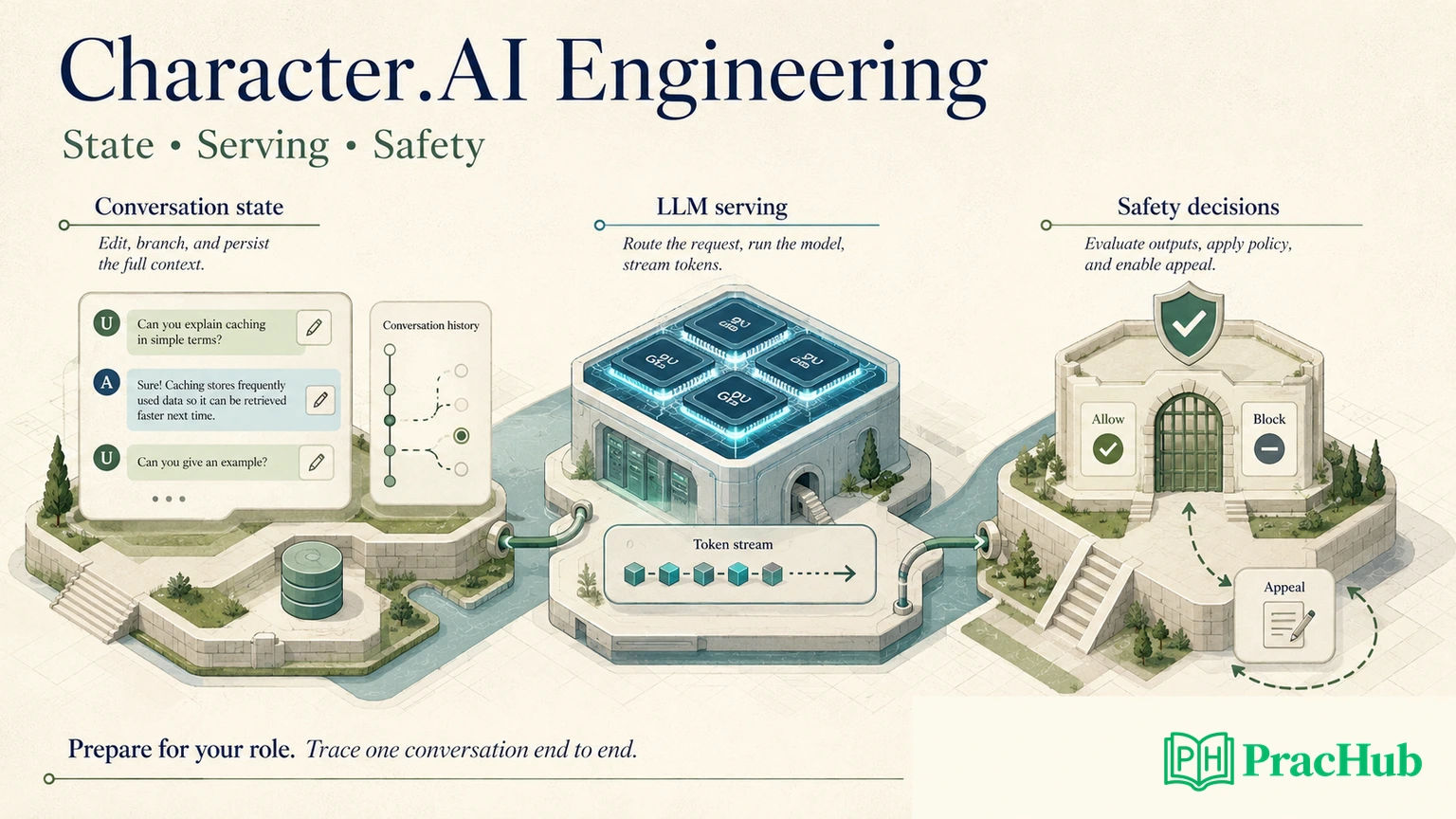
Choose the engineering track before choosing questions
Official role evidence, checked September 7, 2026: Character.AI's Core Product posting emphasizes consumer interfaces, design systems, TypeScript, React, and React Native. That makes interactive application correctness a sensible preparation priority; it does not establish a mandatory React round. Core Product role
The Backend posting asks for five or more years of experience and covers reliable services, APIs, databases, and distributed systems, with Python and Go preferred. The ML Infrastructure posting separately asks for four or more years supporting ML infrastructure, including GPU utilization, training and serving, and diagnosing cluster failures. These are requirements for those listings, not minimums for every Character.AI engineering opening. Backend role, ML Infrastructure role
Safety & Integrity is another distinct track. Its Backend/Applied ML posting seeks eight or more years of experience and describes classification, risk scoring, monitoring, and scalable integrity systems. Treat that as senior role context, not evidence that every applicant will train a safety classifier during an interview. Safety & Integrity role
Preparation inference: product candidates should rehearse state changes and user-visible failures; backend candidates should trace requests and recovery; infrastructure candidates should connect resource constraints to latency; safety candidates should explain both model evaluation and operational decisions. Keep general coding practice, but allocate deeper work to the advertised responsibilities.
What 2026 candidate reports actually establish
Candidate report published February 1, 2026: a Software Engineer applicant described recruiter and manager conversations followed by a React technical screen. The account mentioned a to-do application with history and the importance of choosing state structures that support later features.
A separate report published May 12, 2026 concerns Machine Learning Engineer hiring. It described coding, system design, ML coding, and culture-fit rounds. That account supports preparing beyond algorithms for that applicant's role; it does not verify the same sequence for software engineers. Publication dates do not establish when the interviews occurred. Candidate reports
There is not enough verified same-role evidence here to present a universal 2026 loop, online assessment, cutoff, or response timeline. Ask the recruiter which team owns the opening, whether coding is application-building or algorithmic, what environment is used, and whether any tools are permitted. A precise invitation should drive your final practice session.
Coding preparation: make history survive the next feature
Original exercise inspired by the reported React theme: build a small conversation-note editor with add, rename, delete, undo, and redo. This is a practice adaptation, not a claimed Character.AI prompt.
Define the behavior before the components. Give each note a stable ID and keep selection separate from document content. Decide whether an undo restores selection too. Then make a deliberate choice between full snapshots and operations with inverse actions. Snapshots simplify a small exercise; inverse operations can reduce storage but introduce additional correctness work.
React's official documentation explains that state should be treated as immutable and that object spread copies only one level. Copying an array does not isolate nested objects inside it. A later mutation can therefore corrupt an earlier snapshot. Updating objects in state
Use this original branch trace as an acceptance test:
| Action | Current document | History consequence |
|---|---|---|
| Start at S0 | No notes | Nothing to undo |
| Add note A: S1 | A = “Draft” | S0 remains unchanged |
| Rename A: S2 | A = “Ready” | S1 must still say “Draft” |
| Undo to S1 | A = “Draft” | S2 is available for redo |
| Add note B: S3 | A = “Draft”, B = “Review” | Discard the old S2 redo branch |
For this exercise, a new edit after undo invalidates redo. State that contract explicitly; branching-history products could choose differently. Test repeated undo at the beginning, deletion of the selected item, duplicate labels with different IDs, and edits after redo.
Add one conversational-product follow-up: a generated suggestion arrives after the user has edited the note. Attach the request to a document revision and decide whether to discard the stale result or offer it separately. Silently writing it into the latest revision can overwrite the user's work. Explain the race with actual events before proposing cancellation as the solution.
Algorithm practice still matters. One Character.AI practice record asks for the smallest stored timestamp greater than or equal to a query. That is a ceiling lookup. For stored times 4 and 9, querying 6 returns the value at 9—not at 4. Catching that contract matters more than recognizing a familiar problem name. With sorted per-key arrays, binary search gives logarithmic lookup; discuss insertion order and duplicate timestamps before choosing an implementation.
LLM serving: separate faster computation from faster conversation
Official engineering evidence: a January 13, 2026 Character.AI technical post with DigitalOcean and AMD describes optimizing a specific Qwen3 workload on MI325X GPUs using vLLM. The objective was higher throughput while keeping p90 time to first token and time per output token within bounds. It discusses FP8 key-value (KV) caching, parallelism choices, and prefix reuse. Here, p90 is the latency at or below which 90% of measured requests fall. The reported performance improvement belongs to that workload and configuration. Production inference case study
Preparation inference: a useful design answer explains where latency originates and which measurement improves. Prefill processes the input context; decoding generates subsequent tokens. Processing more requests per second does not guarantee that each user sees a faster first response under load. Describe both admission behavior and per-request experience.
Consider an original toy trace measured from request arrival. Input checks finish at 30 ms, queueing ends at 80 ms, and the model produces its first token at 230 ms. The first approved output reaches the user at 310 ms. Under these chosen measurement boundaries, model TTFT is 230 ms and first-visible-output latency is 310 ms. Those are hypothetical timestamps, not Character.AI benchmarks.
An interviewer can now ask a useful follow-up: which interval changed? If model TTFT improves but visible latency does not, inspect the release policy and downstream buffering. If queueing grows with concurrency, inspect admission and capacity. Do not claim a faster kernel fixes every delay in the request path.
Primary technical reference: vLLM's automatic prefix caching reuses computation for shared prompt prefixes. Its documentation explicitly distinguishes prefill savings from decoding: prefix caching does not accelerate generation of new tokens. Automatic prefix caching
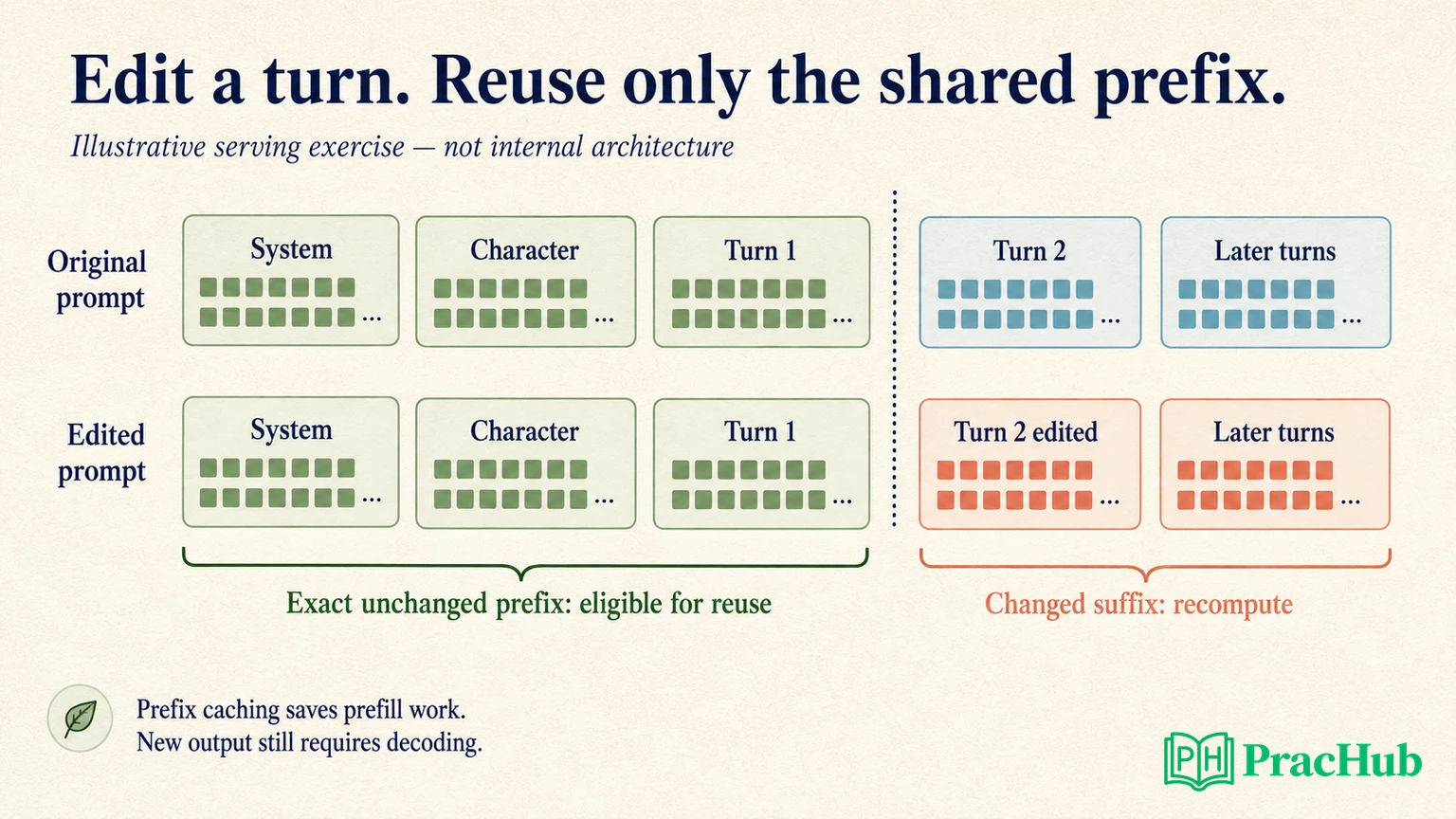
A KV cache retains attention-related intermediate values so the model can reuse prior computation. For the illustrated practice case, suppose a prompt consists of system instructions, a character description, and several conversation turns. Editing an earlier turn changes the context for the suffix. Reuse only the exact unchanged prefix allowed by the serving engine's cache rules. Do not treat similar wording as an identical token sequence, or KV cache entries as the durable conversation database.
Extend the exercise by requiring cache compatibility with model and adapter versions and the deployment's privacy boundaries. These are proposed design constraints. Then explain eviction under memory pressure: a missed cache entry should trigger computation, while the authoritative conversation remains available. Measure cache-hit benefit against memory usage and tail latency instead of maximizing the hit rate in isolation.
Safety systems: trace the decision after detection
Official policy context matters here. Character.AI's September 3, 2026 update says it removed open-ended Character chat for users under 18 the previous year and that the change remains in place. It also describes contextual self-harm detection, clearer moderation notifications and appeals, and continued work on age assurance, including false positives affecting adults. Older descriptions of a guarded teen chat experience should not substitute for this current account. Safety priorities update
Original systems exercise: trace a conversation response through eligibility checks, context selection, generation, an output decision, and any later review. This is a design rehearsal, not a diagram of Character.AI's internal architecture. Start by defining which product experience the user is allowed to access; a moderation score alone cannot answer that question.
Separate three records: the content revision being evaluated, the model or policy version producing a decision, and the action taken. Otherwise, a review team may be unable to explain why an earlier version was restricted after the content changes. Choose access controls and retention deliberately rather than retaining every conversation indefinitely for debugging.
Now introduce a failure: the output-checking service times out. If the practice contract requires approval before release, hold the response and return a bounded, understandable failure instead of streaming unchecked output. Discuss the availability cost and recovery path. For other product surfaces, requirements may differ; make the decision rule explicit before choosing a fallback.
A classifier's aggregate accuracy is insufficient evidence of a good product outcome. Discuss missed violations, incorrect restrictions, performance across supported languages, review load, and appeal reversals. A growing appeal backlog can make a technically reversible action difficult for users to correct. Conversely, optimizing only for fewer complaints could conceal harmful false negatives.
Bring the discussion back to ownership: who can change the policy, how is a rollout monitored, and how can it be reversed? A strong answer connects detection quality, service reliability, reviewer tooling, and understandable user communication without pretending one threshold resolves every trade-off.
Five practice questions with a clear purpose
The first three records are listed for Character.AI. The final two are supplementary practice for cache recovery and conversation delivery. This is a preparation set, not a prediction of the next interview.
| Practice question | What to demonstrate |
|---|---|
| Find Shortest Covering Substring | Maintain window counts and explain repeated-character requirements. |
| Explain strings and copy complexity | Distinguish copying cost from reference assignment; connect the distinction to history storage. |
| Design timestamped key-value map | Implement ceiling lookup, including missing keys and duplicate timestamps. |
| Implement a crash-resilient LRU cache | Explain eviction, restart behavior, and what remains authoritative after failure. |
| Design a Resilient Chat System | Trace durable messages, retries, ordering, and recovery; distinguish delivery from generation. |
After solving, change one assumption. Allow out-of-order timestamps, mutate an older document revision, or interrupt delivery after persistence. Explain what breaks and which invariant the revised solution preserves. That produces a more useful discussion than adding unrelated algorithm names to a revision list.
Prepare the project discussion and confirm the timeline
Choose one project where you owned a visible outcome: a state-management bug, a latency regression, an unreliable service, or an incorrect automated decision. Explain the initial symptom, the evidence you collected, the change you made, and the result. Include one trade-off you would revisit at a different scale.
For product roles, be ready to demonstrate the interaction. For backend or infrastructure roles, bring a request trace and a failure you diagnosed. For safety roles, explain how you evaluated an intervention beyond a single offline score. These are preparation recommendations based on the work described in the official roles, not a published interview rubric.
No fixed recruiting duration is verified by the sources used here. Confirm the next stage, expected scheduling window, permitted language or framework, and any deadlines directly with the recruiter. Begin focused practice once the format is known; do not wait for a rumored company-wide sequence. Use the Character.AI Software Engineer question collection to check your coding fundamentals, then rehearse the conversation-state, serving, or safety exercise most relevant to your team.
Sources and Further Reading
- Character.AI: Core Product engineering role
- Character.AI: Backend engineering role
- Character.AI: ML Infrastructure engineering role
- Character.AI: Backend/Applied ML, Safety & Integrity role
- Glassdoor: dated Character.AI candidate interview reports
- Character.AI: January 2026 production inference case study
- Character.AI: September 2026 safety priorities
- React: updating objects in state
- vLLM: automatic prefix caching
Comments (0)