CI/CD Interview Questions for Senior Engineers: Pipelines, Rollbacks, Flaky Tests, and Secrets
Quick Overview
Prepare for senior engineering interviews with practical CI/CD questions on pipeline architecture, immutable artifacts, deployment gates, rollback safety, flaky tests, secrets, and incident response.
The pipeline is green, the deployment completes, and five minutes later checkout errors climb. The previous image is still available, but the release also ran a database migration that the old code cannot read. Do you roll back, roll forward, disable the feature, or stop traffic first?
That is the level of judgment behind senior CI/CD interview questions. Interviewers care less about whether you use Jenkins or GitHub Actions than whether you can move changes safely, preserve evidence, limit blast radius, and make recovery a designed path.
Start with PracHub's real CI/CD pipeline interview question, then use real interview questions with written solutions to find gaps across the rest of your loop. For a specific employer, add company-specific interview prep so your examples match the role and level.
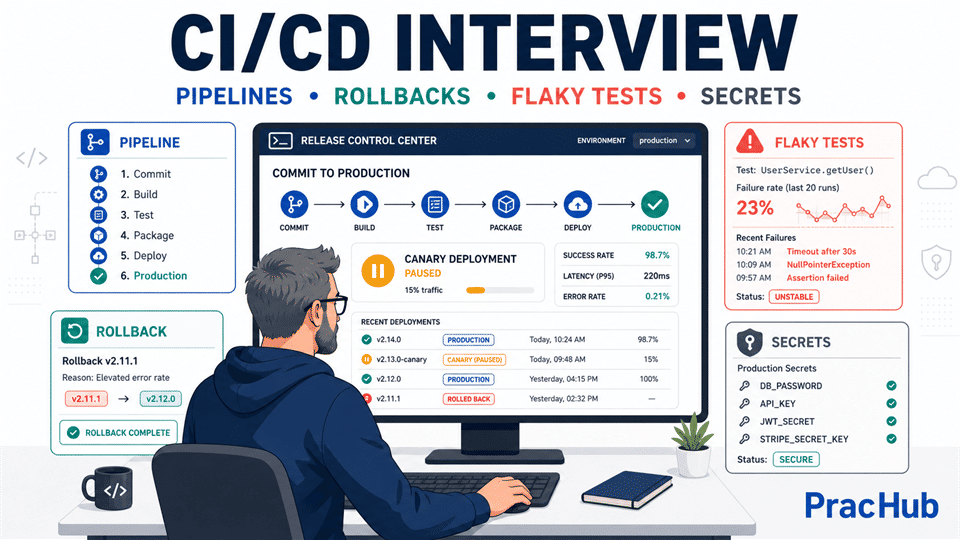
Quick Answer: What Senior Interviewers Want
A strong CI/CD answer treats the pipeline as a production system. It explains how a change becomes a traceable artifact, which evidence permits promotion, what stops a risky rollout, and how credentials and recovery paths stay constrained.
| Area | Strong senior signal | Common weak answer |
|---|---|---|
| Pipeline | Builds once, promotes an immutable artifact, and makes gates explicit | Lists tools and stages without ownership or failure handling |
| Rollout | Uses progressive exposure and service-level stop signals | Calls a deployment successful when containers become ready |
| Recovery | Chooses rollback or roll-forward after checking data compatibility | Assumes every release can be reversed with one command |
| Tests | Measures flakiness, contains it visibly, and assigns an owner | Reruns failures until the pipeline turns green |
| Secrets | Uses short-lived identity, least privilege, protected environments, and audit trails | Stores one long-lived production key as a repository secret |
How to Structure a Senior CI/CD Answer
Begin with requirements: deployment frequency, change risk, compliance needs, recovery objective, traffic shape, stateful dependencies, and who owns the service. A pipeline for an internal batch job should not inherit every control used by a payment service.
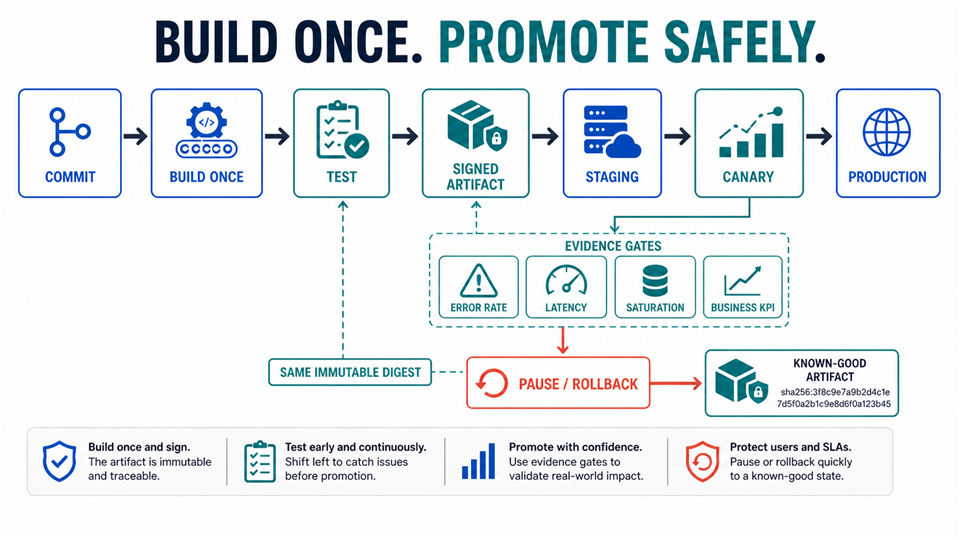
Then walk through four layers: artifact, evidence, exposure, and recovery. Name the artifact being promoted, the checks that produce confidence, how production exposure expands, and the exact conditions that pause or reverse it.
Finish with platform judgment. Explain how the design becomes a reusable paved road, how teams request exceptions, and which metrics reveal that safety controls have become slow or noisy.
Pipeline Design Interview Questions
1. Design a pipeline from commit to production
Start with a source event and a versioned pipeline definition. Run fast static checks and unit tests first, then build the artifact in an isolated environment. Record the source revision, dependencies, test result, and artifact digest so the release can be traced later.
Promote that same artifact through integration, staging, and production checks. Production should have an explicit concurrency rule, environment policy, observability gate, and recovery path. The exact stages can vary; the ownership and evidence cannot be vague.
2. Why build once and promote the same artifact?
Rebuilding for each environment creates a new output, so the binary tested in staging may not be the one released to production. Build once, store the artifact by immutable version or digest, and promote that exact object.
Environment-specific configuration can still be supplied at deploy time. The important boundary is that changing configuration does not silently create a different application artifact.
3. Which checks should block a release?
A blocking gate needs a strong relationship to material risk, reliable execution, a clear owner, and a defined exception process. Fast deterministic tests, required security policy, schema compatibility checks, and critical service health are common candidates.
Slow exploratory suites, noisy scanners, or low-confidence performance signals may begin as advisory. A senior engineer does not make every concern blocking; they improve signal quality and place each check where it protects users without paralyzing delivery.
4. How do you handle concurrent deployments?
Separate superseded validation work from state-changing deployment work. It can be reasonable to cancel a test run for an obsolete commit, but canceling a production deployment halfway through may leave partial state.
Use an environment-scoped lock or queue, define whether a newer release replaces a pending one, and make interrupted operations idempotent. GitHub's deployment guidance, for example, supports environments, protection rules, and concurrency groups; the interview answer should explain the policy behind those controls.
Rollback and Deployment Strategy Questions
5. When do you roll back instead of roll forward?
Choose the fastest path that safely reduces user harm. Roll back when a known-good artifact is compatible with current data and dependencies, the fault is isolated to the new release, and reversal is faster and lower risk than a fix.
Roll forward when the old version is no longer compatible, the change has irreversible side effects, or a small verified patch is safer. A feature flag, traffic cutover, write pause, or degraded mode may be the first mitigation before either code path.
6. Why can a successful application rollback still fail?
An orchestrator may restore an earlier workload template, but it does not automatically undo database migrations, emitted events, cache mutations, third-party calls, or user-visible writes. Kubernetes explicitly notes that a Deployment rollback restores the earlier Pod template revision, not every external effect of a release.
Use backward- and forward-compatible changes where possible. For a schema, that often means expand first, deploy code that tolerates both forms, migrate data, switch reads or writes, and remove the old shape only after the rollback window closes.
7. Canary, blue-green, or rolling deployment?
A rolling update is operationally simple and resource-efficient, but old and new versions coexist during the transition. Blue-green provides a fast traffic switch and a clear old environment, but doubles more infrastructure and still needs data compatibility.
A canary limits initial exposure and supports evidence-based promotion, but it requires representative traffic, correct comparison windows, and reliable analysis. Do not call canary automatically safer; a biased canary or noisy metric can create false confidence.
8. What signals should stop a rollout?
Combine deployment health with user and service outcomes: error rate, latency, saturation, queue depth, dependency failures, and a critical business signal such as successful checkout. Readiness alone proves that a process can receive traffic, not that users are succeeding.
Define thresholds, observation windows, minimum sample requirements, and the action taken when a gate fails. The pipeline should pause exposure and preserve evidence before automation changes the system again.
Flaky Test Interview Questions
9. How do you prove a test is flaky?
A test is flaky when the same code and relevant inputs can produce different outcomes. Reproduce the failure with controlled reruns, inspect timing and ordering, compare execution environments, and look for shared state, concurrency, clocks, random data, network dependencies, or resource pressure.
Do not label every intermittent pipeline failure a flaky test. The failing component may be the runner, dependency download, test fixture, or service under test, and each needs different ownership.
10. Should the pipeline automatically retry failed tests?
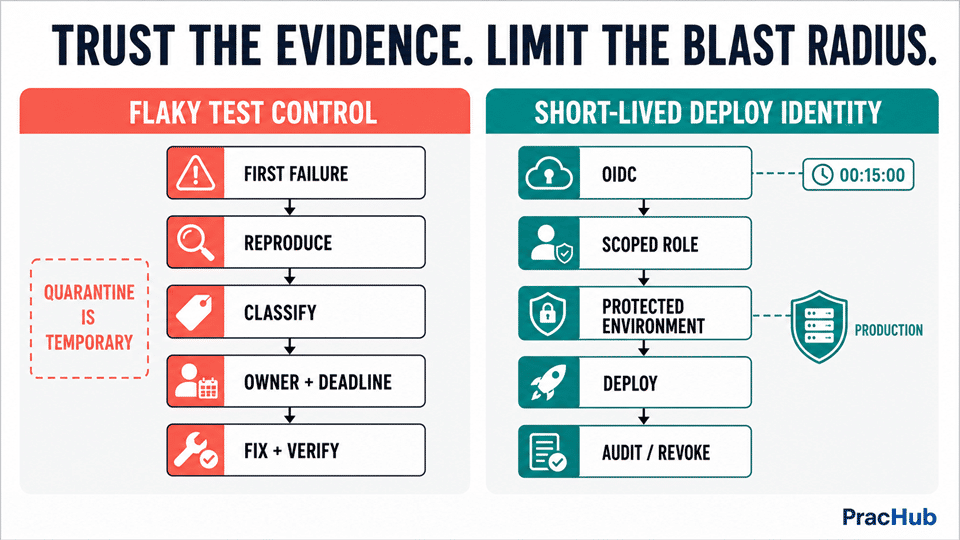
A limited retry can collect evidence and reduce immediate disruption, but a passing retry must remain visible as a flaky event. If the first failure disappears, teams learn to ignore red builds and the suite stops functioning as a trustworthy gate.
Use retries as containment, not resolution. Track the first result, retry count, test owner, suspected cause, and flake rate. Google's testing guidance describes flakiness as a reliability problem to detect, track, mitigate, and fix rather than a reason to accept nondeterministic signals.
11. When is quarantining a test acceptable?
Quarantine can restore a useful merge signal while an unstable test is repaired. It should create a visible issue with an owner, impact level, deadline, and replacement coverage for any critical behavior that is no longer blocking.
A quarantine queue without aging limits becomes a test graveyard. Review its size and escape rate, and escalate tests that repeatedly allow production defects through.
Secrets and Supply-Chain Questions
12. Why prefer OIDC to a long-lived cloud key?
OIDC lets an authorized job exchange workload identity for a short-lived cloud credential instead of storing a reusable cloud key in the CI system. The cloud trust policy should restrict repository, branch, workflow, and protected environment claims as narrowly as the platform supports.
In GitHub Actions, id-token: write permits the job to request an OIDC token; it does not itself grant access to cloud resources. The cloud role and its trust conditions still determine what the job can do.
13. How do you apply least privilege in a pipeline?
Grant read-only source access by default, elevate permissions only in the job that needs them, and keep production credentials behind an environment gate. Separate build identity from deploy identity so untrusted build steps cannot inherit production access.
Masking values in logs is useful but insufficient. GitHub's secure-use guidance warns that automatic redaction is not guaranteed for every transformation, so short lifetimes, limited scope, rotation, and revocation still matter.
14. How do you protect the artifact supply chain?
Pin and review third-party workflow dependencies, isolate untrusted code, minimize token permissions, scan dependencies, and attach provenance to the built artifact. Promotion should verify the artifact identity rather than trust a mutable tag such as latest.
Also protect the pipeline definition itself. Require review for workflow changes, record who approved production, and ensure a compromised pull request cannot alter the release path and immediately obtain deploy credentials.
A Complete CI/CD Incident Walkthrough
Suppose artifact sha256:abc... passes tests and reaches a 5% canary. Pod readiness stays green, but checkout error rate and conversion degrade. The release includes an additive schema change, and the previous application version can still read the new schema.
A strong response pauses promotion, records the release digest and signal window, checks whether the regression is isolated to canary traffic, and verifies data compatibility. Because the old code remains compatible, route traffic back to the known-good digest, confirm user-level recovery, then investigate without expanding the incident.
permissions:
  contents: read
  id-token: write

jobs:
  deploy:
    environment: production
    concurrency:
      group: production
      cancel-in-progress: false
This snippet narrows repository access, allows short-lived identity, uses a protected environment, and prevents one production deploy from canceling another. It is not a complete safety system: the answer still needs cloud trust policy, artifact verification, rollout signals, data compatibility, audit evidence, and a tested recovery path.
If the migration had dropped a column used by the old code, the same rollback could deepen the outage. The senior answer would first stop harm with traffic control or a feature flag, then choose a compatible roll-forward, schema restoration, or carefully rehearsed data repair.
How Interviewers Score CI/CD Answers
| Dimension | Strong evidence | Red flag |
|---|---|---|
| System model | Separates source, build, artifact, environment, deployment, and runtime signals | Treats CI/CD as one script |
| Risk judgment | Matches gates and rollout strategy to blast radius | Adds every possible gate without considering feedback time |
| Recovery | Checks data and dependency compatibility before reversal | Says "just roll back" |
| Evidence | Defines what a test, readiness check, or metric actually proves | Uses green status as proof of correctness |
| Leadership | Defines ownership, exceptions, metrics, and adoption | Proposes a tool with no operating model |
A Focused 5-Day CI/CD Interview Plan
| Day | Focus | Practice output |
|---|---|---|
| 1 | Pipeline architecture | Draw commit-to-production flow and defend every gate |
| 2 | Deployment and recovery | Compare rolling, blue-green, and canary for two services |
| 3 | Flaky tests | Design retry, quarantine, ownership, and measurement policy |
| 4 | Secrets and provenance | Threat-model a workflow and reduce each credential's scope |
| 5 | Full mock | Resolve the incident above, then explain the preventive platform change |
Pair the technical exercise with behavioral and leadership practice. Senior interviewers often ask who resisted a rollout policy, how you handled an urgent exception, and what evidence changed your decision.
Frequently Asked Questions
Do senior engineers need to know a specific CI/CD tool?
Know the stack named in the job description, but lead with durable concepts: immutable promotion, dependency ordering, environment isolation, deployment gates, short-lived identity, observability, and recovery. Translate those concepts into the interviewer's tool instead of turning the answer into product trivia.
Is automatic rollback always the safest choice?
No. Automatic rollback is useful when signals are trustworthy and the previous version remains compatible with current data and dependencies. If a release created irreversible side effects or a destructive migration, automated reversal can make the incident worse. Define conditions that make rollback safe.
Should flaky tests block production?
A known flaky result should not silently control a critical release, but removing the gate without replacement also creates risk. Contain the test visibly, preserve first-failure data, assign an owner and deadline, and maintain reliable coverage for the behavior that matters.
What is the biggest mistake in a CI/CD interview?
Describing the happy path only. A senior answer names how the pipeline behaves when a test lies, a deploy stalls, two releases race, a secret leaks, a migration blocks rollback, or service metrics disagree with infrastructure health.
Practice the Decision, Not the Tool
The best CI/CD answers make risk visible. They identify the exact artifact, state what each gate proves, expose changes gradually, protect credentials by design, and treat recovery as part of delivery rather than an emergency improvisation.
Use PracHub to practice real interview questions with written solutions, then rehearse one pipeline incident end to end. Explain not only what you would configure, but why it is safe, how it can fail, and what evidence would change your decision.
Comments (0)