Cloudflare Orange Cloud Interview: Prepare Evidence for the Six Capabilities
Quick Overview
Build a reviewable story matrix for Cloudflare’s six public capabilities, with individual actions, observable outcomes, evidence gaps, and follow-up practice.
Cloudflare's Orange Cloud interview is easier to prepare for when you stop collecting impressive adjectives and start collecting evidence. “I am curious,” “I take ownership,” and “I communicate well” are conclusions. A useful project story lets the interviewer examine the decisions and actions behind those conclusions.
Official fact: Cloudflare's current careers page describes the Orange Cloud Interview as a conversation about valued behaviors, within its Executive Calls stage. It also publishes six Capabilities used in its culture and performance discussions. The public description does not establish one universal duration, interviewer arrangement, or question sequence for every role. Cloudflare Careers
This guide turns that public framework into an evidence matrix and a worked follow-up exercise. The preparation method is editorial guidance, not Cloudflare's internal scoring rubric. The worked story is explicitly fictional; use its structure to examine your own experience, never as a personal claim.
Start with Give Evidence-Based Strengths, Weaknesses, and Feedback if you need practice turning a general strength into a concrete, defensible example.
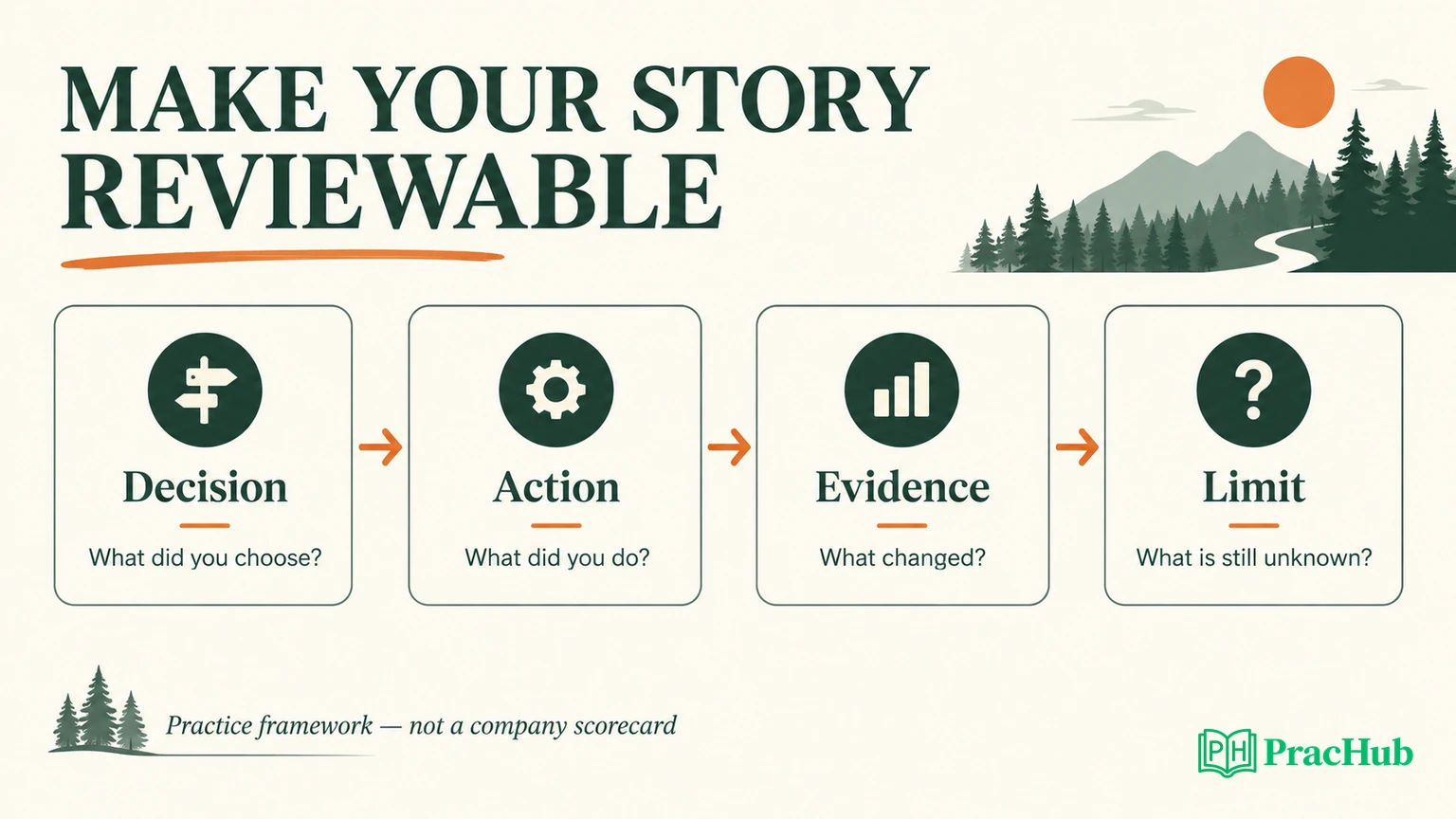
What is verified about the Orange Cloud interview?
The official careers page groups its six Capabilities around learning, clear communication, integrity, different perspectives, delivering commitments, and empathy. The matrix below uses short paraphrased labels for readability; consult the linked page for Cloudflare's exact wording. These are behavioral reference points, not six technical subjects or six guaranteed interview questions.
Candidate report: a Solutions Engineer applicant described a process that included an Orange Cloud round followed by a role-play round. That is one person's account for a different role, not evidence that software engineers receive the same sequence. Solutions Engineer discussion
Candidate-report limitation: in a separate thread started by a SWE intern applicant, an Orange Cloud commenter clarified that they were applying full time and were not in IT. Treating that comment as a SWE internship report would incorrectly merge two people's experiences. Second-round discussion
The practical inference is modest: prepare behavioral evidence, then use your invitation and recruiter to confirm the actual arrangement. Do not infer an offer probability from reaching a named stage, and do not combine several online accounts into a supposedly standard loop. This article focuses on the public behavioral framework rather than claiming to reconstruct a complete engineering hiring process.
Build a story inventory before mapping capabilities
Choose a small set of real projects with different kinds of tension. Useful starting points include a delivery commitment that changed, a disagreement that improved a decision, and a mistake or knowledge gap that changed your working habits. A project need not be famous or financially large to contain good evidence.
For each story, record five facts: the decision you faced, what you personally did, who contributed another perspective, what you observed afterward, and what you still cannot establish. Keep source reminders for yourself, such as a pull request, retrospective, design note, or agreed milestone. You do not need to share confidential material to explain the decision accurately.
Separate ownership from team credit. “We shipped a migration” supplies context; “I compared two rollout options and wrote the rollback checklist” identifies your contribution. Conversely, claiming the whole result as yours obscures the collaboration you may need to demonstrate. Name the boundaries of your work without minimizing it.
Do not force one heroic story to prove every capability. The same project can support more than one angle, but each angle needs an action. If you cannot identify how you considered another perspective, the story does not become evidence of inclusion merely because several people attended a meeting.
A useful inventory also includes an imperfect result. You should be able to explain a missed assumption, a trade-off that remained unresolved, or a change you would make next time. An account with no cost, no uncertainty, and no competing view is often difficult to examine meaningfully.
Map evidence to all six capability themes
Editorial practice matrix: these rows are prompts for reviewing your own stories. They are not company-approved answer templates or a weighted scorecard.
| Theme and personal action | Outcome and evidence gap |
|---|---|
| Curiosity and growth. Tested an assumption, sought feedback, or learned an unfamiliar area. | Whose expertise changed your approach, and what you did differently. Gap: Can you name the changed decision, not just a course you completed? |
| Clear, transparent communication. Communicated a risk, corrected an update, or explained a trade-off. | Who needed the information and what decision it enabled. Gap: Did you disclose uncertainty early enough to affect the plan? |
| Integrity. Chose a defensible action despite pressure or acknowledged your own error. | Who was affected and how you handled accountability. Gap: What real cost or competing incentive made the choice difficult? |
| Diverse perspectives. Invited and used a viewpoint absent from the initial discussion. | How the decision changed because of that contribution. Gap: Are you showing influence on the work rather than naming demographics? |
| Follow-through. Defined a finish condition and carried a commitment through verification. | What was delivered, handed over, or explicitly renegotiated. Gap: Does “done” mean merged code, working release, or confirmed user outcome? |
| Empathy. Understood another person's constraints and changed your response. | What support or adjustment helped them participate or succeed. Gap: Did empathy produce an action while preserving necessary standards? |
A blank cell is useful. It shows where the evidence is thin before an interviewer asks. You can choose a better story, recover a missing fact, or state the limitation. You should not fill the gap by inventing a metric or attributing a teammate's action to yourself.
For example, a customer escalation might show transparent updates and empathy, while a technical review might better show curiosity and different perspectives. A missed deadline could show integrity if you disclosed the risk and renegotiated responsibly, but the disclosure alone does not establish successful follow-through. Keep the themes connected to what actually happened.
Review the matrix horizontally as well as vertically. Does one row contain your action, someone else's contribution, and an observable consequence? If every row ends with “the project succeeded,” your evidence is probably too coarse. Different behaviors should leave different traces in the story.
Replace a vague project claim with a reviewable account
Consider this fictional practice scenario, created to demonstrate the method. An engineer is helping release a customer-facing configuration change. Support worries that the new terminology will confuse existing users, while the product team wants to keep the announced release date.
A weak summary would be:
“I led the project, aligned everyone, and delivered a successful rollout. I showed ownership and strong communication.”
The problem is not brevity. It is that the listener cannot tell what was disputed, what the engineer changed, or what “successful” means. The sentence names capabilities instead of supplying evidence for them.
A more reviewable version is:
“I owned the rollout checklist for a configuration change. Support raised a concern that our new labels would confuse existing users. I had initially treated that as documentation work, but their examples showed a product risk. I compared a full release with a phased release, proposed the phased option, and wrote the rollback conditions. Product and support agreed on the first cohort. We launched that cohort on the revised plan. I verified the release checks, but we had not measured longer-term retention impact.”
This version still leaves room for questions. That is useful: an interview is a conversation, not a monologue that hides every uncertainty. The engineer has made a bounded ownership claim, acknowledged a changed assumption, and separated a delivered cohort from an unmeasured business effect.

Notice what was not added. There is no invented percentage improvement, no claim that everyone agreed immediately, and no suggestion that a phased release is always correct. The example's value lies in the reasoning and evidence, not in making the project sound larger than it was.
When adapting your own story, preserve the real stakes. If it was an internal tool with three users, say so. Explain why the decision mattered to those users rather than relabeling it as a company-wide transformation. Specific small decisions can demonstrate judgment more clearly than inflated outcomes.
Practice follow-ups that expose the missing evidence
The next layer should make the story more precise, not more polished. Use the fictional rollout account to rehearse these original follow-ups:
| Follow-up | What a substantive answer needs |
|---|---|
| What did you personally decide? | The option you recommended, your decision authority, and who approved it. |
| Why was the support team's concern credible? | The examples or observations that changed your initial assumption. |
| Who disagreed, and why? | A fair account of the competing deadline or user concern. |
| What did you communicate before the plan changed? | The risk, uncertainty, audience, and timing of the update. |
| How did you know the cohort launch was complete? | The agreed release checks and the observed result. |
| What would you do earlier next time? | A change in your process tied to the missed assumption. |
In the example, a possible answer to the last question is: “I would ask support to review the terminology before committing to the rollout plan. Their examples changed the decision late; earlier review could have reduced that rework.” That is a reflection on the fictional situation, not proof that the revised process was subsequently adopted.
A useful follow-up can also challenge your result. If someone asks whether the release improved retention, the answer should stay within the evidence: the cohort launched and release checks passed; retention was not measured. You can explain what measurement would be needed without pretending you already have it.
Practice responding when you do not remember a number. Give the direction and the basis you genuinely recall, label it as approximate if appropriate, or say you would need to check. An invented precise number creates more weakness than an honest limit, because the next question may examine the denominator, time window, or your contribution to the change.
Avoid turning disagreement into a story about an unreasonable colleague whom you rescued. In the fictional example, product's deadline concern is legitimate, as is support's concern about user confusion. A strong account explains the trade-off and how the team reached a workable decision while preserving both viewpoints.
Confirm the format and rehearse a flexible conversation
Use your recruiting contact to confirm the scheduled duration, participants, role focus, and whether any preparation material is provided. If your invitation separates an executive conversation from Orange Cloud, ask how those meetings differ. The public careers page's grouping should not override the arrangement you were actually sent.
Prepare a concise opening version of each story, then practice expanding only the part being questioned. You might begin with the decision and your contribution, then supply technical detail when it helps explain the trade-off. A long architecture tour can bury the behavior the interviewer is trying to understand.
For a rehearsal, have a partner select one capability theme and interrupt with a follow-up from the table. Your goal is to remain accurate when the conversation changes direction. Memorizing one uninterrupted script can make it harder to answer the actual question or acknowledge a detail you initially omitted.
Afterward, review the recording or notes for three things: unsupported adjectives, unclear ownership, and outcomes claimed beyond the evidence. Replace each with a concrete action or an explicit limit. This is an editorial self-check, not a prediction of Cloudflare's scoring or a guarantee of an interview result.
Use these transferable PracHub questions for the next rehearsal. They are selected for the behaviors involved, not represented as Cloudflare's exact questions:
| Practice question | Evidence to prepare |
|---|---|
| Give Evidence-Based Strengths, Weaknesses, and Feedback | A specific example and a credible limit on your claim. |
| Respond to Critical Feedback and Show the Change | What changed in your behavior after feedback. |
| Handle diverse styles and give constructive feedback | How another perspective affected your approach. |
| Handle Policy, Confidentiality, Integrity, and Conflict-of-Interest Scenarios | A principled choice and its practical consequences. |
| Describe Leading a Project from Ideation to Delivery | Your contribution, the finish condition, and the verified result. |
Continue with Respond to Critical Feedback and Show the Change. Choose a real example where feedback changed a decision, and prepare to explain both the change and what remains uncertain.
Comments (0)