Code Aloud Review: Conversational Coding Mocks, Follow-Ups, and Scorecards
Quick Overview
Inspect Code Aloud’s editable guest playground, language choices and sign-in gates. Read the public scorecard and compare an independently tested first-repeat example.
Code Aloud aims to make a coding rehearsal feel like a conversation: clarify the problem, explain a choice, write code and respond to follow-ups. Its public scorecard covers communication, problem solving, testing and coding. Those dimensions are useful, but a sample score cannot show how the interviewer responds to your particular mistake.
Our November 22, 2026 check reached the public editor and session configuration. We entered an original Python solution, encountered sign-in when trying to run it and reached a separate sign-in boundary before starting an interview. We inspected the public scorecard PDF without obtaining a personal session result.
PracHub publishes this review and supplies independent practice. Start with its first repeated value question if you want a compact problem whose contract you can explain before coding.
What Code Aloud is offering
The official site describes AI voice interviews with a coding environment, conversational follow-ups and feedback. Its headline proposition is a roughly forty-minute rehearsal that requires you to explain your reasoning while working through a problem.
That format may address a gap in silent coding practice. A correct implementation can conceal an assumption you never stated. Speaking gives an interviewer an opportunity to ask why the assumption holds, what alternative you rejected or how a changed requirement affects the approach.
This is an interpretation of the proposed format, rather than evidence that the AI successfully identifies those gaps. Our guest check did not start the voice session. We therefore cannot judge interruption timing, question selection, speech recognition or whether the follow-ups adapt to a candidate’s actual code.
During a trial, connect those surfaces: preserve the agreed contract, an implementation decision, a test and the feedback about each. That would show whether the conversation contributes information beyond a generic explanation after submission.
The public editor is editable; execution required sign-in
The site’s environment preview opened a separate playground tab. Its initial Python 3 editor contained a small starter program. We replaced that program with an original function for finding the first value repeated during a left-to-right scan.
The text appeared in the editor. Clicking Run then opened a sign-in-to-run-code dialog. We canceled that dialog and obtained no execution output from Code Aloud. Editing and execution were therefore separate access boundaries in the guest path we inspected.
That distinction is relevant if you want to test the environment before creating an account. You can inspect how the workspace looks and enter text, but our visit did not establish a working anonymous compiler or interpreter. A displayed editor is insufficient evidence of a completed coding attempt.
We also did not test persisted code, recovery after connection loss or whether an interrupted run consumes an interview credit. Those are account-side questions to inspect during a legitimate trial, especially if you plan to rehearse under a short deadline.
Check the actual session choices
The configuration page exposed Python as an available language. TypeScript, JavaScript and Java were shown as Coming Soon rather than selectable equivalents. This was the observed configuration at the check date, not a permanent statement about future language coverage.
The interview-style control similarly offered Generic Coding Interview. Company-specific questions were marked Coming Soon. Company names appearing elsewhere on a landing page should not be treated as evidence that those tracks can currently be selected and run.
Continuing through configuration reached the start page, which required sign-in to begin. That page described a thirty-five- to forty-minute voice-and-coding interview with feedback. We did not sign in, grant microphone permission, start a session or spend a credit.
| Surface | What we observed | Evidence still needed |
|---|---|---|
| Playground | Original Python text entered successfully | Execution and resulting output after sign-in. |
| Language selection | Python available; three other languages marked Coming Soon | A running session in another supported language. |
| Interview style | Generic selected; company-specific option unavailable | Actual company-track access when released. |
| Session entry | Sign-in required before starting | Voice behavior, follow-ups and personal feedback. |
If your immediate interview uses Java or a specific company format, resolve those availability questions before treating the product as a matching rehearsal. The observed generic Python path supports a narrower conclusion.
What the sample scorecard establishes
The homepage displays a sample totaling nineteen out of twenty, with four dimension scores of five, five, four and five. Its recommendation is part of that provider example. It is not our score, an independent evaluation or an employer’s hiring standard.
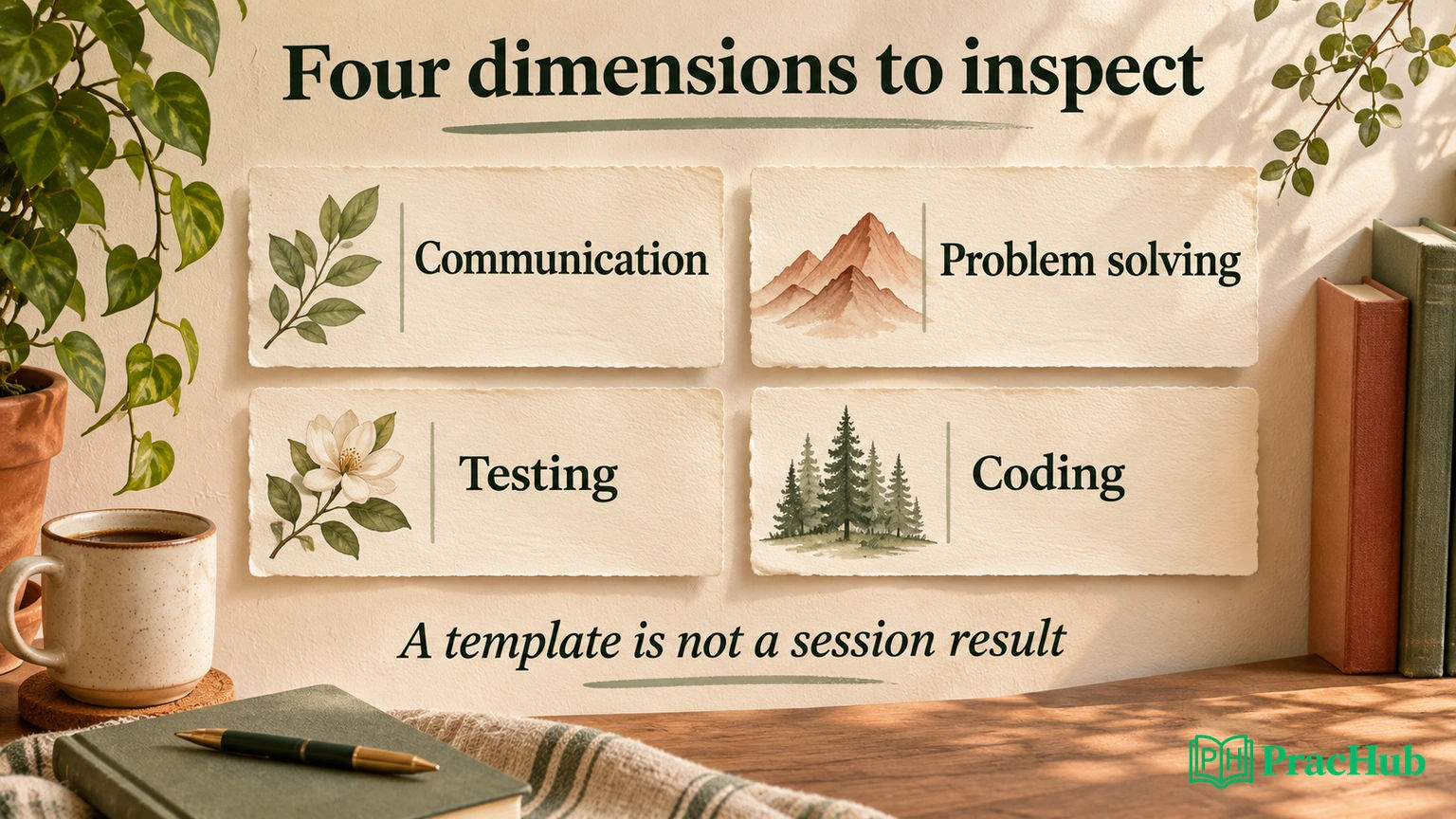
We also opened the public one-page scorecard template, extracted its text and visually inspected the rendered page. It organizes assessment around communication, problem solving, testing and coding, using a one-to-five scale for each dimension.
Those categories create a useful inspection framework. They do not establish calibration: we have no evidence that two evaluators would assign the same score, that the model consistently applies the criteria or that a particular total predicts an interview outcome.
During a trial, look beyond the total. A testing critique should identify a missing case or a weak assertion. A communication critique should point to an unstated decision or confusing explanation. Otherwise, two different mistakes can collapse into the same number without telling you what to change.
An original problem to bring to a conversational rehearsal
Consider this independent contract: scan a sequence of request IDs from left to right and return the current ID when it has appeared before. Return None if there is no repeat. IDs use exact, case-sensitive equality.
Under that contract, ['req-7', 'req-2', 'req-7'] returns 'req-7'. An empty sequence returns None. The sequence ['A', 'a'] also returns None. The last case is useful because a casual phrase such as duplicate ID can hide a normalization assumption.
def first_repeat(ids):
    seen = set()
    for request_id in ids:
        if request_id in seen:
            return request_id
        seen.add(request_id)
    return None
This is our own example, not a Code Aloud question or generated answer. It assumes hashable IDs and the stated exact-match contract. Its expected running time is linear in the number of inspected items under ordinary hash-set assumptions; its extra storage grows with distinct IDs encountered before returning.
A conversational explanation should connect the ordering requirement to the early return. Returning the most frequent ID, the smallest repeated ID or the earliest ID in sorted order would solve different problems. The small function is useful precisely because that difference can be discussed without a large implementation obscuring it.
Use a changed contract to test follow-up quality
Now change the requirement: IDs compare without case, and the function should return the current original spelling. Under this new contract, ['A', 'a'] returns 'a'. Normalizing only for membership checks preserves the requested return value.
That change should affect both the explanation and tests. A follow-up that simply asks for better complexity would miss the new semantic issue. A useful discussion would ask whether case folding is the intended normalization, whether IDs are strings and whether normalized identity is acceptable for the application.
We ran the original exact-match version and a separate case-folded variant locally, outside Code Aloud. Each was compared with an independent implementation that checks earlier positions directly. Across 364 bounded input sequences per contract, the two variants produced 728 matching comparisons and zero mismatches.
This is bounded reference evidence about our examples. It is not Code Aloud execution, a proof for every possible input or a measurement of the AI interviewer. Its purpose is to supply an answer and changed requirement whose behavior can be inspected independently when assessing a future session.
Read the credit packs as purchase units
At the check date, the homepage listed two credits for US$12, five for US$25 and fifteen for US$65. It described one credit per interview and presented the packs without a subscription. These are public provider terms we read, not a checkout or account-balance test.
Simple division gives six dollars, five dollars and approximately four dollars thirty-three cents per listed credit. That comparison assumes each purchased credit is usable for the intended session; it does not establish expiry, refunds, taxes, interrupted-session treatment or whether a restart spends another credit.
The largest pack only saves money if the additional sessions are useful to you. A first session should show that the supported language, audio path and feedback meet your needs before a lower unit price becomes the deciding factor.
We did not buy credits, inspect payment terms inside an account or verify recurring guest allowances. Recheck the current offer and the point at which a credit is consumed before committing to a sequence of timed rehearsals.
What to inspect in your first completed result
Keep the original question and your stated assumptions. Then compare the scorecard against the actual interaction. If testing receives a low score, identify the missing case. If problem solving receives a high score, check whether the explanation addressed the agreed requirement rather than an easier variation.
A particularly useful result would distinguish a code defect from a communication omission. Failing the ['A', 'a'] case after the contract changed is a behavior error. Implementing the correct behavior without explaining the normalization choice is a different gap. The repairs should differ too.
Also inspect follow-up timing. A question asked before you finish clarifying may have a different effect from one asked after you commit to a design. Our guest visit provides no evidence about that timing, but the distinction is central to the conversational product claim.
Use the next attempt to change one condition while retaining the skill being tested. That makes improvement visible in a specific decision or test, rather than relying entirely on a higher overall score.
Independent questions for coding and explanation
The following PracHub records are candidate-reported adjacent practice. They cover scan order, data structures, testing and project explanation; they are not Code Aloud’s question bank or a forecast of an employer’s next interview.
| PracHub question | Use it to rehearse |
|---|---|
| Find the First Value Repeated During a Left-to-Right Scan | Clarify which repeat counts before choosing a scan and return rule. |
| Remove Duplicates While Preserving First-Appearance Order | Preserve the specified order while removing duplicates. |
| Implement a Set Data Structure with a Resizable Array, Then Improve It with Hashing | Compare a baseline structure with hashing and explain its assumptions. |
| Write Unit Tests for a Given Python Class, Covering Normal and Edge Cases | Choose assertions that distinguish ordinary and boundary behavior. |
| Describe Your Most Technically Difficult Project | Explain a difficult technical decision and the evidence behind it. |
For a short rehearsal, choose one coding problem and explain its input contract before writing. Then name the case most likely to distinguish your solution from a plausible wrong one. That creates a concrete testing discussion even when the implementation is small.
Is Code Aloud a fit for your next rehearsal?
Code Aloud is worth investigating if you want a generic Python coding conversation and feedback organized around four distinct skills. The public editor, configuration and scorecard make that proposition understandable before a session starts.
Our check stops short of judging the actual interviewer. Code execution and interview entry both required sign-in; voice adaptation, personal scoring and credit consumption remain untested. The visible Coming Soon choices also limit what can be assumed about language and company coverage today.
Start with PracHub’s first-repeat prompt. State which repeat counts, explain the early return and change the case-sensitivity rule. A later Code Aloud result is easier to evaluate when you already have a small, independently checked behavior to discuss.
Sources and Further Reading
- Code Aloud: current product, sample scorecard and credit packs
- Code Aloud: inspected guest editor
- Code Aloud: inspected session configuration
- Code Aloud: session entry requirements
- Code Aloud: public one-page scorecard template
Checked November 22, 2026. Product access, pricing and policies can change; observed tests and untested features are identified in the review.
Comments (0)