Code2Deploy Academy Review: DevOps Questions, Flashcards, and Interview Practice
Quick Overview
Compare Code2Deploy Academy’s public DevOps bank, flashcards and scenario reading with applied SRE reasoning and paid-course commitments. Includes original request/time denominator checks.
Code2Deploy Academy is useful for browsing DevOps questions and rehearsing short answers with public flashcards. The samples we inspected also show where recall needs a second pass: an error-budget calculation needs a clear denominator, and a production-incident walkthrough needs evidence before intervention. Use the bank to find a gap, then test the missing assumption independently.
PracHub publishes this review and owns the complementary practice links. Our SLI, SLO and monitoring question gives you another place to explain what a reliability percentage measures. The traffic comparison and incident decision map below are original preparation assets, separate from Code2Deploy’s content and paid training.
What is public, and where the questions come from
Provider positioning, checked November 3, 2026: the interview-Q&A directory advertises 2,200 questions across 12 topics, 240 interactive diagrams and 50 mock scenarios. We did not independently count unique questions or validate every diagram. The sampled material was readable without creating an account.
The directory attributes its questions and answers to NotHarshhaa’s open-source collection, with formatting changes, while attributing diagrams and worked examples to the Academy. The linked GitHub repository is publicly available. We verified the attribution and destination, not a complete item-by-item correspondence or licensing-compliance audit.
The attribution helps you decide what the Academy adds to the upstream material. The Academy’s presentation may help you navigate and rehearse material that also has an upstream source. A large advertised question count does not establish originality, technical correctness or the probability of encountering a question in an employer’s interview.
Our review covers public reading and a few interface actions. It does not measure course outcomes, mentor quality, placement success or long-term learning. No independent candidate reports support those conclusions here.
The inspected flashcard makes recall easy to separate from reading
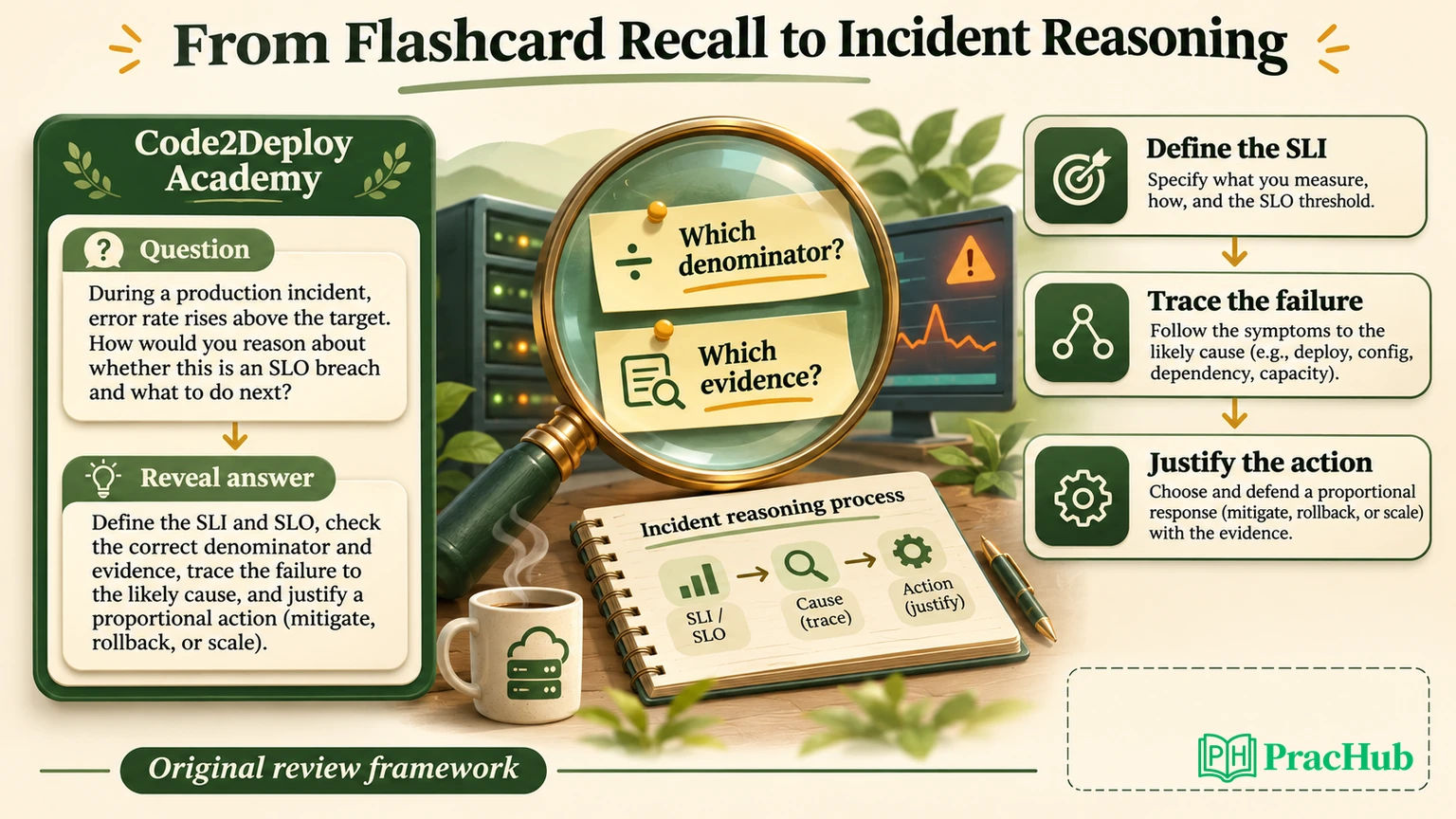
Direct observation: on the Core Concepts & SRE page, filtering for error budget produced four matches. We opened question 54, switched to Flashcards and used Show answer. The question appeared before the answer; revealing it displayed the definition and worked example. Previous, Next and Shuffle controls were visible.
Revealing an answer after speaking gives you an unaided response to compare. Say an answer before revealing it, then compare the mechanism and assumptions. We did not establish that the inspected interaction records mastery, calibrates difficulty or evaluates a spoken response. A successful reveal is evidence of interface behavior, not a validated assessment.
Separate three outputs in your own notes: a definition you recalled, an assumption you missed and a failure case you could not explain. That makes the next practice action concrete. Merely recognizing the revealed answer can otherwise feel like recall even when you could not produce it unaided.
| Preparation mode | Useful output | What still needs checking |
|---|---|---|
| Read a short answer | Vocabulary and a starting explanation | Accuracy and missing assumptions |
| Recall before revealing | An unaided answer to compare | Whether it survives a changed input |
| Trace a counterexample | A visible boundary or failure | Whether the model matches the real system |
| Explain a personal incident | Evidence of your own decisions | Scope, attribution and measurable outcome |
This is our curriculum-to-practice map, not the Academy’s grading rubric. It gives the public reading and flashcard modes a role without turning either into evidence of production experience.
Original drill: equal downtime, different request impact
The inspected error-budget example combines a request-success objective with a time equivalent. Treat that conversion carefully. A percentage of requests is not automatically the same percentage of wall-clock time when request volume changes.
Google’s SLO implementation guidance describes request-driven availability as successful requests divided by eligible requests and emphasizes defining the indicator and policy. The denominator determines what the result means. A time-based indicator can be valid too, but it answers a different question.
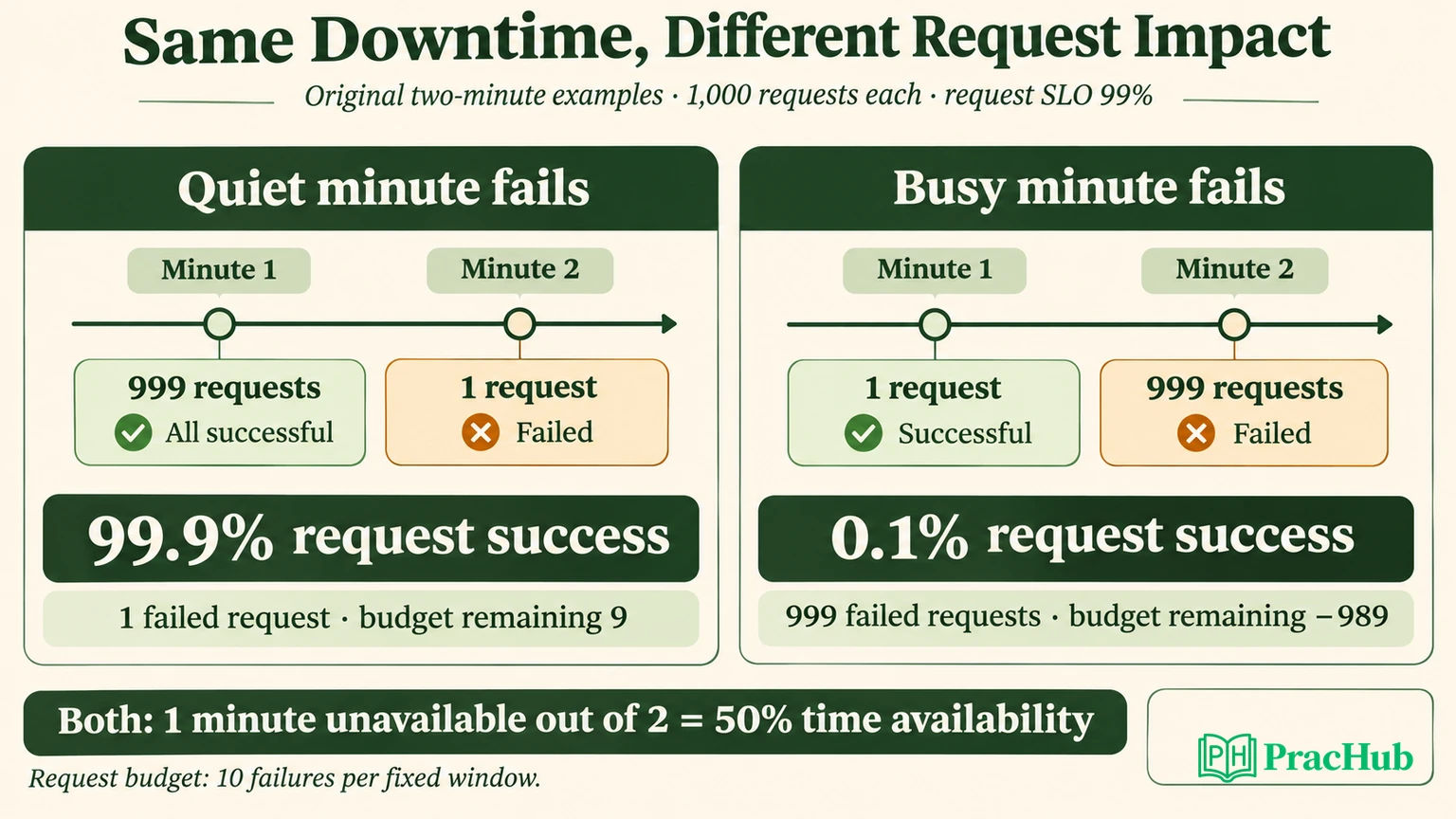
Consider two invented two-minute observation windows. Each has exactly 1,000 requests and one completely failed minute. In the first window, the failed minute has only one request. In the second, the failed minute carries 999 requests. The other minute succeeds completely.
For this exercise, define a request-based SLO of 99 percent. The allowed failures for each fixed window are 10. We count every request as eligible and every unsuccessful request as bad; there are no exclusions or retries to interpret.
| Original case | Failed requests | Request success | Time availability | Remaining request budget |
|---|---|---|---|---|
| Quiet minute fails | 1 of 1,000 | 99.9% | 50% | 9 failures |
| Busy minute fails | 999 of 1,000 | 0.1% | 50% | −989 failures |
Both windows have the same time availability under our stated rule: one of two minutes is entirely available. Their request impact is very different. The first consumes 10 percent of its request-error budget. The second consumes 9,990 percent and exceeds the budget by 989 failures.
Our local arithmetic fixture used exact fractions and checked the shared time availability, the two request-success rates and both remaining budgets. All checks passed. This validates the invented calculation, not a production metric, a vendor result or the suitability of this SLO for a business.
Define the measurement before converting a percentage into another unit. Ask which requests are eligible, how success is detected, what period is measured and whether traffic is uneven. A single monthly percentage can also hide a severe short burst, so explain whether the decision needs a shorter view.
Another follow-up changes the eligibility rule. If internal health probes are counted alongside customer transactions, a large probe volume could dilute the observed user failure rate. Do not simply remove inconvenient events after seeing a breach; document the indicator’s intended population and the reason for exclusions.
Error-budget policy is a decision agreement
Arithmetic identifies budget consumption under a chosen indicator. It does not independently decide which change is safe or who can authorize it. Explain the team’s agreed response when its budget is consumed.
Google’s example error-budget policy illustrates a written response to excessive failures and includes exceptions. It is an example policy, not a universal instruction for every organization. A candidate should distinguish the calculation from the team’s approved operating rules.
In the invented exercise, the negative remaining budget tells us that the request objective was missed. It does not tell us that a database index caused the failure, that every deployment must stop or that a particular person made an error. Those conclusions require additional evidence or a stated policy.
When rehearsing, describe a specific decision boundary. Which releases would pause? Would security fixes remain eligible? Who reviews exceptions, and what evidence permits normal release work to resume? You can explain these as design choices without inventing a policy from an employer you have never worked for.
Read the 504 walkthrough as a conditional scenario
We also opened mock scenario 21, about peak-traffic gateway timeouts. Its walkthrough connects load-balancer symptoms to traces, database locking and intervention. An interactive sequence and Play control were visible; we read the scenario without executing production commands or testing the animation.
The important preparation question is what establishes each link. AWS’s Application Load Balancer troubleshooting guidance lists multiple possible causes of 504 responses, including connection and response timeouts. A 504 alone does not establish a PostgreSQL lock or a missing index.
Here is an original evidence-gated decision map for extending the walkthrough. It is not an incident runbook for a live environment.
| Stage | Evidence to establish | Decision that evidence can support |
|---|---|---|
| Bound the symptom | Affected route, time window, users and error source | Choose where to inspect the request path |
| Locate the delay | Correlated request trace and component timing | Narrow the blocking or slow dependency |
| Examine a lock hypothesis | Relevant lock waits, blockers and transaction context | Assess a targeted, authorized mitigation |
| Choose an intervention | Expected effect, risks, owner and reversal path | Apply one justified change |
| Verify recovery | Affected requests, error rate and latency after the change | Confirm impact and watch for recurrence |
A command that terminates a database session can have consequences beyond the slow query. A proxy does not remove every lock-contention problem. An index may help one access pattern and leave a different bottleneck untouched. Explain the hypothesis and expected effect before treating any of those as the answer.
You can practise this without a cloud account. Give a partner only the first symptom and request one observation at a time. If the answer names a database cause immediately, ask what measurement would distinguish it from a connection timeout. If the answer proposes a change, ask what result would make the hypothesis less likely. Keep a short decision record: the observation, the proposed explanation, the action and the result. If several things change together, say that the recovery does not isolate which change mattered. That limitation is part of a credible incident explanation.
Free scenarios and mentor-led courses are different purchases
The public mock section is a collection of scenario material. Reading a scenario does not establish that a person is interviewing you, assessing your explanation or operating a lab. Check whether “mock” means a readable scenario, a live session or assessed work.
The separate pricing page listed individual tracks and bundles when we checked. As one dated example, DevOps Engineering was advertised at $790 for 72 hours. The course page described a 12-week format and a project ending in a demonstrated rollback. These are provider commitments, not work we completed.
Before considering training, ask which sessions include individual feedback, how a mock is conducted, what infrastructure costs are included and what happens if you miss a session. A public question bank cannot answer whether that paid format fits your schedule or current level.
We did not contact the Academy, enroll, pay, join a cohort or submit project work. We also did not test any private lab, AI assessment or account progress feature. Keep those unknowns separate from the public flashcard behavior we observed.
Practice the gaps the product leaves open
Use these complementary PracHub prompts to extend recall into denominator choices, incident reasoning and deployment decisions. They are independent of Code2Deploy’s catalog and course assessment.
| PracHub question | What to examine |
|---|---|
| Explain SLI/SLO/SLA and design monitoring | Define eligible events, success and the objective window before calculating a budget. |
| Explain SRE architecture and troubleshooting scenarios | Explain which observation changes the next troubleshooting step. |
| Connect Monitoring, Circuit Breakers, Rollback, and CI/CD | Connect a rollout decision to monitoring, reversibility and a recovery check. |
| Respond to a Reliability Regression Shortly After Deployment | Separate a release correlation from evidence of the reliability failure mechanism. |
| Meet a 10-second latency and 99% availability target across 3-5 dependent services | Keep latency and availability targets distinct across dependent services. |
A useful next step with the Academy
Use Code2Deploy Academy when you want a navigable public DevOps bank and a way to rehearse before revealing an answer. The sampled material is most valuable when you add the missing conditions yourself. Use the public access for convenient rehearsal, then check each explanation’s assumptions and limits.
Start with the SLI, SLO and monitoring question. Define the denominator, compare the two invented traffic windows and explain what policy decision the calculation cannot make. Then take one incident scenario and require evidence before its first intervention. That turns reading into an explanation you can defend.
Sources and Further Reading
- Code2Deploy Academy interview directory and attribution
- Core Concepts & SRE questions
- Mock Interviews & Scenarios
- Code2Deploy Academy pricing
- DevOps Engineering course
- NotHarshhaa’s DevOps Interview Questions repository
- Google SRE: implementing SLOs
- Google SRE: example error-budget policy
- AWS Application Load Balancer troubleshooting
Comments (0)