Codejump Review: Frontend Challenges, Hidden Tests, and AI Feedback Limits
Quick Overview
Read our Codejump review for visible flatten tests, hidden-test access, AI feedback evidence and the difference between trial copy and Pro waitlist status. Dated public observations and original worked examples distinguish tested behavior, author descriptions and unverified capabilities.
Codejump is worth a public trial if you want short frontend coding exercises with immediate visible-test feedback. Its anonymous flattening demo gave us a useful result: a one-level implementation passed two of five checks, while an all-depth implementation passed all five. The next step—four hidden tests—required an account. Use that boundary to decide whether the public demo covers your preparation need.
Start with PracHub’s JavaScript flatten code-review question and write down the input contract before opening a solution. Returning the right array, preserving the input, and handling an unexpected nesting depth are separate claims. Codejump’s demo can help investigate some of them; a green visible suite does not settle all of them.
Checked November 3, 2026: this review separates official descriptions, our anonymous browser observations, and original local exercises. We did not create an account, purchase access, run hidden submissions, or receive personalized AI code review. No independent candidate-outcome evidence supports a hiring-effectiveness claim. PracHub publishes this review and provides the linked preparation questions.

What happened in the public flatten challenge
The Codejump homepage contained an editable JavaScript solution and a Run tests control. The starting implementation returned arr.flat(). That method removes one level by default, which is insufficient when the desired output must flatten more deeply nested arrays.
Running the starter produced two passes out of five visible checks. Already-flat and empty inputs passed. Nested numeric, deeply nested, and mixed-string cases failed. The feedback exposed expected and received values, so the failure was interpretable rather than a bare red badge.
We replaced the body with return arr.flat(Infinity) and ran the visible suite again. The result became five out of five. This establishes that the public runner reacted to the depth correction in that exercise. It does not establish whether the four undisclosed cases check mutation, special values, extreme depth, or another requirement.
| Public action | Observed result | Supported conclusion |
|---|---|---|
| Run the supplied one-level flattening implementation | Two of five visible checks passed. | This visible suite distinguishes shallow and deeper flattening. |
| Run the all-depth built-in implementation | Five of five visible checks passed. | The correction satisfied these visible examples. |
| Inspect the submission step | Four hidden tests were advertised; submission required a free account. | Hidden-test outcomes remain unverified in this review. |
The page also noted that an interviewer might ask for an implementation without the built-in shortcut. That is a useful follow-up, although displayed mentor text is not evidence that an AI evaluated our particular code. A static explanation, a rule-triggered message, and a generated individualized review can look similar from one screen.
For a small array contract, the demo provides useful, readable feedback. Its value came from the contrasting outcomes and readable failures. We would not infer the quality of every challenge, framework project, or AI review from this one task.
Read the access pages before planning around Pro
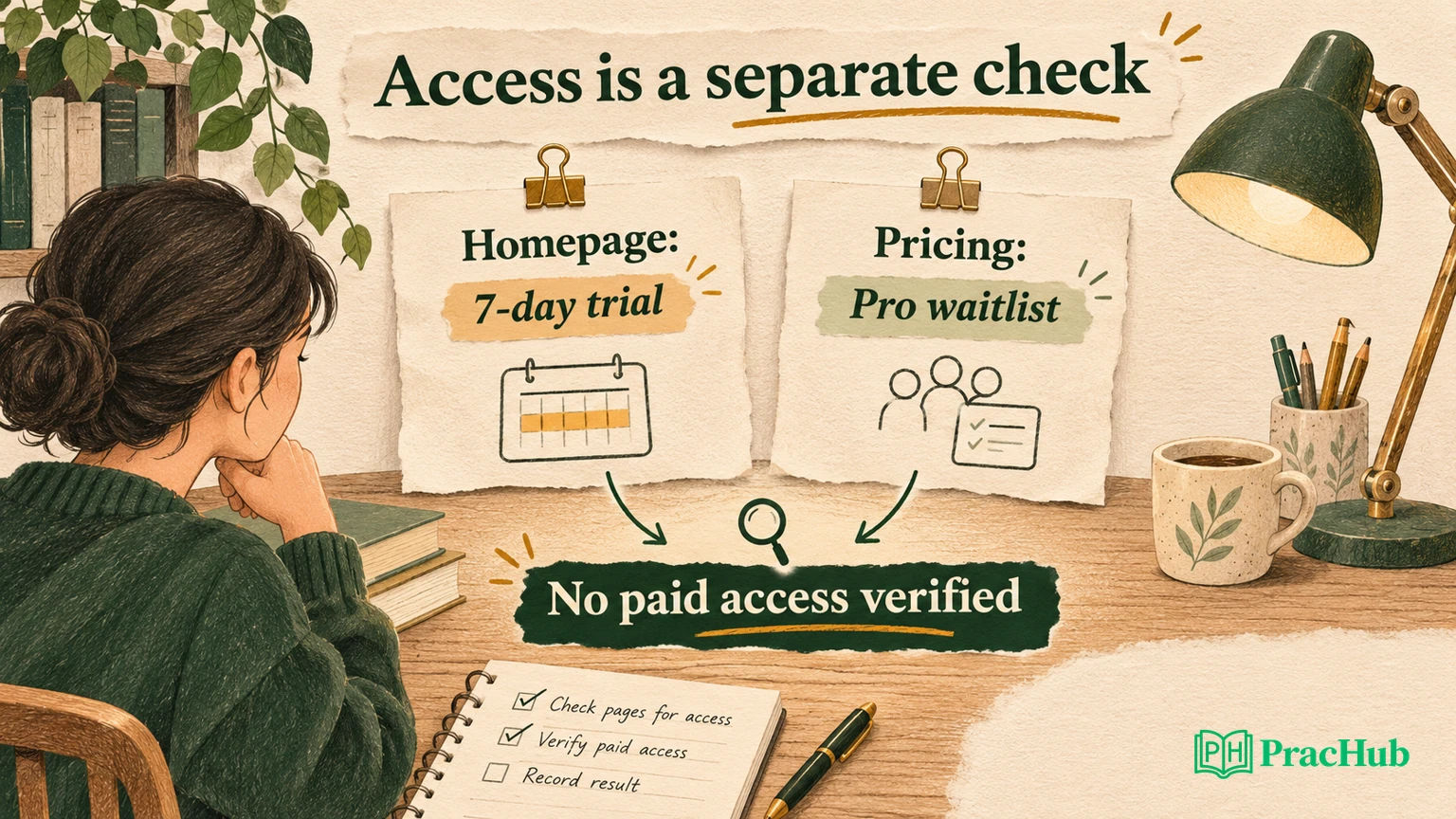
Codejump’s homepage described a seven-day Pro trial without a credit card. The pricing page, inspected in the same research session, presented a different practical purchase state: Pro was labeled launching soon, and its action was a waitlist rather than an active checkout.
The displayed annual Pro offer worked out to $6.58 per month billed as $79 per year. An Interview Pass was displayed at $24.99 for 90 days. Both figures describe the page we saw, not purchases we completed or entitlements we verified. The waitlist wording said there was no payment today.
The Free description listed public-test challenges, quizzes, selected learning-path material and projects, a Lightning mock, eight AI Assistant messages per day, and two AI Code Reviews. These are provider descriptions of allowances. We did not establish when the two reviews reset, whether a particular account receives them, or what feedback quality they deliver.
For a practical decision, distinguish three questions. Can you open and run the exact exercise today? Can you submit and retrieve the additional result with the account you intend to use? Can you actually obtain the paid feature through the current purchase flow? A price printed on a plan card answers none of those questions by itself.
This discrepancy does not prove deceptive intent or a broken billing system. Launch pages can change at different speeds. It does mean the safe preparation plan uses the accessible exercise now and treats trial, hidden-test and Pro expectations as items to confirm before relying on them.
An original flatten exercise beyond the demo
Here is our own transfer case, executed locally in Node.js rather than inside Codejump’s hidden suite. The input is a dense, acyclic nested array whose leaves may be numbers, strings or booleans. Preserve leaf order and values, return a new flat array, and leave the original input unchanged.
function flattenDense(input) {
  const pending = [...input].reverse();
  const output = [];
  while (pending.length) {
    const value = pending.pop();
    if (Array.isArray(value)) {
      for (let i = value.length - 1; i >= 0; i--) {
        pending.push(value[i]);
      }
    } else {
      output.push(value);
    }
  }
  return output;
}
For [0, [false, [], ['x']], [2]], the expected result is [0, false, 'x', 2]. A one-level flatten leaves the inner array containing x in place. The explicit stack processes all declared nesting levels, and pushing each child array in reverse preserves the original left-to-right leaf order.
Our local checks compared this result, checked an empty input, and compared the input serialization before and after execution. Those checks passed. They are an independent teaching fixture, not a reconstruction of Codejump’s hidden tests or a comprehensive JavaScript conformance test.
The zero and false values matter. A tempting shortcut that adds a leaf only when it is truthy silently drops both. The empty nested array contributes no leaves. Explaining those cases shows that you understand the contract beyond copying a familiar loop.
Notice the boundary around “dense, acyclic.” Sparse arrays, self-referential arrays, getters and custom iteration behavior introduce additional decisions. Do not claim this short implementation reproduces every observable detail of a native method. Ask whether those inputs belong in the interview before expanding the contract.
Use failures to choose the next question
An accepted result becomes more useful when you can describe the wrong implementation it excludes. In this demo, the shallow implementation was such a negative control. It ran successfully, passed the simplest inputs, and failed on meaningful depth differences. A syntax error would have established much less about the test suite’s behavioral coverage.
For your next attempt, predict one output before running anything. Then change one requirement: perhaps preserve a shared object leaf by identity, support a maximum depth, or flatten only arrays while leaving other iterable objects intact. Write the expected result for that change separately. Otherwise, you can mistake a new contract for a regression in the old one.
A reviewer may ask how much pending work the traversal retains. The stack and output retain references to pending work and produced leaves; neither makes the operation free. Recursive implementations have an additional call-stack depth concern. The iterative version removes recursive calls but still needs explicit pending storage. Discuss the actual shape of the input when comparing alternatives.
There is also a difference between not modifying array structure and deeply copying leaf objects. This function returns existing object leaves unchanged. If an interviewer asks for a deep clone, that is a different specification involving identity, cycles and supported types. Reusing a flattening answer for that task would leave the main problem unsolved.
What to expect from AI feedback
The useful question is whether feedback names a reproducible defect in your submitted work. “Improve readability” is difficult to act on without a location and reason. “This truthiness guard removes zero, so this input should retain it” gives you a testable claim.
Codejump advertises assistant and code-review features. Our public run did not verify a personalized AI response, model consistency, review latency, or whether suggested fixes survive additional tests. Treat those as unknowns when comparing its AI promise with another product’s working editor or human review.
If you later use a review allowance, keep your initial implementation, the exact feedback, and the changed test result. Ask whether the suggested repair addresses the requirement you were given. An assistant can recommend a neat built-in method even when the exercise intentionally asks you to implement the traversal yourself.
Also separate correctness from explanation quality. A review may correctly identify the nesting bug while offering an explanation you cannot reproduce. Close the feedback, reconstruct the failing input, and explain the repair aloud. That is a more informative preparation result than counting messages used.
There is no evidence here that an AI score predicts an employer’s evaluation. A hiring conversation can add a constraint, ask about an alternative, or inspect how you respond to uncertainty. The appropriate target is a defensible implementation and explanation, not an assumed correspondence between product feedback and an interview cutoff.
Five questions that extend this practice
These linked PracHub records are further rehearsal prompts, not Codejump integrations or a claim that a particular company will ask the demo. Each changes one important part of the original array task.
| PracHub question | Focused follow-up |
|---|---|
| Review a JavaScript flatten PR | Review the shallow-depth defect and propose a counterexample before editing. |
| Flatten a nested JSON object | Define whether array and object paths share one output-key contract. |
| Flatten Nested Comments | Preserve comment identity while traversing nested children. |
| Sum Every Element of a k-Dimensional Array Readable Only Through get(indices) | Respect get(indices) access constraints; this is not an ordinary materialized array. |
| Flatten nested JSON into a string map | Explain key collisions and leaf types when flattening JSON. |
The code-review question is the closest transfer because it asks you to inspect someone else’s flattening logic. JSON questions change the representation and output contract; comments introduce hierarchy and stable identity. The multidimensional-array problem constrains how data may be accessed, so materializing a normal JavaScript nested array may not even be permitted.
Choose the question matching the gap you observed. If you can implement flattening but cannot explain a failure, review a flawed PR. If hierarchy is the difficulty, trace the comments task on a small tree. Finishing five loosely related questions is less useful than obtaining one clear answer about the skill that failed.
Who should try Codejump first?
Try its public challenge if you want a quick JavaScript behavior check and are willing to inspect the failing examples. It is especially useful as a small experiment before committing to a larger frontend preparation workspace. The visible depth correction required little setup and produced an interpretable outcome.
Be more cautious if your immediate need is authenticated hidden-test submission, a verified AI review, or a currently purchasable Pro entitlement. Those were not established in this review. Someone preparing a production-style component exercise should separately inspect keyboard interaction, state transitions, network failures and framework requirements; an array utility does not demonstrate those capabilities.
A sensible next action is to rerun the public example, write an independent implementation without the built-in shortcut, and explain one new counterexample. Then use PracHub’s frontend interview questions to choose a task that changes the input or interaction contract. Keep the actual failure and repair in your notes so the practice produces evidence you can revisit.
Comments (0)