CodenQuest Review: Mobile Coding, Hints, and Gamified Interview Practice
Quick Overview
Review CodenQuest mobile coding claims, guest Run and Submit limits, hint warnings and an original anagram test exposing lost character multiplicity. Dated public observations and original exercises distinguish official descriptions, tested behavior and unverified capabilities.
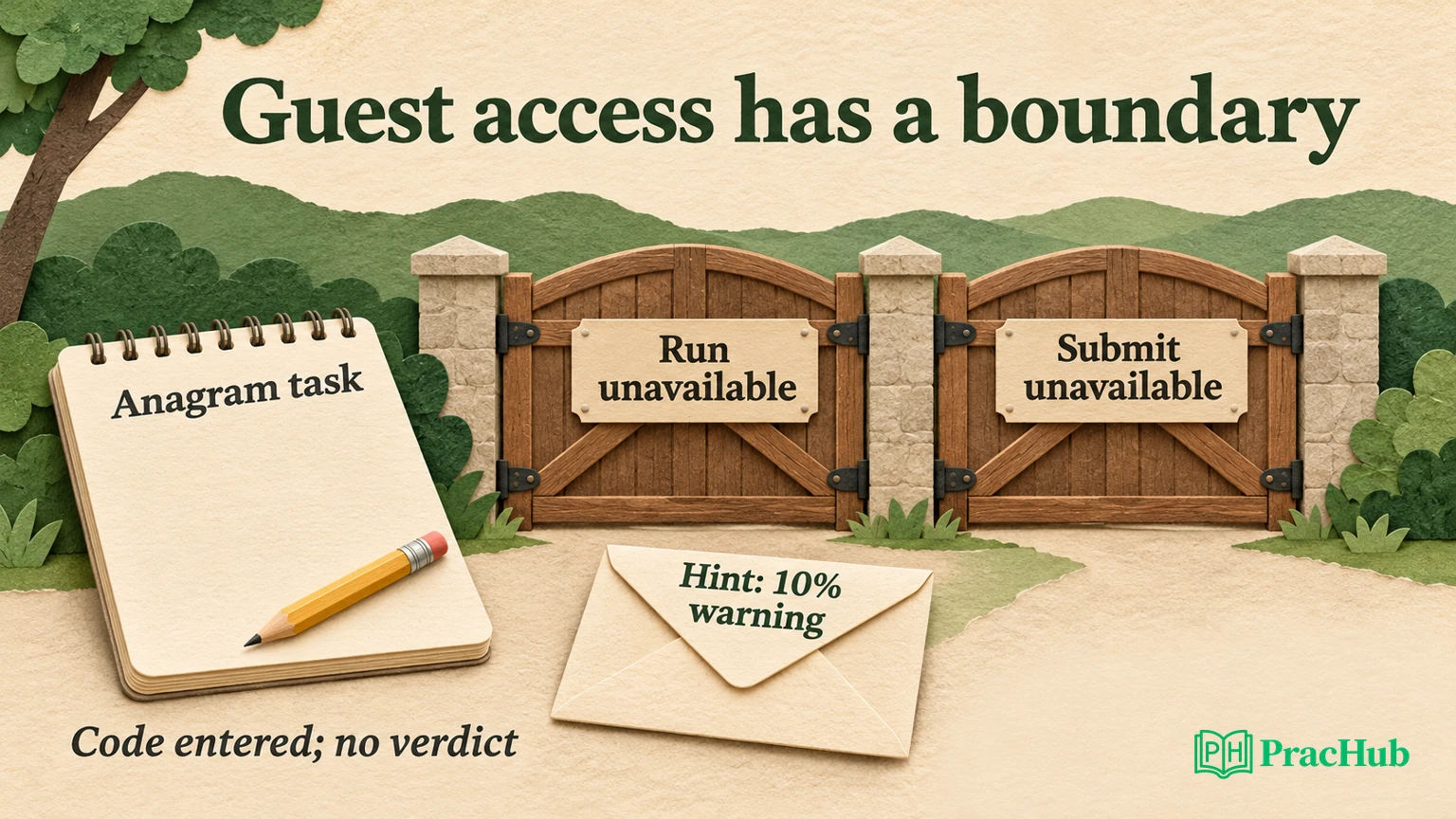
CodenQuest combines mobile-oriented coding practice, gamified progress and a public web question catalog. We could open an anagram task and enter valid JavaScript as a guest, but Run and Submit remained disabled. Its hint control displayed a 10% score warning; clicking it did not unlock a hint during our visit. Those access observations matter more than assuming an editable workspace is already an evaluated attempt.
Begin with PracHub’s anagram-check question and decide whether repeated letters, case and spaces count. A short function becomes useful practice when you can explain the exact string contract and test a tempting wrong shortcut.
Checked November 3, 2026: official descriptions, anonymous web observations and our independent local JavaScript exercise are separated below. We did not install the mobile app, create an account, buy Premium or complete a vendor-judged submission. PracHub publishes interview-preparation content and is the publisher of this review.
What the product is trying to combine
The official site presents coding practice with mobile editing aids, language support and game-like progress. Its descriptions include autocomplete, snippet navigation, custom arrows, weekly leagues and lives. These are provider descriptions of the intended experience, not mobile interactions we tested.
The web catalog was publicly accessible and offered questions, filters and course entrances. That makes it possible to inspect a task’s wording before committing to an account. It does not establish that every catalog item can be executed anonymously or that every language has the same feature coverage.
CodenQuest also links a separate employer-facing interview product. Candidate practice, classroom use and hiring assessments have different users and evaluation requirements. This review concerns candidate preparation; it does not assess employer test administration, proctoring or hiring decisions.
For a learner, ask whether mobile convenience leads to a solved task and a clear explanation. Short attempts can help with recall and small functions. You still need to transfer that reasoning into the environment and explanation format used in your actual interview.
The public anagram task we inspected
We opened “Check Anagram.” Its statement described using all letters to determine whether two strings are anagrams. Public samples included listen and silent as true, hello and bello as false, and act and cat as true.
The page offered a JavaScript language selection among multiple listed languages and displayed three test tabs. Guest submission history, the assistant and solution access were unavailable. We did not infer the contents or quality of those locked surfaces from their labels.
We entered a valid sort-based JavaScript implementation:
const isAnagram = (s, t) =>
  [...s].sort().join("") === [...t].sort().join("");
After entry, both Run and Submit remained disabled. We verified the code was present in the editor, so an empty buffer was not the explanation for this observation. We did not establish the exact access condition responsible and do not claim that signing in would necessarily resolve every unavailable control.
The hint entrance warned of a 10% current-score penalty. We clicked once, but no hint text or score change was observed. We can describe the warning; hint quality and the penalty’s actual effect remain untested.
An editable task and a judged result are different milestones
| Surface | What we observed | Boundary for this review |
|---|---|---|
| Public statement | Anagram requirement and three sample tabs | Statement available to read |
| Code editor | Our JavaScript entered successfully | No execution established |
| Run and Submit | Disabled after code entry | No vendor verdict obtained |
| Hints | 10% warning; no revealed text after click | Hint usefulness untested |
| Assistant and solutions | Unavailable guest controls | Depth and correctness untested |
These distinctions help you compare the site with a tool you have already executed. A catalog can be worth reading even when the current guest route does not provide a runner. Conversely, an attractive editor should not be counted as evidence of working feedback until you observe an actual result.
If you later gain access, use a deliberate logical defect first. A syntax error proves less about the task checker. A set-based anagram implementation supplies a better probe because it can pass ordinary examples while mishandling repeated letters.
Our independent counterexample: sets lose multiplicity
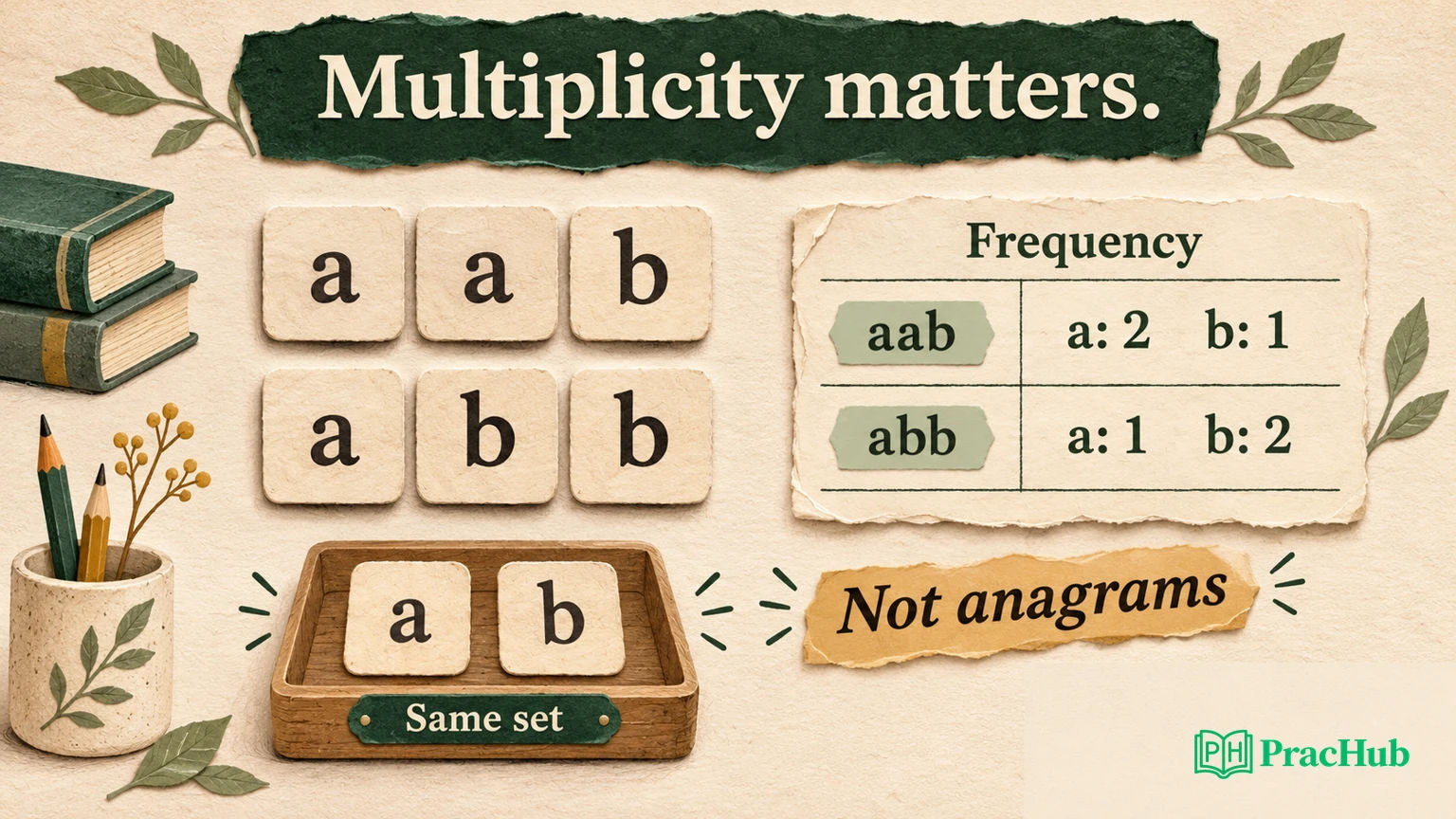
Consider aab and abb. Both strings contain the same distinct letters, a and b. They are not anagrams because the counts differ: the first has two a characters and one b; the second has one a and two b characters.
The following shortcut compares distinct-character sets and returns the wrong result for that pair:
const wrong = (a, b) =>
  [...new Set(a)].sort().join("") ===
  [...new Set(b)].sort().join("");
We executed this shortcut and the full sort-based comparison independently in local Node.js. For aab and abb, the shortcut returned true and the full comparison returned false. For listen and silent, both returned true. The ordinary sample therefore did not distinguish the incorrect algorithm.
| Local input | Expected under our contract | What it tests |
|---|---|---|
aab, abb | False | Character multiplicity |
listen, silent | True | Reordering the same characters |
ab, aab | False | Unequal length and repeated characters |
| Empty string, empty string | True | The declared empty-input policy |
These are our local teaching results, not CodenQuest outputs or a reconstruction of its hidden tests. The contract is case-sensitive and performs no whitespace or Unicode normalization. JavaScript string iteration also should not be mistaken for a complete user-perceived-character model across all writing systems.
State normalization rules before optimizing
An interviewer may ask whether Listen and silent should match. That requires a case rule. A phrase-level task may also ignore spaces or punctuation. Implement those transformations only when the statement calls for them, and explain which inputs are considered equivalent.
For an ASCII-focused exercise, a frequency map can compare counts in linear expected time with space related to the number of distinct characters. A fixed-size array is appropriate only when the allowed alphabet is explicitly bounded. Do not index arbitrary input into a 26-slot array while claiming general string support.
Sorting is simple to inspect but incurs sorting work and creates intermediate arrays in this JavaScript version. Explain that cost honestly. A small interview input may make clarity a reasonable choice, while a larger or repeated-query setting could justify frequency signatures or precomputation.
Then change the requirement. Grouping many words by anagram class needs a canonical signature, not just a boolean pairwise check. Supporting add and remove operations needs a data model for group membership. These follow-ups test whether you understand the character-count invariant beyond one remembered implementation.
Mobile practice should transfer into a desktop attempt
We did not test CodenQuest’s native mobile editor or its keyboard aids. The official descriptions suggest an effort to reduce typing friction on a phone, but our browser visit cannot establish how those controls behave on iOS or Android.
A useful mobile session might involve reading a statement, predicting an output or explaining a short invariant. A desktop transfer attempt should include writing the function from a blank file, running your own cases and explaining a failure without relying on a mobile hint sequence.
| Practice setting | Useful small task | Additional evidence to gather |
|---|---|---|
| Phone reading session | Identify the repeated-letter counterexample | Explain why a set loses information |
| Mobile coding, if available | Implement the declared string contract | Verify actual execution and editor behavior |
| Desktop follow-up | Recreate code and tests independently | Run fresh inputs and inspect a failure |
| Spoken rehearsal | Defend normalization and complexity | Adapt when the alphabet or output changes |
This comparison is our preparation framework. It does not imply that CodenQuest lacks desktop support or that mobile practice is inherently shallow. The point is to check transfer into the format you will actually face.
Hints and gamification need a learning rule
A hint can be useful when it resolves one obstacle while leaving the reasoning to you. For the anagram task, “preserve character counts” is different from revealing the complete implementation. We did not read a CodenQuest hint, so this is an evaluation standard rather than a review of its hint writing.
The displayed score penalty can influence behavior. Decide in advance when you will ask for help: after stating the contract and attempting a counterexample, for example. Avoid repeatedly staring at a task merely to protect a score, and avoid revealing the solution before identifying what you do not understand.
Leagues and lives can support regular practice, but they measure product activity under the provider’s rules. They do not independently establish interview performance. Keep your own record of a fresh case solved, a corrected assumption or a clearer explanation alongside any in-product progress.
A useful test is whether you can solve a related problem after a delay without reopening the hint. If you can only reproduce the exact answer you just saw, repeat the concept with changed data before moving to a harder badge or level.
What the public pricing page did and did not show
The pricing page presented a free Starter tier, one-time purchase options and a subscription option. It described Premium benefits such as unlimited lives, exclusive questions, an intelligent coding assistant, editor themes and an ad-free experience.
During our visit, the displayed monetary fields contained dashes rather than a reliable numeric price. We therefore do not quote a price. The page stated that subscriptions renew automatically and can be canceled; no purchase or cancellation was tested.
Feature lists also need their visual context. A plain-text extraction can include features that are excluded or styled differently in a comparison. Before buying, verify the selected plan’s current price and entitlements in the actual purchase flow. This review establishes the public descriptions and missing numeric display we observed, not checkout behavior.
The most useful first decision is whether the accessible practice loop matches your needs. If you need immediate judged attempts and the guest controls remain unavailable, resolve that access boundary before relying on the product as your main runner. If you need short problem discovery, the public statement already provides some value.
Retain the repeated-letter case when you move between environments. If a future mobile attempt passes ordinary examples, the local aab/abb probe still gives you a fresh question about multiplicity. Explain the expected result before running it, then record whether a real verdict appears.
Five PracHub questions for anagram transfer
These verified destinations change the character-count or data-structure problem. They are separate from CodenQuest’s catalog and do not imply an integration or employer prediction.
| PracHub question | Focused follow-up |
|---|---|
| Collapse runs of adjacent anagrams in a word list | Decide whether adjacent words are compared by character counts or another identity. |
| Shortest Distance Between Two Words, Then a Word-List Class With an Anagram Check | Preserve anagram multiplicity when extending a word-list interface. |
| Minimum Character Replacements to Make One String an Anagram of Another | Count the required replacements from explicit frequency differences. |
| Check Whether Two Words Are Case-Insensitive Anagrams | State the case-normalization rule before comparing words. |
| Check Whether Two Strings Are Anagrams | Use repeated letters to distinguish a set shortcut from an anagram check. |
CodenQuest’s public catalog provides a way to inspect its candidate-practice content, while execution and feedback remained unverified in our guest attempt. Finish with the anagram-check prompt, use the repeated-letter counterexample and defend your normalization rules. That artifact is more informative than an editor screenshot or an unexplained progress score.
Comments (0)