CodeSignal Machine Learning Core Assessment: ML Fundamentals and Coding from Scratch
Quick Overview
Understand the official CodeSignal Machine Learning Core framework and distinguish it from employer-customized assessments. Diagnose ML fundamentals, data handling and independent implementation with tested original Python exercises for row normalization, nearest prototypes and gradient checks, plus evidence-aware preparation guidance.
If your invitation names the CodeSignal Machine Learning Core Assessment, prepare to explain ML fundamentals and implement small algorithms or model components independently. General coding practice alone can leave a gap: knowing how to call a model is different from translating its steps into correct Python.
Start by checking the assessment name, then use the exercises below to diagnose your weakest skill. PracHub's Machine Learning Engineer questions can extend that practice with implementation and explanation prompts.
Evidence boundary: CodeSignal's official framework describes the standardized skills assessment. Candidate reports illustrate individual experiences; they do not establish universal employer rules. The preparation tasks, expected outputs and time-allocation suggestions in this article are original exercises and recommendations, not reproduced assessment questions. Sources were checked on September 9, 2026.
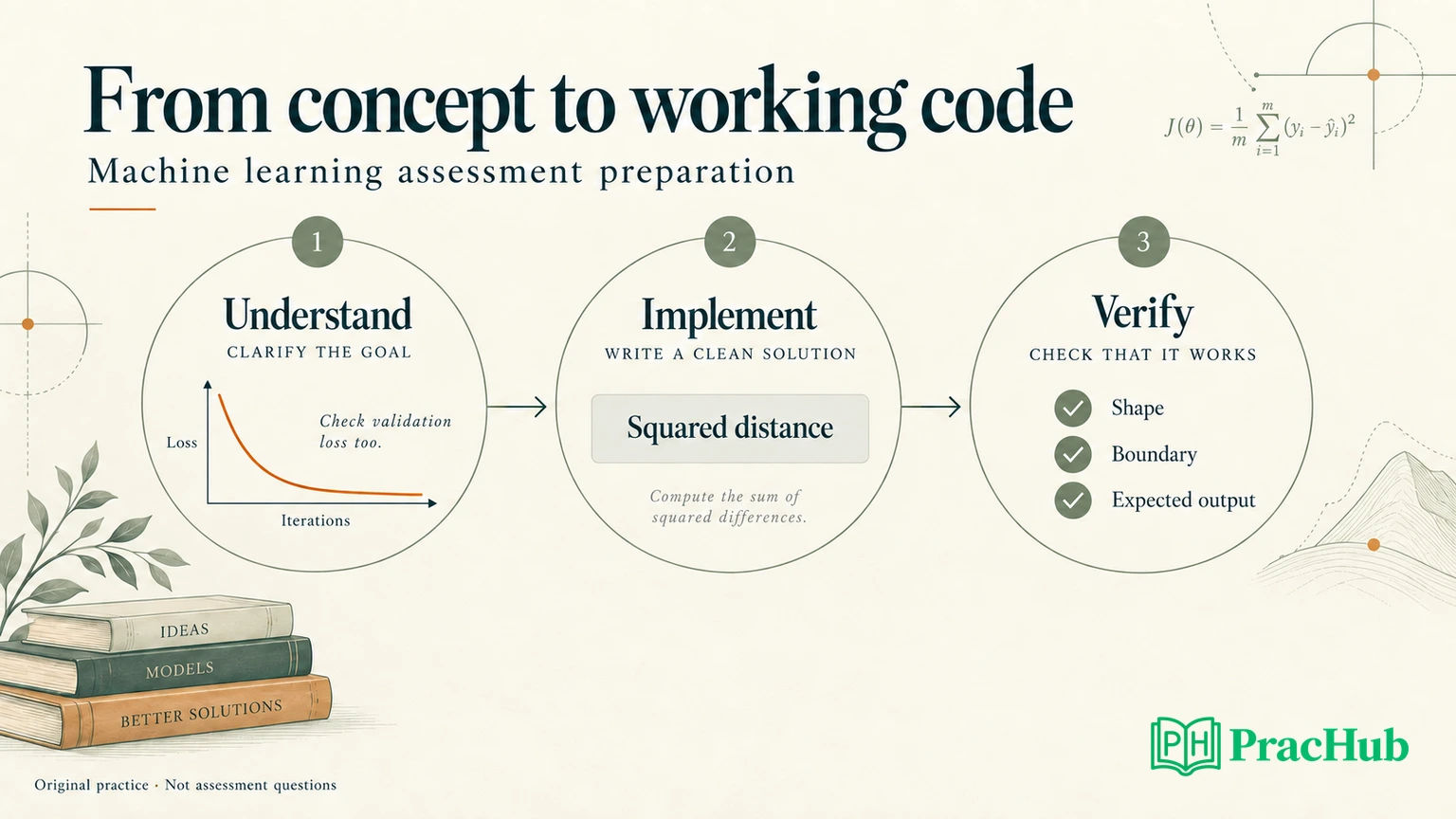
What the official ML Core framework covers
CodeSignal's published technical brief describes three modules: six scenario-based ML fundamentals questions, one basic data-manipulation coding question, and two ML algorithm-implementation coding questions. It specifies a 70-minute evaluation and a 200–600 score range for that framework. This is provider documentation, not a guaranteed format for every test hosted on CodeSignal. CodeSignal: ML Engineering Core framework
The implementation module covers common models, components or concepts. The brief gives examples such as clustering, matrix normalization and forward propagation; it excludes tasks that require prebuilt ML packages. Its public examples illustrate the framework rather than disclose your assigned questions.
The support page lists Python 2 and Python 3 for Machine Learning Core. Practise in Python 3, while checking your invitation and available editor environment. A provider-supported language list does not establish the exact packages or resources permitted in your session. CodeSignal: Supported environments
Preparation needs both algorithm knowledge and correct implementation. “Use nearest neighbors” is a concept-level answer. Correct distances, deterministic ordering, a tie rule and the required return shape are implementation-level responsibilities.
What candidate reports can and cannot tell you
In one public Reddit account, a candidate said they completed the non-ML coding task but struggled with the two ML implementations after relying on packages and AI-assisted workflows in their daily work. That is a personal report of preparation mismatch, not evidence that every candidate receives the same algorithms or that a particular score fails. The page's relative timestamp is inconsistent with search metadata, so we do not use it to infer a current trend. Candidate account
A separate PracHub report, labeled as a February 2026 Pinterest intern experience, describes a 70-minute CodeSignal assessment and hand-written ML tasks. It is a reported employer-specific experience, not independent confirmation of the exact current standardized assessment configuration. Reported Pinterest experience
These sources support a narrow preparation lesson: practise without delegating the core implementation. They do not justify a fixed list of “questions you will get.” Your invitation remains the source for deadlines, permitted assistance, proctoring and employer-specific instructions.
Diagnose three different preparation gaps
Before doing another large practice set, complete one small task in each column. This diagnostic is our recommendation, not CodeSignal's scoring rubric.
| Skill area | Evidence of understanding | Evidence of independent implementation |
|---|---|---|
| ML fundamentals | Explain why a lower training loss may coexist with worse validation performance. | Construct a small example or identify the missing assumption. |
| Data manipulation | Restate how rows, strings or arrays should change. | Produce the exact output without mutating inputs accidentally. |
| Model components | Explain normalization, distance or an update rule. | Translate the rule into loops, validate shapes and test boundaries. |
If you explain a formula correctly but return the wrong shape, practise coding contracts. If your code matches the formula but you chose the wrong formula, revisit the concept. If both are right but the answer is unstable on equal distances, practise specification details.
After each attempt, name the specific failure. “Bad at ML” is too broad to act on; “used column sums where the task required row norms” gives you a precise next exercise.
Exercise 1: normalize rows without changing the input
Original practice task: accept a rectangular matrix of finite numeric values and return a new matrix with each nonzero row divided by its Euclidean norm. Preserve an all-zero row as zeros. Return an empty list for an empty matrix, and reject ragged rows. These are the exercise's rules; another prompt may define different behavior.
For [[3, 4], [0, 0], [-5, 0]], expect [[0.6, 0.8], [0.0, 0.0], [-1.0, 0.0]]. The first norm is five. The third row preserves its sign. Zero handling prevents division by zero.
def normalize_rows(rows):
    if not rows:
        return []
    width = len(rows[0])
    if any(len(row) != width for row in rows):
        raise ValueError("ragged matrix")
    output = []
    for row in rows:
        norm = sum(value * value for value in row) ** 0.5
        output.append([
            value / norm if norm else 0.0
            for value in row
        ])
    return output
This compact implementation assumes ordinary finite values whose squared sums do not overflow. It is a teaching implementation, not a numerically hardened replacement for a scientific library. Explain that limitation if the input constraints permit very large magnitudes.
Row normalization is also different from feature standardization. The former scales each sample; standardization typically uses statistics calculated per feature. Scikit-learn's preprocessing documentation distinguishes these operations. We cite it for the technical distinction, not as permission to import the library during an assessment. Scikit-learn: Preprocessing
A useful follow-up is to normalize [6, 8] and compare it with [3, 4]: both become [0.6, 0.8]. That invariance tests the intended operation. Checking only the output dimensions would miss a column-normalization bug.
Exercise 2: choose the nearest prototype deterministically
Original practice task: given a point and a nonempty list of equal-width prototypes, return the index with the smallest squared Euclidean distance. Break ties by the lower index. Assume finite, moderate-sized values and reject mismatched dimensions.
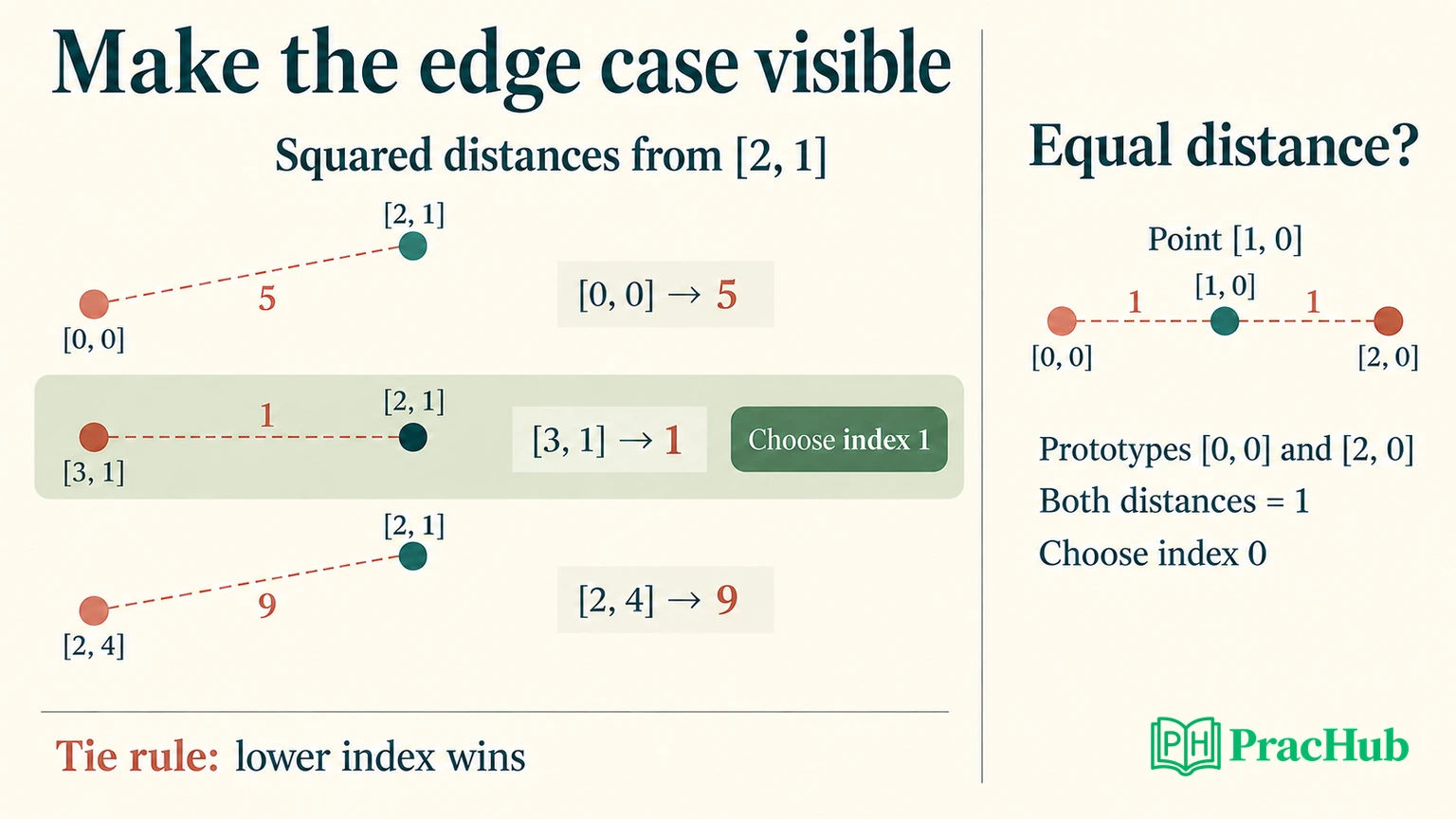
For point [2, 1] and prototypes [[0, 0], [3, 1], [2, 4]], squared distances are [5, 1, 9], so the result is index 1. For [1, 0] against [[0, 0], [2, 0]], both distances are one and the answer is index 0.
def nearest_prototype(point, prototypes):
    if not prototypes:
        raise ValueError("no prototypes")
    if any(len(p) != len(point) for p in prototypes):
        raise ValueError("dimension mismatch")
    best_index, best_distance = 0, float("inf")
    for index, prototype in enumerate(prototypes):
        distance = sum(
            (x - y) ** 2
            for x, y in zip(point, prototype)
        )
        if distance < best_distance:
            best_index, best_distance = index, distance
    return best_index
The strict comparison preserves the first index on a tie. Replacing < with <= changes the result even though most ordinary examples still pass. Checking widths before zip matters because zip otherwise stops at the shorter input and can hide malformed data.
The square root is unnecessary for ranking nonnegative distances because it preserves their order. For k prototypes and d features, this loop uses O(kd) arithmetic and constant auxiliary working space. It does not implement training, voting or an entire clustering algorithm; state that scope clearly.
Exercise 3: check one gradient before writing a trainer
Check one numerical example for sign and scaling mistakes before writing a training loop. Define the original toy loss as L(w) = (w*x - y)^2 / 2, with one scalar sample, no intercept and no regularization.
For x = 2, y = 3, and w = 1, prediction is two, error is minus one, loss is 0.5, and the derivative is (w*x - y)*x = -2. A learning rate of 0.1 updates the weight to 1.2; the new loss is 0.18.
Now make the learning rate 1.0. The weight becomes three and the new loss is 4.5. The correct gradient does not guarantee that every step size improves the objective. That small counterexample is more informative than memorizing “gradient descent reduces loss.”
We ran the two functions and these scalar calculations locally in Python, checking ordinary inputs, ties, empty inputs, mismatched shapes, zero rows and input preservation. The saved results validate these exercises only. They are not a claim that our code was tested against CodeSignal's private tests.
As an additional check, approximate the derivative with a small central difference: (L(w+h) - L(w-h)) / (2*h). It should be close to minus two here. Use an appropriate floating-point tolerance; exact equality is not a sensible general numerical test.
Explain fundamentals through a decision, not a definition
For overfitting, begin with the evidence: training performance improves while validation performance deteriorates under a valid split. Then distinguish model complexity from leakage, distribution mismatch and an unsuitable evaluation metric. The same symptom does not identify a single cause.
For preprocessing leakage, explain when information becomes available. Fitting a feature scaler on all data before splitting lets held-out data influence the transformation. Scikit-learn explicitly recommends learning preprocessing parameters from training data and applying the fitted transformation to held-out data. Scikit-learn: Common pitfalls
For a metric question, use numbers. In an original set of 100 cases with five positives, predicting negative for every case gives 95% accuracy and zero recall for the positive class. Whether that is acceptable depends on the decision and error costs; the accuracy alone cannot answer it.
For an implementation question, connect the concept to one invariant. A probability vector should satisfy the specified normalization. A distance is nonnegative. An update should use the intended batch's gradient. These checks do not prove an entire model is correct, but they help locate mistakes quickly.
How to rehearse and handle the actual invitation
Use the official duration as a rehearsal constraint only after confirming that your invite names this assessment. Our suggested rehearsal reserves a final review block, samples all task descriptions early, and changes focus when one unresolved task is consuming the remaining session. This is preparation advice, not a claim about task navigation or scoring features in every environment.
Rehearse with the tools your assessment permits. If the prompt requires a component from scratch, reproduce it with ordinary Python before practising a vectorized version. If a task supplies a function signature, keep its parameters and return contract. Extra printed diagnostics should not become the submitted answer format.
Before starting, verify the exact assessment title, completion window, session duration, language, libraries, external-resource policy and any required setup. Distinguish the deadline for starting or completing the invitation from the duration of the timed session. Ask the recruiter or provider support about a material contradiction before launching the test.
A score range is not a hiring cutoff. We found no evidence establishing a universal passing score for this assessment. Employer decisions and custom assessments cannot be inferred from one candidate's result.
Extend the practice with five focused questions
These PracHub records are related interview practice, not CodeSignal replicas. Some are broader than the core assessment; use the specified subskill rather than assuming every advanced follow-up belongs in your preparation priority list.
| PracHub question | Focus for this preparation |
|---|---|
| Implement K-Means and compare with GMM | Separate assignment, centroid updates and stopping conditions. |
| Implement linear and logistic regression | Check a prediction, loss and gradient before a full trainer. |
| List regularization methods and trade-offs | Explain a method's purpose and limitations; prioritize fundamentals. |
| Address Overfitting in Supervised Learning Models | Diagnose validation evidence and distinguish possible causes. |
| Explain metrics, regularization, and ablation studies | Connect metrics and model choices to the question being answered. |
Choose one Machine Learning Engineer practice question, implement its smallest meaningful component, and write an expected output before running it. Repeat until you can explain both the algorithm and the edge case that would break a careless implementation.
Sources and Further Reading
- CodeSignal: Machine Learning Engineering Core Skills Evaluation Framework
- CodeSignal: Languages and environments by certified assessment
- Reddit: An individual ML Core preparation-mismatch account
- PracHub: Reported Pinterest intern ML assessment experience
- Scikit-learn: Preprocessing data
- Scikit-learn: Common pitfalls and recommended practices
Comments (0)