CodeSignal OA Guide: Scoring, Question Types, and How Companies Read Your Report
Quick Overview
CodeSignal OA Guide: Scoring, Question Types, and How Companies Read Your Report now pairs its existing format and process guidance with a clearly sourced PracHub practice set. The added section shows each question's actual company, stored round, difficulty, prompt shape, and a timed workflow without claiming guaranteed assessment reuse.
You finish a CodeSignal online assessment, see a number between 200 and 600, and immediately ask the question every candidate asks:
Was that score good enough?
The uncomfortable answer is that the number is only one part of the decision. A company can use a cut score, but it may also review which questions you solved, how your code changed, how long you spent, whether your implementation was readable, and whether the session raised integrity concerns.
That is why preparing only to "get a high CodeSignal score" is too vague. You need to understand the assessment format, the four question types, and the evidence your report leaves behind.
Before memorizing another random problem list, practice real interview questions with written solutions and filter by your target company through company-specific interview prep. PracHub helps you train the coding patterns and company context that CodeSignal is trying to measure, then continue preparing for the interviews that come after the OA.
This guide explains the current CodeSignal General Coding Assessment, how scoring works, what employers can inspect, and how to build a practical preparation plan.
Quick Answer: What Is the CodeSignal OA?
A CodeSignal OA is an online assessment a company uses to evaluate technical candidates before or during its interview process.
The phrase can refer to two different things:
- A certified assessment, such as the General Coding Assessment, built and maintained by CodeSignal
- A custom assessment, configured by an individual employer with its own questions, duration, and scoring
The standardized General Coding Assessment, or GCA, currently contains 4 coding questions and normally gives candidates 70 minutes. All four questions are available when the timer starts, and you can answer them in any order.
The four GCA modules are:
- Basic Coding
- Data Manipulation
- Implementation Efficiency
- Problem Solving
Certified assessments use an Assessment Score from 200 to 600. A higher score generally means that more requirements and test cases were completed successfully.
Custom assessments can look very different. The company may choose another time limit, use different question formats, assign its own point values, and decide not to show the score to the candidate.
CodeSignal GCA Structure in 2026
CodeSignal's current candidate guide says the GCA has 4 questions of varying difficulty and a 70-minute time limit.
The company can configure a different duration, so always read the invitation page before starting. That page should show the number of questions, the time limit, and the rules for your specific assessment.
All Four Questions Are Available Immediately
You do not have to finish Question 1 before opening Question 2.
Once the timer begins, you can inspect every question and choose your order. This matters because Question 3 is implementation-heavy while Question 4 is more algorithmic. Depending on your strengths, one may be a better place to invest your remaining time.
The Assessment Must Be Completed in One Sitting
Once you start, the timer runs continuously.
There is no normal pause and resume option. Make sure to prepare your browser, charger, internet connection, water, and workspace before you click the final start button.
You Must Submit Your Work
Code that only exists in the editor is not enough. You have to use the submit button for every solution you want scored. CodeSignal states that the highest-scoring submission for a question is retained, even if a later submission performs worse or contains a syntax error.
That means frequent meaningful submissions are safer than waiting until the final minute.
The CodeSignal IDE Is Part of the Test
The GCA must be completed in CodeSignal's environment rather than an outside IDE.
You can choose an available programming language and change editor settings. Practice in the CodeSignal interface before the real attempt so that language selection, running tests, reading errors, and submitting code feel routine.
The Four CodeSignal Question Types
The GCA is not simply four LeetCode questions arranged from easy to hard.
Each question represents a different module in CodeSignal's General Coding Framework. The goal is to measure a range of implementation and problem-solving skills within this one assessment.
Question 1: Basic Coding
The first module focuses on basic operations with numbers, strings, and arrays.
CodeSignal's framework says candidates are typically expected to write approximately 5 to 10 lines of code and solve the task in about 10 minutes.
Common requirements include:
- Iterating through an array
- Applying conditions
- Performing basic arithmetic
- Splitting or modifying a string
- Combining two or three simple operations
This question usually should not require an advanced algorithm.
How to Approach Question 1
Aim for a clean first submission within 8 to 10 minutes.
Read every boundary condition, implement the direct solution, and test:
- Empty or minimum-size inputs
- The first and last array positions
- Negative numbers
- One-character strings
- Off-by-one behavior
A careless miss on Question 1 is expensive because it is designed to be the most accessible source of points.
Question 2: Data Manipulation
The second module tests whether you can translate multi-step requirements into correct transformations.
CodeSignal's framework describes solutions of roughly 10 to 20 lines and an average target time of about 15 minutes.
The task may involve:
- String comparison and transformation
- Array reversal or concatenation
- Digit manipulation
- Nested iteration
- Combining three to five basic operations
The difficulty often comes from specification detail, not from discovering a sophisticated algorithm.
How to Approach Question 2
Turn the prompt into a checklist before coding.
For example:
- Identify exactly what counts as a match.
- Write the smallest helper function that checks one candidate.
- Iterate over all valid positions.
- Test the first, middle, and final valid positions.
- Confirm behavior when there is no match.
Candidates lose points here when they understand the idea but miss one condition buried in the prompt.
Question 3: Implementation Efficiency
Question 3 is usually the most implementation-heavy module.
The official framework describes solutions of approximately 25 to 40 lines and an average target time near 20 minutes. It may require you to split requirements into subtasks, work with multidimensional arrays, use hash maps, or simulate a process efficiently.
It generally does not require specialized graph algorithms or advanced dynamic programming.
Why Question 3 Feels Hard
The algorithm may be straightforward, but the state and edge cases are not.
You may need to:
- Simulate movement through a grid
- Maintain several conditions at once
- Transform a matrix
- Implement a custom merge or comparator
- Break a long prompt into helper functions
This is where readable code becomes a performance tool. Clear names and small helpers reduce debugging time.
How to Approach Question 3
Write down the state transitions before implementing them.
Then test one tiny example manually. If the question involves a matrix or simulation, use a deliberately small input that lets you inspect every state.
Do not keep patching a confused monolithic function. A two-minute rewrite into helpers may save ten minutes of debugging.
Question 4: Problem Solving
Question 4 focuses on algorithmic problem solving.
CodeSignal's framework describes solutions around 25 to 35 lines with an average target time of about 30 minutes. Expected techniques can include hash maps, sets, greedy reasoning, divide and conquer, or two pointers.
Their framework specifically avoids requiring highly specialized algorithms such as Dijkstra, Kruskal, or FFT.
How to Approach Question 4
First identify the brute-force approach and its complexity.
Then ask the following questions:
- Can repeated work be stored in a hash map?
- Can sorting expose a useful order?
- Can two pointers replace a nested loop?
- Can a set answer membership questions quickly?
- Can the problem be reframed as counting complements?
Do not spend 25 minutes chasing a clever insight with no code submitted. A partially correct solution that passes meaningful tests can still improve your score.
How CodeSignal Scoring Works
For the certified GCA, CodeSignal reports an overall Assessment Score between 200 and 600.
A score of 400 does not mean you answered 40% correctly, and a score of 500 does not mean you received 500 points out of 600 in a simple linear grading system.
Test Cases Drive the Score
CodeSignal's General Coding Framework research paper states that questions are scored through unit tests.
Each solution earns credit based on the proportion of test cases it passes. Test cases are equally weighted within and across these 4 questions, and performance across all questions is aggregated into the Assessment Score.
The practical lesson is important:
Partial progress matters.
If you cannot finish a question, submit the strongest correct version you have. Passing a meaningful subset of tests can be better than leaving the problem blank while trying to perfect one difficult edge case.
Does Speed Affect Your CodeSignal Score?
CodeSignal's candidate-facing materials describe the assessment as evaluating correctness, speed, implementation, and problem solving.
Its technical framework adds a useful nuance: speed is not described as a separate arithmetic term in the score. Instead, it is captured indirectly because the assessment is timed. Faster candidates have more opportunities to pass additional tests across more questions.
In plain English, typing faster does not automatically add points. Using the 70 minutes effectively does.
What the Official Score Guide Suggests
CodeSignal publishes estimated GCA skill profiles for several score patterns:
- 200-279: No question is fully solved; the candidate may still demonstrate some basic coding ability.
- 296: Question 1 is fully solved, showing basic programming familiarity.
- 396: Questions 1 and 2 are fully solved, indicating solid implementation and data-manipulation skills.
- 496: Questions 1, 2, and 3 are fully solved, showing strong implementation and useful algorithmic ability.
- 500: Questions 1, 2, and 4 are fully solved, showing strong implementation plus problem-solving strength.
- 600: All four questions are fully solved.
These are estimated profiles, not universal pass lines. Partial test cases can produce many scores between these examples.
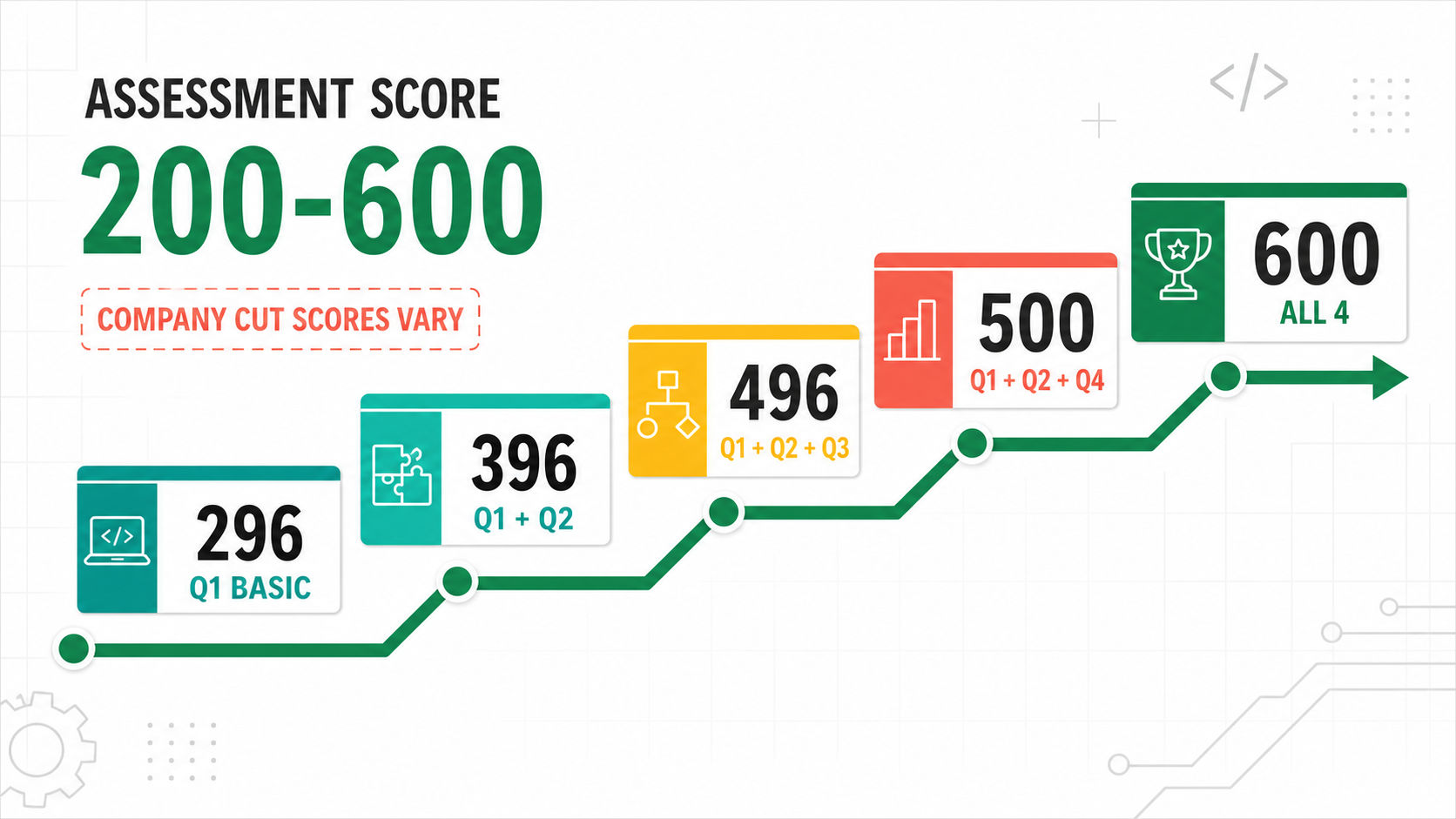
The score ladder shows example fully solved question combinations. Individual scores can vary with partial test-case credit, and every employer sets its own hiring threshold.
What Is a Good CodeSignal Score?
There is no universal passing score.
Each company can set a cut score based on the role, candidate pool, and where the assessment appears in the hiring funnel. CodeSignal's own guidance tells employers to define the minimum job-relevant skill level rather than blindly choosing the highest possible threshold.
A 396 demonstrates a different profile from a 500, but neither number guarantees a pass or rejection without the employer's context.
Avoid relying on anonymous posts that claim every company uses the same cutoff. The only authoritative source for your process is the hiring company.
How Companies Read Your CodeSignal Report
Candidates often imagine that a recruiter sees one score and a green or red result.
The employer-facing Coding Report can contain much more.
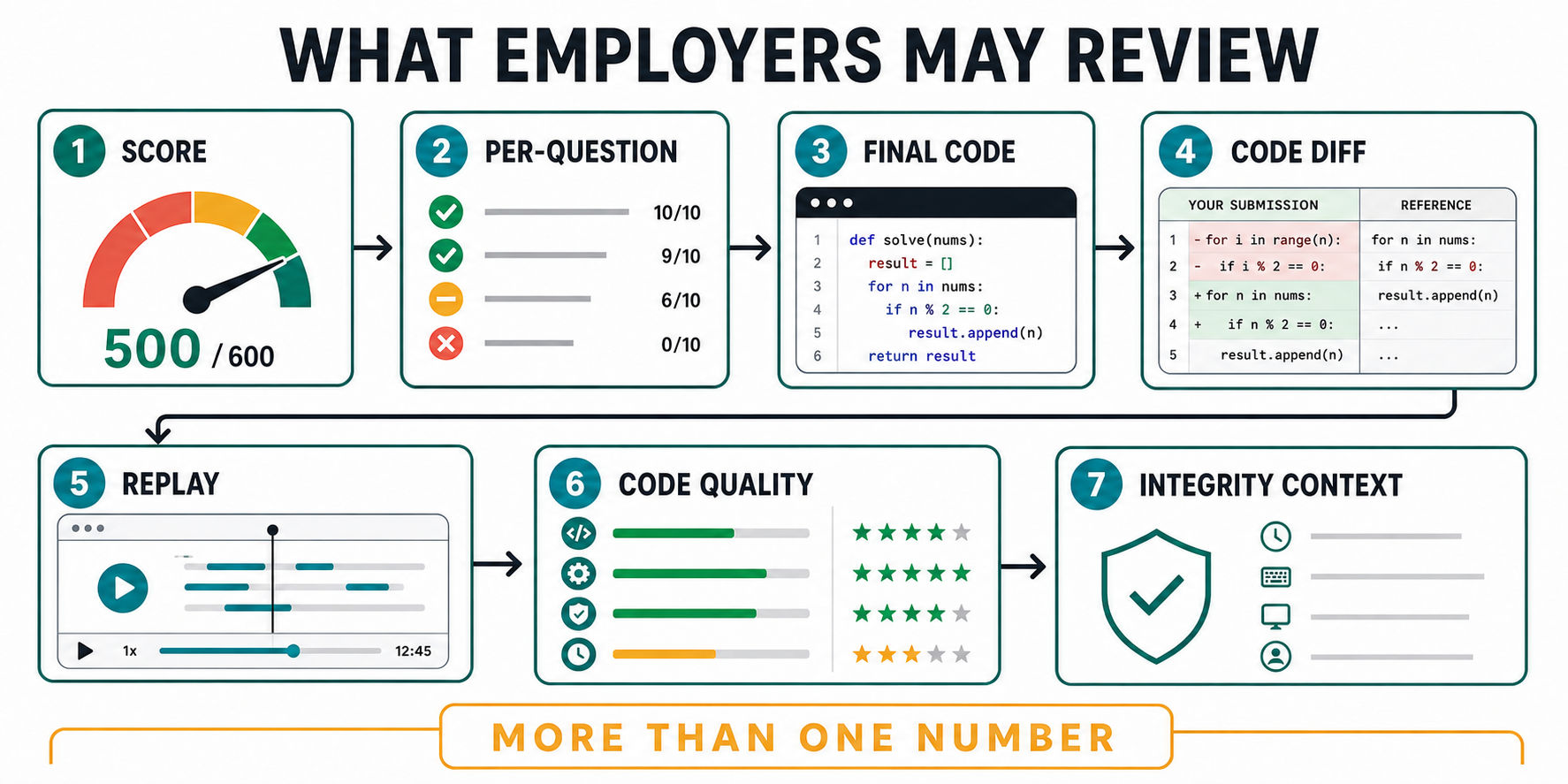
A hiring team may begin with the overall score, then inspect question-level evidence when it needs more context.
1. The Overall Assessment Score
The overall score is the fastest screening signal.
A company may compare it with a configured cut score and use that threshold to decide who moves forward. Recruiters can also see a candidate's assessment history; CodeSignal notes that the highest score may appear in the company dashboard even when it is not the most recent.
However, what a specific employer receives can depend on whether you shared an existing result or completed a new attempt for that invitation.
2. Per-Question Performance
The report shows the individual questions and the score for each one which reveals your skill pattern. Two candidates with similar overall scores may look different if one completed the implementation modules while the other showed stronger algorithmic problem solving.
For role-specific hiring, that pattern can matter.
3. Your Final Code and Code Changes
Employers can open a question and inspect the provided starter code, your final solution, and the changes you made.
This means a correct answer can still communicate:
- Clear or confusing variable names
- Thoughtful or improvised structure
- Effective use of helpers
- Duplicated logic
- Excessive complexity
- Testing discipline
You do not need to produce production-perfect architecture in a timed OA. You should still leave code another engineer can follow.
4. Coding Replay and Time Spent
The Coding Report can include a replay of your work.
Reviewers may inspect how you built the solution, where you paused, how often you changed direction, and when code was pasted. CodeSignal's employer documentation also says the report can show total time open for each question.
Most companies will not watch every second of every candidate. The capability exists, especially when a result needs closer review.
5. Code Quality Signals
CodeSignal provides directional code-quality insights.
Its documentation lists factors such as function naming, consistent abstraction levels, oversized monolithic functions, duplicated code, cyclomatic complexity, and cognitive complexity.
Treat this as another reason to write understandable code, not as a reason to over-engineer a 20-minute solution.
6. Skill-Area Proficiency
Certified assessment reports can show skill labels such as:
- Developing
- Intermediate
- Advanced
- Expert
CodeSignal explicitly describes these labels as directional. Its documentation says skill-area proficiency is not intended to make hiring decisions by itself.
The overall score and job-relevant evidence remain more important.
7. Integrity and Proctoring Context
For proctored assessments, companies may see verification status and integrity-related signals.
CodeSignal's Suspicion Score can flag behaviors that deserve review, including unusual paste activity or solution similarity. CodeSignal also warns employers that a flag does not prove cheating and should be interpreted in context.
Follow the rules displayed for your assessment. Do not assume advice from another candidate applies to your invitation, because companies can configure different policies.
Certified GCA vs Custom CodeSignal Assessment
This distinction changes almost everything.
Certified GCA
A standard GCA normally has:
- Four coding questions
- A 70-minute default duration
- The four published modules
- A 200-600 Assessment Score
- A reusable result when sharing requirements allow it
- Standardized scoring and proctoring workflows
Custom Assessment
A custom company assessment may have:
- A different number of questions
- A different duration
- Company-authored problems
- Progressive tasks
- Database, frontend, file-system, or role-specific formats
- Employer-assigned point values
- No score visible to the candidate
If your result page does not show a score, it may be because the assessment was custom and the employer chose not to share the result. CodeSignal recommends asking the hiring company directly.
Do not apply GCA score charts to a custom assessment.
A 70-Minute CodeSignal Time Strategy
The official average module times add up to more than the full assessment window: 10 minutes for Question 1, 15 for Question 2, 20 for Question 3, and 30 for Question 4.
That makes prioritization part of the test.
Minute 0-3: Scan All Four Questions
Read the input, output, and constraints for every task.
Decide whether Question 3 or Question 4 better matches your strengths. Do not begin the hardest-looking question just because it is next in numerical order.
Minute 3-13: Secure Question 1
Implement the direct solution.
Run the examples, test boundaries, and submit. If one hidden edge case fails, fix it quickly without turning the easiest question into a 20-minute project.
Minute 13-28: Complete Question 2
Convert the prompt into explicit rules.
Use a helper if it makes matching or transformation logic easier to verify. Submit once the core behavior works, then improve edge cases.
Minute 28-50: Attack Your Stronger Advanced Question
Choose Question 3 if you are strong at detailed implementation, matrices, and simulation.
Choose Question 4 if you recognize the algorithmic pattern quickly. The goal is not to follow one universal order; it is to maximize correct test cases.
Minute 50-65: Collect Partial Credit on the Remaining Question
Implement the brute-force or limited version if it can pass valid smaller cases.
Do not leave runnable progress sitting unsubmitted.
Minute 65-70: Final Submission Audit
Check that:
- Every intended solution was submitted
- Debug output was removed
- Function names and signatures were not changed incorrectly
- Obvious overflow or empty-input cases were considered
- No unsaved work remains in another question
How to Prepare for a CodeSignal OA
Random hard problems are not the most efficient starting point.
Train the four modules separately, then combine them under one timer.
Step 1: Choose One Language
Use the language in which you can write arrays, strings, maps, sets, sorting, and helper functions without searching for basic syntax.
Changing languages during preparation creates unnecessary friction.
Step 2: Build Implementation Accuracy
Practice short prompts with detailed requirements.
For every solution:
- Restate the rules.
- Identify boundaries.
- Implement the direct version.
- Run at least three custom tests.
- Review the written solution.
PracHub's real interview question bank is useful here because you can attempt a problem first and then compare your approach with a written solution.
Step 3: Practice the Core Patterns
Prioritize:
- Arrays and strings
- Hash maps and sets
- Matrix traversal
- Sorting
- Two pointers
- Counting and frequency maps
- Greedy reasoning
- Simulation
The GCA framework is not designed around obscure advanced algorithms. Consistent implementation beats collecting rare tricks.
Step 4: Run Full 70-Minute Mocks
A four-question mock exposes problems that isolated practice hides:
- Spending too long on an easy task
- Refusing to switch questions
- Forgetting to submit
- Debugging without a hypothesis
- Losing accuracy under the final timer
Track test cases passed, time per question, and the reason each miss occurred.
Step 5: Prepare Beyond the OA
Passing CodeSignal is usually the beginning, not the offer.
After coding practice, add system design questions if the target role is mid-level or senior, and use behavioral and leadership interview practice for the later interview loop.
The best preparation plan connects the OA to the company process that follows it.
CodeSignal Mistakes That Lower Otherwise Strong Scores
Treating the Score Like a Percentage
The 200-600 scale is not a school exam percentage.
Use the official score profiles to understand broad patterns, not to calculate a fake percent correct.
Perfecting One Question While Leaving Others Blank
Because test cases across questions contribute to the score, broader correct progress can be valuable.
Submit working partial solutions and move when the expected value of more debugging becomes low.
Ignoring the Specification
Questions 2 and 3 often punish missed details more than weak algorithm knowledge.
Create a checklist from the prompt and test each rule.
Waiting to Submit
Your highest-scoring submitted version is retained.
Submit after meaningful milestones so a browser problem, timeout, or late syntax error does not erase good work.
Using Unapproved Help
CodeSignal rules can vary by assessment.
For the standard GCA, current guidance allows limited syntax-reference searches but prohibits outside help with solution logic and prohibits AI use. Follow the exact rules shown on your screen.
Preparing Only for the OA
A high screening score does not prepare you for system design, behavioral follow-ups, or company-specific interview questions.
Use the OA as one stage in a complete interview plan.
Practice with real questions from PracHub
A platform or process article cannot honestly attribute one company's question to every employer that uses the format. This set therefore uses real cross-company PracHub questions to rehearse common OA patterns. Each row shows its actual company and stored round; none is claimed to be supplied by this platform.
| Question | Evidence | Difficulty | Main pattern |
|---|---|---|---|
| Q1: Implement Interview Coding Problems | Amazon · Technical Screen | Easy | Intervals |
| Q2: Solve Wonderful Strings and Grid Queries | Uber · Technical Screen | Hard | Sliding window |
| Q3: Find Largest Adjacent Stock Price Change | Instacart · Technical Screen | Medium | Strings |
| Q4: Implement Task Management and Duplicate Detection | Anthropic · Technical Screen | Medium | Graphs |
What the prompts actually ask
Q1. Implement Interview Coding Problems
Bank evidence: Amazon, Technical Screen, Easy. Solve the following independent coding tasks from a new-grad software engineering interview. 1. Implement a hash map from scratch. - Support integer keys and integer values. - Implement put(key, value), get(key), and remove(key).
Q2. Solve Wonderful Strings and Grid Queries
Bank evidence: Uber, Technical Screen, Hard. Two algorithmic tasks were reported. Task 1: Minimum-cost wonderful string A string is considered wonderful if, among the letters 'a' through 'j', at most one letter appears an odd number of times. You are given: - A string s of length n containing only letters from 'a' to 'j'.
Q3. Find Largest Adjacent Stock Price Change
Bank evidence: Instacart, Technical Screen, Medium. You are given an unsorted list of stock price records. Each record has two fields: - date: a date string in YYYY-MM-DD format - price: an integer stock price Sort the records by date in ascending order. Then find the adjacent pair of dates with the largest absolute price change.
Q4. Implement Task Management and Duplicate Detection
Bank evidence: Anthropic, Technical Screen, Medium. You are given two independent coding tasks from a software engineering interview. Task 1: Build an in-memory task management system Implement an in-memory task management service. The interviewer will reveal requirements in levels; design your code so later levels can be added cleanly.
Run the set like an assessment
- Read all four prompts first. Give each a difficulty estimate and choose an order before coding.
- Hide the solution. Write the invariant, complexity target, and three edge cases before opening the editor.
- Use one timer. Preserve five minutes at the end for boundary, tie, scale, and output-format tests.
- Log the failure mode. Record the broken invariant or missed edge case, not merely the question title.
FAQ
Is 400 a Good CodeSignal Score?
There is no universal passing score. CodeSignal's published guide uses 396 as an example of fully solving Questions 1 and 2, which signals solid implementation ability. Whether that advances depends on the employer's role-specific cut score, candidate pool, and review process.
Is 500 a Good CodeSignal Score?
CodeSignal's official guide associates a score around 500 with fully solving Questions 1, 2, and 4, a strong combination of implementation and problem-solving skills. It is a strong result, but no public score guarantees advancement at every company.
Do You Get Partial Credit on CodeSignal?
Yes, for GCA questions scored through unit tests. The score reflects the proportion of test cases passed across the assessment. Submit a correct partial solution rather than leaving a difficult question blank, because passed tests can still contribute to the overall result.
Does CodeSignal Score Speed?
Speed matters primarily through the time limit. CodeSignal's technical framework says speed is not an explicit arithmetic component of the GCA score, but efficient candidates can pass more test cases during the 70-minute window. Candidate-facing materials also use speed as part of the broader performance description.
Can Companies See My CodeSignal Code?
Yes. Employer documentation says reviewers can view the final solution, compare it with starter code, inspect changes, and open a coding replay. Reports may also include per-question scores, time information, code-quality insights, skill-area labels, and integrity context.
Why Can I Not See My CodeSignal Score?
Certified assessment results normally appear in the Assessments section of your CodeSignal profile. Custom assessments may not show a candidate score because the hiring company controls whether results are shared. Contact the employer if you need clarification about a custom assessment.
Can I Retake the CodeSignal GCA?
Retakes are subject to CodeSignal cooldown rules and require a new invitation. Current CodeSignal guidance allows up to two GCA attempts in 30 days and three attempts in 180 days. During a cooldown, you may need to share an eligible previous result instead.
Can I Use Google or AI During CodeSignal?
Use only what the rules for your assessment permit. Current GCA guidance allows limited searches for language syntax references but not searches that provide solution logic. It also states that AI assistance is not allowed, including for syntax searches.
Final Takeaway
A CodeSignal OA is not just four coding questions and one mysterious score.
The standard GCA measures four different skill areas under a 70-minute constraint. Test cases drive the 200-600 Assessment Score, while the employer report can provide deeper evidence about per-question performance, final code, working process, code quality, and session integrity.
Your best strategy is therefore simple:
- Secure the accessible implementation points.
- Choose between the advanced questions based on your strengths.
- Submit working progress early.
- Leave readable code.
- Prepare for the interview stages after the OA.
Start with PracHub's real interview questions and written solutions, select your target company, and run a timed set that combines short implementation, data manipulation, and algorithmic problem solving. You will learn more from one measured 70-minute simulation than from another night of random problem grinding.
Sources and Further Reading
- CodeSignal: What to Expect in the General Coding Assessment
- CodeSignal General Coding Framework Technical Research Paper
- CodeSignal: Understanding the GCA Assessment Score
- CodeSignal: Guide to Setting Cut Scores
- CodeSignal: Accessing a Test-Taker's Assessment Result
- CodeSignal: GCA Rules and Setup
- CodeSignal: Cooldown Periods and Retakes
Comments (0)