Data Analyst Interview Review: SQL Practice, Open Learning Hubs, and Mock Options
Quick Overview
Review Data Analyst Interview’s working SQL hub, observed NULL results, open learning and currently inactive human-mock booking and checkout features. Dated public observations and original exercises distinguish official descriptions, tested behavior and unverified capabilities.
Data Analyst Interview, at dataanalystinterview.com, provides open learning hubs and a working browser SQL workspace. We executed two small NULL-related queries there and received different, meaningful results. Its human mock service had a different availability state: booking and checkout were marked inactive, with Coming Soon messaging. Use the learning tools now; do not treat the planned mock packages as currently bookable.
Start with PracHub’s SQL count-and-NULL question and predict the answer before executing it. A compiler can show what your query returns, while you still need to decide whether those rows answer the business question.
Checked November 3, 2026: this review concerns the exact website, rather than the generic phrase “data analyst interview.” Official descriptions, native browser results and independent local examples are separated below. No mock was booked or completed, and no paid feedback was reviewed. PracHub publishes interview-preparation content and is the publisher of this review.
What is usable in the open learning hubs
The site links SQL, Python and interview-practice material. Its about page describes an advertising-supported learning model and identifies its founder. Those descriptions explain how the site presents its educational offering; they do not establish the accuracy of every lesson or independent hiring outcomes.
The SQL hub offered a browser SQLite environment with four synthetic tables, an editable query area and a Run Query control. The page included examples involving joins, common table expressions and window functions. It described reloading as a way to reset the environment.
The workspace lets you test a small claim immediately. You do not have to assume that a worked answer is correct simply because it is published. A small independent query can reveal the behavior of an operator before you use it in a larger metric.
We did not audit every table, lesson or reset path. The results below refer to the exact statements we entered in the public workspace. They establish execution, not a graded certification of our answers or the complete learning hub.
A public NULL probe that produced an empty result
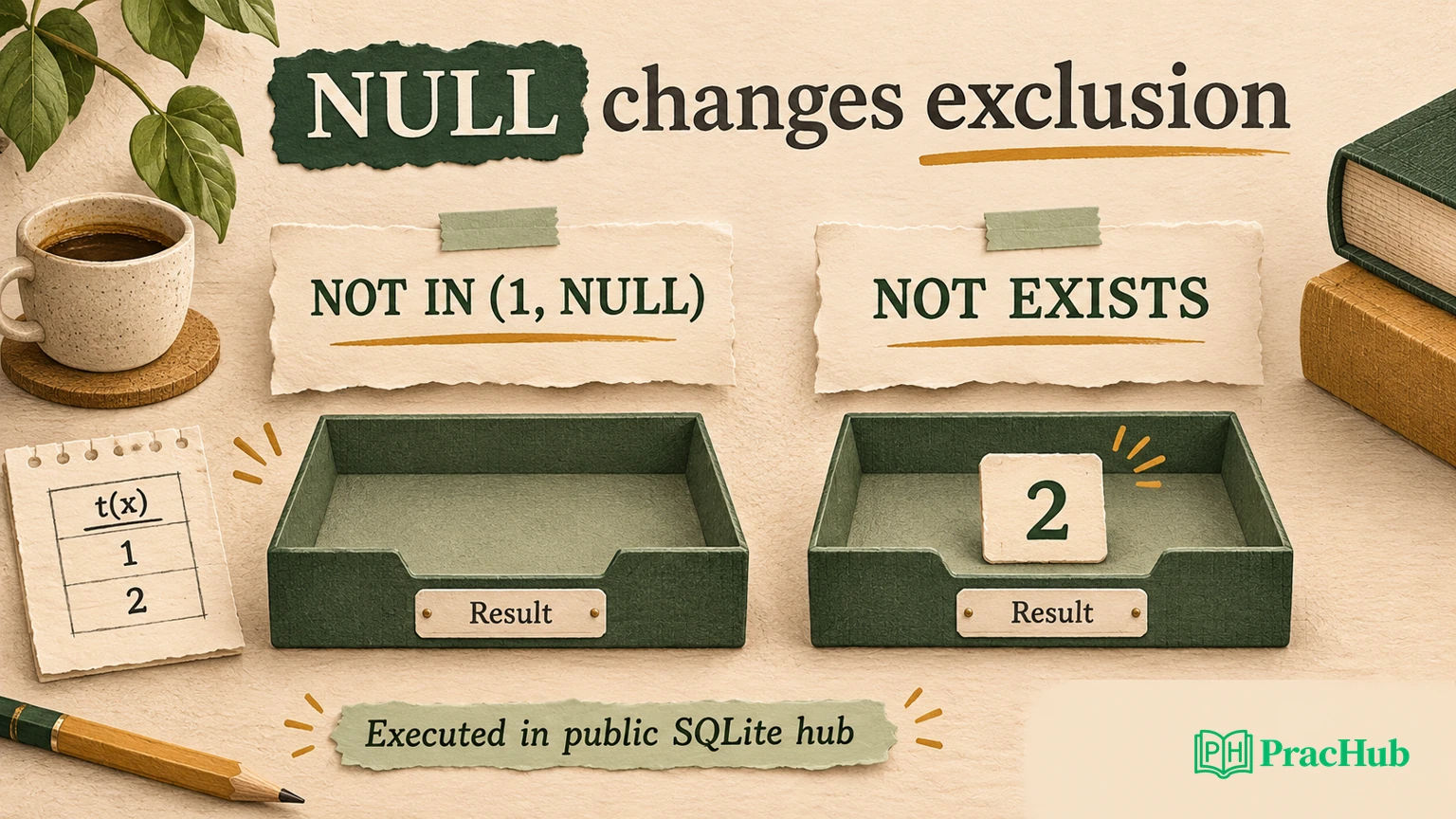
Our first query asked whether the known value 2 was absent from a list containing 1 and NULL:
SELECT 2 AS candidate
WHERE 2 NOT IN (1, NULL);
The site reported successful execution with no rows returned. The statement was syntactically valid, so an execution-success message did not mean it selected the candidate we might casually expect.
The result exposes a common interview mistake: treating an unknown comparison as false and then assuming its negation must be true. SQL’s missing-value logic requires more care. The filter did not establish that 2 was definitely absent from every possible value represented by the list.
We then ran an explicitly correlated existence check:
WITH banned(id) AS (VALUES (1), (NULL))
SELECT 2 AS candidate
WHERE NOT EXISTS (
  SELECT 1
  FROM banned
  WHERE banned.id = 2
);
This returned one row, with candidate 2. No row in the inner query satisfied equality with 2, so the existence condition had a different result from the earlier NOT IN expression.
Both outputs were observed in the native public workspace. We also reproduced them independently in local SQLite. Neither statement was a site-assigned challenge, and the interface did not issue an accepted-answer verdict. These were our own diagnostic probes.
Decide the missing-value policy before replacing an operator
Decide what the data means before replacing one exclusion expression with another. Is a missing identifier invalid input, an unknown entity or a record that should be excluded from a particular analysis?
For the toy exclusion example, we wanted to retain a known candidate with no matching known banned identifier. That contract made the correlated existence formulation useful. Another business rule could require an exception whenever the exclusion list contains unresolved data. A query that silently proceeds would then be incomplete.
| Data condition | Question to clarify | Possible analysis consequence |
|---|---|---|
| Missing identifier in exclusion data | Is the row valid enough to apply? | Quarantine or a declared known-match policy |
| Missing candidate identifier | Can the entity be identified? | Exclude, flag or report separately |
| No exclusion rows | Does absence mean eligible? | Usually a different state from unknown data |
| Repeated known identifier | Does multiplicity matter? | Existence and event counting need different contracts |
State that policy beside the query. Otherwise, two analysts can produce different numbers while each believes they used the “correct” SQL pattern. The disagreement may concern the business definition rather than syntax.
Counting rows, events and known values gives different answers
Our second independent example concerns counting after a left join. It is a local teaching fixture, not a task executed in the website’s runner.
Assume three users. User 1 has two event records with known page names. User 2 has one event with a missing page name. User 3 has no event. After a left join from users to events, compare three counts grouped by user.
| User | COUNT(*) | COUNT(event_id) | COUNT(page_name) |
|---|---|---|---|
| 1 | 2 | 2 | 2 |
| 2 | 1 | 1 | 0 |
| 3 | 1 | 0 | 0 |
The counts answer different questions. The left join preserves a row for user 3, so counting joined rows does not measure actual events. Counting event identifiers distinguishes user 2’s recorded event from user 3’s missing event. Counting page names measures only events with a known page field.
If the business asks for active users, you also need an activity definition. Is any recorded event enough, or must it have a valid page and event type? Do not choose a count simply because it produces the expected-looking total on a clean sample.
This is the kind of counterexample that makes an open compiler useful. Add one missing field and one absent relationship, predict the rows, then run the query. A successful execution message becomes evidence you can interpret rather than a substitute for interpretation.
Worked lessons and an answer checker have different jobs
The site’s SQL and Python material can help you learn syntax and compare approaches. In our observed SQL attempt, the runner displayed results and execution status. We did not establish that it knew the intended answer to our arbitrary queries.
A worked solution provides an explanation you can challenge. A judge compares an attempt with a declared task contract. A compiler executes a program. A human reviewer can ask why the chosen metric supports a recommendation. Those functions can complement each other, but none should be inferred from the mere presence of another.
For practice, keep a tiny expected-result table beside your SQL. Change one meaningful condition after the first run. If the explanation says a join preserves all users, add a user with no events. If it says a ranking handles ties, add equal values at the cutoff.
Then explain what would invalidate the conclusion. A query can be mechanically correct while its source population changed, an event stopped logging or the metric definition shifted. An analyst interview often tests whether you notice those boundaries before making a business recommendation.
The human mock service was not currently active
The about material discussed human mock interviews, but the current service page explicitly displayed Coming Soon and said booking and checkout were inactive. We use that current service state for availability rather than treating an older or broader description as proof that a session can be purchased today.
The page showed planned packages and custom-round pricing. We did not quote those as live purchasable offers, test a payment flow or book a time. It also said mock delivery and feedback would be in English even if a reader used translated website content.

| Need | Current evidence | Sensible next action |
|---|---|---|
| Test a small SQL claim | Public runner executed our queries | Use an independently calculated result |
| Read SQL or Python material | Public learning entrances available | Challenge one explanation with a new input |
| Obtain human interview feedback | Service page says Coming Soon | Seek an actually available session elsewhere |
| Buy a planned mock package | Checkout marked inactive | Recheck availability before making plans |
| Use a translated page | Website content may be translated | Do not infer mock delivery language from it |
This is a service-availability finding, not a review of interviewer quality. We did not meet an interviewer, receive a debrief or evaluate scheduling reliability.
When self-study is enough and when feedback adds value
Self-study works well when you can construct an oracle. The two NULL probes have exact small outputs. The count fixture can be drawn as four joined rows. If your result differs, you can investigate without needing someone to assign a score.
Feedback becomes more useful when the difficulty is framing or communication. Suppose your SQL is correct but you recommend launching a feature from a selected sample without discussing who is missing. A reviewer can challenge the causal or business inference that the query alone cannot validate.
A mock can also expose an explanation gap. You may know why user 3 has no event but struggle to explain why COUNT(*) still returns one. Practice saying what the join preserved before naming the aggregate. The order of the explanation helps a listener follow the mechanism.
Since this site’s human service was not active, evaluate any alternative by the feedback you need. Ask for a changed requirement, a challenge to the denominator or a review of the recommendation. A generic confidence score would not directly address those weaknesses.
Build one analysis packet instead of collecting more answers
Choose one business question, such as which users had a known page interaction in a period. Define the eligible population, time boundaries and treatment of missing identifiers. Include the three-user fixture and exact expected rows.
Write the query, run it and retain the output. Then explain a tempting alternative and why it changes the meaning. In our fixture, counting all left-joined rows makes an inactive user appear to have a row of activity. That is a concrete defect you can demonstrate.
Finish with a recommendation proportional to the evidence. The fixture checks the query’s logic on selected cases; it does not establish real user behavior or a product effect. State what production data-quality and population checks would be needed before using the metric in a decision.
The open hub can support this loop by reducing setup friction. Its value depends on the questions and checks you bring to the workspace. A page of correct-looking outputs becomes preparation evidence when you can explain which assumption each case tested.
Five PracHub questions for a fresh analysis
These verified prompts extend count, time-window and business-metric reasoning. They are independent of this website and do not imply that its compiler grades them.
| PracHub question | Focused follow-up |
|---|---|
| Compare SQL counts, windows, and NULL semantics | Predict preserved rows and choose the count that matches the requirement. |
| Estimate Page-Visit Duration from the Next User Event | Define which next event ends a visit and how missing successors behave. |
| Compute Ride Metrics in SQL | State the ride metric denominator before aggregating. |
| Write SQL for multi-account metrics | Keep account and user grains separate across the query. |
| Write SQL to analyze group-call concurrency | Show how event overlap and time boundaries affect concurrency counts. |
Data Analyst Interview’s open SQL hub demonstrated a useful execution loop in our visit. Its planned human mocks remained unavailable. Finish with the SQL count-and-NULL prompt, predict the preserved rows and choose the aggregate that matches the question. Seek spoken feedback when the remaining gap is explaining or defending the analysis.
Comments (0)