DevOpsInterviewPrep Review: Worked Questions, Troubleshooting Reasoning, and Access Limits
Quick Overview
Review DevOpsInterviewPrep’s public pipeline answer, release lesson and three access layers. Includes independent artifact hashes and a ledger separating observations, supported claims and open questions.
DevOpsInterviewPrep is worth inspecting if you want worked explanations and follow-ups rather than a short list of DevOps definitions. The sampled pipeline answer and public release lesson connect decisions to evidence. Turn the reading into an explanation you can demonstrate: use the material to build an explanation you can check, and inspect the access requirement of each page before planning around it.
PracHub publishes this review and owns the complementary practice links. Our container-image flow question offers another setting for explaining what moves through a pipeline. The hashed-byte receipt and decision ledger below are independent extensions of the sampled release lesson, not DevOpsInterviewPrep exercise results or a real deployment.
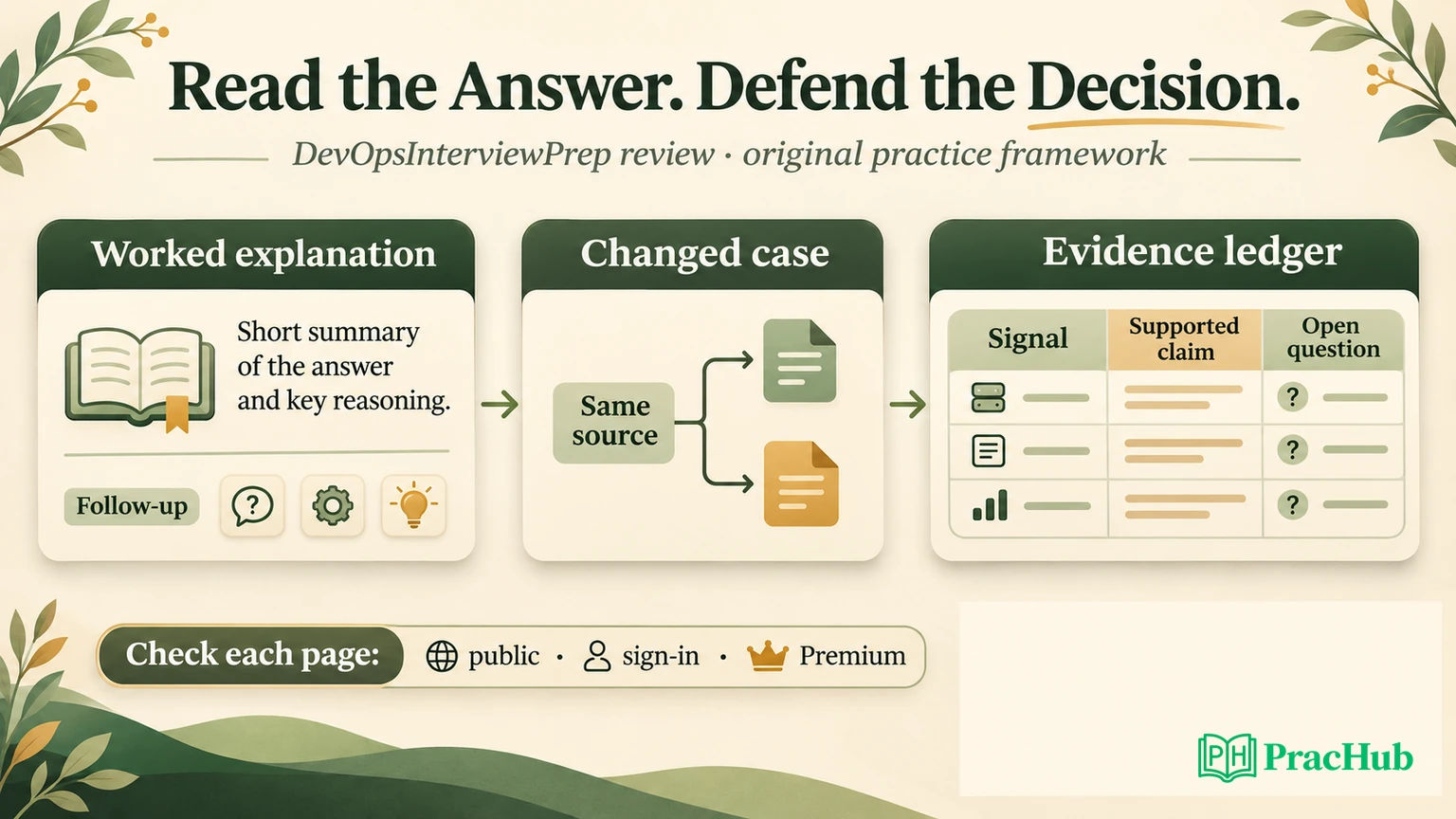
What the sampled worked answer contains
Direct observation, November 3, 2026: the public pipeline answer was readable without signing in. It included a short summary, an approach, a longer explanation, follow-up questions and common mistakes. We also saw manual review and progress controls; we did not use them or test a mastery estimate.
The answer connects pipeline stages to outputs, failure conditions and timing. Use the failure conditions and timing to explain what the build, test and deploy stages actually decide. Its particular targets and example choices still need the context of the system you are discussing.
Company tags appeared beside the question. We did not independently verify employer provenance, candidate reports or the provider’s broader hiring-loop research. Treat those associations as provider labels, not proof that a particular company currently asks the question or accepts the displayed answer.
Our assessment: the format is useful when you want to inspect why an answer works and then challenge one assumption. It does not establish that you can operate the corresponding system, and we did not observe an independent assessment of our own explanation.
The public course lesson makes the evidence subject explicit
We read the artifact-promotion lesson. It describes a fictional release review and distinguishes source identity, artifact identity, configuration and validation. Its table and worked reasoning were public. We did not complete an assignment, submit a release approval or run a course environment.
The lesson makes each piece of evidence answer for a specific subject. A report about one artifact should not silently become a claim about another. Matching application bytes also does not establish that a changed environment will behave identically.
Ask what a green pipeline result actually establishes for this release. Which subject did the check validate? Which conditions changed afterward? What additional evidence does the release decision require? Preserve those questions when extending the lesson into your own project explanation.
The SLSA build-provenance specification provides a primary reference for recording build definitions and execution details. Provenance and validation answer related but different questions. Recording where an artifact came from does not independently establish that it satisfies every application requirement.
Original fixture: one source label, two byte strings
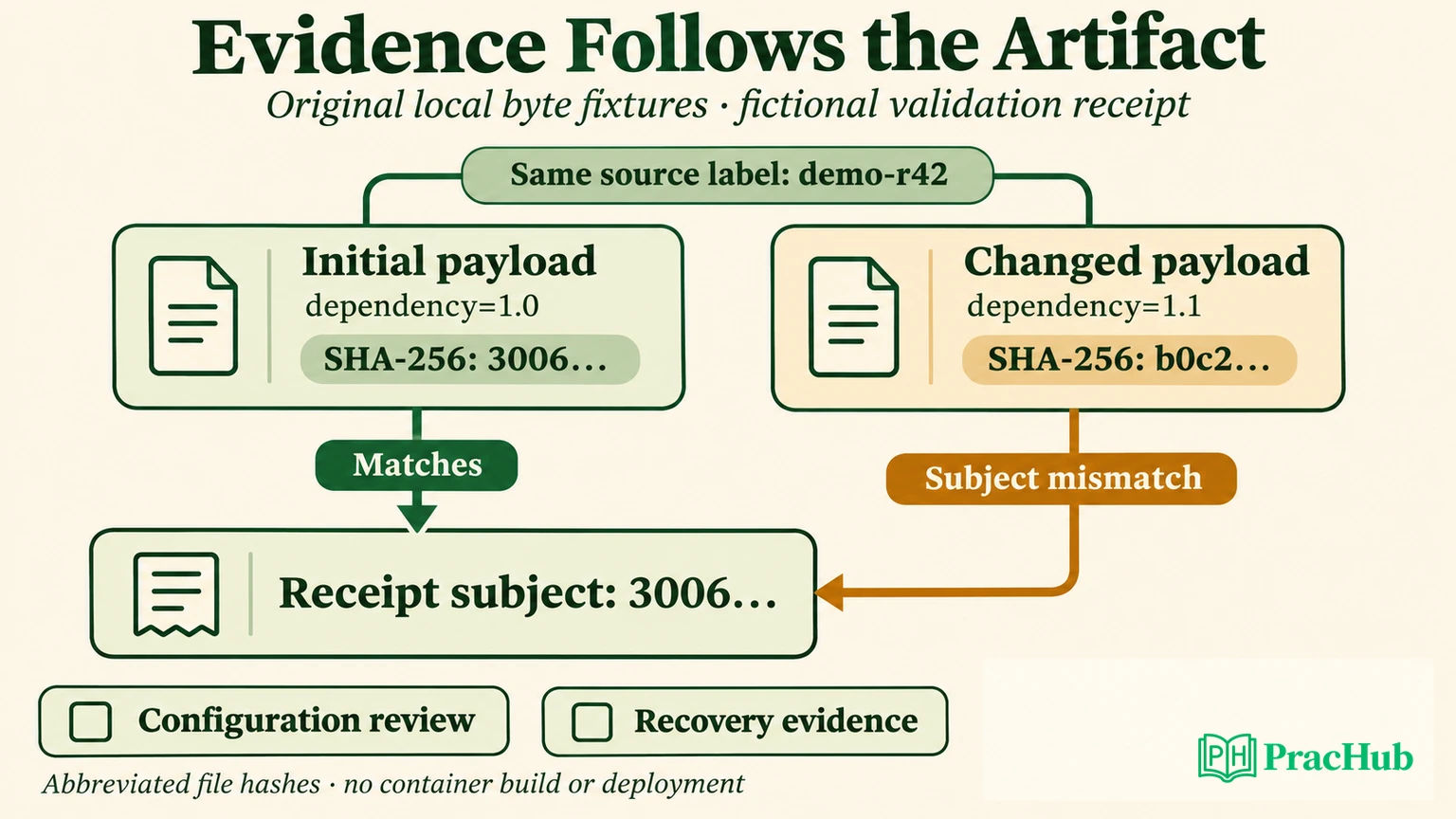
We extended the lesson with two small local payloads. Both carry the same invented source label, demo-r42. The first text contains a dependency value of 1.0; the second contains 1.1. They are plain byte strings, not container images or the output of a real build pipeline.
We computed SHA-256 for each payload and created a fictional receipt whose subject is the first hash. That receipt is input data for the exercise: no application acceptance test was run. The local checks examine whether a proposed artifact matches the receipt’s subject.
| Independent fixture | Source label | SHA-256 prefix | Receipt relationship |
|---|---|---|---|
| Initial payload | demo-r42 | 3006db88f6a3… | Matches the fictional receipt |
| Changed payload | demo-r42 | b0c2a6951ebf… | Does not match the receipt |
The hashes shown here are abbreviated for reading. They are not image references to paste into a deployment. The complete local result preserves both full hashes and the fixture definitions.
The checks confirmed that the two payloads differ and that copying the initial bytes preserves their hash. They also checked four review outcomes: a subject mismatch, missing configuration review, missing recovery evidence and the presence of the declared inputs needed for a further scoped review.
Passing those relationship checks does not approve a production release. It does not verify a signature, authenticate a builder, execute the application or establish the truth of the fictional receipt. Compare the proposed subject with the identity named by its evidence before relying on a shared source label.
For real container images, the Docker digest documentation distinguishes content-based digests from tags that may be reused or changed. Apply the actual registry and verification rules rather than treating our plain-text hash fixture as an image-validation implementation.
The same lesson applies to a familiar interview claim: “We deployed the commit that passed tests.” Ask whether the deployment used the tested artifact or rebuilt it under different inputs. Then explain what evidence links the proposed artifact to its checks. Do not infer the link from the label alone.
Keep the signal and the hypothesis in different columns
Here is an original decision ledger for discussing a release whose evidence appears to conflict. It extends the sampled lesson; it is not a transcript of a production incident or the site’s answer key.
| Observed signal in an invented review | Supported conclusion | Hypothesis or decision still needing evidence |
|---|---|---|
| Source labels match, payload hashes differ | The compared payloads are different | Which build input or process produced the difference |
| A green report names the initial hash | The report’s declared subject is that artifact | Whether another artifact satisfies the same checks |
| The artifact matches, configuration changed | The byte identity transfers; environment assumptions changed | Whether the changed behavior was exercised |
| A rollback artifact is available | A previous artifact can be identified | Whether data and state remain compatible with recovery |
Keep the supported conclusion separate from the unresolved cause. You can identify a subject mismatch before knowing why the second payload changed. You can request a configuration check without asserting that the configuration caused a failure.
A follow-up can change one assumption. Suppose the proposed artifact now matches the receipt, but the configuration points to a new dependency. The artifact-identity question is resolved; dependency identity and behavior remain open. Repeating the hash comparison does not answer the new question. Record when each check ran, which environment it covered and what changed afterward. A successful check from before a migration may not support a later release decision even when the application bytes remain the same.
Another follow-up removes the rollback option. An old binary may still exist while a state change makes reverting it unsafe or ineffective. Explain the recovery condition rather than using the word “rollback” as a guarantee. If you have not rehearsed recovery, describe it as a plan needing verification.
For a personal project answer, replace every invented field with a fact you can support. Name the change you owned, the evidence you collected and what remained outside your responsibility. Do not turn a guided tabletop exercise into commercial incident experience.
The free and paid boundaries have three layers
The CI/CD category displayed 53 questions, with 18 unlocked for an unsigned reader. It advertised ten more after free sign-in and labeled 25 as Premium. We expanded question 29 and saw an access prompt rather than its full answer. We did not create an account or test an entitlement grant.
The homepage advertised 617 worked questions across 12 topics. Those are provider counts, not a unique-item audit we performed. Do not assume that a visible question title means its complete answer is open, or that a public lesson establishes access to every course page.
| Access surface | What we could inspect | What remains unverified |
|---|---|---|
| Anonymous reading | Sampled full pipeline answer and release lesson | Every item described as public |
| Free account | Advertised additional answers and progress features | Actual grant, persistence and mastery calculation |
| Premium | Advertised full curriculum and guide access | Paid answer quality, downloads and purchase activation |
Use the category’s access labels to choose a narrow trial. Read a complete answer and one relevant lesson, then attempt a changed case with the material closed. That tests whether the depth helps your explanation before you rely on a larger curriculum.
Check the price period and reading limits
Direct observation on November 3: the pricing page displayed an introductory $25, or ₹2,000, for six months, described as a single payment without automatic renewal. We did not proceed to payment, verify activation or test a refund. Recheck the current offer before purchasing.
The same page disclosed signed-in reading limits of 150 question bodies and 120 concept bodies per hour, including Premium accounts. We did not exercise those limits. “Full access” therefore should not be interpreted as a claim of unlimited request volume or an entitlement we tested.
Its guide and course inclusions are also provider commitments. We inspected one public course lesson, not all paid lessons, PDFs or local practice kits. A purchase decision should depend on the specific depth you need and the terms currently attached to it.
Review the answer before raising a mastery label
The sampled question’s review buttons were manual controls, not evidence that an evaluator had checked our response. We did not click them. A useful personal record should name the missing mechanism or unsupported conclusion rather than preserve only a confidence label.
For this lesson, an actionable note might say: “I matched the source revision but forgot to compare the artifact subject.” Another might say: “I verified the artifact but had no evidence for the changed configuration.” The next attempt should target that particular gap.
A worked response is a reference, not a script for inventing experience. Use the provider’s structure to organize your own facts and limits. If a suggested timing target, release strategy or failure condition does not fit your project, explain the constraint and defend your alternative.
Practice the gaps the product leaves open
These PracHub prompts extend the sampled release lesson into artifact flow, dependency checks and an explanation of personal experience. They are independent questions, separate from DevOpsInterviewPrep’s bank or mastery estimate.
| PracHub question | What to examine |
|---|---|
| Explain container image flow in CI/CD | Follow the artifact identity from build through registry and deployment. |
| Design a Dependency-Aware CI/CD Pipeline | Identify which checks depend on which inputs before promoting an artifact. |
| Resume deep dive: CI/CD pipelines, test automation and the practices behind them | Keep a pipeline explanation tied to decisions and work you actually performed. |
| Design a container image registry | Distinguish a mutable label from the content and evidence it references. |
| Design a CI/CD pipeline with scheduler | Explain scheduling and failure handling alongside the pipeline’s happy path. |
Who should try DevOpsInterviewPrep next
Consider it if you want structured explanations, follow-ups and publicly inspectable course reasoning. The sampled material provides enough depth to evaluate that style, while the account and Premium boundaries leave substantial features untested. We cannot establish hiring outcomes or an independently calibrated mastery score.
Start with the container-image flow question, bind each check to its artifact and identify one configuration or recovery assumption left open. Then explain the decision without the answer visible. Choose further reading based on the gap that attempt exposes.
Comments (0)