DialogDrill Review: Voice Coding, ML Systems, and Interview-Track Limits
Quick Overview
Review DialogDrill’s public coding preview, technical and ML-system positioning, replay claims and conflicting interview allowances. An original six-check Python example separates event time from availability time; live voice, grading quality, private tracks and paid entitlements remain untested.
DialogDrill advertises conversational coding and several interview tracks, including ML Systems. Its public staged preview helps explain the intended experience; it does not demonstrate a completed user interview. Check coding execution, spoken reasoning and ML-system assumptions separately; clarify the conflicting plan counts before paying.
PracHub publishes this review and owns the complementary practice links. Our feature-pipeline review question provides an independent follow-up. The timestamp example and evaluation matrix below are original exercises, not DialogDrill tasks or measurements of its evaluator.
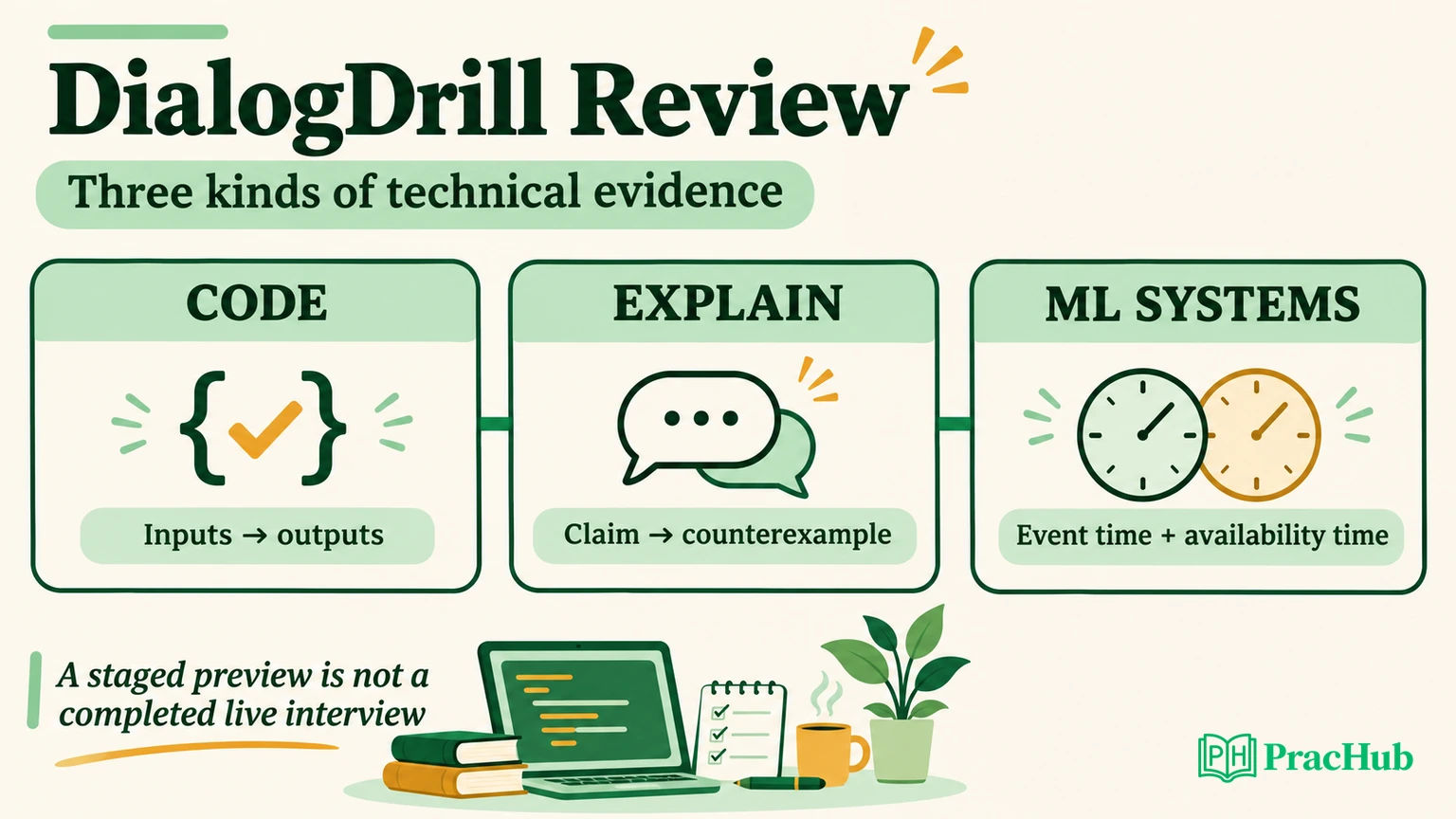
One brand, with a carefully bounded review
Public-source observation, November 3, 2026: InterviewRise and DialogDrill currently return pages titled DialogDrill. We treat them as one product identity. We did not observe a current HTTP redirect and do not use the two domains as evidence of two independent services.
Our review uses public product material and the staged homepage example. We did not create an account, grant microphone access, start a live conversation, run the product’s judge, open a private replay or activate a paid plan. No candidate experience or independent hiring-outcome study is being substituted for those missing tests.
A voice product needs an additional kind of verification. A text transcript can show an intended follow-up, but cannot establish interruption behavior, audio delay or whether the interviewer notices a mistaken statement while someone is typing. Those need an actual session with a known input and a saved result.
What the staged coding preview establishes
Provider illustration: the homepage stages a Two Sum conversation about solution guarantees, pair selection and complexity. It also shows a sample scorecard and replay. These are product examples, not our submitted solution or returned score.
Use this material to decide what to inspect during a trial. A useful follow-up should connect to the actual constraint that was stated. If the task requires two different indices, the explanation and implementation must both preserve that condition. Check whether the judge actually enforces the stated constraint.
Try a tiny independent counterexample first: two copies of the value three with target six. A valid result uses both occurrences. A single three with the same target cannot supply a second index. Track the two occurrences and their indices.
Before judging an AI hint, record what you had already established. If you explicitly rejected index reuse, a later reminder may be redundant rather than evidence of adaptive diagnosis. Conversely, an overlooked duplicate case can be a useful prompt. A replay should make that difference inspectable.
Coding, technical QA and ML Systems need different checks
Provider positioning: DialogDrill describes code execution, technical questioning and ML-system rehearsal spanning model choices, pipelines and deployment. We did not verify the available language list, track access or completed sessions in those modes.
The following is our evaluation matrix. It defines evidence to look for without assuming that the advertised product supplies it or that one track’s feedback transfers to another.
| Practice mode | Useful evidence | What a positive result leaves open |
|---|---|---|
| Coding | Executed input, expected output, actual output and constraints | Whether the explanation and complexity argument hold |
| Technical QA | A precise claim, counterexample and acknowledged assumptions | Whether the speaker can implement or operate the mechanism |
| ML Systems | Prediction target, available data, evaluation split and serving contract | Whether a proposed model improves the real objective |
| Replay review | Exact code or statement and its timestamp | Whether the criticism is technically correct |
For example, naming a feature store in an architecture answer does not establish that historical training data reproduces what serving knew. That is a specific boundary worth probing in an ML interview. An algorithm run cannot establish what the feature values meant at prediction time.
The dedicated ML page includes implementation practice
Direct public-page observation: the ML Systems landing page promotes coding and technical Q&A, with a staged KV-cache implementation example and categories covering inference, training and GPU work. We did not execute that example, inspect private tests or verify that every advertised item is accessible.
That is a more specific signal than the homepage’s broad ML-system-design description. Before choosing a session, distinguish implementing a component, explaining a mechanism and designing a full service. A KV-cache coding exercise and a feature-availability architecture discussion require different evidence; a shared ML label does not make them interchangeable.
Our timestamp example below fills a separate reasoning gap. It is independent preparation material, not a claim that the product asks this question or that its ML track evaluates historical feature correctness.
Original ML exercise: event time is not availability time
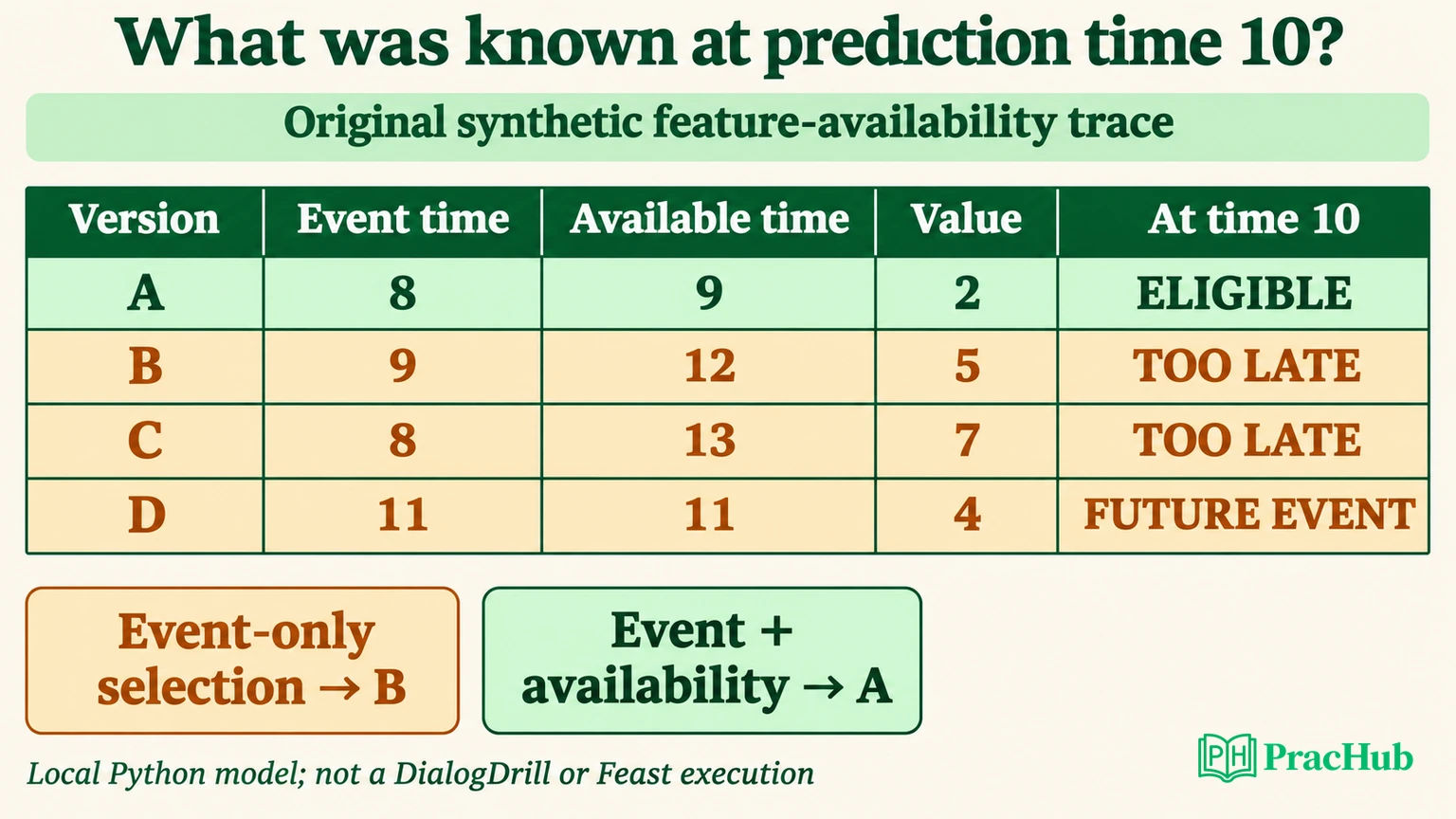
Consider a synthetic customer-risk feature. At time ten, a model makes a prediction. The offline source contains the following rows, expressed as small integer times for clarity. These are invented data, with no customer or employer information.
| Version | Feature event time | Available to serving | Feature value |
|---|---|---|---|
| A | 8 | 9 | 2 |
| B, delayed arrival | 9 | 12 | 5 |
| C, correction | 8 | 13 | 7 |
| D | 11 | 11 | 4 |
At prediction time ten, only A is eligible under a contract requiring both timestamps to be at or before the prediction. B describes an earlier event but arrives too late. C is a later correction to an old event. D occurs in the future relative to that prediction.
An offline query taking the latest event timestamp no later than ten would choose B. It would silently grant training access to a value unavailable during serving. Sorting by event time alone does not repair the missing availability condition.
This is not a claim that every pipeline needs the same schema. The point is to define which timestamp represents usable knowledge. If the source cannot reconstruct that history, say so. A timestamp assigned during a later bulk import may not establish when online inference originally had the value.
Official technical reference: Feast’s current point-in-time join documentation distinguishes event-time filtering from an optional created-timestamp constraint, with store-support and non-null requirements. We did not run Feast. Our example implements its own explicit eligibility contract and does not assume that any default join reconstructs availability automatically.
An executable trace with a narrow result
The independent Python model below selects the latest eligible event, resolving equal event timestamps by the later eligible availability time. No database, network service, feature store or DialogDrill session is involved.
rows = [
    ("A", 8, 9, 2),
    ("B", 9, 12, 5),
    ("C", 8, 13, 7),
    ("D", 11, 11, 4),
]

def available_as_of(t):
    eligible = [r for r in rows if r[1] <= t and r[2] <= t]
    return max(eligible, key=lambda r: (r[1], r[2]), default=None)

assert available_as_of(7) is None
assert available_as_of(10)[0] == "A"
assert available_as_of(11)[0] == "D"
assert available_as_of(12)[0] == "D"
assert available_as_of(13)[0] == "D"
event_only = max((r for r in rows if r[1] <= 10), key=lambda r: r[1])
assert event_only[0] == "B"
print("6 checks passed")
We executed these six checks locally. At eleven, D becomes eligible; at twelve, B’s arrival does not make its older event supersede D. At thirteen, the correction C is still older by event time. Those results follow from the declared ordering, not a universal rule for every feature definition.
A different business contract could prefer the most recently received message regardless of event time. That would be a different feature. Explain the choice before comparing outputs, rather than describing either implementation as correct without specifying what it represents.
The fixture has one entity, no null timestamps and no retention window. A real design needs entity keys, duplicate handling, timestamp tie rules and missing-feature behavior. Passing six local checks establishes the stated toy behavior; it does not establish a leakage-free production model or a measured improvement in generalization.
Follow-ups that reveal ML-system understanding
After stating the eligibility rule, ask how training and serving preserve it during corrections. A defensible answer identifies the retained versions, the publication boundary and how a historical query obtains the same interpretation. Merely saying that both use the same column names does not answer that question.
Then introduce labels. Suppose the outcome becomes known later than the prediction. It can be a training target after maturation, while still being invalid as a prediction-time input. Delayed labels also affect when an evaluation cohort is complete. Missing outcomes should not automatically be interpreted as negative outcomes.
Next, ask what happens when A is too old. Choose an explicit fallback, refusal or missing-value path and describe how it is measured. Freshness requirements belong to the feature contract; adding a cache icon to the diagram does not define them.
Finally, distinguish offline and online evidence. An offline accuracy gain can coexist with a serving path that misses its latency objective or uses stale values. State which observation would change the model, the data pipeline or the deployment decision. This is a practical way to test whether a rehearsal develops reasoning across the full ML-system boundary.
Replay feedback should point to a checkable claim
In its March 23 team introduction, DialogDrill describes code-and-whiteboard awareness, timed replay coaching and interviewer styles. This is a historical provider account, not an independent user report or proof of current account features.
For our timestamp exercise, useful feedback would identify a precise mistake: choosing B for prediction time ten despite availability twelve. The learner can inspect and correct that statement. Advice to improve architectural depth would be less useful unless it names the missing boundary.
Check the criticism’s validity after locating it. A timestamp can make feedback easier to locate while the reasoning remains wrong. Check the cited code state, task assumptions and expected output before accepting a scorecard’s conclusion.
Keep a correction in your own words: “I filtered event time but forgot when the value became available.” Then change the input. Move B’s availability to ten and predict the new answer before running anything. That tests the revised rule rather than recall of the previous result.
Free access and paid counts require clarification
Advertised access, November 3: the homepage lists two free interviews restricted to Two Sum. Its plan cards show Plus at $20 monthly for twenty interviews and Pro at $40 for fifty. A separate comparison on the same page associates $20 with fifty. We did not activate an allowance or verify checkout.
Do not calculate a guaranteed per-session cost from conflicting counts. Ask which track consumes an interview, whether an interrupted session counts and which allowance the account actually receives. Keep the account’s answer separate from an older launch description or an undated comparison.
The public live-demo invitation also calls for microphone use. We did not grant that permission. A no-sign-in label alone does not establish how a recording or transcript is processed, how much of a session is included or whether a replay persists.
A narrow trial is sensible only after those boundaries are clear. Choose one known problem and one deliberately stated constraint; inspect whether the actual follow-up responds to it. That would supply more useful evidence than treating a marketing score as a measured readiness estimate.
Practice the gaps the product leaves open
These independent PracHub questions extend the coding-to-ML-system distinction. They are not DialogDrill exports, its question bank or verified company interview formats.
| PracHub question | What to examine |
|---|---|
| Two Sum — Indices Summing to a Target | Clarify index reuse and duplicates before implementing a solution. |
| Review a Feature Pipeline PR for Production Risks, Then Serve Features by Freshness | Review feature freshness, failure paths and a concrete serving contract. |
| Data quality, lineage, monitoring and backfill design for an ML feature store | Connect data quality, lineage, monitoring and backfills. |
| Design a leak-free time-split model | State what information was available at the split and prediction times. |
| Resume ML Project Deep Dive: Loss, Training Data, Features, Architecture, Cold Start | Defend your own training data, features and architectural choices. |
Who should consider it, and what to verify first
DialogDrill may fit a learner who wants to rehearse explaining technical choices aloud while working with code or a diagram. Our public-source review supports evaluating that workflow, but cannot recommend its grading accuracy, language coverage or ML-system depth as tested qualities.
For an ML-focused trial, take the feature-pipeline review, write the prediction-time contract and identify one delayed-data failure before speaking. After a session, check whether the feedback caught that failure and whether you can explain the corrected rule on a changed input. Record the changed input and your predicted result before rerunning the example.
Comments (0)