Do Partial Test Cases Count in an OA? Hidden Tests, Weighted Scores, and Cutoffs
Quick Overview
An evidence-backed guide to whether partial test cases count in online assessments, how hidden and weighted tests work, and why platform scores differ from company cutoffs.
Do Partial Test Cases Count in an OA? Hidden Tests, Weighted Scores, and Cutoffs
Partial test cases often count in an online assessment, but the scoring unit matters. On many coding platforms, each individual test case is pass or fail: you receive all of that case's assigned points or none. The coding question can still earn a partial score because its total is the sum of the cases you passed.
Passing 7 of 10 cases does not always equal 70%. Hidden cases may carry different weights, samples may be worth zero, and some platforms add completion bonuses. Employers can then apply a separate cutoff or review.
The safest interpretation is: preserve every working case you can, but do not infer your hiring result from the pass count alone. Practice with PracHub interview questions and written solutions, record which edge cases you missed, and treat the exact invitation and in-test instructions as the source of truth.

Quick answer
| Question | Short answer |
|---|---|
| Do passed test cases earn partial credit? | Often yes. Many coding questions add the points assigned to each passed case. |
| Is one test case partially correct? | Usually no. A case normally passes only when the output and execution requirements are satisfied. |
| Are all cases worth the same amount? | Not necessarily. Employers or question authors may assign different weights. |
| Do visible sample cases count? | Sometimes, but they may be assigned zero points. |
| Do hidden cases count? | Yes when they are scored; they commonly test boundaries, performance, and unseen paths. |
| Does a partial platform score clear the company cutoff? | It can, but the cutoff and later review process are employer-specific. |
A solution that passes meaningful cases is usually better than a blank submission, but the dashboard may not reveal the employer's decision rule.
What "partial credit" can mean
Candidates use one phrase for several different mechanisms. Separating them prevents most scoring confusion.
Partial score for a coding question. Your code passes some test cases and fails others. The platform adds the points from the passed cases, so the question receives something between zero and full credit.
Partial credit inside one test case. This is less common for ordinary exact-output coding tests. A case generally succeeds only when the program returns the required output within the applicable limits. A nearly correct output is still a failed case.
Partial progress in a module. A platform can award base points for progress and reserve extra points for completing the whole module. CodeSignal's current Assessment Score uses this kind of two-tier model.
Partial credit on another question type. Multi-select questions, manually reviewed repository tasks, approximate-solution problems, and project assessments can use different rubrics. HackerRank, for example, documents partial credit for selecting some correct options in a multiple-answer MCQ, subject to its configured rules.
When someone says there is "no partial credit," determine whether they mean each case is binary, each whole question is all-or-nothing, or the employer uses a fixed threshold. Those are different rules.
HackerRank: why two official statements sound contradictory
HackerRank provides the clearest illustration. Its employer documentation says each test case has a predefined score. Passing the case earns that full score; failing it earns zero. It then says partial scoring does not apply. In the same section, it explains that the total question score is the sum of all passed cases.
Its candidate documentation describes the result from the other level: pass all cases for a full score, pass some cases for a partial score, and pass none for zero.
Both statements can be true:
- One test case: binary, with no fractional credit inside that case.
- One coding question: partially scored by adding the points from passed cases.
HackerRank's official example uses two sample cases worth zero, three easy hidden cases worth 5 points each, four medium cases worth 10 each, and two difficult cases worth 20 each. A candidate who passes all three easy cases, three medium cases, and one difficult case earns 65 out of 95.
That candidate passed seven of nine hidden cases, or about 78% by count, but earned about 68% of the available points. The difference comes from weighting. The missed difficult case costs more than a missed easy case.
Hidden tests can be worth more than visible tests
Visible samples explain input, output, and basic behavior; they are not necessarily a miniature score. HackerRank allows sample tests to carry zero points.
Hidden tests are unseen inputs used to evaluate paths the samples do not expose. Common categories include:
- empty, minimal, or maximum-size inputs;
- duplicates, ties, negative values, or overflow boundaries;
- parsing details such as whitespace and output formatting;
- disconnected graphs, cycles, or degenerate trees;
- large inputs that distinguish an efficient algorithm from one that times out.
A solution can pass every sample and still score poorly because the hidden suite measures completeness and robustness. Fix visible failures first because they reveal a known mismatch, but do not stop testing after the samples turn green.
How major platforms handle partial results
Scoring changes over time, and employers can configure assessments. This comparison summarizes current official documentation rather than promising what your invitation uses.
| Platform | How partial work can affect the result | Important qualification |
|---|---|---|
| HackerRank | Passed coding test cases contribute their predefined points; multi-answer MCQs can award partial credit | One coding case itself is pass/fail, and case weights can differ |
| CodeSignal | Base points reflect progress or completion within modules, while full module completion unlocks bonus points | A partly solved module and a fully solved module do not necessarily scale linearly |
| Codility | Task scores combine into the overall score; coding tasks can measure correctness and, where applicable, performance | Employers can weight tasks differently, and "performance" means algorithmic efficiency |
| CoderPad Screen | Working code can contribute points, reports can show point and comparative scores, and timed-out code is submitted for validation | Candidate-visible validators may differ from the final validators; employers can review the detailed work |
| Coderbyte | Coding test cases contribute points; custom unit-test challenges can score by the fraction passed | Questions can be weighted and employers can set a qualifying score |
CodeSignal's completion bonus means finishing one nearly solved module may be worth more than scattering a little progress across several. Codility adds a vocabulary trap: its performance score can measure runtime behavior on large data sets, not how quickly the candidate clicked Submit.
Platform score and company cutoff are separate
The assessment platform calculates evidence. The employer decides how to use it.
A cut score is a threshold selected for a role or hiring process. CodeSignal's employer guidance explains that organizations calibrate it to the job, candidate pool, and hiring goals. The same platform score can therefore lead to different outcomes across employers or roles.
Companies may use:
- an absolute score threshold;
- a benchmark or comparative score;
- different thresholds by role or location;
- resume, eligibility, integrity, or work-style review;
- manual review for borderline or project-based submissions.
An anonymous claim that "the cutoff is 70%" is therefore weak evidence without the exact employer, role, location, and assessment version. Partial credit can matter without being sufficient: the same score may advance at one employer, miss another threshold, or enter manual review.
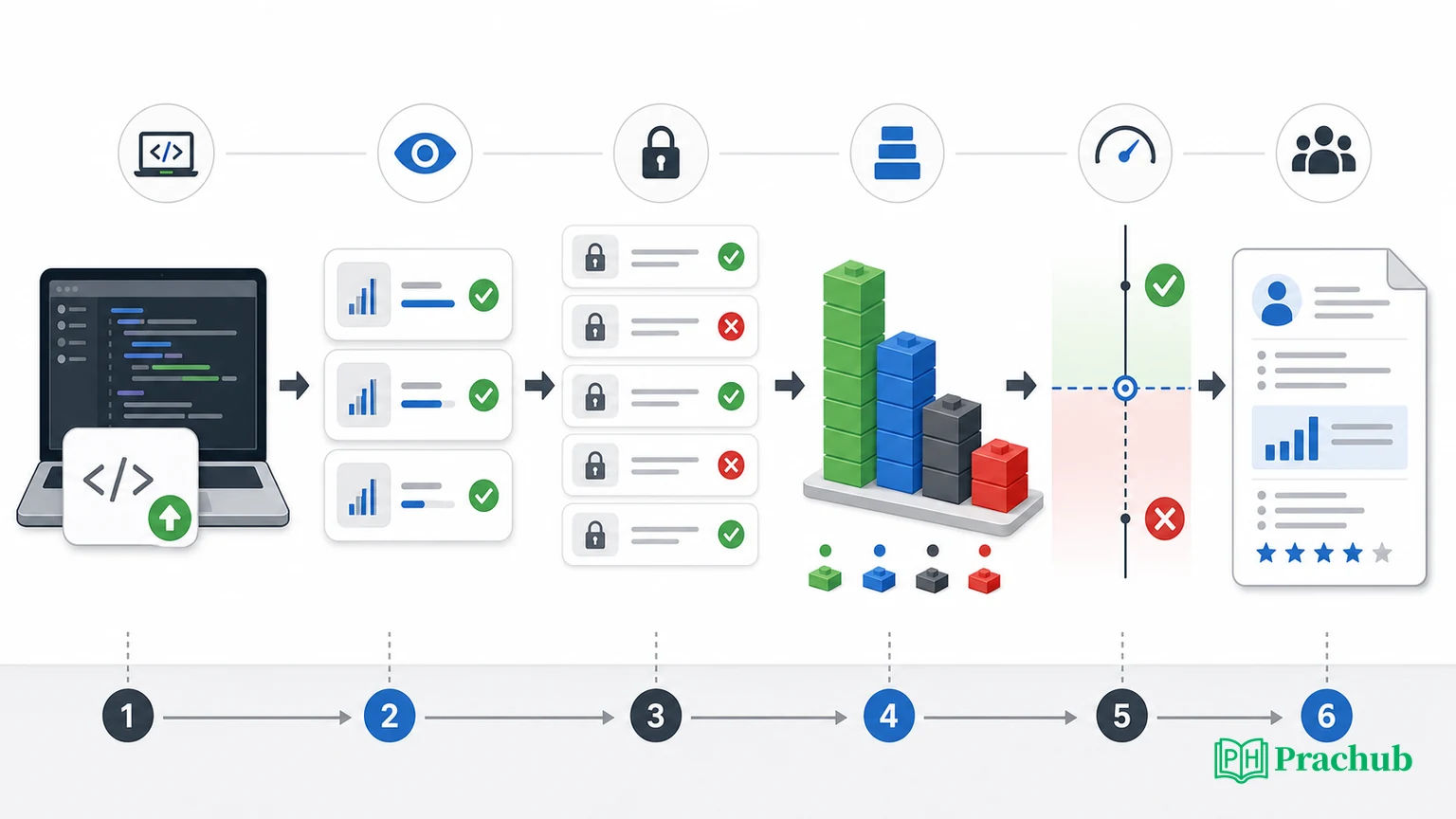
What to do when only some tests pass
Protect working behavior before chasing a full score:
- Save the strongest working version so a risky change does not erase earned cases.
- Read the failure category. Wrong answer, runtime error, timeout, memory limit, and formatting problems need different repairs.
- Map failures to the contract. Recheck empty inputs, boundaries, duplicates, tie rules, indexing, output order, and numeric limits.
- Check complexity. If small cases pass but large cases fail, inspect time and space complexity before adding conditionals.
- Change one thing at a time, retest, and submit the stable version before time expires.
Avoid hardcoding visible examples or guessing hidden inputs. The useful goal is a general solution you could defend in a technical follow-up.
How to allocate the final minutes
For multi-question tests, use the scoring model you can actually observe.
| Situation | Best next move |
|---|---|
| A nearly complete question has one identifiable boundary bug | Fix and retest it |
| A blank question has a straightforward baseline solution | Implement the baseline and bank valid cases |
| A working solution times out only on large inputs | Improve complexity if the change is localized and understood |
| Several questions have scattered progress, and one is close to completion | Finish the closest one when the platform rewards completion bonuses |
| The remaining fix requires a full redesign with little time | Preserve the stable submission and document the idea for later practice |
Choose the action with the clearest path to additional verified behavior, not cosmetic polishing or an emotional reaction to one hidden failure.
Practice hidden-test discipline with PracHub
These PracHub question-bank records train edge-case coverage and partial-progress judgment. They are practice material, not predictions of your exact assessment. Each complete title in the first column opens the question and written solution.
| PracHub question | Practice focus | Why it helps |
|---|---|---|
| Solve Five OA Coding Tasks | Independent tasks, parsing, and hidden suites | Trains banking progress across several separately graded implementations |
| Solve Two OA Coding Problems | In-place updates, integer operations, and boundaries | Shows how two complete subproblems can demand different test strategies |
| Group strings that are anagrams | Hashing, canonical keys, and duplicates | Exposes hidden failures caused by key design and repeated values |
| Merge Overlapping Intervals | Sorting, endpoint rules, and invariants | Forces a precise decision about touching and overlapping boundaries |
| Design comprehensive OA test cases | Equivalence classes, oracles, and stress cases | Turns hidden-test preparation into a reusable checklist |
Frequently asked questions
If I pass 7 of 10 test cases, is my score 70%?
Not necessarily. It is 70% only if all ten cases carry equal points and there are no separate bonuses, penalties, or task weights. Some platforms let question authors assign different case values, and visible samples can be worth zero. Treat 7/10 as coverage feedback unless the scoring rubric confirms equal weights.
Do hidden test cases count more than sample tests?
They can. Hidden cases may receive the same weight, a higher weight, or simply be the only scored cases. HackerRank's official example assigns zero to sample cases and increasing values to easy, medium, and difficult hidden cases. Your own assessment may use another configuration.
Can partial credit still get me an interview?
Yes, when the partial score clears the employer's threshold or the submission receives favorable manual review. It is not guaranteed. Employers can combine the assessment with resume fit, eligibility, integrity signals, hiring capacity, and later screens.
Should I attempt every question or finish one question completely?
Use the visible scoring structure. If tasks are independently scored, a simple working baseline on each can protect points. If full completion unlocks a bonus, finishing a nearly solved module may be more valuable. Always preserve working submissions before switching.
Can recruiters see which hidden tests I failed?
Authorized reviewers can often see question results, code, execution information, and activity history while candidates see only a count or generic failure. Keep the final code readable and defensible.
Final takeaway
Partial test cases often count, but they do not all have to count equally. A coding case is commonly binary, while the whole question receives the sum of points from every passed case. Hidden cases can be weighted, samples can be unscored, and platforms such as CodeSignal can reserve additional value for complete modules.
Your best response is not to guess the hidden cutoff. Preserve working code, test the contract systematically, fix the highest-confidence failure, and submit a stable version. Then use the outcome to improve the next attempt: solve a PracHub coding question, build your own boundary tests before opening the explanation, and record which hidden-case category your first solution missed.
Sources and Further Reading
- HackerRank: Coding Questions and test-case scoring
- HackerRank Candidate Support: Evaluation Method of Coding Questions
- HackerRank: Test Cases in Coding and Approximate Solution Questions
- HackerRank: Multiple Choice Questions and partial credit
- CodeSignal: Understanding Assessment Score
- CodeSignal: Guide to Setting Cut Scores
- Codility: Reading a Candidate Test Report
- Codility: Weighted Scoring
- CoderPad Screen: Candidate Reports
- CoderPad Screen: Candidate Preparation and Scoring
- Coderbyte: Scoring and Test-Case Points
- Coderbyte: Scoring Custom Unit-Test Challenges
Research note: This guide was checked on August 29, 2026. Assessment providers and employers can change scoring, weighting, cutoff, and reporting settings; your invitation and in-test instructions control your specific attempt.
Related Articles
CodeSignal Business Skills Assessment Guide 2026: AI Interview, Timers, and Employer Reports
Prepare for a CodeSignal Business Skills Assessment: understand AI conversations, question timers, written tasks, submissions, and employer review.
Which Programming Language Should You Use in an OA? Speed, Compatibility, and Employer Preferences
Choose the best programming language for an OA by comparing speed, runtime compatibility, employer preferences, and your own error rate with confidence.
Does Finishing an Online Assessment Early Matter? Completion Time, Accuracy, and Recruiter Review
Does finishing an online assessment early matter? Learn when time affects scoring, what recruiters see, and when accuracy should win in coding tests.
Why Do CodeSignal GCA Questions Feel Uneven? Dynamic Rotation, Difficulty, and Scoring
Why CodeSignal GCA questions feel uneven: how rotation, four difficulty modules, partial credit, completion bonuses, and 200-600 scoring work.
Comments (0)