Which Programming Language Should You Use in an OA? Speed, Compatibility, and Employer Preferences
Quick Overview
A practical framework for choosing an OA programming language based on platform rules, employer preferences, fluency, runtime versions, and problem constraints.
Which Programming Language Should You Use in an OA? Speed, Compatibility, and Employer Preferences
Use the programming language that is allowed by the assessment, familiar enough for you to debug under pressure, and compatible with the exact runtime. If the employer or role explicitly prefers a language, treat that as an important signal. Otherwise, the best OA language is usually the one in which you can implement a correct solution, test edge cases, and explain your choices with the fewest mistakes.
Python is not automatically best because it is concise, and C++ is not automatically best because it can be fast. Algorithm choice normally matters more than small runtime differences between accepted languages. Check the invitation, job description, and platform tutorial, then use PracHub interview questions with written solutions to test your choice against realistic parsing, data-structure, and edge-case work.

Quick answer: which language should you choose?
Use this order of decisions:
- Required language: If the test permits only one language, the decision is already made.
- Allowed list: Eliminate anything not shown in the assessment interface.
- Explicit employer preference: Favor a listed preferred language when you are genuinely competent in it.
- Personal reliability: Choose the language in which you make fewer syntax, type, parsing, and library mistakes.
- Problem fit: Consider standard-library support, integer behavior, input parsing, and performance constraints.
- Exact environment: Confirm the compiler or runtime version and available libraries.
| Situation | Recommended decision | Main reason |
|---|---|---|
| One language is required | Use that language | The test contract overrides general advice |
| Several languages are allowed and none is preferred | Use your strongest timed-problem language | Reliability beats novelty |
| The role strongly emphasizes C++, Java, or another stack | Use it if you are already fluent | It may align with later technical review |
| The task is framework or repository based | Use the provided project environment | Dependencies and tests define compatibility |
| Your favorite language is missing or uses an unfamiliar version | Choose the next-best practiced option | Unsupported features can waste the timer |
Allowed, preferred, and strategic are different
An allowed language is one the assessment environment can compile or run. A preferred language is one the employer or job description says is especially relevant. A strategic language is the option that gives you the best chance of producing a correct, reviewable answer in this particular test.
Those categories can point to different answers. A platform might support dozens of languages, yet the employer may enable only Java and C++. A backend job may mention Java while its language-agnostic OA allows Python. If you are much more reliable in Python and the invitation says nothing else, Python can still be sensible.
Do not infer a hidden preference from another candidate's test. HackerRank says test creators select allowed languages; CodeSignal likewise says the inviting company may limit its normally broad list. Your own interface is the source of truth.
How major OA platforms handle language choice
Platform support is a ceiling, not a promise about your test. Employer configuration, assessment type, and question design can all narrow the list.
| Platform | Current official behavior | Candidate implication |
|---|---|---|
| HackerRank | Coding questions support more than 35 languages, but test creators select allowed languages and may need custom stubs for less common options | Check whether your language has a complete starter stub before the timer matters |
| CodeSignal | The company may limit languages; certified assessments expose different environments by assessment type | A broad GCA list does not apply to every specialized test |
| Codility | Employers can limit languages; Codility publishes exact compiler and runtime versions for current task types | Verify version-specific syntax and standard-library behavior |
| CoderPad Screen | Test creators choose skills and languages, and even language-independent questions can be restricted | Use the tutorial tied to your invitation rather than a generic sandbox |
Assessment type can matter as much as provider. CodeSignal lists many languages for the GCA, SQL environments for Data Analytics, JavaScript for its specialized JavaScript assessment, and Python for Machine Learning Core. In a CoderPad project exercise, the repository and test suite may matter more than a general algorithm-language preference.
Python vs Java vs C++ vs JavaScript and other options
There is no universal winner. Compare languages by the mistakes and delays they create for you, not by reputation.
Python
Python is effective for many language-agnostic questions because dictionaries, sets, sorting, heaps, and concise iteration reduce implementation overhead. Its integers can grow beyond fixed machine-word sizes, removing one common overflow trap.
Deep recursion can encounter limits, large inputs can expose runtime overhead, and concise syntax does not protect a poor algorithm. Confirm the Python version and available standard library.
Java
Java offers predictable primitive types, mature collections, and explicit interfaces. It is strong when you can write comparators, use long correctly, parse efficiently, and use collection APIs without searching for syntax.
Java's extra ceremony can cost time if you rarely practice it. Time your own implementation instead of assuming shorter code will be safer.
C++
C++ provides the Standard Template Library, efficient containers, and detailed control over memory and numeric types. It aligns naturally with many low-latency, embedded, systems, or quantitative-development roles.
Choose it because you are fluent, not for prestige. Iterator invalidation, signed/unsigned comparisons, overflow, and comparator mistakes can erase its speed advantage. Know the platform's C++ standard and compiler version.
JavaScript or TypeScript
JavaScript and TypeScript are practical for frontend or full-stack candidates, especially in Node, React, or repository assessments. They offer convenient arrays, maps, sets, and string processing.
JavaScript's Number cannot safely represent every integer beyond Number.MAX_SAFE_INTEGER; use BigInt only when the environment and output contract support it. Verify the configured Node and TypeScript versions.
Go, Kotlin, Rust, and other languages
These are good options when allowed, role-aligned, and already part of your timed practice. The risk is choosing an unfamiliar language during a fixed timer because it looks strategically impressive.
Choose by problem type, not by stereotype
For arrays, strings, graphs, trees, and dynamic programming, fluency is normally decisive. A correct O(n log n) Python solution beats a buggy O(n) C++ attempt, while a fluent C++ candidate should not switch merely to shorten code.
Parsing-heavy tasks reward safe tokenization and precise whitespace handling. Large-number tasks require understanding integer width and overflow; deep trees expose stack limits. For performance-heavy problems, choose the algorithm first and confirm the runtime fits the published constraints second.
For a supplied Django, Node, Spring Boot, React, or C++ repository, use its stack. The task evaluates navigation, debugging, tests, and integration rather than language freedom.
Compatibility checks that prevent avoidable failures
Run this checklist before committing to a language:
| Check | What to verify | Typical failure prevented |
|---|---|---|
| Version | Python, Java, C++, Node, TypeScript, or framework version | Using syntax or APIs the runner does not support |
| Starter code | Function name, parameters, return type, and input/output contract | Rewriting a correct stub incorrectly |
| Standard library | Available modules, imports, and package restrictions | Depending on a missing helper library |
| Numeric model | Integer width, overflow, precision, and modulo behavior | Passing samples but failing boundary tests |
| Recursion and memory | Stack depth, heap limits, and input size | Runtime errors on deep or large cases |
| I/O behavior | Line parsing, whitespace, encoding, and output formatting | Wrong answers caused by formatting rather than logic |
Codility currently lists concrete versions such as Python 3.12, Node.js 22, Java 11 or 21, and separate C++ standards. Values can change, and other platforms may differ. Practice in the closest available environment, not whatever your laptop happens to run.
When employer preferences should change your choice
An explicit restriction always wins. A preference matters when the language is central to the role and your code may be reviewed later, such as C++ for latency-sensitive systems or TypeScript for a frontend project.
A preference should not push you into a language you cannot use reliably. If a posting says "C++ preferred" but the OA permits Python and you have barely practiced C++, guessing is unlikely to help. Ask the recruiter when instructions are ambiguous.
Distinguish the OA from later interviews. You may solve a language-agnostic screen in Python and later discuss the team's production stack. Use one language throughout only when the company requires it.
Should you switch languages between OA questions?
Switch only when the platform allows it and the next problem has a clear advantage that outweighs context switching. One familiar language keeps helpers, testing habits, and syntax loaded.
Do not switch after substantial progress unless you know the platform preserves code correctly. Test the provider's practice environment beforehand to learn whether language choice is per test, per question, or employer-fixed.
Practice with OA questions from PracHub
These PracHub question-bank records train language selection, implementation, parsing, data structures, and test design. They are practice material, not predictions of your exact assessment.
| PracHub question | Practice focus | Why it helps |
|---|---|---|
| Choose Between Python, Java, and C++ for a Service | Language trade-offs | Forces recommendations to follow workload and team constraints |
| Solve Five OA Coding Tasks | Parsing and language edge cases | Exposes modulo, integer, whitespace, and ordered-dedup differences |
| Solve Two OA Coding Problems | Timed implementation | Tests whether your chosen language supports fast, reliable execution |
| Group strings that are anagrams | Maps and canonical keys | Compares standard-library fluency across languages |
| Design comprehensive OA test cases | Hidden-test preparation | Builds a repeatable boundary and compatibility checklist |
A seven-day language readiness plan
| Day | Focus | What to do |
|---|---|---|
| Day 1 | Environment | Confirm the allowed version and rebuild your basic input/output template |
| Day 2 | Core containers | Practice maps, sets, sorting, heaps, queues, and custom comparators |
| Day 3 | Numeric safety | Test overflow, large integers, modulo, division, and precision behavior |
| Day 4 | Parsing | Solve one line-based and one structured-input task without outside helpers |
| Day 5 | Performance | Compare a correct baseline with an optimized solution on maximum-size inputs |
| Day 6 | Full simulation | Complete a timed set using only the language and tools allowed by the invitation |
| Day 7 | Review | Rehearse templates, failed edge cases, and platform controls; do not learn a new language |
Frequently asked questions
Is Python always the best language for an OA?
No. Python is concise and has useful built-in data structures, but the best choice depends on the allowed list, your fluency, the exact runtime, and the problem constraints. A candidate who writes safer Java or C++ under pressure should usually use that stronger language rather than switching because Python code can be shorter.
Do employers care which language you use?
They may care when the role, invitation, or assessment explicitly names a required or preferred language. In a genuinely language-agnostic screen, correctness and problem-solving usually matter more than choosing a fashionable stack. Never treat a broad platform language list as evidence that the employer has no preference.
Is C++ better for avoiding time-limit failures?
Not automatically. C++ can offer strong runtime performance, but an inefficient algorithm can still time out, and implementation errors can fail correctness tests. First choose the right complexity. Then use C++ when it is allowed and you can implement and test it as reliably as your alternatives.
Can I use different languages for different questions?
Some platforms and test configurations allow per-question choice; others restrict the whole assessment or provide language-specific starter code. Check the invitation and tutorial before starting. Even when switching is permitted, staying with one practiced language often saves more time than a theoretical per-question advantage.
What if the platform version is older than the one I practiced?
Use only syntax, APIs, and libraries supported by the listed environment. Run a practice question in that version, replace unsupported conveniences, and keep a small compatible template. If the invitation and platform disagree, ask the recruiter or assessment support before the deadline rather than discovering the mismatch during the timer.
Final takeaway
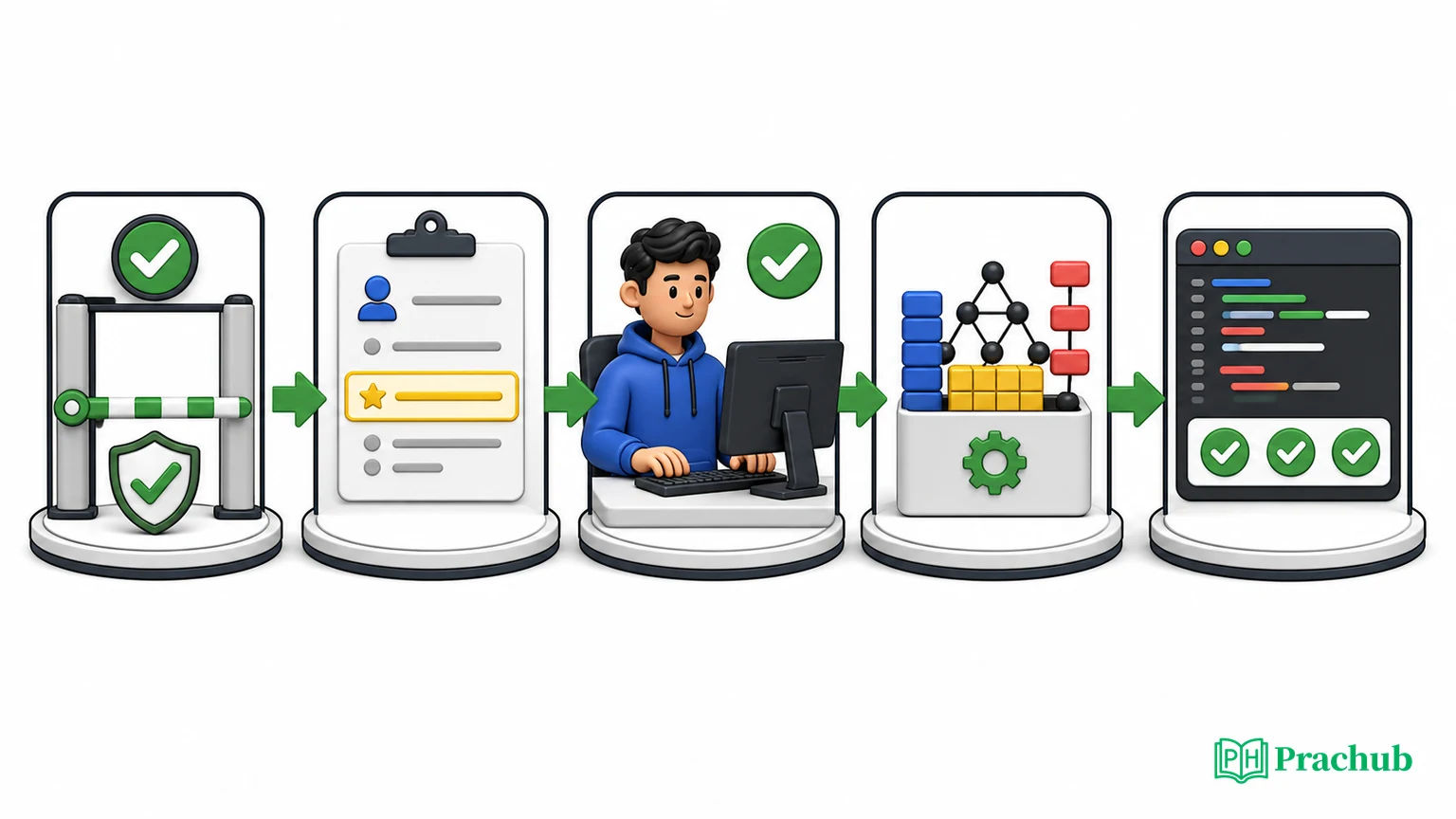
The best programming language for an OA is the one that survives four gates: it is permitted, you can use it reliably, it fits the problem, and it runs in the published environment. Employer preference becomes decisive when it is explicit and you are competent in that language; it should not be reverse-engineered from rumor.
Choose before the assessment, practice in the closest environment, and test the language-specific failure modes most likely to hide behind sample cases. Then use PracHub's interview question library to turn the decision into timed, repeatable practice instead of debating language rankings in the abstract.
Sources and Further Reading
- HackerRank: Modify Question Settings for Tests
- HackerRank: Coding Questions and Language Configuration
- CodeSignal: What Languages Can I Use?
- CodeSignal: Languages and Environments by Certified Assessment
- CodeSignal: Preparing for Your Assessment
- Codility: Supported Technologies and Runtime Versions
- CoderPad: Creating and Configuring a Screen Test
- CoderPad: Candidate Screen Preparation Guide
- Python documentation: Numeric Types
- MDN: Number.MAX_SAFE_INTEGER
Related Articles
CodeSignal Business Skills Assessment Guide 2026: AI Interview, Timers, and Employer Reports
Prepare for a CodeSignal Business Skills Assessment: understand AI conversations, question timers, written tasks, submissions, and employer review.
Do Partial Test Cases Count in an OA? Hidden Tests, Weighted Scores, and Cutoffs
Do partial test cases count in an OA? Learn how hidden tests, weighted scores, platform rules, and employer cutoffs affect coding assessment results.
Does Finishing an Online Assessment Early Matter? Completion Time, Accuracy, and Recruiter Review
Does finishing an online assessment early matter? Learn when time affects scoring, what recruiters see, and when accuracy should win in coding tests.
Why Do CodeSignal GCA Questions Feel Uneven? Dynamic Rotation, Difficulty, and Scoring
Why CodeSignal GCA questions feel uneven: how rotation, four difficulty modules, partial credit, completion bonuses, and 200-600 scoring work.
Comments (0)