Why Do CodeSignal GCA Questions Feel Uneven? Dynamic Rotation, Difficulty, and Scoring
Quick Overview
An evidence-backed explanation of why CodeSignal GCA attempts can feel uneven, how question randomization differs from adaptive testing, and how modules, partial progress, and completion bonuses shape the 200-600 score.
Why Do CodeSignal GCA Questions Feel Uneven? Dynamic Rotation, Difficulty, and Scoring
CodeSignal GCA questions can feel uneven because candidates receive different prompt variations inside a fixed four-module framework, and those variations do not create identical subjective workloads. One candidate may recognize the key pattern in Question 4 immediately, while another spends most of the session translating a long Question 3 specification into reliable code.
That does not mean the GCA is an adaptive test that becomes harder when you answer correctly. CodeSignal's public materials describe question or task randomization, framework-based variations, and calibrated scoring. They do not describe a live algorithm that raises or lowers your next question based on your performance. "Dynamic rotation" is useful candidate shorthand, but question rotation is not the same as adaptive difficulty.
For the general format, use PracHub's CodeSignal OA guide. This guide focuses on the narrower fairness question: why two valid GCA attempts can feel very different, how the modules are intended to remain comparable, and how the current 200-600 score works.
Quick answer: is CodeSignal GCA difficulty random?
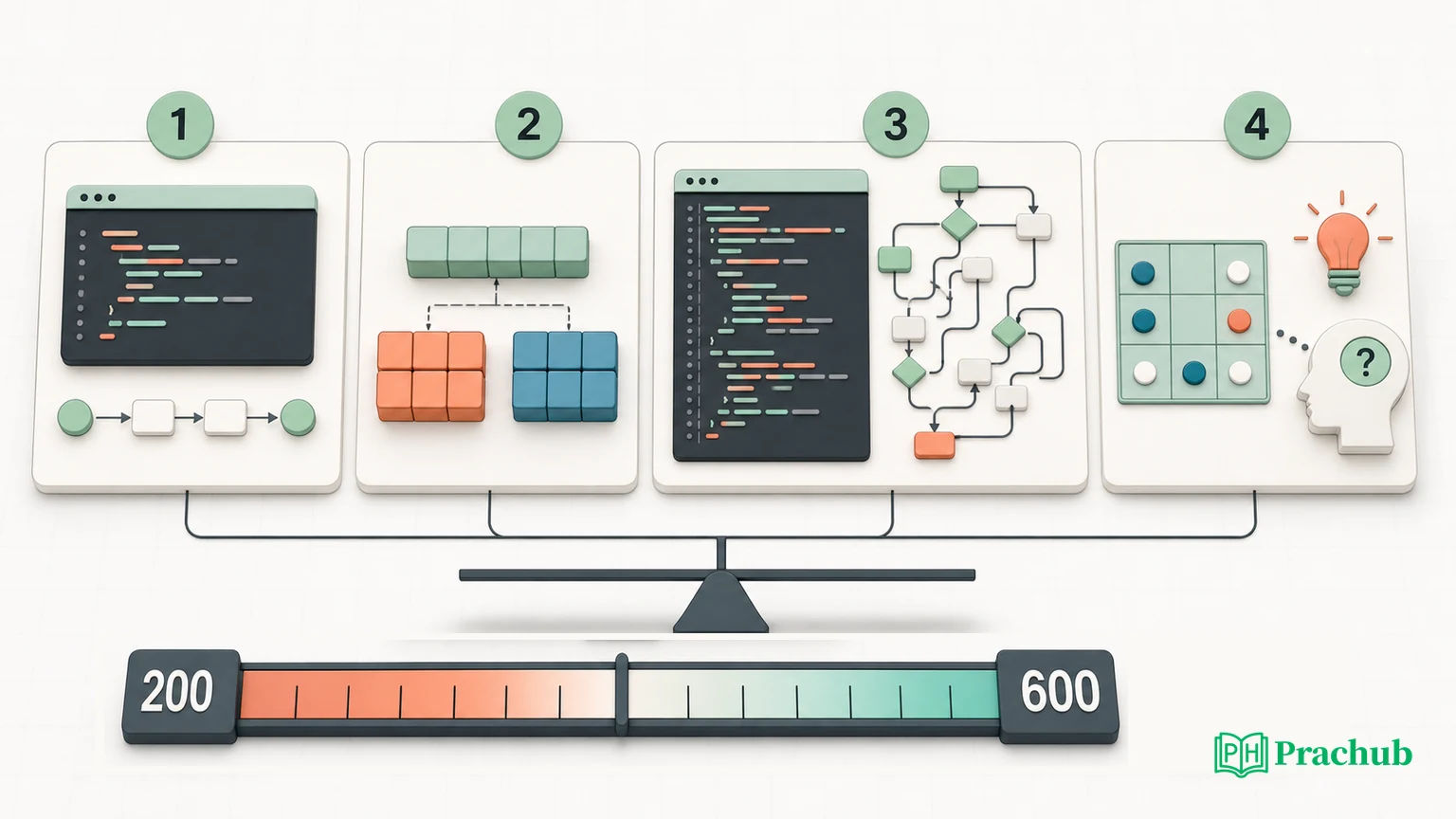
The content rotates, but the framework is fixed. CodeSignal's current GCA description says the assessment normally contains four questions of varying difficulty in 70 minutes. Its technical framework assigns one question to each of four modules: Basic Coding, Data Manipulation, Implementation Efficiency, and Problem Solving.
CodeSignal also says framework specifications can produce different question variations while keeping results comparable across candidates and attempts. Its employer documentation describes randomized questions within a slot as interchangeable when they have similar difficulty, topic, and format. That is the intended design standard, not a promise that every candidate will perceive every prompt as equally difficult.
| Module | Intended work | CodeSignal's average expectation | Why it may feel different |
|---|---|---|---|
| Question 1: Basic Coding | Arrays, strings, numbers, and one straightforward loop | 5-10 lines, about 10 minutes | Edge-case wording can slow an otherwise simple task |
| Question 2: Data Manipulation | Several basic operations composed together | 10-20 lines, about 15 minutes | Parsing and specification density may create hidden implementation work |
| Question 3: Implementation Efficiency | Multi-step implementation, matrices, maps, and careful state | 25-40 lines, about 20 minutes | Long code and many branches make debugging expensive |
| Question 4: Problem Solving | Choose and implement an efficient algorithm | 25-35 lines, about 30 minutes | Pattern recognition can make it feel easy or nearly impossible |
These are framework averages, not personal timers. A strong competitive programmer may solve a familiar Question 4 faster than a verbose Question 3. A careful application developer may have the opposite experience.
What "dynamic rotation" actually means
CodeSignal does not use "dynamic rotation" as the official name for the GCA mechanism. The more accurate concepts are question randomization, assessment variations, and framework modules.
In CodeSignal's general assessment tooling, an employer can place several interchangeable questions into one slot. Different test-takers may then receive different questions from that slot. The platform's May 2026 guidance says those questions should have similar difficulty levels, topics, and formats. Employers can also build complete assessment variations when a particular set of questions needs to stay together.
For the certified General Coding Framework, CodeSignal says similar questions are developed continuously to reduce the value of leaked prompts. The framework defines what each module should include and exclude so that variations can measure the same broad skill. The public research page explicitly lists task randomization as one way to reduce plagiarism.
None of those statements says the fourth question changes because you solved the first three quickly. All four GCA questions are visible once the timer starts, and you may move among them. That is inconsistent with a conventional computer-adaptive test that selects the next item after observing the previous answer.
Why equivalent questions can still feel uneven
Psychometric comparability is not sameness. Two questions can target the same module and have similar historical solve rates while placing different demands on one individual.
Topic familiarity is the largest source of perceived variance. A two-pointer problem may be routine for one candidate and unfamiliar to another. A matrix simulation can be conceptually simple yet require thirty minutes of indexing, boundary checks, and state updates. CodeSignal can calibrate population-level difficulty, but it cannot make every topic equally familiar to every person.
Prompt length also distorts first impressions. Long specifications often feel harder because they increase reading and implementation load, even when the required algorithm is not advanced. Short Question 4 prompts may hide the opposite problem: little code, but one crucial observation.
Finally, one missed condition can create a cascade. A candidate who overlooks a tie rule may spend ten minutes debugging correct-looking code. Another candidate may notice that condition immediately. The underlying question has not changed, but the experienced difficulty has.
Recent candidate discussions reflect this spread. Some test-takers describe Question 3 as the time sink; others report an unusually familiar Question 4 or a second question that felt much harder than expected. These reports demonstrate perception and topic fit, not proof that CodeSignal abandoned calibration.
Why Question 3 can feel harder than Question 4
The module names explain the apparent inversion. Question 3 measures implementation efficiency: breaking a large specification into correct code, often across nested structures or several rules. CodeSignal's framework allows 25-40 lines on average and emphasizes reliable translation from requirements into code.
Question 4 measures algorithmic problem solving. It may require a stronger insight, but the final implementation can be compact once the pattern is recognized. If you see the invariant, the code may be shorter than Question 3. If you do not, no amount of clean implementation will rescue the optimal solution.
So the intended progression is not simply "each question takes longer than the previous one." It moves from basic operations to composition, then implementation complexity, then algorithmic insight. Those are different dimensions of difficulty.
How the current 200-600 scoring works
CodeSignal's current Assessment Score uses a two-tier system. Base points reward progress within modules, while completion bonuses are awarded only when a module is fully solved. CodeSignal says the base layer treats modules relatively equally. Bonus allocation reflects a module's normative difficulty and how well it distinguishes between test-takers.
That means the score is not a simple percentage of four questions, and different solved combinations need not produce the same number.
| Official score-guide example | Fully solved modules | What the guide is illustrating |
|---|---|---|
| 296 | Question 1 | Basic coding familiarity |
| 396 | Questions 1 and 2 | Solid implementation and data manipulation |
| 496 | Questions 1, 2, and 3 | Strong implementation plus broader problem solving |
| 500 | Questions 1, 2, and 4 | Completing the more difficult problem-solving module earns a different bonus |
| 600 | All four | Full completion across the framework |
These are anchor examples, not a lookup table for every partial result. Hidden and visible test cases create partial progress, and the public documentation does not expose a candidate-facing formula for every intermediate score.
CodeSignal's technical paper describes solutions as unit-tested and says performance is based on requirements or test cases passed. Its rules also say the highest-scoring submission for a question is retained, even if a later submission introduces an error. Submit working increments instead of waiting for one perfect final attempt.
Does finishing faster directly increase your score?
Do not assume that submitting ten minutes early adds a secret speed multiplier. CodeSignal's technical paper says speed is not explicitly included in the Coding Score calculation; it is captured indirectly through the time limit because faster candidates can complete more requirements.
The current GCA overview says the broader Coding Report includes coding-speed, implementation, and problem-solving signals. That is different from saying two identical final solutions receive different overall scores solely because one was submitted earlier. Correctness and completed requirements should remain your first priority.
What question variance means for your strategy
The right response is not to memorize a leaked list. Rotation is designed partly to make that strategy unreliable. Prepare for the four module shapes and make your test-taking process robust to an unfamiliar surface story.
- Scan all four questions. CodeSignal exposes them at the start. Identify the implementation-heavy and insight-heavy tasks before committing the whole session.
- Secure complete modules. Full completion can unlock a module bonus, so finish nearby edge cases when the remaining work is small.
- Submit working milestones. The highest-scoring submission is retained. Bank partial credit before a risky refactor.
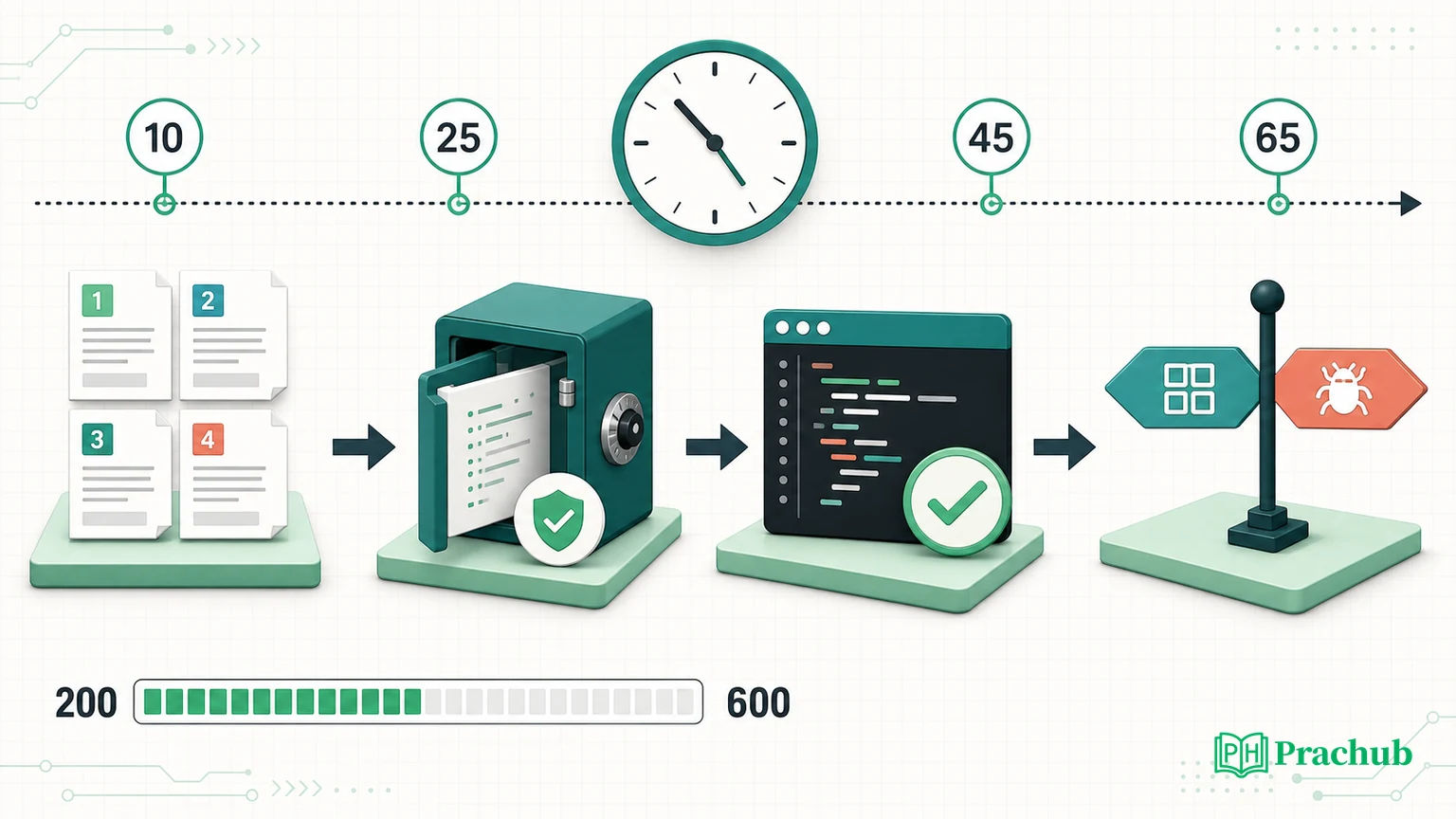
- Use checkpoints. At roughly 10, 25, 45, and 65 minutes, decide whether the next test case is worth more than switching modules.
- Practice topic rotation. Mix strings, arrays, maps, matrix simulation, sorting, and common optimization patterns instead of drilling one favorite category.
Practice across the GCA difficulty ladder
These PracHub question-bank records train different implementation and problem-solving demands. They are not CodeSignal questions and not predictions of your exact GCA. The table is the navigation surface: each complete title in the first column opens the question and written solution.
| PracHub question | Practice focus | Why it helps |
|---|---|---|
| Count substrings and generate TOC | Strings, runs, and one-pass parsing | Trains basic operations and precise output rules without advanced algorithms |
| Find Largest Adjacent Stock Price Change | Sorting, records, and tie handling | Builds data-manipulation discipline and careful edge-case reading |
| Implement Task Management and Duplicate Detection | Stateful implementation and decomposition | Rehearses the long-specification pressure that makes Question 3 difficult |
| Solve Wonderful Strings and Grid Queries | Parity, grids, and query optimization | Tests whether you can recognize and implement a stronger algorithm under time pressure |
| Implement Interview Coding Problems | Hashing, intervals, and two pointers | Builds breadth and forces fast switching between common coding patterns |
A seven-day preparation plan
Day 1: Read the official four-module framework and take one untimed practice set. Label each mistake as reading, implementation, algorithm choice, or testing.
Day 2: Drill basic coding and data manipulation. The goal is not cleverness; it is completing short tasks with correct boundaries and output formatting.
Day 3: Complete one implementation-heavy problem. Break the specification into helpers, write invariants, and submit after each stable milestone.
Day 4: Practice two algorithmic problems from different families. Stop after five minutes to name the brute-force method, bottleneck, and optimization target.
Day 5: Run a 70-minute mixed simulation. Use checkpoints and record every switch decision.
Day 6: Retest only the failure categories from Day 5. If reading consumed the session, practice specifications; if debugging did, build a hidden-test checklist.
Day 7: Complete a lighter mixed set, confirm the assessment rules and permitted resources, and stop early enough to sleep. Your invitation remains the authority because companies can configure non-GCA CodeSignal assessments differently.
Frequently asked questions
Does every candidate receive different CodeSignal GCA questions?
CodeSignal publicly describes task randomization and framework-based variations, so candidates can receive different prompts. It does not publish a promise that every pair of candidates receives completely unique sets. Treat the four module types as stable and the exact stories, data structures, and implementation details as variable.
Is CodeSignal GCA adaptive?
Public documentation does not describe the GCA as an adaptive test that changes later questions based on earlier performance. All four questions are available when the timer begins. Randomized or rotated question forms should not be confused with real-time adaptive selection.
Can one GCA attempt genuinely be harder than another?
At the individual level, yes: topic familiarity, prompt density, and debugging paths can make one attempt feel much harder. CodeSignal's framework aims for comparable measurement across variants, but comparable population-level difficulty does not guarantee identical personal effort.
Why did I get 496 for Questions 1-3 but someone got 500 for Questions 1, 2, and 4?
CodeSignal's official score guide uses those exact combinations to illustrate different module value. The current system includes completion bonuses informed by module difficulty and discrimination, so solved combinations are not scored as four equal 25-percent blocks.
Should I start with Question 4 to avoid a bad rotation?
Scan it, but do not adopt one universal order. If the pattern is immediately familiar, starting there can work. Otherwise, secure the shorter modules and return with enough time. The best order is the one that converts your strengths into completed requirements, not the one favored in a forum post.
Final takeaway
CodeSignal GCA questions feel uneven because a standardized module can still vary in story, implementation burden, and personal familiarity. The platform's stated goal is comparability across rotated forms, not an identical experience for every candidate. There is no public evidence that the test dynamically punishes strong performance with harder follow-up questions.
Prepare for the framework rather than a fixed prompt list. Use varied PracHub coding questions to practice reading, implementation, optimization, and hidden-test recovery, then measure your process across several mixed sessions instead of judging your readiness from one lucky or unlucky set.
Sources and Further Reading
- CodeSignal: What to expect in the General Coding Assessment
- CodeSignal General Coding Framework technical research paper
- CodeSignal: Using assessment variations and question randomization
- CodeSignal: Understanding Assessment Score
- CodeSignal: Guide to Setting Cut Scores
- CodeSignal GCA rules and setup
- Recent candidate discussion about uneven GCA difficulty
- Candidate discussion comparing multiple GCA attempts
Research note: This guide was checked on August 29, 2026. CodeSignal can update its assessment framework and employers can configure custom assessments, so verify the name, duration, and rules shown in your own invitation.
Related Articles
CodeSignal Business Skills Assessment Guide 2026: AI Interview, Timers, and Employer Reports
Prepare for a CodeSignal Business Skills Assessment: understand AI conversations, question timers, written tasks, submissions, and employer review.
Which Programming Language Should You Use in an OA? Speed, Compatibility, and Employer Preferences
Choose the best programming language for an OA by comparing speed, runtime compatibility, employer preferences, and your own error rate with confidence.
Do Partial Test Cases Count in an OA? Hidden Tests, Weighted Scores, and Cutoffs
Do partial test cases count in an OA? Learn how hidden tests, weighted scores, platform rules, and employer cutoffs affect coding assessment results.
Does Finishing an Online Assessment Early Matter? Completion Time, Accuracy, and Recruiter Review
Does finishing an online assessment early matter? Learn when time affects scoring, what recruiters see, and when accuracy should win in coding tests.
Comments (0)