Does Finishing an Online Assessment Early Matter? Completion Time, Accuracy, and Recruiter Review
Quick Overview
An evidence-backed guide to whether early online-assessment completion affects scoring, which platforms expose time, what recruiters review, and when accuracy should take priority.
Does Finishing an Online Assessment Early Matter? Completion Time, Accuracy, and Recruiter Review
Finishing an online assessment early usually does not earn an automatic bonus. Most coding platforms primarily score what your solution accomplishes: passed requirements, test cases, correctness, and sometimes code quality or algorithmic efficiency. A submission with 20 minutes left is not inherently better than an equally correct submission with two minutes left.
Completion time can still matter in three narrower ways. It may be visible in the employer's report, it can limit how many requirements you complete, and a company may explicitly configure speed as part of its grading. Those cases are different from a universal rule that every unused minute increases your score.
The practical goal is therefore not to finish as fast as possible. It is to finish with enough time to verify the contract, hidden edge cases, complexity, and final submission state. Use PracHub interview questions with written solutions for timed practice, then compare your answer with the explanation only after you have completed your own review.
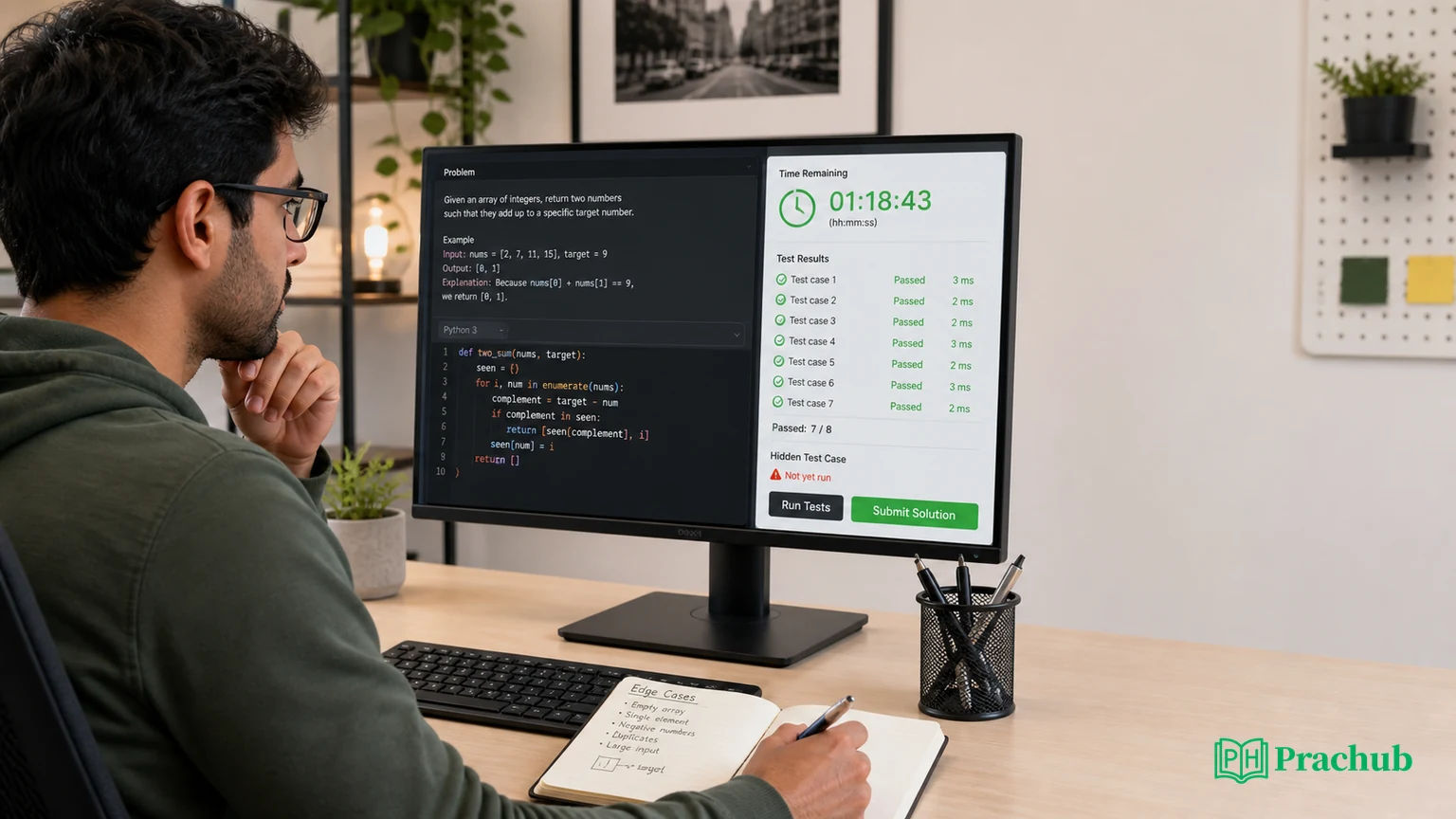
Quick answer: should you submit an OA early?
Submit early when the solution is complete, the required complexity is appropriate, and another review pass is more likely to introduce a risky rewrite than find a real defect. Keep working when you have untested boundaries, ambiguous output rules, unfinished questions, or a known performance problem.
Do not intentionally wait just to make the attempt look more thoughtful. Recruiters may see total time, but the public documentation reviewed for this guide does not establish a general preference for candidates who consume the entire allowance. Waiting creates its own risks: a network interruption, an expired timer, or an accidental edit to working code.
| Situation | Better action | Why |
|---|---|---|
| Visible tests pass, but edge cases are untested | Keep checking | Sample tests do not prove the full contract |
| All requirements pass and complexity fits the constraints | Submit | Extra polishing has diminishing value |
| One question is partial but a clear fix remains | Use the time | Additional completed requirements can raise the score |
| Only a broad refactor remains | Avoid the rewrite | A late structural change can break working behavior |
| Instructions explicitly say time affects grading | Balance speed and accuracy | This is a test-specific rule, not a platform-wide assumption |
The three different ways completion time can matter
Candidates often combine three separate ideas into one claim: "speed matters." Separating them makes the decision much easier.
First, the assessment has a fixed time limit. Faster implementation can let you complete more questions, requirements, or hidden-test fixes. Time affects the opportunity to earn points even when the scoring formula has no direct speed bonus.
Second, completion time may be recorded and shown. HackerRank, CoderPad, Codility, and other platforms expose some form of time spent, attempt activity, or question timeline to authorized employers. Visibility means a reviewer can consider the signal; it does not prove that every employer uses it as a cutoff.
Third, time can be an explicit grading input. Coderbyte's employer documentation, for example, lets an assessment creator decide whether time taken should be part of grading. If your instructions describe a speed component, believe the instructions. Without that statement, do not invent one.
This distinction also prevents a common terminology mistake. On Codility, a coding task's "performance" score refers to computational efficiency on large inputs. It measures whether the algorithm scales, not whether the candidate clicked Submit quickly.
What major assessment platforms actually expose
Platform behavior changes, and employers can configure individual tests. The table summarizes current official documentation, not a guarantee about your invitation.
| Platform | What official documentation says about time | What you should infer |
|---|---|---|
| CodeSignal | The current GCA page mentions correctness, speed, implementation, and problem solving; the published Assessment Score mechanics emphasize completed questions, base points, and module bonuses | Faster work may help you complete more, but there is no public universal unused-minutes formula |
| HackerRank | Summary reports can show completion time and time spent by question alongside score, code quality, optimality, and integrity signals | Recruiters can see speed in context; time alone is not the whole report |
| Codility | The report timeline shows time used, while coding-task correctness and performance evaluate test results and runtime complexity | Do not confuse wall-clock time with algorithmic performance |
| CoderPad Screen | Candidate reports show time spent relative to the allocation and question results | A reviewer can compare time, but the assessment result still carries the substantive evidence |
| Coderbyte | Employers can choose whether time taken is included in grading | Read the test's rules because this setting can make speed directly relevant |
CodeSignal deserves extra care because its documentation uses "speed" at more than one level. Its GCA overview says responses and the broader Coding Report include speed-related signals. Its April 2026 Assessment Score article explains a two-tier score based on progress and full module completion. The safest interpretation is that speed is observable and useful within a timed assessment, but candidates should not assume that every remaining minute converts directly into points.
Accuracy and completed requirements usually dominate
For an auto-scored coding question, a fast wrong answer is still wrong. Hidden tests can expose empty inputs, duplicate values, integer overflow, malformed parsing, incorrect tie handling, or an algorithm that times out at the maximum constraint.
The highest-value use of spare time is often one focused verification pass. Re-read the output contract, test the smallest and largest meaningful inputs, examine a duplicate or tie case, and state the dominant time and space complexity. If the required output is sorted, stable, formatted, or case-sensitive, confirm that behavior explicitly.
There is also a difference between polishing and protecting correctness. Renaming a confusing variable can help a human reviewer. Rebuilding a working solution into a new abstraction during the final five minutes usually does not. Under time pressure, prefer a small correction with a clear reason over cosmetic motion.
What recruiters and technical reviewers can see
An employer may begin with an automated cutoff, a benchmark, or a resume re-screen, so not every assessment receives a detailed human inspection. When someone does open the report, modern platforms can provide much more than a percentage.
HackerRank's current summary documentation lists overall score, code quality, completion time, question results, attempt activity, and integrity signals. Its detailed report can expose test-case outcomes, execution time, memory, output differences, and keystroke playback. CoderPad reports can show the time spent compared with the allocated time, while Codility timelines can show edits, focus state, and pasted text.
That means a reviewer can ask a contextual question: did the candidate finish quickly because the solution was strong, or did the candidate stop before testing? The report itself may answer through passed requirements, complexity, code quality, runs, and editing history. Completion time is one column, not the verdict.
For a deeper view of these artifacts, read what employers can review after an OA.
Does an extremely fast submission look suspicious?
There is no published universal threshold at which a fast attempt becomes suspicious. Strong candidates sometimes recognize a familiar pattern and finish cleanly. A short completion time is not proof of unauthorized help.
However, an unusually fast result can attract attention when it appears alongside other integrity signals: a large unexplained paste, highly similar code, repeated focus loss, or a final solution that appears without an understandable editing path. HackerRank documentation explicitly gives reviewers access to attempt activity and, in some configurations, session or code playback.
The correct response is not to slow down theatrically. Follow the assessment rules, build the solution in explainable steps, run your own tests, and submit code you could defend in a follow-up interview. Artificial waiting does not make an unexplained result more credible.
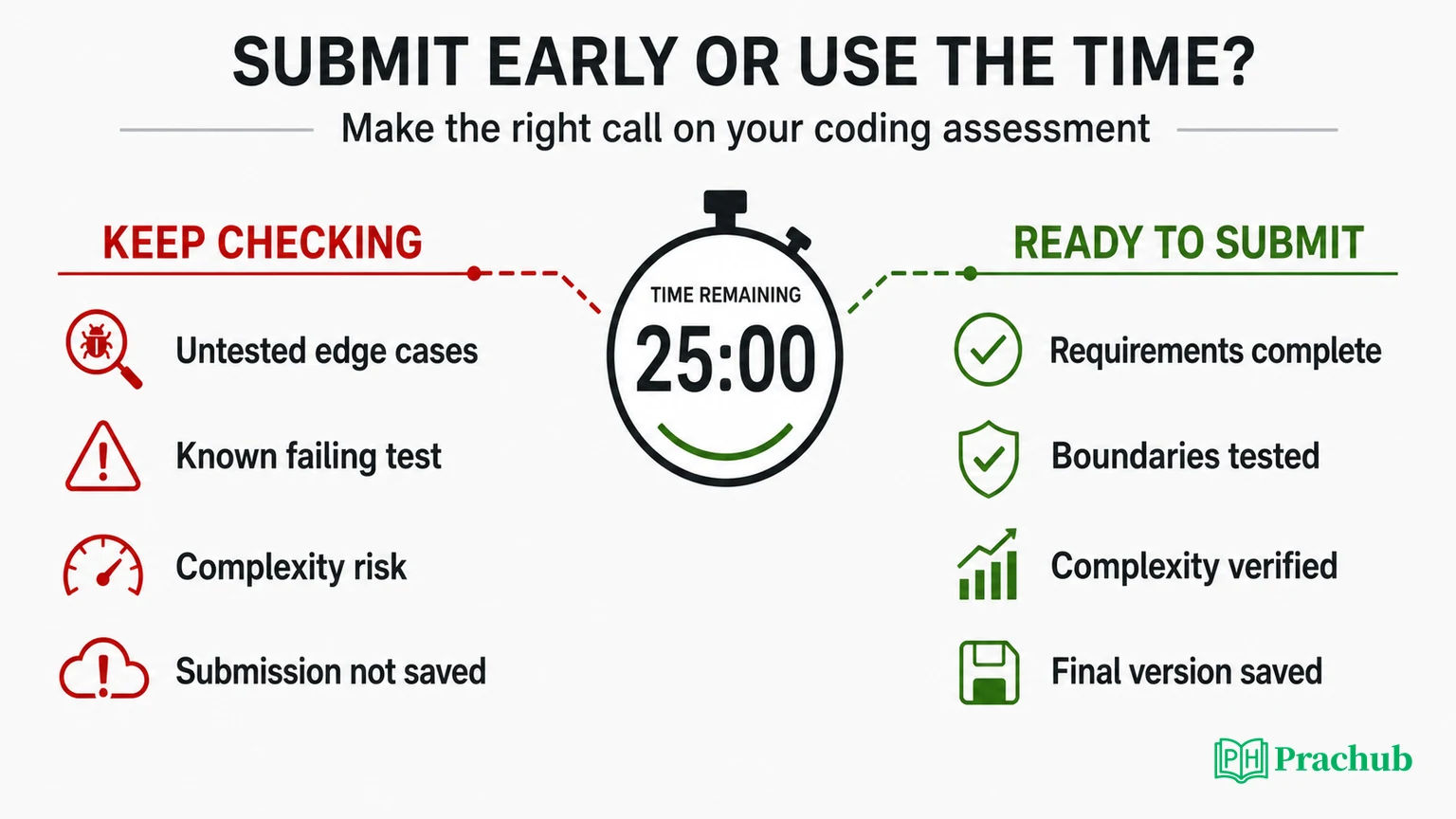
A better decision rule than "finish fast"
Think in terms of expected value per remaining minute. Continue working when a concrete action has a meaningful chance of increasing correctness or completed scope. Submit when the remaining work is speculative and risks damaging a stable solution.
Use this order:
- Correctness: Does the implementation satisfy every stated rule?
- Coverage: Have you tested normal, boundary, and adversarial inputs?
- Complexity: Will the algorithm finish within the largest constraints?
- Submission state: Is the intended version compiled, saved, and formally submitted?
- Readability: Can another engineer understand the main state and invariant?
If those five checks are complete, early submission is reasonable. If the timer auto-submits and there is no benefit to leaving, you may still keep a small buffer to verify the confirmation screen or recover from a transient problem. Do not depend on the final few seconds.
How to use the final 10 minutes
The final review should be mechanical. A checklist prevents anxiety from turning into random edits.
| Time remaining | Review action | Avoid |
|---|---|---|
| 10-7 minutes | Re-read inputs, outputs, constraints, and tie rules | Re-solving the problem from scratch |
| 7-5 minutes | Run one boundary case and one adversarial case | Repeating only the provided sample |
| 5-3 minutes | Verify time and space complexity against limits | Optimizing without a demonstrated need |
| 3-1 minutes | Remove debug output and confirm the saved submission | Large renames or structural rewrites |
| Final minute | Check submission confirmation and note genuine technical issues | Waiting for zero or refreshing the page |
For multi-question tests, apply the same logic at question level. A five-minute review of a complete question may be worth more than five minutes of unstructured work on a problem you have not modeled. Conversely, if one additional requirement is close to passing, completing it may have higher value than polishing already correct code.
Practice accuracy under time pressure with PracHub
These PracHub question-bank records train completion, edge-case review, and complexity judgment. They are practice material, not predictions of your exact assessment. Each complete title in the first column opens the question and written solution.
| PracHub question | Practice focus | Why it helps |
|---|---|---|
| Solve Two OA Coding Problems | In-place updates, integer operations, and boundaries | Forces a clean switch between two independently graded tasks |
| Group strings that are anagrams | Hashing, canonical keys, and complexity | Shows when a quick implementation is sufficient and explainable |
| Merge Overlapping Intervals | Sorting, invariants, and endpoint cases | Rewards one precise boundary rule instead of repeated patching |
| Find a Valid Task Execution Order with Dependencies | Graphs, cycle detection, and correctness | Requires both a complete result and a defensible ordering invariant |
| Design comprehensive OA test cases | Equivalence classes, boundaries, and hidden tests | Turns the final review into a repeatable process under time pressure |
Frequently asked questions
Do recruiters care if I use the full assessment time?
Some reports show total time, but there is no universal rule that using the full allowance is negative. A complete, correct submission made near the deadline can be stronger than a fast submission with missed requirements. Treat the published time as available working time unless your instructions explicitly describe speed-based grading.
Can two identical solutions receive different scores because of completion time?
They can only be assumed to differ when the assessment's scoring rules include time or another speed-based measure. Platform reports may display time without using it in the automated score. Because employers can customize tests, the invitation and instructions are the source of truth.
Should I wait before submitting if I finish very early?
Do not wait merely for appearance. Use a structured review: test boundaries, verify complexity, remove debug output, and confirm the required format. Once those checks are complete, submit with a buffer. Deliberate idle time adds no demonstrated benefit and can create deadline or connectivity risk.
Is coding speed the same as algorithm performance?
No. Coding speed describes how quickly a candidate progresses through the assessment. Algorithm performance describes how runtime and memory scale with input size. A candidate can code quickly but submit an inefficient algorithm, or work slowly and produce an optimal one. Platform terminology must be read in context.
What if I finished early but was still rejected?
Early completion does not guarantee progression. The employer may use hidden tests, a cutoff, resume re-screening, role eligibility, integrity review, headcount, or comparison with other candidates. Save the confirmation, record what you learned, and continue other applications instead of treating completion time as the only explanation.
Final takeaway
Finishing an online assessment early matters only in context. It can give you time to complete more work, appear in a recruiter report, or affect a test whose creator explicitly includes time in grading. It is not a dependable universal bonus.
Optimize for a complete, correct, explainable submission with a safe time buffer. Practice that trade-off deliberately: solve a timed PracHub coding question, spend the final minutes on hidden cases and complexity, and record whether the review changed the result. The habit you want is not rushing. It is knowing when the evidence says the work is done.
Sources and Further Reading
- CodeSignal: Understanding Assessment Score
- CodeSignal: General Coding Assessment structure and scoring signals
- HackerRank: View Candidate Test Summary Report
- HackerRank: Viewing a Candidate's Detailed Test Report
- Codility: Reading a candidate test report
- CoderPad Screen: Candidate reports
- Coderbyte: Creating an assessment and choosing whether time affects grading
- Coderbyte: AI-powered candidate report analysis
Research note: This guide was checked on August 29, 2026. Assessment providers and employers can change scoring, reporting, and integrity settings; your invitation and in-test instructions control your specific attempt.
Related Articles
CodeSignal Business Skills Assessment Guide 2026: AI Interview, Timers, and Employer Reports
Prepare for a CodeSignal Business Skills Assessment: understand AI conversations, question timers, written tasks, submissions, and employer review.
Which Programming Language Should You Use in an OA? Speed, Compatibility, and Employer Preferences
Choose the best programming language for an OA by comparing speed, runtime compatibility, employer preferences, and your own error rate with confidence.
Do Partial Test Cases Count in an OA? Hidden Tests, Weighted Scores, and Cutoffs
Do partial test cases count in an OA? Learn how hidden tests, weighted scores, platform rules, and employer cutoffs affect coding assessment results.
Why Do CodeSignal GCA Questions Feel Uneven? Dynamic Rotation, Difficulty, and Scoring
Why CodeSignal GCA questions feel uneven: how rotation, four difficulty modules, partial credit, completion bonuses, and 200-600 scoring work.
Comments (0)