Do Employers Review Your Code After an OA? Test Runs, Complexity, Style, and Playback
Quick Overview
Learn when employers review online assessment code, what test runs, complexity, style, and playback reveal, and how to submit code that holds up to human review.
Updated August 20, 2026.
You submitted the online assessment, saw most of the tests turn green, and closed the tab. Is the decision now just a number, or will someone at the company open your code and inspect how you got there?
Both outcomes are possible. Many employers use automated scores to handle a large applicant pool, so not every attempt receives a line-by-line engineering review. But modern assessment reports can expose far more than a final score: individual test results, runtime and memory, code quality, solution optimality, copy-paste events, and a replay of how the code changed.
This guide explains when employers are most likely to review that evidence, what different reviewers care about, and how to write an OA submission that holds up after the timer stops. Before your next test, practice with PracHub interview questions with written solutions, then use the hidden-test debugging checklist to pressure-test your solution.
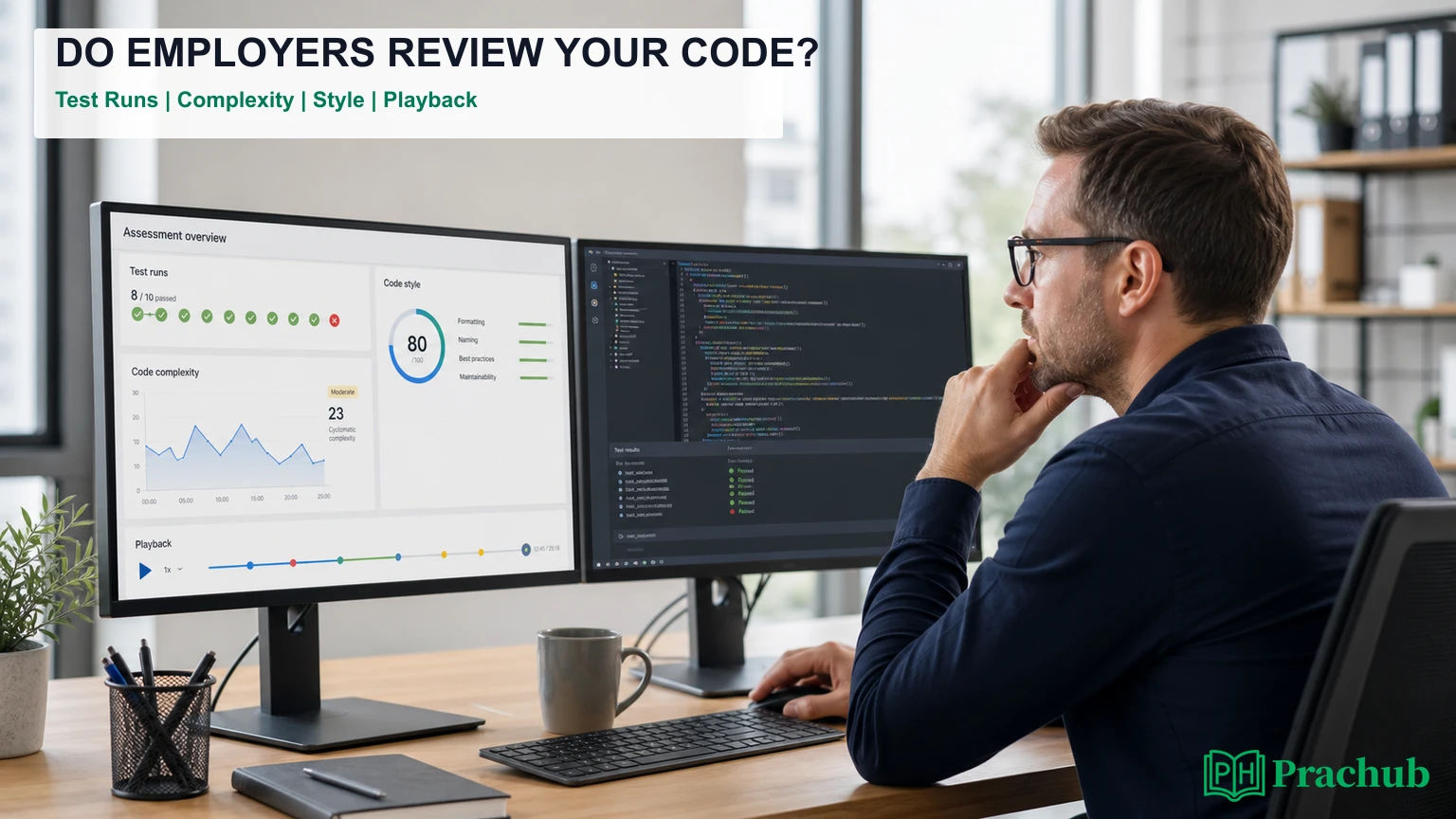
Quick answer: Do employers review your code after an OA?
Yes, employers can review your submitted code, and some do. Whether they actually open it depends on the platform, the company's process, the number of candidates, the role, and what your report shows.
A high-volume early-career screen may begin with a score cutoff and resume re-screen. A smaller team, senior role, project assessment, borderline result, or integrity flag is more likely to receive deeper review. Even within one company, one candidate may be advanced automatically while another candidate's code is inspected before a decision.
The safest assumption is simple: write every submission as if a competent engineer may read it later. That does not mean polishing it like production software. It means correct behavior, appropriate complexity, understandable structure, and no decisions you could not explain in a follow-up.
Automated grading and human review are different layers
Most coding OAs start with automated evaluation because test cases are fast, consistent, and scalable. The platform runs your program against visible or hidden inputs and records outcomes such as passed tests, execution time, memory use, and errors.
Human review adds context. A reviewer can ask why a solution passed only part of the suite, whether the algorithm scales, whether the code is maintainable, and whether the editing history makes sense. The company decides how much of that context matters.
| Review layer | What it can reveal | What it cannot prove alone |
|---|---|---|
| Automated score | How much of the configured rubric or test suite passed | Why the candidate made each decision |
| Test details | Failures, output differences, runtime, memory, and error type | Whether every hidden test is well designed |
| Optimality | Whether time and space use fit expected constraints | Overall engineering judgment |
| Code quality | Structure, naming, duplication, and maintainability signals | How the candidate collaborates on a real team |
| Playback or replay | How code evolved, including runs, edits, and some paste events | Intent from one isolated action |
| Human review | Context across the prompt, code, report, role, and hiring rubric | A perfectly objective decision without a defined process |
What assessment platforms can show employers
The exact report varies by provider and employer settings. The important point is not that every platform exposes every signal; it is that the final percentage is rarely the only artifact available.
HackerRank
HackerRank's current employer documentation says a detailed coding report can include the submitted solution, test-case result, score, execution time, memory use, and output diff. Reviewers can open the code in a review environment, change a question score, and leave comments.
Its newer summary reports can also surface code-quality and optimality grades when enabled. For coding questions, keystroke playback lets reviewers examine how the answer developed rather than seeing only the final snapshot.
CodeSignal
CodeSignal says assessment results show the questions attempted and the score for each. Employers can open the candidate's coding report, inspect the solution diff, and use coding replay to watch keystrokes in real time or at a faster speed. Its own quick-start guide describes the score as a fast top-of-funnel signal while giving teams access to the code when they want to dig deeper.
Coderbyte
Coderbyte's candidate report can include the final score, question-level breakdown, submitted solutions, coding playback, and details such as pasted code or detected similarity. The employer can also use the report to run test cases again when investigating a candidate-reported issue.
Codility
Codility offers code playback for classic tasks and session replay for some repository-style VS Code tasks. For those project workflows, a reviewer can see file navigation, edits, and terminal use over time. That is especially relevant when the assignment is designed to resemble work in an existing codebase.
When is a human most likely to open your code?
No public rule applies to every employer, but several situations make deeper review more useful and therefore more likely.
Your score is near a decision boundary
A very low score may end the process before technical review. A clearly qualifying score may advance through a configured workflow. A borderline score creates a harder decision: did you miss one edge case, choose an algorithm that cannot scale, or leave a promising solution almost complete?
Opening the code and failed tests can separate those cases. A clean near-solution with one boundary error is different from code that happens to pass several weak tests.
The role is senior, specialized, or high impact
For senior backend, infrastructure, security, data, or machine-learning roles, correctness is only one part of the signal. Reviewers may care more about trade-offs, failure handling, data modeling, and maintainability. A project or repository task naturally invites code review because the work product is the assessment.
The assessment requires manual judgment
Open-ended code review, debugging, frontend, API, and take-home tasks cannot always be reduced to one numeric score. A human may evaluate requirements coverage, tests, architecture, communication, or the quality of the patch. Our code review interview guide covers the same prioritization skills from the candidate side.
The report contains an unusual signal
A suspicious-activity flag, large pasted block, code-similarity match, extremely short completion time, or candidate-reported technical failure may trigger review. These events deserve context. A platform flag is evidence to examine, not a complete explanation of intent.
The hiring team wants evidence before the next round
An interviewer may read the OA code to choose follow-up questions: Why did you use a heap? What breaks when the input is empty? How would you reduce memory? That makes your submitted code a preview of the next technical conversation.
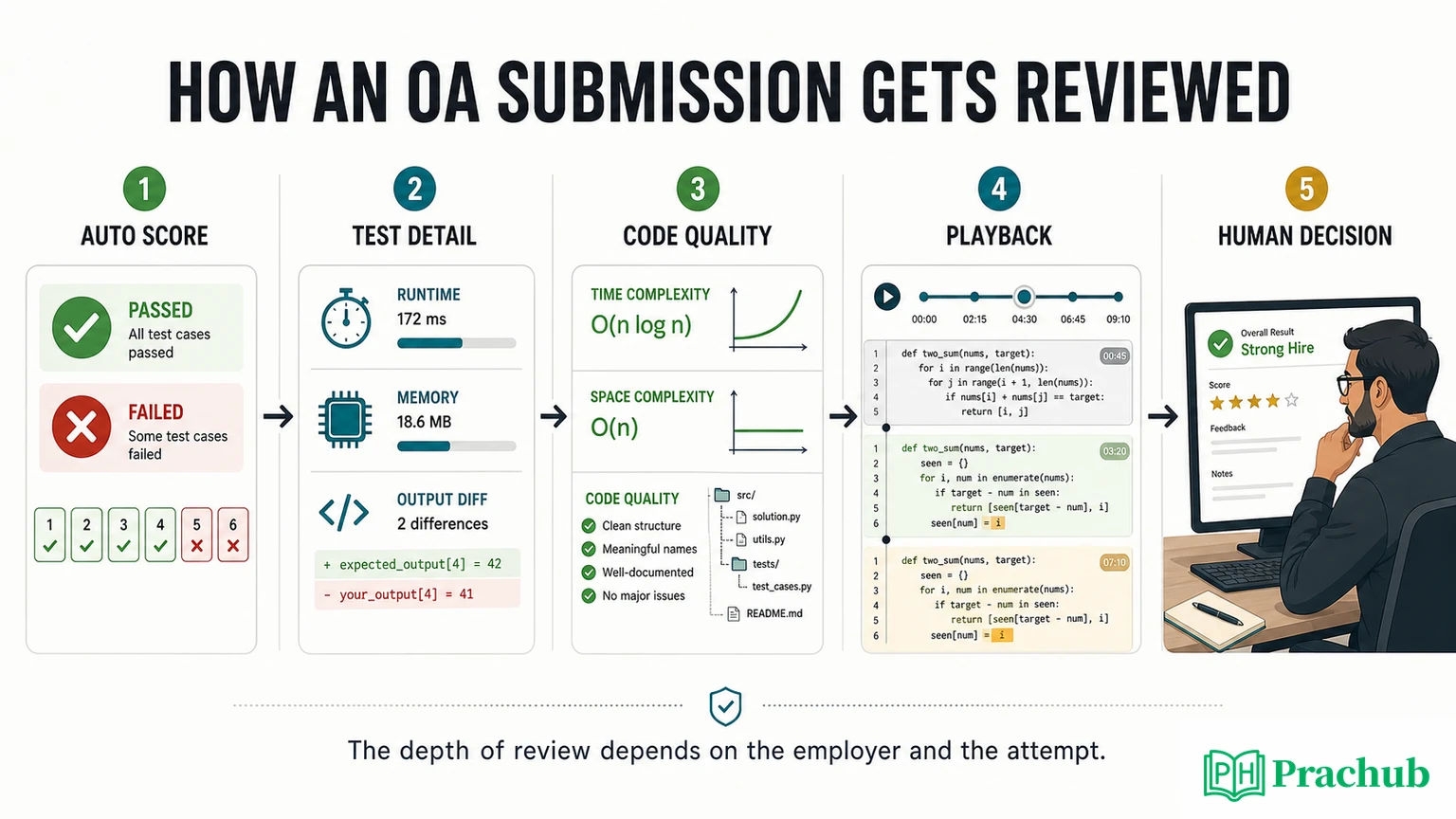
What test runs tell a reviewer
A test result is more informative when paired with the reason it failed. Reports may distinguish wrong answers, timeouts, runtime errors, compilation failures, and output differences. Each failure points to a different problem.
| Report signal | Likely reviewer question | Candidate lesson |
|---|---|---|
| One boundary test fails | Is this an off-by-one or missing empty-input case? | Test minimum, maximum, empty, duplicate, and tie cases. |
| Large tests time out | Does the algorithm violate the input constraints? | State and verify time complexity before submitting. |
| Runtime error | Was an index, null value, parse rule, or overflow missed? | Trace error-prone branches with concrete inputs. |
| Output diff | Is the logic wrong or only the required format? | Match whitespace, ordering, and data types exactly. |
| No formal submission | Is the last compiled or saved version still usable? | Leave time to run and submit the intended final version. |
Hidden tests are not merely traps. They approximate the broader contract expressed by the prompt and constraints. Your job is to infer that contract from the visible examples instead of coding only to those examples.
How much does complexity matter?
Complexity matters most when the constraints make it observable. If the input can contain 200,000 items, an O(n²) loop may time out regardless of how cleanly it is written. If the input contains at most 20 items, a simpler algorithm may be the better engineering choice.
Reviewers generally look for proportional judgment, not ritual optimization. A candidate who can explain “this is O(n log n) because of sorting, then O(n) for the scan” demonstrates more control than someone who writes a complicated structure without connecting it to the limits.
Before submission, verify four things: the dominant time cost, auxiliary space, repeated work inside loops, and whether recursion depth can exceed the language's practical limit. If you knowingly leave a less optimal solution, a short comment describing the scalable alternative can preserve useful context, although comments do not recover failed tests.
Does code style matter if every test passes?
Sometimes. Passing tests establish behavior against the configured cases; they do not make code easy to verify or maintain. Some platforms now provide explicit code-quality signals, and a human reviewer can always form an opinion from the source.
For an OA, good style is restrained. Use meaningful names, small helpers where they clarify a repeated operation, and comments for invariants or non-obvious choices. Avoid building a framework around a 30-line problem, renaming everything during the final minute, or adding comments that merely restate the code.
A reviewer should be able to answer three questions quickly: What state does this function maintain? Why is the algorithm correct? Where are the dangerous edge cases handled?
What code playback can and cannot show
Code playback reconstructs how the solution changed. Depending on the platform, the reviewer may see edits, runs, periods of activity, pasted content, file navigation, or terminal use. This can help distinguish a candidate who incrementally tested a solution from a final answer that appeared suddenly.
Playback is not mind reading. Deleting a working approach may reflect a legitimate correction. A paste may be a permitted snippet, starter code, or forbidden external content depending on the rules. A long pause may mean careful reasoning or a distraction. Good review uses playback together with the instructions, integrity settings, final code, and other evidence.
Do not try to perform for the playback. Instead, follow the stated resource policy, make progress in understandable steps, run targeted tests, and keep the final solution explainable.
Who actually reviews an OA?
| Reviewer | Likely first concern | What may trigger escalation |
|---|---|---|
| Recruiter or coordinator | Score, benchmark, completion, verification, and configured cutoff | Borderline result, status issue, or hiring-manager request |
| Hiring manager | Role fit and whether the result supports another interview | Unusual strengths, inconsistencies, or a high-impact role |
| Engineer or technical evaluator | Correctness, complexity, structure, tests, and reasoning evidence | Manual grading, project work, or ambiguous automated result |
| Integrity or platform reviewer | Whether the session follows the configured rules | Flagged events, identity concern, or verification failure |
One person may fill multiple roles at a startup. At a large employer, these steps may be separated and partly automated. That is why two candidates taking the same platform can experience very different review depth.
What can a reviewer learn in the first 60 seconds?
Assume the first review is a scan. The reviewer can often see the overall result, the weakest question, the language, the final code shape, and any prominent quality or integrity signal before deciding whether to dig deeper.
Make that scan work in your favor. Put the main algorithm on a clear path, avoid dead experiments in the submitted version, use names that reflect the problem, and keep special-case logic close to the condition it protects. If the solution depends on an invariant, explain it in one useful comment.
Why a perfect score can still be rejected
A perfect OA score proves that the submission satisfied the platform's scoring rules. It does not guarantee that the employer has finished evaluating the application. The company may still re-screen the resume, compare candidates, review role eligibility, inspect verification, or weigh a behavioral assessment.
Likewise, a perfect result with unreadable code is not automatically disqualifying, but it may be less persuasive when humans compare otherwise similar candidates. For the wider decision process, see why candidates get rejected after a perfect OA score.
Can partial credit still move you forward?
It can, but there is no universal cutoff. A partially correct answer may reveal useful progress, especially if the remaining failure is narrow and the rest of the application is strong. On the other hand, an employer may use a strict automated threshold before anyone opens the code.
During the test, prioritize a complete, tested solution to one question over scattered fragments across several unless the platform's scoring model clearly rewards a different strategy. When time is nearly gone, preserve compilable code, remove debugging output, and submit the best working version.
A review-proof OA submission checklist
| Stage | Action | What it protects |
|---|---|---|
| Before coding | Restate inputs, outputs, constraints, and ambiguous rules. | Problem interpretation |
| Before implementation | Choose an algorithm that fits the largest valid input. | Optimality and hidden tests |
| While coding | Use clear names and isolate non-obvious repeated logic. | Human readability |
| While testing | Run one normal, one boundary, and one adversarial case. | Correctness |
| Before submitting | Remove debug output and verify the required format. | Execution and output diff |
| Final minute | State complexity and leave only useful comments. | Reviewer context |
| After submitting | Save confirmation and document genuine technical issues promptly. | Process integrity |
Frequently asked questions
Do recruiters read every line of OA code?
Usually not. Recruiters often begin with the score, status, benchmark, and configured decision rules. Engineers or hiring managers are more likely to perform detailed technical review, and not every company routes every attempt to them.
Can employers see which hidden tests failed?
Many assessment reports expose test-case outcomes and diagnostic details to authorized reviewers, although the exact visibility depends on the platform and the employer's configuration. Candidates may see less information than the hiring team.
Can employers rerun submitted code?
Some platforms let reviewers compile, run, or inspect a solution in a detailed report. The behavior depends on question type and platform capabilities.
Does code playback record my screen?
Not necessarily. Code playback usually reconstructs editor changes. Screen or session recording is a separate capability that may capture broader activity. Read the assessment's consent and proctoring notice for the exact collection.
Will messy code fail an otherwise perfect assessment?
There is no universal rule. Some screens use correctness as the dominant filter; others include code-quality evaluation or human review. Clean, proportional structure reduces risk without requiring production-level polish.
Should I add comments to explain my solution?
Add short comments for an invariant, a surprising boundary, or a deliberate trade-off. Do not narrate obvious syntax. Correct code and good names matter more than a block comment claiming the solution is efficient.
Final takeaway
Employers may review much more than your OA score, but they do not all review every submission with the same depth. Automated scoring handles scale; test details, quality signals, playback, and human judgment help resolve the cases where a number is not enough.
Prepare for both layers. Write code that passes the tests, fits the constraints, and can be understood by another engineer. Use PracHub Software Engineer questions to practice under time pressure, compare your work with written solutions, and build the habit of explaining correctness and complexity before you submit.
Sources and Further Reading
- HackerRank: View Candidate Test Summary Report
- HackerRank: Viewing a Candidate's Detailed Test Report
- HackerRank: Code Quality Evaluation
- HackerRank: Advanced Evaluation
- CodeSignal: Quick Start Guide for Assessments
- CodeSignal: Accessing a Test-Taker's Assessment Result
- Codility: Session Replay for VS Code Tasks
Research note: Assessment platforms and employer review policies change. Your invitation, assessment instructions, and recruiter guidance are the source of truth for your specific process.
Related Articles
CodeSignal Business Skills Assessment Guide 2026: AI Interview, Timers, and Employer Reports
Prepare for a CodeSignal Business Skills Assessment: understand AI conversations, question timers, written tasks, submissions, and employer review.
Which Programming Language Should You Use in an OA? Speed, Compatibility, and Employer Preferences
Choose the best programming language for an OA by comparing speed, runtime compatibility, employer preferences, and your own error rate with confidence.
Do Partial Test Cases Count in an OA? Hidden Tests, Weighted Scores, and Cutoffs
Do partial test cases count in an OA? Learn how hidden tests, weighted scores, platform rules, and employer cutoffs affect coding assessment results.
Does Finishing an Online Assessment Early Matter? Completion Time, Accuracy, and Recruiter Review
Does finishing an online assessment early matter? Learn when time affects scoring, what recruiters see, and when accuracy should win in coding tests.
Comments (0)