DrillCheck Review: Experience Scenarios, Follow-up Depth, and Pass Limits
Quick Overview
Review DrillCheck’s current AI/data roles, experience scenarios, required agreement boundary and free-versus-Pass offers. Original RAG traces and a follow-up ladder separate plausible explanations from evidence-based diagnosis.
DrillCheck’s interview practice is most relevant when you want to explain an AI or data project and defend the evidence behind a decision. Its public scenarios expose specific follow-up directions, but our unsigned start reached a required terms-agreement screen before any interview turn. We did not accept it or test the conversation. Use the visible setup to assess fit; follow-up and assessment quality remain unverified.
PracHub publishes this review and owns the complementary practice links. Our RAG evaluation and debugging question offers an independent prompt. The document-version counterexample and follow-up ladder below are original educational exercises, not a DrillCheck session, score or account of work we performed for an employer.
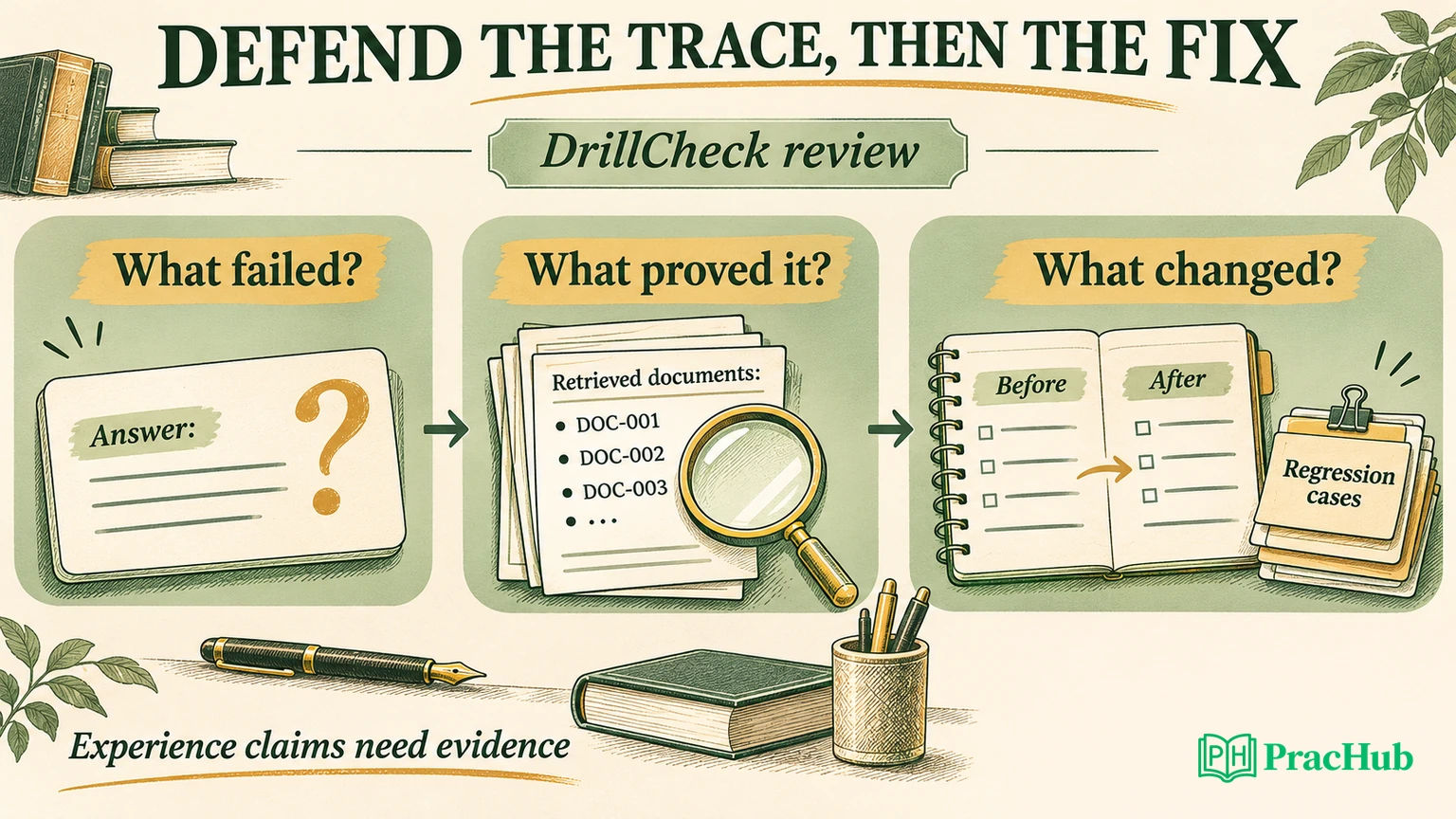
The current practice page is oriented toward AI and data roles
Direct observation, November 3, 2026: the practice page offered Data Analytics, ML/AI Engineer, LLM/Prompt Engineer and AI Product Manager. The Kubernetes query in the supplied URL did not select a Kubernetes-specific role. Do not treat the parameter as evidence of a specialist track.
The page presented three free experience scenarios, including a RAG answer based on wrong evidence, a local-versus-deployed failure and an automation that incorrectly reported completion. These are useful starting distinctions because each asks you to explain how you noticed and checked a failure.
Provider positioning: the format is intended to keep asking why, optionally using resume and job-description context. We did not validate personalization, adaptive depth or the correctness of resulting feedback. No independent candidate reports or employer-process evidence support this review.
Keep hypothetical practice distinct from your project history. A hypothetical response can be useful practice, but it should not become an invented project story. The selected RAG scenario explicitly allowed discussing what you would do if you had not faced it before.
How far the public setup actually proceeded
We selected the RAG scenario and inspected its setup. It exposed three investigation directions: locate the failure stage, explain the confirming evidence and describe re-verification. Selecting the scenario also selected the LLM role in the interface.
The next step offered difficulty, style and language. Standard was available in the unsigned flow; Pressure and Deep technical were marked as requiring sign-in. We retained the defaults and left the optional context empty. No resume, job description or self-introduction was submitted.
Starting the interview revealed a required agreement to the terms and privacy policy. We did not check that box or continue. This was the boundary of the interaction: there was no generated question turn, answer submission, follow-up, final report or score to evaluate.
This is narrower than claiming the mock worked end to end. It is also different from saying the site requires an account for every free interview. We observed a terms gate in the unsigned path, not an account requirement at that step.
Original RAG case: the same wrong number can have different causes
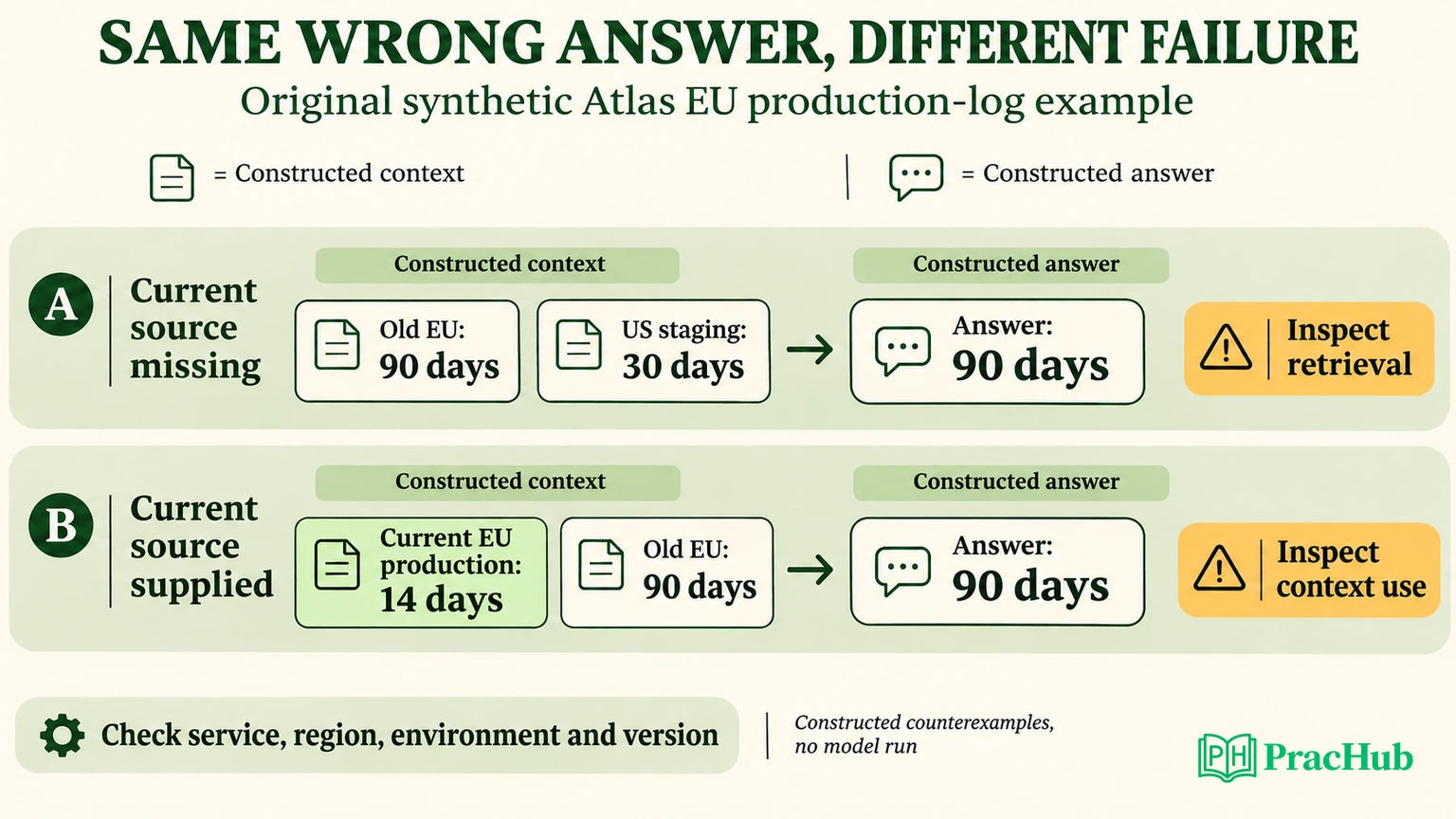
Imagine an internal assistant answering: how long are production logs retained for the fictional Atlas service in the EU region? Our synthetic corpus contains a current document saying fourteen days, an obsolete EU document saying ninety days and a US staging document saying thirty days.
All service names, documents and policies in this example are invented. No real retention requirement or product behavior is being asserted. The exercise asks what trace evidence you need before calling a wrong answer a retrieval failure or a generation failure.
The official Microsoft RAG evaluator documentation distinguishes retrieval-process evaluation from response groundedness and relevance. We use that separation as a technical reference, not as evidence that DrillCheck uses those evaluators.
Now compare three paper traces. In trace A, the selected context contains only the obsolete EU document and the US staging document. The answer says ninety days. The current evidence is missing from the context, so the first investigation should examine why the relevant document did not reach the generator.
In trace B, the current EU production document is present and clearly identified as authoritative, but the answer still says ninety days. Retrieval has supplied the needed evidence. You now need to inspect how the answer used the conflicting context and whether the current source was actually included in the final model input.
In trace C, the context contains the correct fourteen-day statement and the answer gives that value with the correct service, region and environment. That is a correct result for this particular paper query. It does not establish that the whole pipeline handles every version or ambiguous question.
| Original paper trace | Evidence available to the generator | First failure question |
|---|---|---|
| A: ninety-day answer, current source missing | Obsolete EU and unrelated staging material | Why was the current relevant document absent? |
| B: ninety-day answer, current source supplied | Current EU production evidence plus conflicting history | Why did the final answer use unsupported or superseded information? |
| C: fourteen-day answer with the right scope | Current EU production evidence | Does the result hold when scope or version changes? |
Identify the failure stage before choosing a fix for the wrong number. Increasing top-k, changing a prompt and replacing a model address different mechanisms. A defensible answer identifies what the trace establishes before choosing among them.
Add the missing scope before declaring the answer correct
Suppose the user asks only about Atlas logs, without specifying production or staging. A confident fourteen-day answer may still be incomplete because the query’s scope is unresolved. The correct evidence for one interpretation does not remove ambiguity from the question.
For this original case, identify service, region, environment and effective version. If one field is absent, explain whether the assistant should ask a clarification, state an assumption or present the supported alternatives. Choose the behavior according to the application’s requirements rather than assuming every question has one obvious answer.
Check relevance and version as well as grounding. A response can accurately repeat an obsolete passage while answering the current-policy question incorrectly. You need a relevance and version rule in addition to a check that the words appear somewhere in retrieved text.
No retriever, embedding model or language model was executed for these traces. They are deliberately constructed counterexamples. They demonstrate why a debugging explanation needs intermediate evidence; they do not provide measured accuracy or a production benchmark.
A follow-up ladder that tests reasoning rather than fluency
Prepare three levels of explanation for an experience-led scenario. First state the observation: which answer was wrong, against which reference and for which query. Preserve the difference between a reported problem and a confirmed mismatch.
Second, localize the mechanism. In the original traces, request the retrieved document identifiers, version metadata and final context. Check whether the needed evidence was absent, filtered out, truncated or present but not used appropriately. Do not infer that an intermediate retrieval result was necessarily the exact prompt context.
Third, explain the intervention and its re-verification. If the current source was excluded by a filter, test that filter change against relevant queries and cases that should remain excluded. If the answer ignored a supplied version rule, compare the generated response under controlled inputs and inspect regressions.
This ladder mirrors the kinds of questions the public scenario advertises, but it is our independent exercise. We did not establish that DrillCheck asks these exact follow-ups or recognizes these distinctions in a submitted answer.
A weak rehearsal answer says “I improved the RAG and the answers got better.” A stronger answer names the failed trace, the changed component, the comparison and the remaining limitation. For a hypothetical case, say that these are proposed checks rather than results from a project you never ran.
Make re-verification specific enough to challenge
Test a correction against cases beyond the original failure. Include a current-version case, an obsolete-version query where history is intentionally requested, a different region, an ambiguous environment and a case with no authoritative answer available.
For each case, define the expected behavior before looking at the output. A missing-answer case may require abstention or clarification. A historical question may legitimately use an old document. The evaluation should not punish every mention of an older value merely because the current query uses fourteen days.
Record which component changed while holding other inputs fixed where practical. If the corpus, retriever, prompt and model all change together, an improved result does not isolate the contribution of any single adjustment. That uncertainty belongs in your explanation.
Keep correctness, latency and cost as separate observations. A faster answer is not necessarily more accurate, and a more accurate answer may change resource use. We did not measure any of those properties for DrillCheck or for a real RAG system here.
Free scenarios, day access and the Pass
The pricing page displayed a $20 monthly Pass with sixty mock-interview turns per day and access to every Practice scenario. It separately advertised a $9 day ticket lifting the interview-turn cap for twenty-four hours. We did not buy or activate either offer.
The practice page described three free scenarios and sixty more with the Pass. Pricing also described thirty daily turns for signed-in free users. That is not a verified guest allowance, and turns should not be silently converted into complete interviews.
| Public offer | Described practice scope | Check before relying on it |
|---|---|---|
| Free route | Three listed scenarios; an open interview option | Actual guest availability and applicable setup conditions |
| Day ticket | All scenarios and uncapped turns for the stated window | Start time, duration and current purchase terms |
| Monthly Pass | All scenarios and a daily turn allowance | Turn accounting, renewal and entitlement state |
The page says the free interview also receives an assessment; paid access changes allowance rather than promising a different report. Those are provider terms. We did not validate report contents, interruption handling, consumed turns or cross-device access.
The pricing page also offers human services. They are separate from this AI practice review; we did not apply, contact anyone or evaluate those services. Do not use the price of a human checkpoint as a description of the free scenario flow.
Experience context should improve specificity, not create history
Optional background can make a question more relevant, but it cannot supply evidence for a claim you did not substantiate. For practice, use a contact-free project summary and be explicit about which decisions you made, which results you observed and which checks remain proposed.
Our review did not test the upload or personalization path. The visible fields therefore establish an offered input method, not successful parsing or retention behavior. Read the current terms and privacy information before providing real application material.
If a scenario is unfamiliar, answer it as a design or diagnostic proposal. Distinguish “I would inspect the final context” from “I inspected it and confirmed the cause.” Use the tense that accurately describes whether you performed the check.
Practice the gaps the product leaves open
These independent PracHub questions extend the RAG scenario into evidence and re-verification. They are complementary prompts, separate from DrillCheck’s scenarios, Defense Guides and assessment reports.
| PracHub question | What to examine |
|---|---|
| Design RAG Evaluation and Debugging | Separate retrieval evidence from the generated answer when locating a failure. |
| Evaluate Factual Accuracy and Consistency in a Domain-Specific RAG Chatbot | Define factual correctness and consistency against a known reference. |
| Design an Evaluation and Improvement Loop for a Production LLM Application | Explain a correction with a baseline, a regression set and a repeatable comparison. |
| Assemble a RAG Pipeline From Provided Python Interfaces and Explain Retrieval | Trace what reaches the generator through a concrete pipeline interface. |
| Reconcile RAG Document Expiry, Chat History, and Cold Audits | Preserve document version and expiry semantics when an old answer remains visible. |
Who should consider DrillCheck next
DrillCheck’s visible format fits AI and data learners who want to defend project decisions and explain re-verification. Its public setup gives a focused starting point, while actual follow-up depth and assessment quality remain untested in this review.
Answer the RAG debugging prompt using traces A and B. Request the evidence that distinguishes them before proposing a fix. Save the changed assumption and the regression case you would add; that gives a future mock a concrete reasoning target.
Comments (0)