eBPF Interview Questions: Tracing, Networking, Verifier Rules, and Performance
Quick Overview
Prepare eBPF interview questions on tracing, networking, maps, verifier rules, performance, observability, and safe rollout.
eBPF interview questions test whether you can use a powerful kernel extension without hand-waving about safety or overhead. Be ready to distinguish tracepoints, kprobes, uprobes, socket or XDP programs, maps, ring buffers, and user-space loaders. The Linux and eBPF documentation make the verifier's role explicit: programs must satisfy safety, boundedness, pointer, and helper rules before native execution. Strong answers connect the hook to the question, the map to the data path, and the measurement to a baseline.
Start with PracHub interview questions to practice the underlying skill while this article explains the named platform, workflow, or engineering topic. PracHub questions are practice material; they are not claims about a private employer question bank.
Quick answer
| Question | What the evidence supports | Practical move |
|---|---|---|
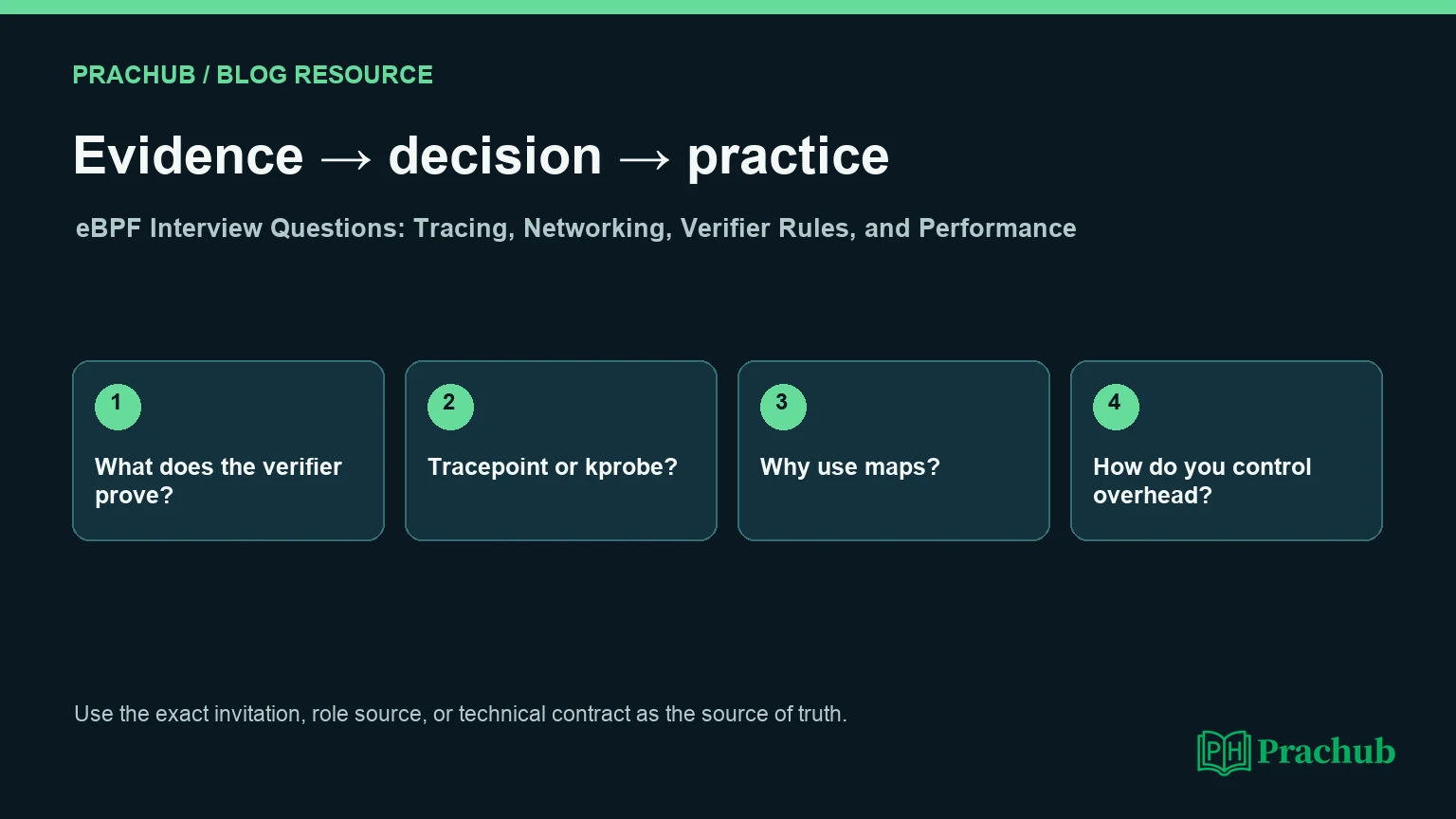
| What does the verifier prove? | It checks safety properties such as bounded execution, valid memory access, and helper arguments. | Explain the proof obligation, not just the error message. |
| Tracepoint or kprobe? | Tracepoints offer stable predefined events; kprobes attach to kernel symbols and can be more version-sensitive. | Choose based on stability and the question. |
| Why use maps? | Maps share state between eBPF programs and user space with defined types and access rules. | State capacity, contention, and cleanup. |
| How do you control overhead? | Filter early, aggregate in kernel space, sample, and bound event output. | Measure CPU, latency, and lost events. |
| What is a safe rollout? | Load narrowly, observe verifier and runtime errors, and keep a detach or rollback path. | Never start with an unbounded production probe. |
Read this article in three layers. An official provider or employer source establishes what the product or process says. A candidate report can suggest a useful preparation drill, but it does not prove that every candidate sees the same configuration. The final layer is an inference: a tactic that follows from the evidence. Keeping those layers separate prevents a familiar platform name from turning into an invented universal rule.
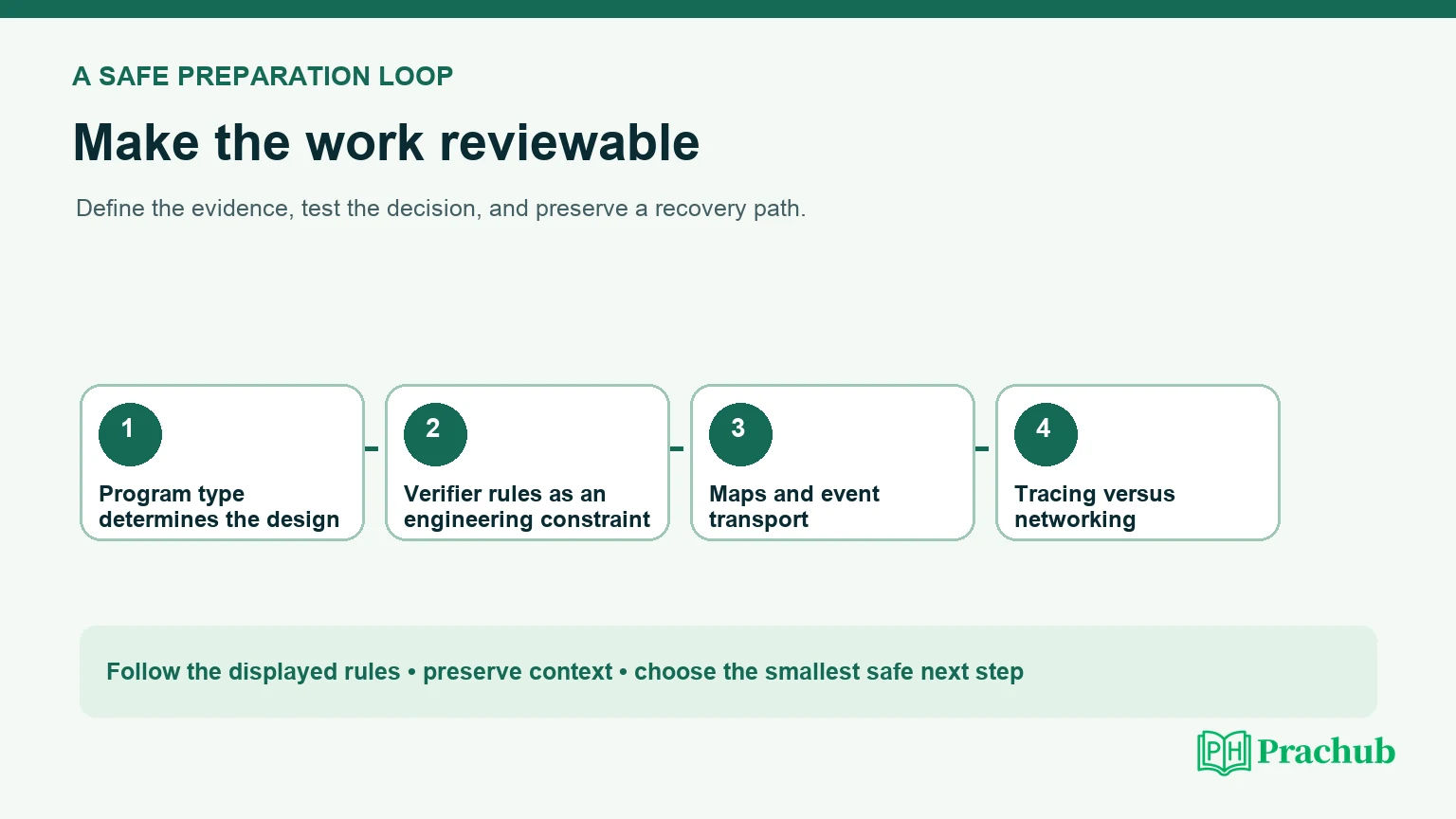
Program type determines the design
A tracepoint program observes a predefined kernel event; a kprobe or uprobe attaches to a symbol; a networking program may inspect packets under stricter bounds. The hook determines the context fields, helpers, permissions, and stability risk. Start an interview answer with the event you need and the kernel or user boundary where it exists. A generic 'attach eBPF' answer misses the main design choice.
Verifier rules as an engineering constraint
The eBPF verifier tracks pointer types, bounds, null checks, initialized stack values, loop termination, and helper arguments. The Linux kernel documentation explains that programs cannot read arbitrary memory, run indefinitely, or leave locks held. When a verifier error appears, simplify the proof: check the pointer, bound the loop, narrow the context, and move complex parsing to user space. Tail calls or separate programs can split logic, but they do not remove the need for safe boundaries.
Maps and event transport
Use maps for state that must survive between invocations or be read by user space. Choose a hash, array, LRU, per-CPU map, ring buffer, or perf buffer based on access pattern, ordering, memory, and event rate. Aggregate counters or histograms in the kernel when individual events are unnecessary. If every packet becomes a user-space event, the transport—not the probe—may become the bottleneck. State how you handle lost samples and map cleanup.
Tracing versus networking
For latency tracing, correlate entry and exit with a key that cannot collide under concurrency, then account for missing exits and task reuse. For networking, respect packet bounds, parse only what the program type permits, and decide whether XDP, TC, socket, or user-space capture is the right layer. A networking answer should mention malformed packets and CPU cost. A tracing answer should mention clock choice, aggregation, and the difference between observed overhead and causation.
Performance and correctness
Measure baseline CPU, tail latency, memory, event loss, and verifier load before and after attaching a program. Filter by cgroup, process, namespace, or port when the question permits. A low average overhead can hide a severe tail or a hot-path regression. Validate the event schema across kernel versions and keep a feature-detection path for missing helpers or BTF. The strongest answer treats observability as production code with an operational budget.
Debugging and rollout
Use a minimal reproducer, verifier logs, program statistics, and a known-good event before adding complexity. Load in a narrow scope, confirm events, compare against an existing metric, and keep a detach command or daemonset rollback. If a program fails only on one kernel, inspect program type, BTF, helper availability, and verifier state. Do not claim that passing verification proves the measurement is semantically correct; safety and meaning are separate checks.
Practice with five verified PracHub questions
Use these complete PracHub question titles as deliberate practice. Work once under a timer, then repeat while narrating the invariant, the failure mode, and the trade-off. The links build transferable skill; they do not imply that the named company or platform will reuse the prompt.
| PracHub question | Skill to rehearse | Review prompt |
|---|---|---|
| Implement a crash-resilient LRU cache | durability, recovery, and invariants | State the invariant, test one failure case, and explain the complexity. |
| Find a valid task execution order with dependencies | graphs, ordering, and cycle handling | State the invariant, test one failure case, and explain the complexity. |
| Compute statistics in a data stream | streaming state, numerical stability, and scale | State the invariant, test one failure case, and explain the complexity. |
| Implement a thread-safe rate limiter | concurrency, backpressure, and correctness | State the invariant, test one failure case, and explain the complexity. |
| Build a versioned in-memory database | versions, reads, writes, and consistency | State the invariant, test one failure case, and explain the complexity. |
A focused preparation and recovery plan
| Step | What to do | Evidence to keep |
|---|---|---|
| 1. Confirm | Read the invitation, role page, or assessment landing page. Record the deadline, timezone, timer, allowed tools, identity checks, and accommodation contact. | A screenshot or saved message with private details redacted. |
| 2. Baseline | Complete one representative exercise without changing the rules. Measure correctness, time, and the point where you became uncertain. | The prompt, your approach, and a short error log. |
| 3. Diagnose | Separate a content problem from a platform, network, account, or evidence problem. Do not refresh repeatedly while a timer is running. | Timestamped notes, browser version, and visible error text. |
| 4. Rehearse | Repeat the narrow skill this article identifies. Add one adversarial case and one explanation of what would change at larger scale. | A corrected solution or one-page decision record. |
| 5. Escalate | If the official owner must change a deadline, reopen a session, or explain a report, send a concise factual request. | The original invite, incident timeline, and requested remedy. |
Frequently asked questions
Why can the verifier reject a null map value?
A lookup can return null, so the program must prove the pointer is checked before dereference.
When is a tracepoint preferable to a kprobe?
When a stable predefined event is sufficient and kernel-symbol coupling would add version risk.
How do you reduce eBPF overhead?
Filter early, aggregate, sample, use appropriate maps, and measure lost events and tail latency.
What makes an eBPF loop acceptable?
The verifier must prove it is bounded and safe for the program type and kernel limits.
What is a good eBPF incident answer?
Name the hook, prove the data path, compare with a baseline, and keep a detach and rollback plan.
Before you start
Turn the article into a small decision record before you act. Write the exact question you need to answer, the source that could answer it, and the consequence of being wrong. For an assessment, that might be whether the timer stops, whether a second display is allowed, or whether a previous result can be reused. For a technical interview, it might be whether the system promises per-key ordering, whether the verifier can prove a loop is bounded, or whether a cache update can be replayed. This framing keeps preparation tied to the target rather than to a list of fashionable keywords.
Next, separate hard constraints from choices. A deadline, access rule, memory limit, privacy boundary, or source-of-truth requirement is a constraint. A page size, data structure, model pair, retry policy, or practice order is a choice that you should justify. Write one default choice, one alternative, and the signal that would make you switch. Interviewers and recruiters can then see judgment instead of a memorized answer.
Finally, decide what evidence will close the loop. Save a confirmation, a source position, a benchmark row, a test result, a metric, or a recovery ticket. Do not collect private assessment content or credentials. The evidence should be sufficient for the next person to reproduce the decision without exposing information they are not authorized to see. If the evidence is missing, label the conclusion provisional and ask the owner for the exact next action. That discipline is useful whether the page is about a hiring platform, a production system, or a candidate-reported study.
A final quality check is simple: remove any claim that depends on an unnamed company policy, an undated forum anecdote, or a number whose denominator you cannot explain. Replace it with the narrower fact, the verification step, or the limitation. Readers usually need a safe next move more than a confident-sounding prediction. That editorial boundary also makes the draft easier to update when a platform changes its controls or a new hiring cycle starts. Use the same discipline for every source and every handoff.
How to decide what to trust
The live invitation and the instructions shown inside the assessment outrank a generic article. The provider's current help center explains default product behavior, but employers can choose different question types, timers, proctoring controls, report fields, or deadlines. An official employer page establishes the published role or event context; it does not establish every team's interview sequence. Candidate reports are useful when they identify the role, date, and product, yet they remain samples. When two sources disagree, record the conflict instead of averaging it into a made-up number. If a technical incident is involved, preserve the state first, then use the platform's support route or the recruiter who owns the invitation. This approach is slower than guessing, but it gives the reader an action that can be defended and repeated.
Final takeaway
Use eBPF as a constrained, measurable program. Explain the hook, verifier proof, state path, event budget, and rollback rather than treating the technology as a magic kernel sensor.
Sources and Further Reading
Research note: Sources checked 2026-09-06. Platform settings, recruiting schedules, and technical documentation can change; verify the exact invitation or current release before acting.
Comments (0)