ElevenLabs Software Engineer Interview Guide 2026: CoderPad, Audio Streaming, and Product Engineering
Quick Overview
An evidence-labeled ElevenLabs SWE interview guide separating official hiring and role expectations from dated and undated candidate reports, with original workspace-permissions and audio-interruption exercises.
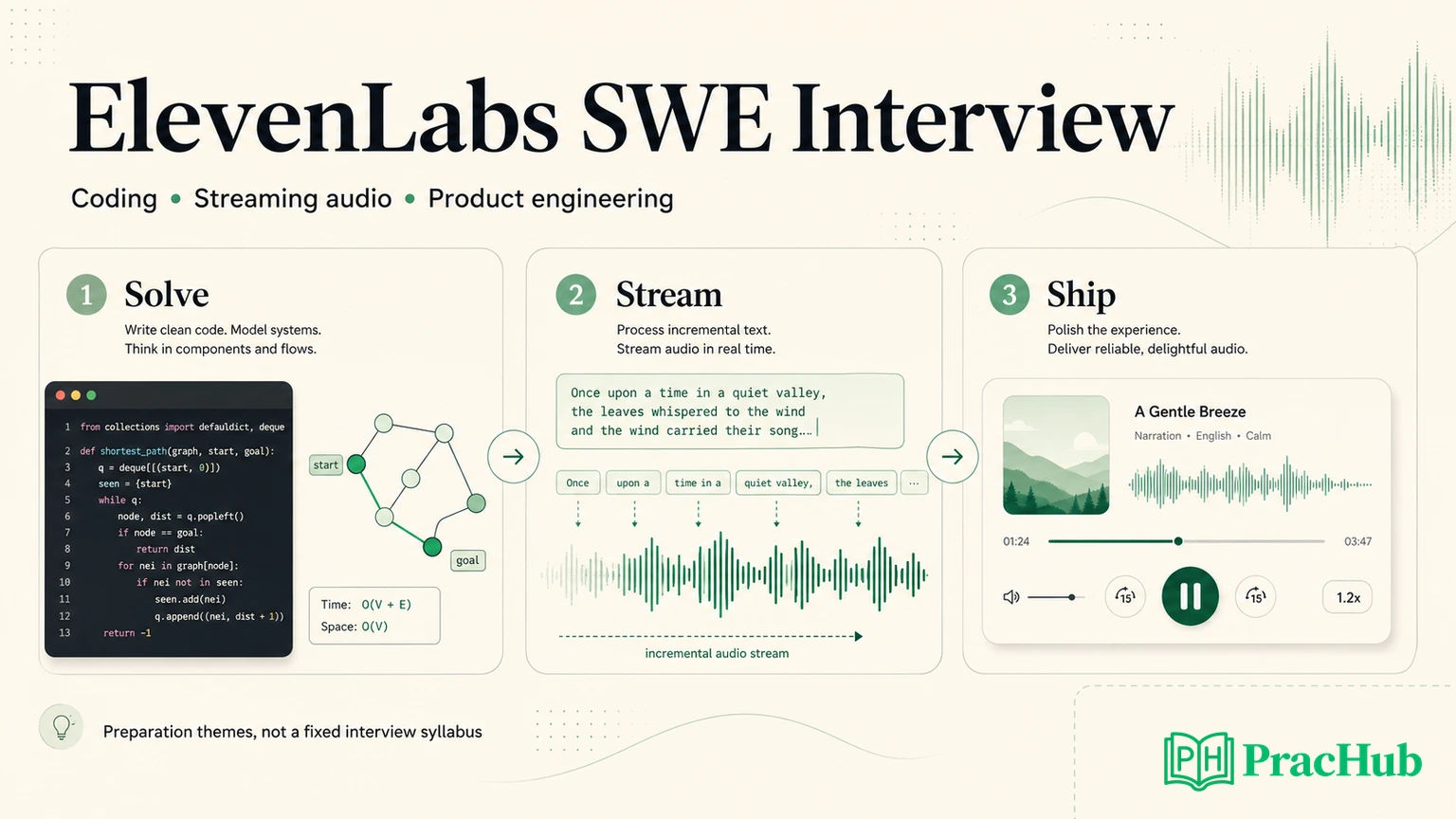
Preparing for an ElevenLabs software engineer interview in 2026 means separating three things: the process your recruiter confirms, the coding exercises candidates describe, and the engineering problems suggested by ElevenLabs’ audio products. CoderPad appears in a historical candidate account; a universal 90-minute assessment is not established by the official careers page.
A useful preparation strategy connects these layers. Solve a bounded problem clearly, then explain how your code behaves when speech arrives incrementally, a user interrupts playback, or an edited script makes generated audio obsolete. This guide distinguishes official facts, candidate reports, and original practice recommendations throughout.
Use the cross-company PracHub Software Engineer questions to rehearse implementation and tradeoffs alongside the audio-specific exercises below. These practice records do not establish ElevenLabs’ interview syllabus.
What is confirmed about the interview process?
Official facts: ElevenLabs says the process varies by role. Its general framework includes a pre-screen, virtual interviews that may include a skills assessment or take-home exercise, a hiring-manager interview, and a final conversation with a founder or Bar Raiser. That framework does not specify a company-wide coding platform, question count, passing score, or completion deadline. ElevenLabs careers
Candidate reports: The accounts below show useful preparation signals, with different dates and circumstances. They are individual experiences, not a pooled estimate of what every applicant receives.
| Evidence | What the candidate described | How to use it |
|---|---|---|
| Historical full-stack account; interview date unverified | A 90-minute CoderPad with two medium-level problems, followed by practical coding and product decomposition | Rehearse timed implementation, but confirm the current format |
| SWE account accessed in 2026; indexed view says India remote | A three-part OA involving maps, queues, and BFS, then a permissions problem | Practice data structures and translating rules into code |
| May 2026 frontend-leaning account, London; published August 26 | Additional take-home and live coding after moving from one role process to another | Ask whether changing teams changes the remaining stages |
Sources: historical full-stack account, SWE account accessed in 2026, and Glassdoor frontend-leaning report.
The indexed Exponent views show relative interview dates, while the live pages no longer expose those dates consistently. Treat their event timing as unverified.
The distinction matters for scheduling. The historical account describes a two-week process; the other SWE account was still awaiting a result after two weeks. Neither establishes a current end-to-end timeline. Get the remaining stages and expected response date from your recruiter before making plans around an assumed final round.
Match your preparation to the actual role
Official role expectations: The backend-leaning full-stack listing emphasizes Python, backend development, APIs, storage, test design, and security fundamentals. The frontend-leaning listing names TypeScript/React, UI/UX, and ownership of features across frontend and backend. Both describe work that turns voice-model capabilities into usable products. These are job requirements, not proof of particular interview questions. Backend role, frontend role.
Preparation inference: A backend candidate should be able to implement collection operations, explain asynchronous failures, and defend an API contract. A frontend candidate should also make loading, cancellation, stale results, and recovery understandable on screen. For either track, choose one audio workflow and explain what the user can do at each state.
Avoid spending all your preparation on model training because ElevenLabs is an AI company. For a product-engineering role, being able to locate a playback bug across client state, transport, and generation may be a more useful demonstration. Check your specific opening before assigning that emphasis to a research or infrastructure position.
Prepare for CoderPad without treating one report as a rule
Recommended practice: Run a timed session in a plain editor with executable tests. If your invitation confirms a two-problem, 90-minute format, rehearse that format; otherwise match the invitation. The historical report supports including this rehearsal, not assuming its timer still applies.
Before coding, clarify the input contract, permitted mutations, and the expected behavior for missing data. State a simple approach and its complexity. Then implement a complete version, run ordinary cases, and spend the remaining time on counterexamples rather than unnecessary abstractions.
For a Python exercise, know the difference between a queue with efficient removal and repeatedly shifting a list. For asynchronous work, explain what happens when one request fails while others are running. A solution that starts every operation simultaneously needs a reason the downstream service can tolerate it.
Ask which language, libraries, documentation, and AI tools are permitted. ElevenLabs’ enthusiasm for AI in everyday work does not itself authorize assistance during an assessment. The invitation and interviewer’s instructions define that boundary.
Original coding exercise: permissions for an audio workspace
The following is an original practice problem, motivated by the reported permissions topic and adapted to an audio workspace. It is not a reconstruction of the candidate’s prompt or ElevenLabs’ access-control implementation.
A reviewer belongs to group studio-editors. That group inherits permissions from project-members, which inherits from workspace-readers. The reviewer may also belong directly to workspace-readers. Each group grants a set of actions on a recording. Compute the union of permissions reachable from the reviewer’s starting groups.
For this exercise, inheritance points from a group to the groups whose permissions it receives. Grants are additive, with no explicit deny rule. Given read on workspace-readers, comment on project-members, and regenerate on studio-editors, the result is {read, comment, regenerate}.
Use a queue or stack and a visited set. Add each newly reached group’s grants once, then traverse its inheritance edges. The visited set handles both repeated paths and an accidental cycle. With adjacency lists, traversal costs O(V + E), plus the number of grant entries processed, for the reachable subgraph.
Test a reviewer with no groups, a diamond-shaped inheritance graph, an unknown group identifier, and a cycle. Define whether unknown identifiers cause validation failure or contribute no permissions; do not silently choose behavior halfway through implementation.
Now change the contract: the workspace introduces explicit denies. Your additive union is no longer sufficient. Ask about precedence, scope, and whether a direct grant overrides an inherited deny. This follow-up tests whether you notice that a new business rule can invalidate an otherwise correct algorithm.
Audio streaming: separate generation from playback
Official API behavior: ElevenLabs distinguishes sending complete text for HTTP streaming from sending text incrementally over a WebSocket. Streaming generation begins returning audio before the whole utterance is synthesized. Committing with less text can reduce waiting but sacrifice context for natural speech. Model inference latency also differs from the time until the user hears audio. Audio-streaming documentation
Original design exercise: Build a spoken preview for a script editor. If the complete paragraph already exists, explain why you would begin with a complete-text request. If a response is arriving from an LLM, explain what policy decides when accumulated text is ready to send. Make the input availability drive the transport choice.
Instrument separate events: request sent, first audio received, first decoded samples ready, and playback started. A slow first sound may come from the client even when the network response is prompt. Record buffer underruns as well as startup delay, because minimizing buffering can create audible gaps.
Use a simple sizing calculation in your explanation. In a hypothetical uncompressed mono stream at 24,000 samples per second and 16 bits per sample, 200 milliseconds contains 9,600 bytes. This is an exercise assumption, not an ElevenLabs default. Compressed audio and transport chunk boundaries require their own decoding rules; a received chunk is not automatically a playable frame.
Then describe overload. If audio arrives faster than playback consumes it, an unbounded queue increases memory and leaves more unwanted speech waiting after an interruption. Choose a buffer policy, cancellation behavior, and metrics before adding infrastructure.
Original interruption trace: stop the old answer completely
Official API behavior: ElevenLabs’ multi-context WebSocket guide describes separate generation contexts and handling interruptions by closing the old context and starting another. Its example sends close_context for the interrupted context. Closing a generation context and removing audio already queued in your player are separate operations. Multi-context WebSocket guide
Original client design: Assign each spoken response a generation identifier. The active response is 41; the client has played chunk A0 and queued A1. The user interrupts. Advance the active identifier to 42, stop scheduled playback where supported, discard buffered audio from 41, and request closure of the old server context.
Now a delayed chunk A2 arrives from generation 41. Reject it before decoding or enqueueing. When generation 42 produces B0, accept it for the new playback stream. Audio already heard cannot be undone, so measure how quickly interruption detection reaches the actual player, not merely when the cancellation message was sent.
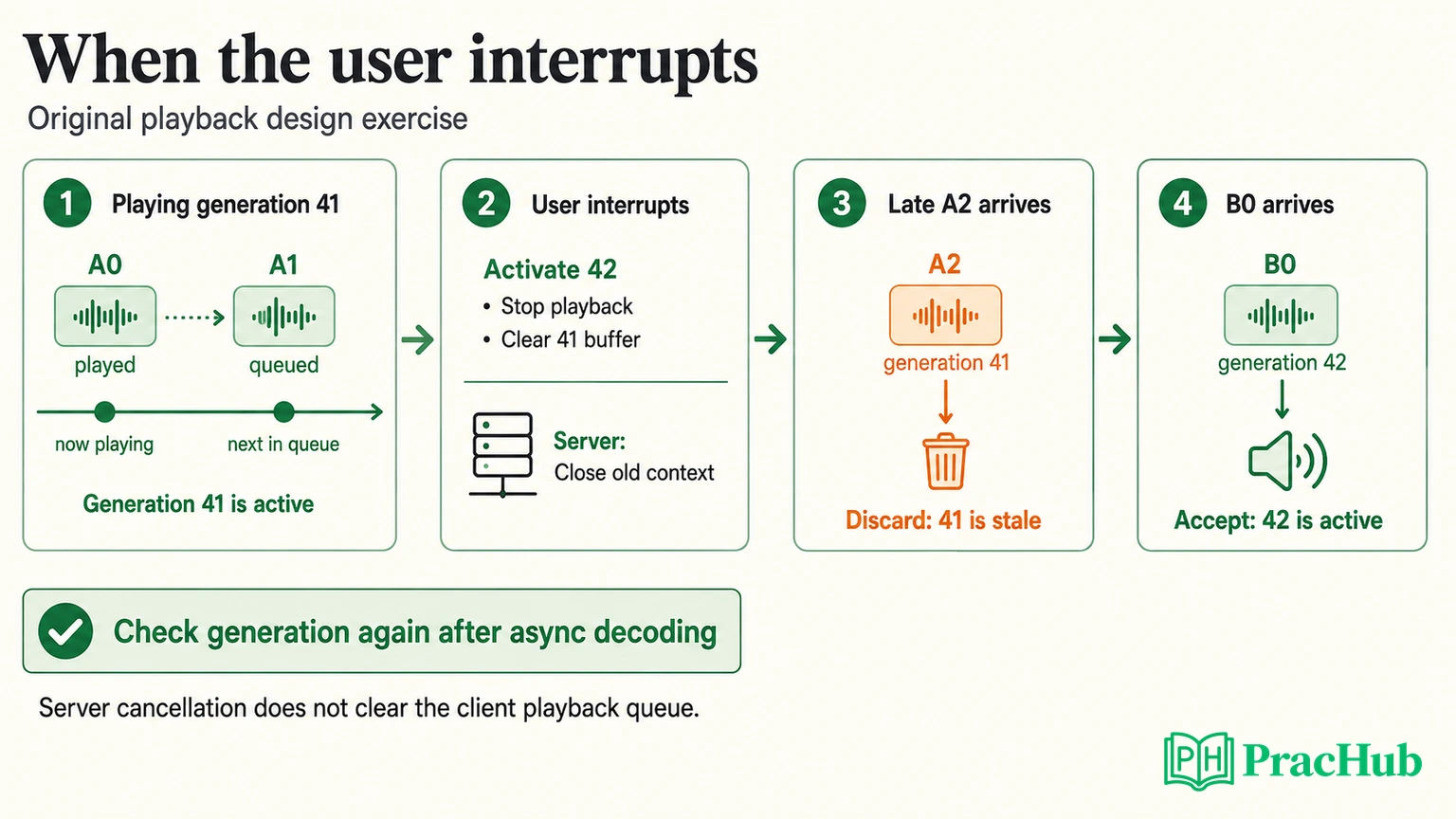
The key invariant is: only the active generation may add audio to the current playback queue. Check the identifier again after any asynchronous decode operation, since an interruption may happen while decoding is in progress. Keep that check and the queue update coordinated with the interruption handler.
Test interruption before the first chunk, during decoding, while audio is scheduled, and twice in quick succession. Also test a delayed error from the canceled generation: it must not replace the new response’s healthy state with an error banner. This makes the exercise about visible product correctness as well as transport cleanup.
Product engineering: make edited speech understandable
Original preparation scenario: A creator changes one sentence while its spoken preview is generating. Decide what identifies the requested output: document, sentence, text revision, voice, and relevant generation settings. When the old request finishes, keep it from attaching its audio to the new sentence revision.
Separate the editing state from the generation state. A sentence can be saved while its preview is still generating or has failed. Give the creator an accurate action: continue editing, retry the failed preview, or listen to a clearly labeled earlier version. Avoid a single spinner that hides whether text was saved.
Start the design discussion with one creator previewing one sentence. Define revision identity, completion handling, and retry semantics before expanding to collaboration or many simultaneous previews. For retries, first check whether the API supports resuming an existing request. If it requires a new generation, explain that the output and cost may change.
For your project discussion, prepare a story about a feature you shipped. Explain the user problem, the first usable scope, one technical compromise, and what changed after feedback. Bring an artifact you can discuss without exposing private work. If the project never shipped, explain what prevented it and what evidence you still obtained rather than inventing adoption.
Five focused PracHub exercises
These are cross-company practice records, not reported ElevenLabs questions. Choose them for the underlying skills: graph traversal, incremental state, concurrent updates, admission control, and ownership of media work. Some full question details may require access.
| PracHub question | Practice focus | Audio-product follow-up |
|---|---|---|
| Solve Open the Lock BFS | Queue discipline and visited states | Explain how the visited set changes for inherited permissions |
| Median of a Data Stream | Incremental aggregation | Distinguish arrival order from the state your algorithm maintains |
| Design and Implement a Thread-Safe LRU Cache | Atomic state updates | Identify cached preview keys that must include a text revision |
| Implement a thread-safe rate limiter | Concurrent admission decisions | Explain how rejected generation requests appear to the creator |
| Design a Concurrent Image Processing Service | Worker ownership and retries | Compare background media jobs with interruptible playback |
What to confirm before the next round
Ask for the coding environment, language expectations, remaining stages, and whether the design discussion emphasizes product workflows or infrastructure. Request an expected follow-up date, especially if the team or opening changes. The public evidence does not support a universal 2026 cutoff or hiring timeline.
For your next rehearsal, start with Solve Open the Lock BFS, then explain the permissions traversal aloud. Finish by walking through the generation-41 interruption trace, including the late chunk and the decode race. You should be able to demonstrate both a correct algorithm and what the user hears when the system changes state.
Sources and Further Reading
- ElevenLabs careers: official hiring framework
- ElevenLabs Full-Stack Engineer, Back-End Leaning
- ElevenLabs Full-Stack Engineer, Front-End Leaning
- Exponent: historical full-stack candidate account
- Exponent: software engineer candidate account, accessed in 2026
- Glassdoor: ElevenLabs candidate reports, including May 2026 frontend-leaning experience
- ElevenLabs: understanding audio streaming
- ElevenLabs: multi-context WebSocket guide
Research checked September 7, 2026. Candidate accounts vary by role and location; relative dates are not treated as exact calendar dates. Official job and API documentation inform preparation, not a guaranteed interview syllabus.
Comments (0)