Embedded Level Review: Topic Ratings, Firmware Questions, and JD-Based Prep
Quick Overview
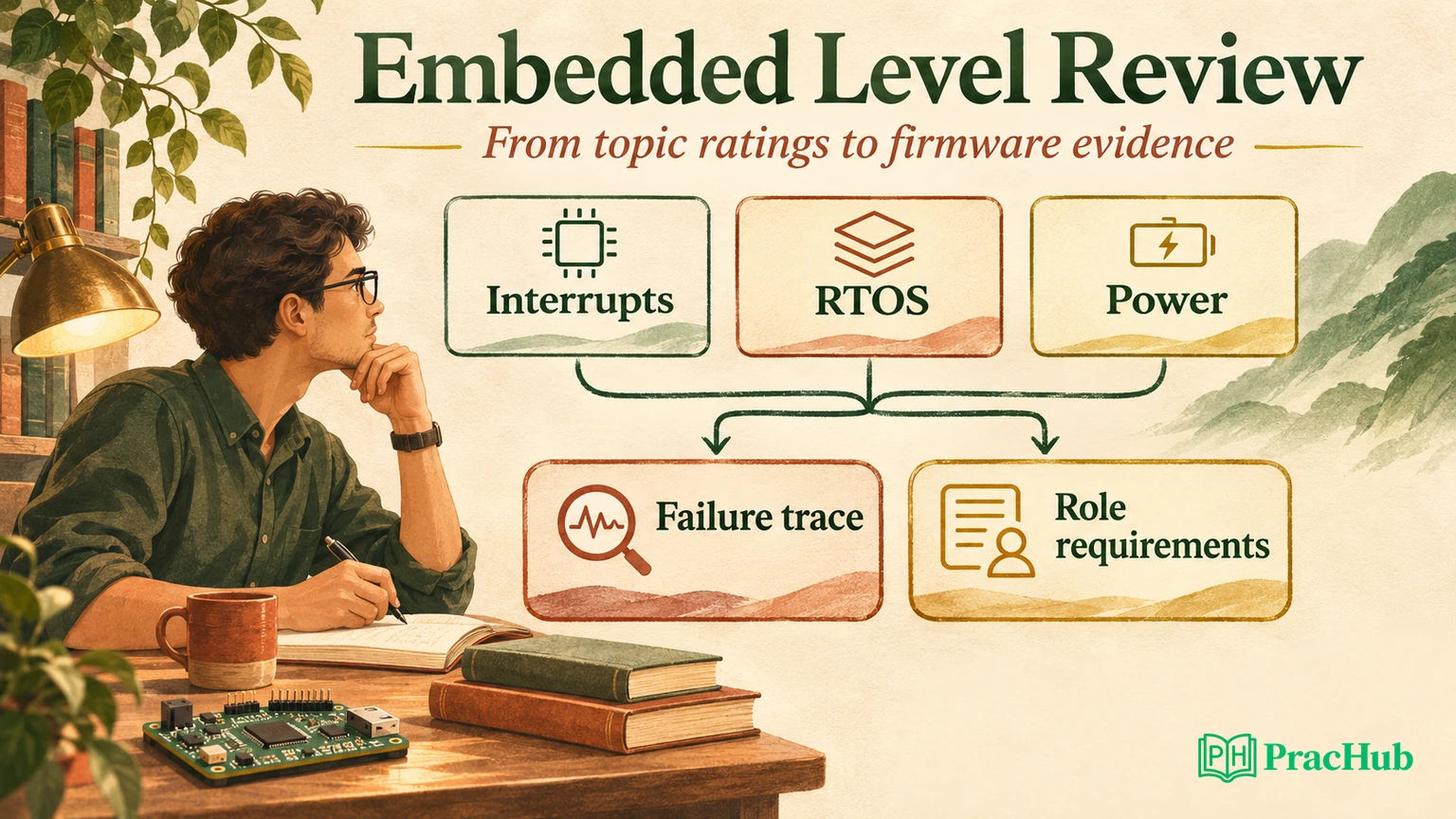
Embedded Level review distinguishing public example feedback, the anonymous level-test starting page, account-based practice and paid JD preparation. An original sequential multiword-read model shows why observable reads do not establish a coherent snapshot. A synthetic sensor-logger role map connects topic ratings to evidence and keeps illustrated readiness scores separate from measured outcomes.
Embedded Level is worth inspecting if you want short firmware questions to identify the next concept to practise. Its public examples expose assumptions about interrupts and integer arithmetic, while its account-based practice and paid job-description preparation promise a more personalized route. Our review found that distinction useful, but did not validate a topic rating or readiness percentage against interview performance. Treat a result as a starting point for an explanation you can defend.
PracHub publishes this review and owns the complementary practice links. The PracHub overheat-controller exercise offers another setting for explaining shared state and decisions. Our multiword snapshot below is an original sequential model; it is not a measured Cortex-M execution or an Embedded Level solution.
What we could try without an account
Direct observation, November 3, 2026: the homepage exposed answer buttons for firmware examples. We checked the interrupt-flag answer and deliberately chose an incorrect arithmetic option. The page explained both results, including integer promotion. These were public sample interactions, not a completed level assessment.
The level-test start page described 13 questions, about five minutes, adjustable difficulty, and selectable topics. It stated that no account was needed and identified Cortex-M assumptions for relevant questions. We inspected the starting interface without completing the test or generating a personal level.
The Practice route instead displayed a sign-in requirement and said progress and level were saved to an account. We stopped there. A public example, an anonymous placement route, and an account-based practice history are three different access states; opening one does not verify the others.
Use those access boundaries to choose what to inspect first. A sample can show the explanation style. A placement attempt can expose topics you should revisit. A saved practice account would be needed to evaluate whether scheduled reviews and topic adaptation remain useful over time. This review establishes the first route's visible behavior and the other routes' public boundaries.
A topic rating is a reason to ask another question
Official positioning: Embedded Level describes topic ratings that respond to answer difficulty and uses Elo-like language. Its homepage marks the displayed rating table as sample data. The paid-preparation illustration includes an 81% overall readiness readout and is labeled an example. Neither display is a result we obtained.
Our inference: a topic label can help choose a follow-up. Establishing the skill you demonstrated still requires the question, assumptions and answer. A correct answer about a flag might depend on a single-writer assumption. A different question can add another writer, a larger value, or a requirement about when associated data becomes visible.
Ask what information would make a result actionable. Which topics were sampled? Which assumptions were stated? Could you explain the rejected alternatives without seeing them? Could you solve a changed version? Those questions are useful whether a rating rises, falls, or remains stable.
There is also a difference between remembering an explanation and transferring it. If the next attempt repeats nearly identical wording, recognition can improve while your ability to diagnose an unfamiliar failure remains untested. Use a changed input or execution sequence to check that gap before describing yourself as ready for a particular role.
Why a volatile flag does not settle every firmware problem
The inspected homepage explanation distinguishes its simple flag from a larger value or a read-modify-write. Preserve that qualification when practising. Keep the particular interrupt-sharing assumptions when explaining what volatile does.
The SEI CERT C recommendation on volatile and synchronization explains why volatile does not supply the synchronization guarantees needed for general concurrent code. Separately, GCC documents that volatile access is not a memory barrier ordering non-volatile accesses. Those sources constrain the conclusion; they do not specify an unidentified device's register behavior.
Name the promise you are trying to establish. “The access occurs” differs from “the whole value is read as one indivisible operation.” Both differ from “reading this flag makes a separate payload safe to use.” If an answer moves between those promises, ask what mechanism supports each transition.
For a real firmware discussion, identify the target, alignment, access width, writer context, and permitted interruption points. If you are discussing C++ threads instead of a platform-specific interrupt contract, use the applicable language synchronization rules. Our review does not test whether one declaration produces the desired instructions on every target.
Original counterexample: two real reads, one incoherent value
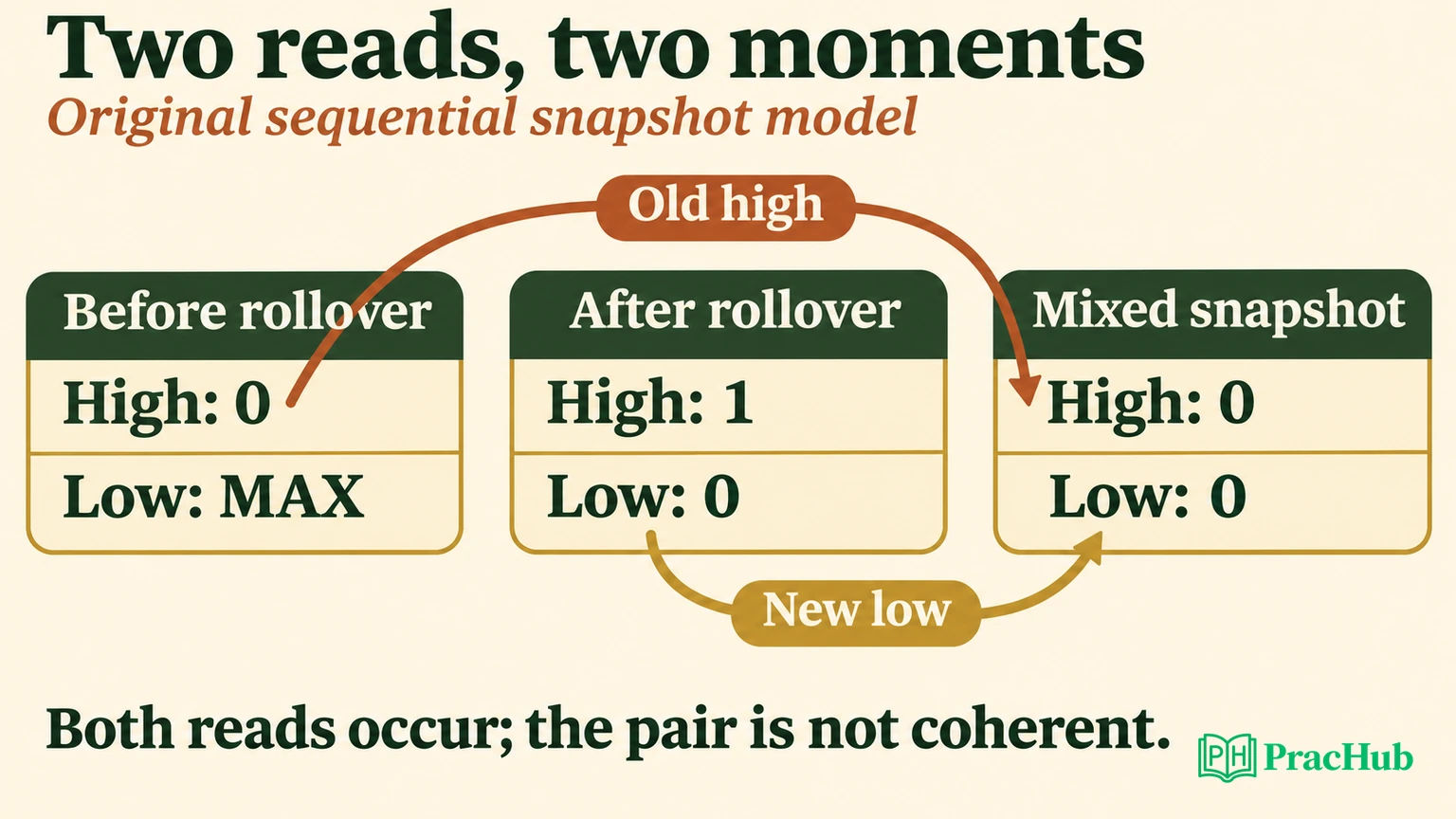
Consider a counter represented by a high word and a low word, each 32 bits. Assume the reader samples the high word first and the low word second. One complete writer update may happen between those reads. This is an abstract model with explicit steps, not a claim that a specific compiler emits this sequence for a particular declaration.
Before the update, the logical value is hexadecimal 00000000_FFFFFFFF. After one increment, it is 00000001_00000000. A reader that takes the old high word and the new low word reconstructs zero. That is neither complete logical value.
| Original trace step | Reader or writer action | Evidence retained |
|---|---|---|
| 1 | Reader samples the high word before rollover | High word is zero |
| 2 | Writer completes the rollover update | Logical value becomes 00000001_00000000 |
| 3 | Reader samples the low word afterward | Low word is zero |
| 4 | Reader combines its two samples | Reconstructed value is zero |
Both reads occur. Combining pieces from different moments creates the failure. Simply insisting that both reads happen does not make their combined result a coherent snapshot.
We ran an original Python model with the writer event before, between, and after the two reads. Four assertions checked the complete new value, the complete old value, the mixed zero result, and that the mixed result was neither valid complete state. No hardware, peripheral register, compiler-generated access sequence, real interrupt, or racy C++ program was exercised.
Choose a repair from the actual writer contract
A repair needs to prevent or detect the interleaving that matters. First identify whether one interrupt handler is the only writer, whether another core or DMA can update the storage, and whether a target-supported atomic accessor exists. These are questions to resolve before selecting an implementation.
If you propose a critical section, identify exactly which writer it excludes. The official FreeRTOS critical-section documentation explains that masking depends on the port and configured interrupt priorities. It also requires short, paired sections and distinguishes task-context use from ISR variants. Calling something a critical section does not establish that every possible writer is blocked.
If you propose retrying a snapshot, explain what change the retry detects, whether the writer can change again, and what bounds reader progress. Our model did not implement or validate a universal retry algorithm. The useful interview answer names the mechanism and its assumptions instead of replacing volatile with another unexplained keyword.
Separate the free allowance from paid JD preparation
The pricing page stated that the free plan included beginner lessons, the level test, and practice on three days with up to three questions a day. The paid plan advertised unrestricted daily practice plus JD preparation. It described one payment for 30 days without automatic renewal. These were public plan statements, not entitlements or billing behavior we exercised.
The Interview prep page placed its JD-based route behind sign-in and the paid plan. It advertised 30 role-specific questions, a readiness report, and CV-related outputs. We did not upload a job description or CV, create an account, pay, or inspect a private generated result.
Check the current displayed amount and currency on the pricing page before purchasing. More fundamentally, decide which capability you need to evaluate: explanations for public samples, persistent practice, or generated role preparation. The existence of one visible route does not validate the depth or accuracy of another.
Original role map: what a logger job would require
Here is a synthetic role used only for this review: maintain a battery-powered sensor logger that records timestamps, buffers measurements, writes to flash, and wakes after sleeping. It is not the site's automotive example, a real vacancy, or a JD submitted to the product.
A topic-oriented preparation tool can help locate vocabulary for this role. Our inference is that you still need an evidence map connecting each responsibility to behavior you could explain. Use this original map to expose what a generic overall percentage leaves unspecified.
| Synthetic responsibility | Follow-up to practise | Evidence worth discussing |
|---|---|---|
| Record reliable timestamps | What if the counter changes during a read? | Snapshot contract and the smallest breaking interleaving |
| Buffer incoming measurements | What happens when storage is full? | Ownership, admission policy, and a boundary trace |
| Write batches to flash | What remains after an interrupted write? | Commit boundary and recovery assumptions |
| Wake from sleep | Which state and clocks remain available? | Target-specific retention and wake-source requirements |
| Diagnose field faults | What distinguishes a stuck producer from missing reports? | Observations, competing hypotheses, and the next check |
Choose the row most closely tied to the actual job's responsibilities. A single topic can appear in several rows for different reasons. For example, concurrency affects timestamp reads, buffer ownership, and recovery state, but each has its own correctness promise.
Then explain one failure and one recovery boundary aloud. If your answer depends on a board detail the job description does not provide, say so and ask for it. Preparation should improve your ability to identify missing information as well as recall a plausible mechanism.
Use feedback to choose the next experiment
The arithmetic sample rejected our deliberately chosen wraparound explanation and explained promotion before arithmetic. A useful next step would change where the value is converted, then predict what that changes. The sample feedback alone did not test that transfer.
Use the same discipline for firmware scenarios. Change one contract detail at a time, explain what breaks, and decide which evidence would resolve the new question. Retain a trace or a small model when it helps; do not let a successful local model stand in for target validation.
If you later use the account-based practice route, compare the feedback against those unresolved questions. Does it explain the assumption you missed, or only reveal the accepted option? Does the next task challenge the same mechanism in a new setting? Those are useful product-evaluation questions that remain open in this bounded review.
Practice the gaps the product leaves open
These complementary PracHub prompts ask for an explanation across state, timing and diagnosis. They are not Embedded Level exports or evidence that a displayed topic rating predicts a company outcome.
| PracHub question | What to examine |
|---|---|
| Implement a Multicore Overheat Prevention Controller | Define the shared state and the response when temperature changes during a decision. |
| How to root-cause Wi‑Fi chip stops after 30 minutes | Use observations to narrow a failure that appears only after running for a while. |
| Design a smartwatch sensor subsystem | Translate sensing, buffering and power requirements into subsystem trade-offs. |
| Implement File Tail and Sensor Health | Make stale or missing sensor evidence explicit before selecting an action. |
| Explain C++ memory, types, and concurrency fundamentals | State which memory and concurrency assumptions support the explanation. |
Embedded Level may fit a learner who wants structured short questions and a way to prioritize weak topics. Inspect the public explanation style first, distinguish demonstrations from your own results, and check the current account and plan boundaries. Continue with the PracHub overheat-controller exercise to practise a different shared-state decision. Retain one failure trace and explain the assumptions behind its repair.
Sources and Further Reading
- Embedded Level public examples and sample ratings
- Level-test start page
- Practice sign-in boundary
- Plans and pricing
- Interview prep and sample role questions
- SEI CERT C: volatile is not a synchronization primitive
- GCC volatile-access documentation
- Official FreeRTOS task-context critical-section documentation
Comments (0)