Embedding Pooling Interview Questions: Masks, Normalization, and Similarity Scores
Quick Overview
Worked vector counterexamples explain masked pooling, normalization order, invalid vectors, metric rankings, and query-document representation contracts.
A sentence produces one embedding alone and a different embedding when batched with a longer sentence. The encoder checkpoint has not changed. Where would you look first?
Check padding and pooling before blaming the vector index. A tensor can have the correct output shape while averaging padded positions, dividing by the wrong token count, or normalizing at the wrong stage.
Embedding pooling interview questions test whether you can connect token-level representations to a sentence vector and then explain what its similarity score means. The useful answer includes a formula, a numerical counterexample, and a reproducible contract for queries and stored documents.
Evidence boundary: Implementation facts come from official Sentence Transformers documentation, an official model card, and Faiss documentation. Numerical vectors and debugging exercises below are original preparation material, not outputs from a pretrained model. Historical Sentence-BERT research is identified separately. No candidate reports support employer-specific interview-frequency claims. Explore related PracHub Machine Learning Engineer questions.

What Does Pooling Reduce, and Which Shape Should Remain?
For a batch of token embeddings H with shape [B, T, D], ordinary sentence pooling reduces the token dimension T and produces [B, D]. Averaging over D instead collapses embedding coordinates and changes the meaning of the representation. Averaging over B mixes different examples.
Start by naming every axis. If an implementation concatenates multiple pooling strategies, the final dimension can be larger than D. Shape expectations must follow the selected model configuration rather than a universal assumption that every sentence vector has the encoder's hidden width.
Official Sentence Transformers module documentation supports several pooling modes, including mean, max, CLS, and last-token pooling. Combining modes concatenates representations. Its Normalize module can operate on the pooled embedding or another configured feature key.
These choices are not interchangeable just because they produce fixed-size vectors. Use the pooling configuration associated with the trained model, and evaluate any proposed change. Historical Sentence-BERT research concerns learning useful sentence representations; taking an arbitrary encoder output and averaging it does not establish equivalent retrieval quality.
For an interview, clarify whether the exercise provides token embeddings, a complete sentence encoder, or a helper that already returns pooled and normalized vectors. Applying pooling twice is a different bug from choosing the wrong axis.
How Should Masked Mean Pooling Work?
Let m_bt be 1 for an included position and 0 for an excluded position. For each batch item b, masked mean pooling computes:
numerator_b = sum over t of m_bt × H_bt
count_b = sum over t of m_bt
embedding_b = numerator_b / count_b
The mask broadcasts across D, but the denominator counts included token positions. It should not sum embedding coordinates or include padded length. An explicit empty-input policy handles count zero.
The official all-MiniLM-L6-v2 model card demonstrates attention-mask-aware mean pooling followed by normalization when using the underlying Hugging Face transformer. This is evidence for that model's documented usage, not a prescription to replace every model's pooling.
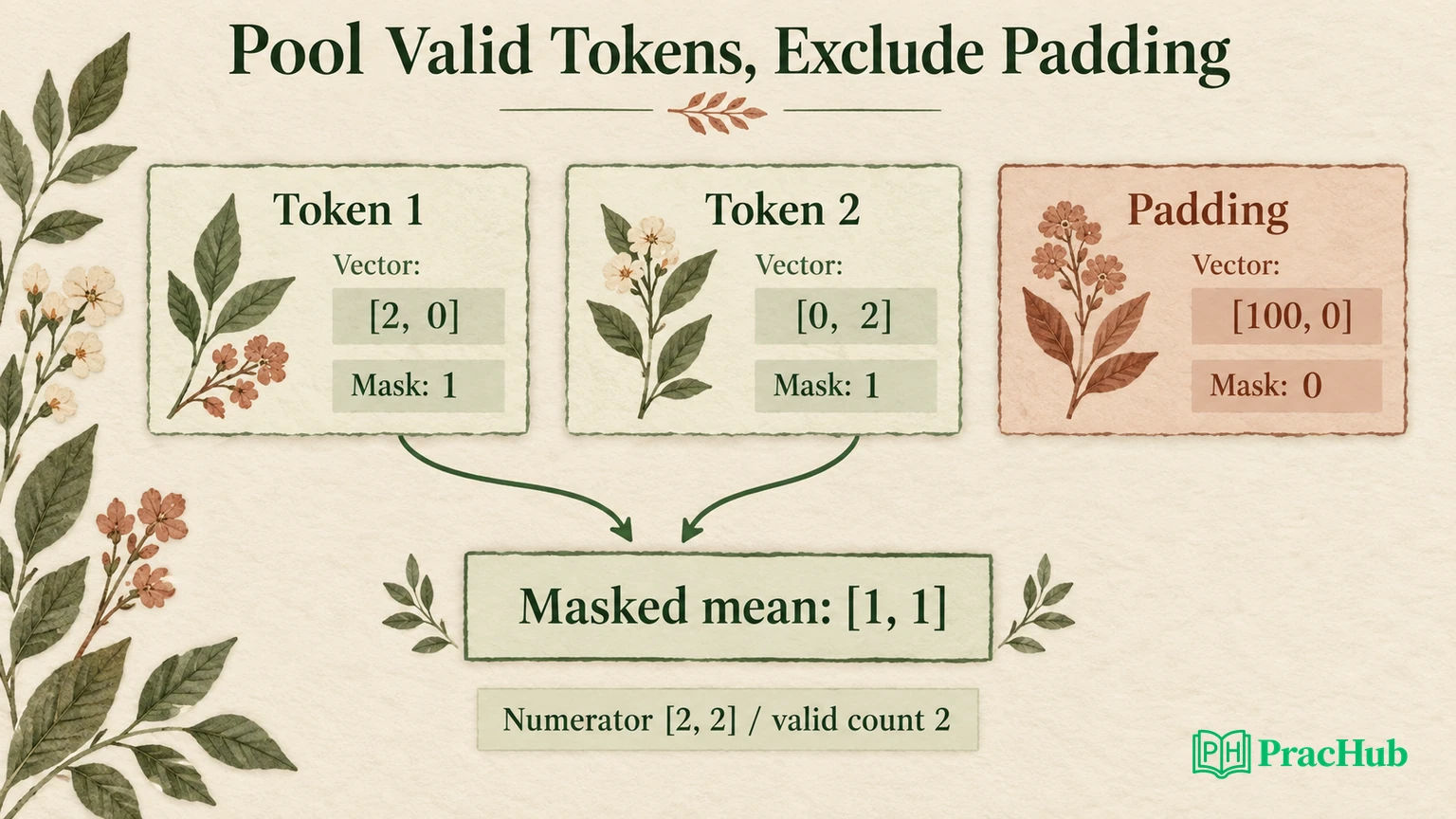
Consider an original three-position example:
| Position | Token vector | Pooling mask |
|---|---|---|
| First valid token | [2, 0] | 1 |
| Second valid token | [0, 2] | 1 |
| Padding position | [100, 0] | 0 |
The correct masked numerator is [2, 2], the count is 2, and the mean is [1, 1]. Averaging all three positions gives [34, 2/3]. The padding vector is intentionally exaggerated to make the error visible; it is not a claim about typical model outputs.
Another bug masks the numerator but divides by padded length 3, yielding [2/3, 2/3]. Its direction matches the correct vector, so a later exact L2 normalization can hide this error in cosine scores for this example. Raw dot products, unnormalized consumers, and other pooling operations can still change. Inspect the pre-normalization vector as well as the final score.
Is an Attention Mask Always the Right Pooling Mask?
Not automatically. An attention mask controls which positions participate in the encoder's computation according to that implementation. A pooling mask specifies which resulting positions contribute to the sentence representation. They may agree for padding while differing for prompts or special tokens.
The pooling decision should follow the trained representation. Do not remove every special token on the assumption that it has no information; do not include a query instruction by accident if the documented configuration excludes it. A retrieval model may also require different query and document prefixes.
An original debugging exercise is to print token IDs, decoded tokens, attention positions, and pooled positions for one short input. Check whether the numerator and denominator refer to the same set. This small trace is more useful than inspecting only a final cosine score.
Last-token pooling also needs a definition of “last.” The final array position may be padding. A simple count-minus-one index works for some right-padded layouts but fails with left padding or noncontiguous masks. Find the intended included position using the actual mask and the model's special-token convention.
For max pooling, filling excluded positions with zero is unsafe when valid values are negative. A padded zero could win the maximum. Exclude those positions with an appropriate sentinel and then handle the all-excluded case separately. Mean, max, and last-token pooling have different mask failure modes.
Should You Normalize Tokens Before or After Pooling?
The operations generally do not commute. Normalizing each token changes its contribution before averaging. Normalizing the pooled vector preserves the direction of that average while removing its final magnitude.
In an original example, the valid token vectors are [4, 0] and [0, 1]. Their mean is [2, 0.5]. Normalizing after pooling gives [4/√17, 1/√17], approximately [0.9701, 0.2425].
Normalize each token first and the vectors become [1, 0] and [0, 1]. Their mean is [0.5, 0.5]; final normalization gives approximately [0.7071, 0.7071]. The second procedure gives equal directional weight to both tokens, while the first retains the larger first token's contribution.
Neither numerical operation establishes which representation is better for a particular model. Match the trained and documented pipeline, then evaluate a deliberate alternative. Changing normalization order is a representation change, not harmless numerical cleanup.
Finite precision and near-zero norms need a separate policy. A denominator floor can prevent division by zero, but it cannot create semantic content for an empty or cancelling vector. Record whether invalid inputs are rejected, skipped, assigned a fallback, or returned with a validity flag.
Avoid making a missing embedding look like an ordinary low-similarity result. If a zero placeholder enters top-k retrieval, it can rank above valid documents with negative scores. A validity mask should remain distinguishable from the similarity matrix.
When Do Dot Product, Cosine, and L2 Give the Same Ranking?
For nonzero vectors q and d, cosine is q·d / (||q|| ||d||). Raw dot product includes magnitude. An original ranking counterexample uses q=[1,0], document A=[1,0], and document B=[2,2].
Dot products are 1 for A and 2 for B, so raw dot product ranks B first. Cosines are 1 for A and approximately 0.7071 for B, so cosine ranks A first. A score is meaningful only with its metric and normalization contract.
Official Faiss metric guidance explains mapping cosine search to inner-product search by normalizing query and database vectors. For unit vectors, squared L2 distance equals 2 − 2(q·d). Descending inner product and ascending squared L2 therefore agree in exact arithmetic on the same normalized vectors.
Normalizing only the query does not eliminate document-norm effects. For a fixed nonzero query, multiplying all its scores by the same positive factor preserves a dot-product ranking, but it does not turn the score values into cosine similarities.
Official Sentence Transformers similarity documentation distinguishes cosine, dot product, and distance-based options, and explains the normalized-vector equivalence. A configuration change should be checked against what the encoder actually emits.
A cosine score is not automatically a calibrated relevance probability. A threshold such as 0.8 needs validation for the model, task, language, and corpus. Reusing a threshold after changing pooling or normalization can silently change which results are accepted.
How Would You Test Pooling Without a Large Model Run?
Begin with constructed token vectors and exact masks. The three-position mean example detects both padding inclusion and denominator errors. Negative-valued examples expose max-pooling mistakes. All-excluded and cancelling inputs exercise validity handling.
An original batching-invariance check holds valid token vectors fixed, appends arbitrary excluded vectors, and verifies that masked pooling is unchanged. Repeat with different padding lengths and layouts. This isolates the pooling layer; it does not establish that a complete encoder will be bitwise identical across all devices and batching configurations.
Then compare a real text alone and in several batches using the intended model, evaluation mode, and documented preprocessing. Specify numerical tolerances rather than requiring exact floating-point equality. If vectors differ materially, inspect tokenization, truncation, masks, dropout state, and pooling before blaming retrieval.
For an index migration, preserve a small set of queries and documents with expected scores or rankings. Record encoder revision, tokenizer, prompts, truncation, pooling, normalization, dimension, dtype, and index metric. Matching dimensions alone cannot make embeddings from different pipelines compatible.
If pooling changes, rebuild or version the document index and compare retrieval quality before switching queries. Mixing new query vectors with old document vectors may yield plausible numbers while using incompatible representations. A migration should have a clear rollback path and a known evaluation set.
What Do Common Pooling Failures Look Like?
This original diagnostic table connects a symptom to a discriminating check:
| Symptom | First inspection | Useful counterexample |
|---|---|---|
| Embedding changes with padded batch length | Numerator and denominator masks | Append excluded vectors with large values. |
| Max-pooled vector becomes less negative | Padding sentinel | All valid coordinates negative. |
| Last-token output selects padding | Included-position indexing | Compare left and right padding. |
| Correct cosine but inconsistent raw scores | Mean denominator and normalization | Compare vectors before normalization. |
| Dot and cosine rank different documents | Document norms | Use A=[1,0], B=[2,2]. |
| Empty text returns ordinary retrieval hits | Validity policy | Exclude invalid vectors before top-k. |
| New encoder deployment hurts recall | Query/document contract | Compare versions and rebuild the index. |
Do not diagnose retrieval quality from self-similarity alone. A vector can have cosine 1 with itself while carrying little useful information about relevance. Use labeled query-document judgments and metrics such as recall at k or ranking quality, with task-relevant slices.
Five PracHub Questions to Practice
These verified question destinations cover sentence similarity, retrieval implementation, and embedding-service design. The pooling targets are original extensions rather than assertions about exact employer evaluation criteria.
| Practice question | Pooling-focused answer target |
|---|---|
| Embedding Retrieval with Cosine Similarity in a Notebook, and Choosing the Metric | Derive normalization and metric equivalence, including invalid vectors. |
| Compute Sentence Similarity | Explain masked averaging and model-specific pooling choices. |
| Implement 1NN Embeddings and Forward Pass | Keep batch, token, and embedding axes distinct. |
| Design a multimodal embedding service | Version representation contracts across modalities and stored vectors. |
| Write Pseudocode for Embedding Creation and Vector Search | Preserve query/document compatibility and test migration behavior. |
Continue with Machine Learning Engineer interview practice. Calculate the masked mean first, then explain the normalization-order and ranking counterexamples without relying on a library call to hide the reasoning.
Comments (0)