Epic Skills Assessment: What the Official Process Says and How to Get Ready
Quick Overview
Understand which Epic Skills Assessment invitation you received, what Epic officially confirms, and how dated software-developer and hospital-applicant reports differ. Includes an original optional unfamiliar-rules exercise with checked answers and questions to resolve with your recruiting contact.
The Epic Skills Assessment is part of Epic’s hiring process, but the name alone does not tell you which tests, instructions or employer apply to you. Start by confirming whether your invitation concerns employment at Epic or an Epic-related role at a hospital. Then use the instructions attached to that application rather than borrowing another candidate’s complete test blueprint.
Official fact: Epic says its assessments include logic and reasoning and require no preparation work. Its public application page also says the process varies slightly by role. It does not publish a universal question count, timer or passing score there. Epic’s application process
This article separates that official boundary from dated candidate accounts and original preparation suggestions. For a broader software-engineering interview overview, use PracHub’s Epic Software Engineer guide; the focus here is identifying your invitation and preparing around the instructions you actually receive.
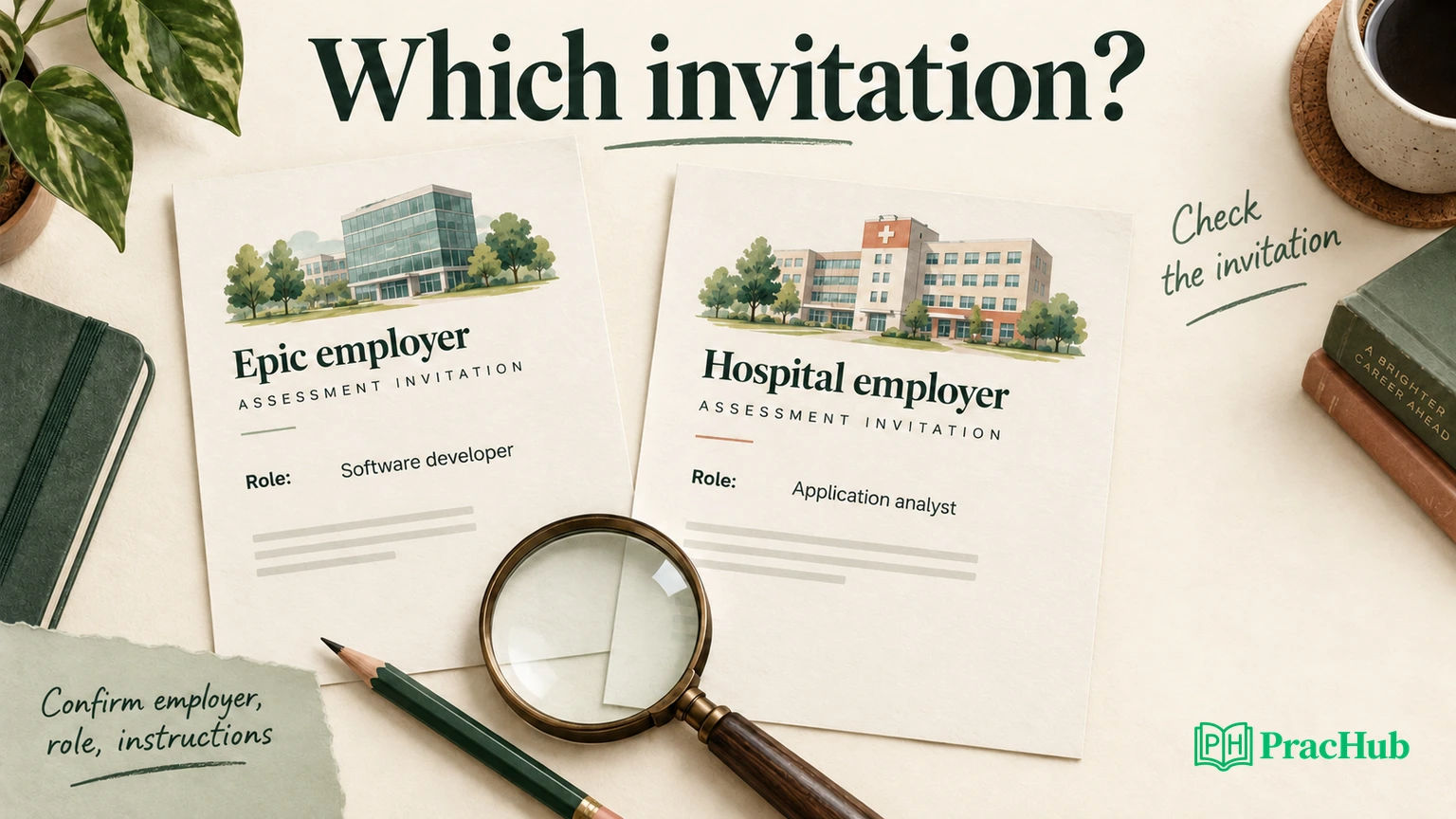
Which employer and role are actually assessing you?
An assessment invitation is the set of instructions connected to one application: who requested it, which role it concerns, how to access it and which conditions apply. A recognizable product or test name cannot replace those details.
Compare the employer in your application confirmation with the role in the invitation. A software-developer application to Epic and an application-analyst role at a hospital can both involve the word Epic while belonging to different hiring processes. An assessment vendor may send the access link even though Epic or a hospital requested it. Match the link to the application rather than treating the sender’s brand as the employer.
| What the application identifies | What you can infer safely | What to confirm |
|---|---|---|
| Epic as employer, software-developer role | Epic’s public careers process is relevant background. | The assessment components and instructions assigned to this application. |
| Hospital as employer, Epic application-analyst role | The hospital is making the hiring decision. | Its assessment requirements and recruiting contact. |
| An assessment provider without a clear employer or requisition | The delivery name is insufficient to identify the process. | Which application requested it before you rely on format advice. |
| Training, certification or existing-employee material | This may concern a different activity from hiring. | The stated purpose and responsible organization. |
These are original interpretation rules, not a verified directory of every employer’s test package. Keep your application reference and the message together. If the two appear inconsistent, ask the recruiting contact to reconcile them rather than guessing from a search result.
What does the official Epic process establish?
Official process: Epic’s public outline moves from application and learning about the role to assessments, a final interview and a decision. It also describes a visit to Madison. Treat that as the company’s general outline, subject to its explicit role-variation caveat, rather than a promise about your calendar. Official application-process page
The page emphasizes honest representation throughout recruitment. If you are unsure whether outside assistance is permitted, Epic directs you to your HR contact. That supports one practical action: resolve tool and assistance questions before beginning, using the instructions for your actual assessment.
It does not establish whether your particular session permits notes, a calculator, an external editor, internet access or AI tools. It also does not establish a universal accommodation procedure or technical-failure remedy. Those are invitation-specific questions. Resolve these conditions before launch so you can choose a compliant setup and avoid discovering an access or materials problem after a timer begins.
The official statement that no prep work is required should stay intact. The exercises later in this article are optional ways to become comfortable reading instructions; they are not required by Epic, endorsed by Epic or evidence that a paid preparation product is necessary.
What do recent candidate reports add?
Candidate report, January 2026: A software-developer applicant described receiving invitations for a phone screen and assessment around the same period. The account includes an unsuccessful application and a later application that progressed differently. It is evidence of that person’s sequence, not a promised response time or reapplication policy. Software-developer timeline
Candidate reports, March 2026: Participants in a new-graduate software-development discussion described combinations of logic, math, programming analysis and coding. Their descriptions include personal impressions of difficulty and time. Those accounts make unfamiliar-rule reasoning a reasonable optional practice area, but they do not establish your assigned components or the weight of any section. New-grad discussion
Adjacent-employer report, September 2026: A hospital application-analyst applicant compared a current hospital assessment invitation with an earlier Epic software-developer assessment and asked whether they were equivalent. That is useful evidence of the naming confusion. It does not confirm that hospitals and Epic use identical tests or that every hospital follows the described arrangement. Hospital-versus-Epic discussion
Two accounts can disagree without either proving a universal change. Role, application date, assigned modules and recollection can differ. Compare those attributes before treating a discrepancy as a new policy. A post asking what to expect is also not a report of a completed assessment.
Turn your invitation into a short readiness record
Preparation inference: Separate information you have from questions that remain open. Record the employer, exact role, application reference, completion deadline and recruiting contact in separate fields, each copied from the relevant application or invitation. Next record any stated session length, browser requirements, permitted materials, interruptions policy and support instructions.
Do not fill blank fields with numbers copied from a forum. For example, a deadline several days away tells you when completion is due; it does not tell you how long a launched session can remain open. A section timer and an overall appointment length are different constraints. Likewise, an invitation arriving near a phone-screen message does not prove which must occur first.
A useful clarification message is: “I’m applying for [role/reference]. Could you confirm which assessment components are assigned, the time I should reserve, and the rules for notes, calculators and outside tools? I also want to confirm what to do if the platform disconnects.” This is an original message template, not an instruction to contact an unrelated test vendor.
If you need an accommodation, ask the recruiting contact about the available process before starting. Describe the practical adjustment you are seeking and follow its channel for any required information. This article cannot promise approval, extra time or a particular documentation requirement.
Try an optional unfamiliar-rules warm-up
Here is an original exercise, unrelated to Epic’s actual question bank or any proprietary test language. It practices reading a short specification and tracing state. You can do it on paper; programming is optional.
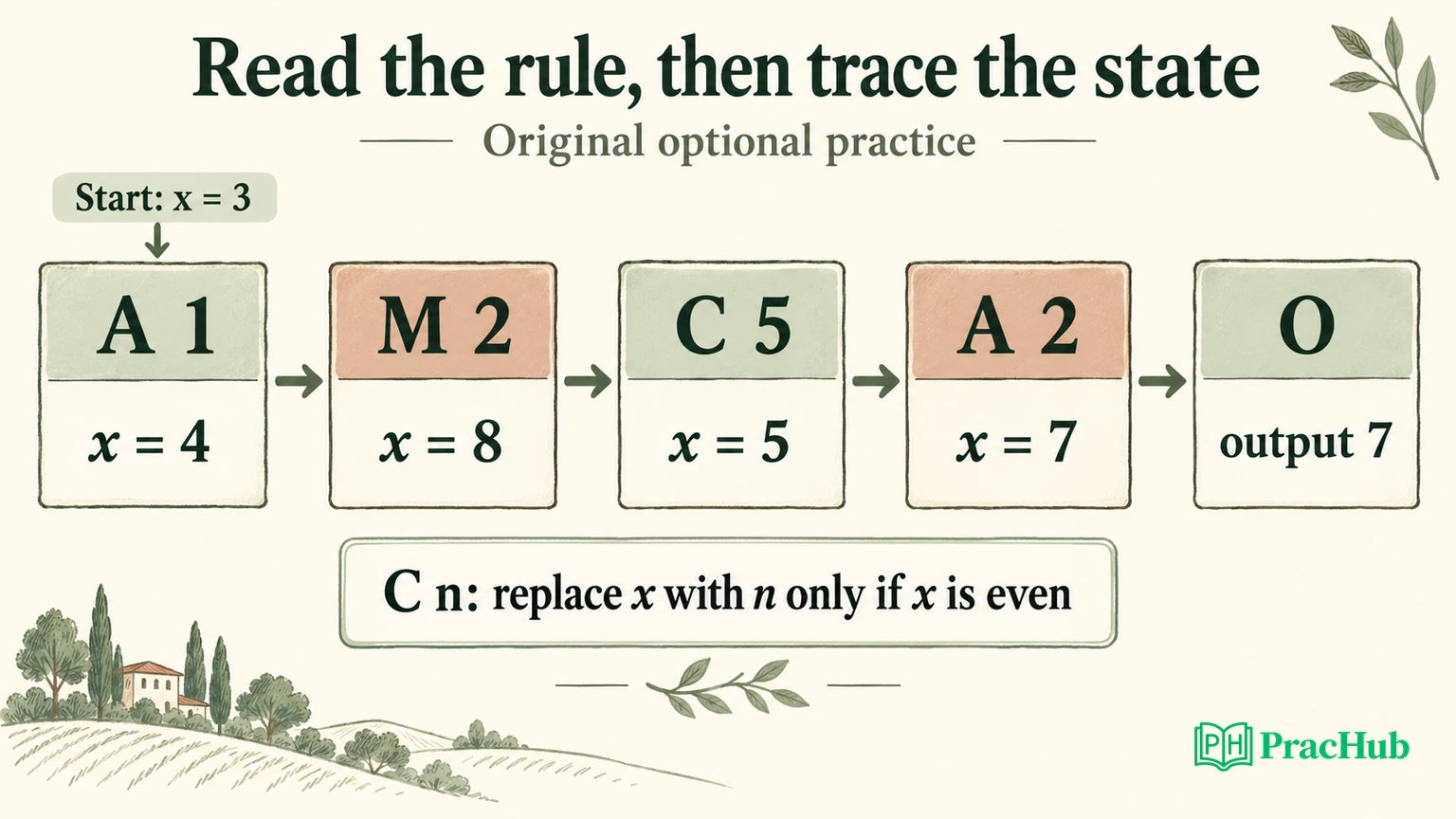
There is one integer, x, initially 3. Execute commands in written order. A n adds n to x. M n multiplies x by n. C n replaces x with n only when the current x is even; otherwise it does nothing. O outputs the current value without changing it.
Trace this sequence:
A 1
M 2
C 5
A 2
O
Before reading the answer, write the value after each command and state what the conditional checks. This is sequential execution, not a mathematical expression with multiplication evaluated before addition.
The values are 4, 8, 5, 7, 7, and the only output is 7. The conditional sees the current value 8, so it replaces that value with 5. It neither checks whether the argument 5 is even nor adds five to the state. The output command observes seven without resetting the integer.
Now try C 9; A 1; C 6; O, again starting at three. The first conditional leaves three unchanged; addition gives four; the next conditional replaces four with six; the output is six. This counterexample tests whether you understand the branch, rather than remembering the first trace.
Local verification: A locally executed Python 3.12.14 implementation checked six original cases with 12 assertions, including zero, negative values, two outputs and an empty command list. These results verify our specified exercise. They do not reveal an Epic language, assessment timer, score calculation or pass threshold.
Review the mistake before adding more practice
Preparation inference: Classify a wrong answer by what failed. Did you misread the command, apply arithmetic incorrectly, check the condition against the wrong value, or record output at the wrong moment? Each error suggests a different correction.
If you checked the argument instead of the current state, underline the condition’s subject and rewrite it in plain English. If you treated the sequence as one expression, keep a separate state row after every command. If you changed x when executing O, distinguish an observation from a mutation. Then retry a different case that targets the same misunderstanding.
This is more informative than repeating the easy example until its output feels familiar. To make the exercise harder, add one rule at a time and specify it precisely. A command that stores a previous value, for example, needs an explicit definition of when that value is captured. Ambiguity in your invented practice problem should not be mistaken for difficulty in an employer’s assessment.
For ordinary quantitative practice, check units and write the relationship before calculating. For coding practice, define inputs, outputs and edge cases before implementation. These are general preparation recommendations. They do not establish that your Epic invitation contains either kind of task.
Use PracHub questions as practice with clear labels
The following records are practice material, not predictions of an exact assessment. The company labels identify the bank records; general questions from other employers train transferable reasoning and do not prove Epic uses those tasks.
| PracHub question | Practice action | Evidence boundary |
|---|---|---|
| Encode Letters with a Telephone Keypad | Translate a mapping rule into explicit cases. | Epic-labeled bank record; not a forecast of your invitation. |
| Solve Coin, Growth, Time, and Rate Problems | Identify units and the relationship before calculating. | Epic-labeled bank record; verify the prompt’s assumptions. |
| Solve Timed Logical and Quantitative Reasoning Cases | Explain why one answer follows from the stated constraints. | Epic Systems-labeled record; its timing is not your assessment policy. |
| Design time strategy for rapid-fire OA | Compare a skip decision with time spent checking one item. | Reported practice context, not an official scoring rule. |
| Learn What You Need to Solve an Unfamiliar Problem | Explain how you extract and test a new rule. | General Amazon-labeled practice, not Epic process evidence. |
Select a question that matches a skill you want to rehearse. Explain your reasoning, check the supplied conditions and identify one mistake you corrected. Avoid treating a company tag as a guarantee that memorizing the answer will help on a current test.
What should you do before and after the session?
Before the session, choose an environment that meets the actual instructions, check the stated access requirements and reserve the requested uninterrupted time. Save the support channel and completion deadline. If instructions are incomplete, clarify them rather than assuming the forum account closest to your expectations is correct.
During the assessment, use the permitted resources and the platform’s stated navigation rules. Advice to skip and return is only useful when returning is allowed. A candidate’s belief that speed matters is not a published scoring formula, so do not reverse-engineer a cutoff from one person’s outcome.
Afterward, retain the completion confirmation and any authorized support reference. If a technical problem occurred, report the observable issue and follow the designated channel; do not assume you may launch a second attempt. If the recruiting contact gave a response window, use it for follow-up. The public process page does not supply a guaranteed decision deadline.
Feeling unsettled after one section does not tell you whether you will receive an offer. Other applicants’ outcomes cannot reveal how your complete application will be evaluated. The useful next step is to confirm completion, resolve any documented technical issue and prepare for the next stage only when it is assigned.
For one optional practice attempt, open Epic Software Engineer questions on PracHub, select a relevant task, write its input and output rules, then explain one checked answer aloud. Keep the distinction intact: official instructions govern your assessment; dated reports provide context; practice builds familiarity without promising a result.
Sources and Further Reading
- Epic: official application process and assessment guidance
- Software-developer application timeline, January 2026
- New-grad software-development assessment accounts, March 2026
- Hospital analyst applicant compares assessment names, September 2026
Research checked October 11, 2026. Candidate reports concern individual applications. Confirm your role’s current instructions with its recruiting contact.
Comments (0)