Five Rings Quant Trading OA 2027: 17-Minute HackerRank, Question Types, and Cutoffs
Quick Overview
Evidence-checked guide to the Five Rings Quant Trading OA 2027, including the reported 17-minute HackerRank format, question patterns, cutoff uncertainty, next steps, and a seven-day preparation plan.
Updated August 17, 2026.
Seventeen minutes. A HackerRank link. Almost no time to recover after a slow start. If you expected a normal coding assessment, the current Five Rings Quant Trading Intern OA reports can feel like a category error.
The clearest Summer 2027 evidence points to a rapid quantitative screen built around short math and estimation decisions, not a LeetCode-style programming test. The hard part is less about advanced theory than choosing a workable shortcut before the clock consumes the question.
Start with Five Rings interview questions on PracHub, then use this guide to train the specific gaps the 17-minute format exposes. Below, we separate current Quantitative Trading reports from Quantitative Research reports, explain what is known about cutoffs, and build a practical seven-day plan without pretending anonymous posts are official policy.
Quick verdict
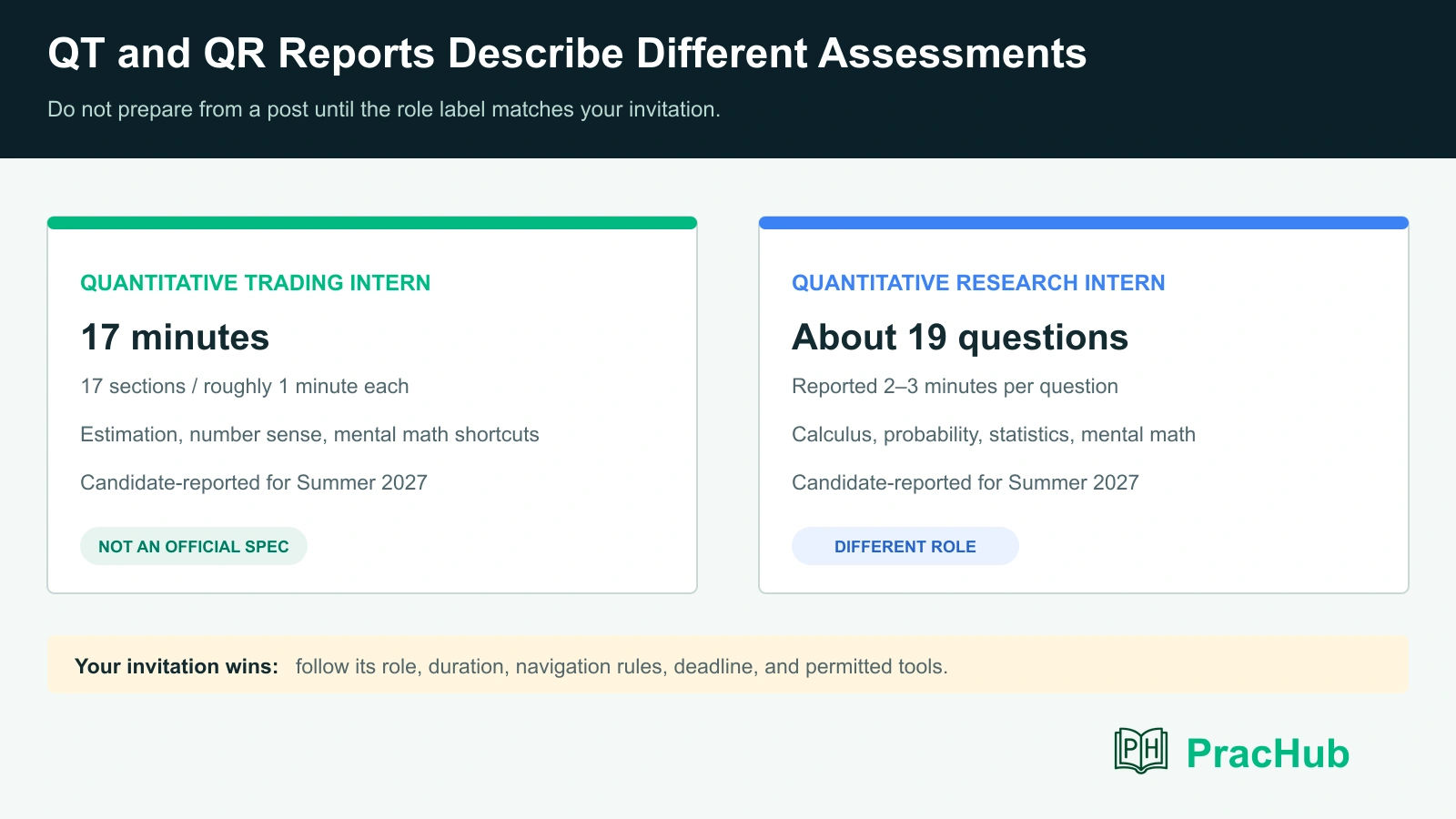
Prepare for roughly 17 short quantitative sections in 17 minutes, but treat that as current candidate-reported evidence rather than a permanent Five Rings specification. A July 2026 Quant Trading Intern report describes a 17-minute HackerRank, another recent candidate says the prior-year version contained 17 questions, and a July 30 Glassdoor report describes 17 sections with about one minute each.
The reported content emphasizes estimation, number sense, mental math, number theory, and fast quantitative shortcuts. HackerRank is only the delivery platform; its presence does not mean this particular assessment is a coding test.
| Candidate question | Best evidence-based answer |
|---|---|
| Is the test really 17 minutes? | That duration appears in multiple recent QT reports. Your invitation remains the controlling source. |
| How many questions are there? | Current evidence points to 17 sections or questions, approximately one minute each. |
| Is it coding? | Recent QT reports describe rapid math and estimation, not a standard coding OA. |
| Is the 19-question format the same test? | No reliable evidence says so. The recent 19-question, 2–3-minute format is associated with Quant Research. |
| What score passes? | Five Rings has not published a cutoff, and current anecdotes do not support a defensible threshold. |
What Five Rings is hiring for
Five Rings' official Summer 2027 Quantitative Trader posting describes a nine-week New York internship with hands-on projects, classroom instruction, strategy games, mock trading, and research and development work with traders. The firm says it wants candidates who are quantitatively focused, curious, detail-oriented, quick to learn, and comfortable in a fast-paced collaborative environment.
That profile helps explain the assessment design. A trader often has to form a useful estimate, notice which information matters, and commit under time pressure. A long exact derivation may be mathematically respectable yet operationally poor when a good approximation was available in ten seconds.
The role posting also says applicants may apply to multiple positions but should identify a top choice. That matters because Five Rings hires for Quantitative Trading, Quantitative Research, and software roles, and those pipelines should not be blended into one universal OA description.
What the 17-minute HackerRank appears to contain
The most recent detailed QT report says the OA contained 17 sections with one minute per question. The candidate described many prompts as problems that were impractical to solve exactly and therefore required estimation, number-theory awareness, or shortcuts. A separate current Reddit discussion also identifies a 17-minute HackerRank and includes a prior-cycle candidate describing 17 rapid mental-math questions.
This evidence is directionally consistent, but it still has limits. Candidate reports can reflect different versions, offices, accommodations, or recruiting batches. Five Rings can also change the test without announcing the change publicly.
Estimation and order-of-magnitude reasoning
Some prompts may be intentionally hostile to exact arithmetic. Your job is to identify a bound or approximation that separates the answer choices. Useful tools include rounding to friendly numbers, factoring a large expression, comparing logarithms, and estimating a count from density rather than enumerating every case.
Do not round blindly. Keep the direction of the error visible: if you rounded two factors upward, your product is an upper estimate. When answer choices are close, refine the term that contributes most to the uncertainty.
Number sense and mental arithmetic
At one minute per item, fluent arithmetic becomes part of reasoning. Practice percentage changes, fraction-to-decimal conversions, squares, powers of two, divisibility, rough logarithms, and rearrangements such as turning 49 × 51 into 50² − 1.
The goal is not performance art with enormous numbers. It is reducing a calculation to a form you can verify quickly. If your shortcut creates more moving parts than the original expression, it is not helping.
Probability and expected value
Historical Five Rings interview reports frequently mention probability, stochastic thinking, betting scenarios, and intuitive answers that are generalized through follow-ups. The 17-minute OA may be more estimation-heavy than a traditional probability round, but probability remains central to later Quant Trading preparation.
Know how to use complements, conditional probability, symmetry, linearity of expectation, and small-state recursion. Under severe time pressure, first ask whether the answer can be bounded or compared without computing the entire distribution.
Counting, sequences, and number theory
A recent Glassdoor report gives a counting-style example involving prime numbers under a digit restriction. The ethical preparation lesson is not to memorize that exact prompt. It is to practice decomposing a large count into manageable cases, estimating the density of a set, and checking whether an exact count is even necessary.
Sequences and pattern questions similarly reward disciplined hypothesis testing. Check the simplest relationship first, but do not force a pattern after seeing only two transitions. Use the answer choices to test whether the intended rule is coarse or exact.
Why HackerRank does not mean a coding test
HackerRank lets employers create sections, choose question types, set section-level time limits, randomize questions, and control whether candidates can revisit earlier sections. The platform supports much more than programming, so the product name alone does not identify the content.
Before starting, read the landing page and instructions for the exact number of sections, navigation rules, permitted tools, and deadline. HackerRank's current candidate experience may warn when you leave an unanswered section or move into a section that cannot be revisited, but the employer controls the underlying test settings.
If sections are locked after submission, spend the final seconds checking the current answer rather than planning to return. If revisiting is allowed, flag uncertain items and preserve momentum. Never infer the rule from someone else's screenshot.
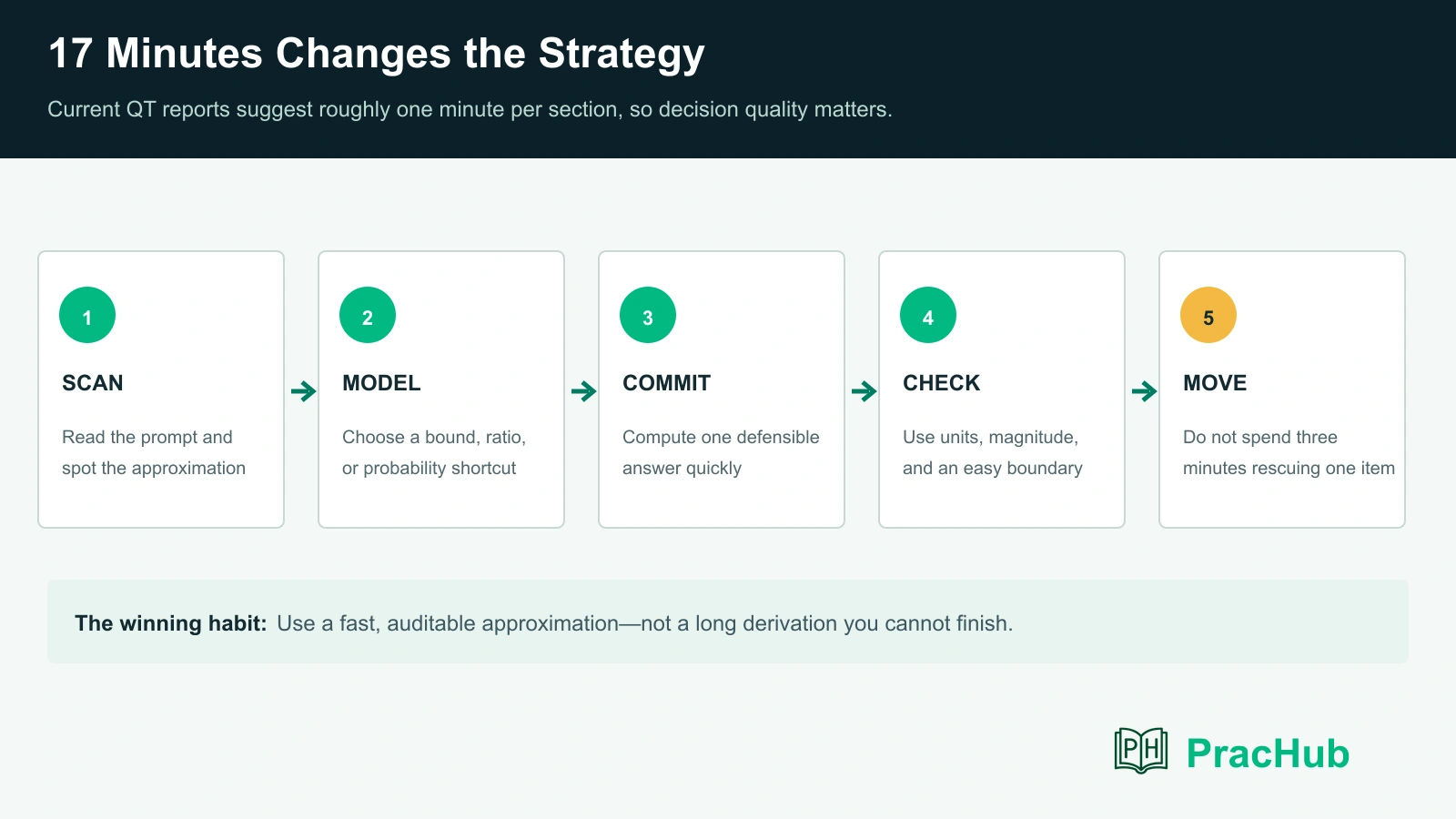
A one-minute decision framework
One minute is too short for a normal solve-review cycle. You need a compact decision process that works even when the prompt looks unfamiliar.
| Elapsed time | Action | What good execution looks like |
|---|---|---|
| 0–10 seconds | Classify | Identify estimation, counting, probability, algebra, or pattern recognition. |
| 10–25 seconds | Choose a model | Select one shortcut, bound, symmetry argument, or compact calculation. |
| 25–45 seconds | Compute | Keep the arithmetic small and write only the values you must track. |
| 45–55 seconds | Sanity-check | Verify sign, scale, units, probability bounds, and the closest answer choice. |
| 55–60 seconds | Commit | Submit the best-supported answer and move forward according to the navigation rules. |
If you still do not have a model at 25 seconds, change tactics. Compare answer choices, derive a rough upper and lower bound, or eliminate impossible values. The worst response is spending the entire minute repeating an unproductive exact calculation.
Do not confuse the QT and QR formats
A separate August 2026 Quantitative Research report describes approximately 19 questions with two to three minutes per question, covering calculus, probability, statistics, and mental math. That is materially different from the 17-minute QT report.
The roles overlap in quantitative reasoning, but the pacing changes what mastery looks like. A QT screen can reward a fast estimate that identifies the right choice; a QR screen may give enough time for a more formal derivation. Preparing for one as though it were the other can distort both your topic mix and your timing.
What is the Five Rings OA cutoff?
No official Five Rings cutoff was found for the Summer 2027 Quant Trading OA. The company does not publish a required number correct, a percentile threshold, or a rule such as “15 out of 17 advances.”
That absence matters. Online discussions often convert one candidate's outcome into a supposed cutoff, but a single result cannot reveal whether the firm used raw accuracy, different test variants, resume review, recruiting capacity, or another signal. Even two candidates with the same self-estimated score may have answered different questions or estimated their performance incorrectly.
Your practical target should therefore be maximum reliable accuracy without sacrificing the entire test to one item. Train until you can make sound approximations quickly, but do not chase an invented perfect-score requirement. The assessment is a screen, not a publicly documented certification exam.
Is the OA automatic?
Current reports do not support a universal answer. One July candidate said the invitation arrived the same day as the application, while another reported applying on July 20 and receiving the OA on July 27. A different applicant with the same application date had not received one and suspected a resume screen.
Those anecdotes show variable timing, not the internal rule. A fast invitation can be automated, batch-triggered, or simply processed quickly; a delayed invitation can reflect review order rather than rejection. Treat receipt of the OA as progress, but not proof that every later resume or capacity check has been completed.
What happens after the OA?
A July 2026 Glassdoor report describes an online assessment followed by three technical interviews and one HR interview. The technical rounds reportedly began with a game or math problem, then expanded the scenario through harder follow-ups. That sequence is useful preparation context, not a guaranteed schedule for every candidate.
Other current candidate discussions mention fast intuitive estimation, probability, expected value, and betting-style reasoning in live rounds. Expect the evaluation to shift from “choose an answer quickly” toward “show how your model changes when the interviewer changes the rules.”
Response time after the OA varies. Do not infer rejection from a few silent days, especially during a high-volume internship cycle. Keep a record of the completion date, follow a recruiter-provided timeline, and continue other applications while you wait.
Practice with Five Rings and related quant questions from PracHub
These question-bank records are practice material, not predictions of your exact OA. The first is stored under Five Rings; the others provide focused repetitions for probability, expectation, and rapid quantitative reasoning.
| PracHub question | Practice focus | Why it helps |
|---|---|---|
| Solve Coin Probability and Bayesian Inference Problems | Pattern races, runs, and Bayesian updating | Builds structured probability reasoning from a Five Rings question-bank record. |
| Solve Quick Probability Questions | Dice, cards, complements, and expectation | Trains short setups and one-line checks under a timer. |
| Compute Expectations, Conditionals, Odds, and Distributions | Expected value, conditional probability, and betting odds | Connects probability calculations to trading-style decisions. |
| Solve Graduate Trader Probability Questions | Combinatorics, logic, and expected value | Provides a mixed quantitative set for practicing fast problem classification. |
Attempt each full title in the first column before reading its written solution. For broader coverage, use PracHub's Statistics & Math interview questions, then return to the Five Rings set and explain every shortcut aloud.
A seven-day preparation plan
| Day | Focus | What to do |
|---|---|---|
| Day 1 | Diagnostic | Run 17 short quantitative questions in 17 minutes and label every miss by cause. |
| Day 2 | Number sense | Practice percentages, fractions, squares, powers, divisibility, and order-of-magnitude estimates. |
| Day 3 | Probability | Drill complements, conditioning, symmetry, expected value, and small sample spaces. |
| Day 4 | Counting and number theory | Work on combinations, digit restrictions, prime estimates, sequences, and quick case splits. |
| Day 5 | Timed simulation | Use the exact reported 17-minute format, then review only after the timer ends. |
| Day 6 | Live-round bridge | Explain probability and betting problems aloud while a partner changes one assumption. |
| Day 7 | Final review | Rework recurring errors, confirm test rules, and stop adding new material. |
Frequently asked questions
Is the Five Rings Quant Trading OA 17 minutes long?
Recent Summer 2027 candidate reports say yes, and the clearest report describes 17 sections at about one minute each. Five Rings has not published that as a permanent global format, so confirm your own invitation.
How many questions are on the Five Rings QT OA?
Current evidence points to 17 questions or sections. The separate 19-question format reported in August 2026 is associated with Quantitative Research and should not be assumed to apply to QT.
Are the questions coding or math?
For the current QT report, the questions are described as rapid math, estimation, number sense, and quantitative shortcuts. HackerRank can host many question types, so its logo does not imply coding.
Do I need advanced calculus?
Calculus appears in a recent QR report, not the clearest 17-minute QT report. For QT, prioritize estimation, mental arithmetic, probability, counting, and fast modeling unless your invitation says otherwise.
What score do I need to pass?
There is no public official cutoff. Aim for high accuracy and consistent pace, but do not treat anonymous score claims as a universal threshold.
Can I use a calculator or scratch paper?
Use only what your invitation explicitly permits. Platform and company settings can vary by test version, and preparation should include at least one simulation with the same allowed tools.
How should I prepare for the interviews after the OA?
Move from rapid multiple-choice decisions to spoken reasoning. Practice probability, expected value, estimation, and game-style problems while explaining assumptions and responding to follow-up changes.
Final takeaway
The Five Rings Quant Trading OA 2027 appears to be a deliberately compressed test of quantitative judgment: roughly 17 short sections in 17 minutes, with estimation and number sense doing more work than long exact derivations. That format is candidate-reported, the QR assessment is different, and no defensible public cutoff exists.
Use Five Rings interview questions to start with company context, complete the linked quant drills under a timer, and review the reasoning behind every miss. The best preparation is not memorizing a leaked prompt; it is becoming faster at choosing a model you can trust.
Sources and Further Reading
- Five Rings Summer Intern 2027 - Quantitative Trader
- Five Rings Careers
- Current Candidate Discussion: Five Rings QT Intern 2027 OA
- Current Candidate Discussion: Five Rings QR OA
- Current Candidate Discussion: Five Rings 2027 Interview Sequence
- HackerRank: Manage Sections in Tests
- HackerRank: Section Navigation and Timing Settings
Research note: This guide was checked on August 17, 2026. Official Five Rings and HackerRank sources establish the role and platform capabilities; candidate reports are used only for current-cycle format, question-type, sequence, and timing signals. Test versions can change.
Comments (0)