GitLab Technical Writer Interview: Defend Work Samples and Documentation Decisions
Quick Overview
Prepare GitLab Technical Writer interviews with official guidance, a work-sample packet, checked CLI examples and a review ledger for documentation decisions. Primary references, original worked assets and explicit evidence boundaries support focused interview practice.
A GitLab Technical Writer interview needs more than a polished writing sample. Prepare to explain the user problem, the documentation decision, the evidence behind it and how you handled review. A short, attributable change with a clear verification boundary gives an interviewer more to discuss than an attractive page whose origin and maintenance are unclear.
Official scope: GitLab's Technical Writer role description, checked November 3, 2026, asks for work samples and describes interviews about the candidate's approach, experience and documentation strategy. The original rehearsal below is not a GitLab assessment prompt. Use PracHub's cross-functional project explanation to practice translating a writing decision for engineering, product and support audiences.
Use the published role expectations to choose the conversation
The official role page describes a recruiter screen, a Technical Writing Manager conversation, a Technical Writer conversation, a cross-functional partner conversation and a final discussion with a documentation leader. It identifies sample walkthroughs and documentation strategy among the discussion areas. Confirm your actual invitation rather than treating this public description as a guaranteed schedule.
GitLab's technical-writing hiring guidance also tells interviewers to read the candidate's resume, pre-interview responses and writing samples. That supports a practical preparation choice: your sample wrapper should make the work's context and your contribution easy to identify.
Candidate evidence boundary: research did not verify two independent same-cycle Technical Writer reports. A post asking for interview experiences is not a completed candidate account, and engineering reports do not establish this role's loop. This article therefore uses official guidance and an original rehearsal, without claiming private prompts, scoring weights or a common candidate outcome.
Read the level and responsibilities of the actual opening. A sample demonstrating careful task writing may support one part of the role; a more senior discussion may also require information architecture, prioritization and cross-team maintenance decisions. Do not inflate your ownership to match a level you have not performed.
Build a sample packet that exposes your decisions
Choose authorized work that you can discuss accurately. For a public contribution, retain the issue or request, the relevant revision and the discussion that led to the final text. For confidential work, use an approved sanitized version or an explicitly fictional replacement. Permission is part of sample preparation, not something a good-looking PDF makes unnecessary.
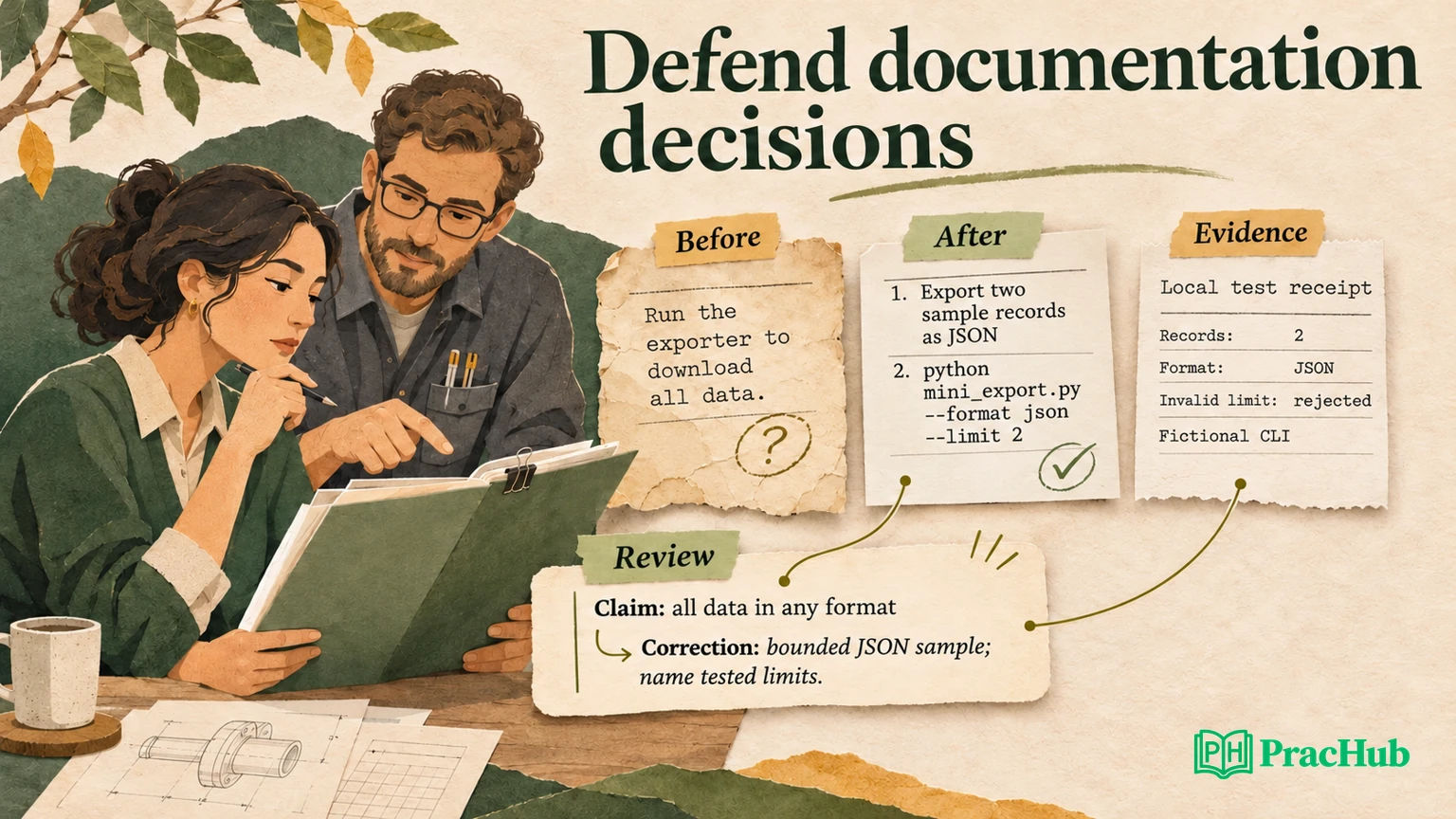
The original packet for this article contains a fictional export command, an ambiguous instruction, a corrected procedure and local test receipts. It also contains a short review disagreement. These assets let you rehearse the decisions without claiming to have shipped GitLab documentation.
| Packet item | What the interviewer can assess | Boundary to state |
|---|---|---|
| User and task statement | Whether the content serves a concrete need | The case is fictional |
| Before-and-after excerpt | Which consequential choice changed | The revision is your rehearsal work |
| Command and output receipt | What was actually checked | Local fixture, not a GitLab product test |
| Review decision ledger | How evidence resolved conflicting feedback | Comments are invented for practice |
| Maintenance note | Who updates the contract when behavior changes | Proposed responsibility, not a deployed process |
For real samples, replace those boundaries with truthful provenance. Explain whether you authored, edited, tested or coordinated the work. “I wrote the page” should not absorb an engineer's implementation, a researcher's findings or another writer's information architecture.
Choose a sample the interviewer can inspect during the conversation. A reviewer should be able to locate one meaningful change and ask why you made it. A long portfolio tour can consume the available conversation before the decision becomes visible.
Walk through one consequential documentation correction
The fictional tool exports up to three local records. Its only supported output format is JSON, and its --limit accepts integers from one through three. The initial instruction reads:
Run the exporter to easily download all your data in the format you need.
That sentence creates several unsupported expectations: “all” exceeds the fixture's bounded records, “download” suggests a remote operation, and “the format you need” implies choices the command does not support. Remove “easily,” then correct the unsupported scope and format claims.
The revised task is:
Export two sample records as JSON

Prerequisite: Python is available and mini_export.py is in your working directory.

Run:
    python mini_export.py --format json --limit 2

Expected output:
    [{"id": 1, "status": "ready"}, {"id": 2, "status": "ready"}]

The --limit value must be between 1 and 3. This local fixture supports JSON only.
The code is a fictional teaching utility, not a GitLab CLI command. The executed checks confirm two returned records for the documented command, one for --limit 1, and exit code 2 for --limit 0 and unsupported --format csv. The tests inspect parsed output length and failure status rather than merely finding a familiar word in stdout.
Explain why each revision matters. The title states the task and scope. The prerequisite prevents an avoidable file-location failure. The example establishes a concrete result. The bounds tell the user how to correct invalid input. None of those changes requires claiming that every environment has been tested.
Connect the sample to GitLab's documentation conventions
Official fact: GitLab's documentation style guide emphasizes concise, direct language, task-oriented topic types and documentation as a source of truth. It describes a docs-first approach in which missing product information should be added through a merge request. The policy does not mean that every repeated sentence must be eliminated mechanically.
In the rehearsal, separate the export procedure from a conceptual explanation of request identity. A user trying to run the command needs prerequisites, steps and expected output. A reader choosing a retry strategy needs conditions and consequences. Combining both into a sprawling introductory paragraph makes either task harder to find.
Use the guide to explain an editorial choice rather than reciting it. For example, changing “the system allows you to leverage flexible exporting” to a bounded task removes marketing language and clarifies the supported result. A style rule is more persuasive when you show the user misunderstanding it prevents.
If a reviewer requests custom HTML for a visual arrangement, ask whether standard Markdown can express the content. Consider rendering, accessibility, localization and maintenance. The right answer is not automatically “never use HTML”; it is to justify the exceptional requirement and verify the supported presentation path.
Resolve conflicting feedback with a condition you can test
The second original asset is a fictional review of retry documentation. An engineer comments, “Retry is safe.” Support replies, “Some jobs run twice.” The writer asks, “Does the same request key identify the same operation, and what happens with a new key?” The disagreement exposes a missing retry condition.
| Review claim | Evidence needed | Documentation decision |
|---|---|---|
| Retrying is safe | Same-key behavior under repeated submission | State the key and operation conditions |
| Duplicate jobs occur | Whether retries used a new key | Warn that a new identity can create new work |
| A timeout means failure | Whether the server accepted the first request | Describe ambiguous outcomes and a readback path |
| The example is complete | Supported environment and failure cases | Record tested scope and remaining gaps |
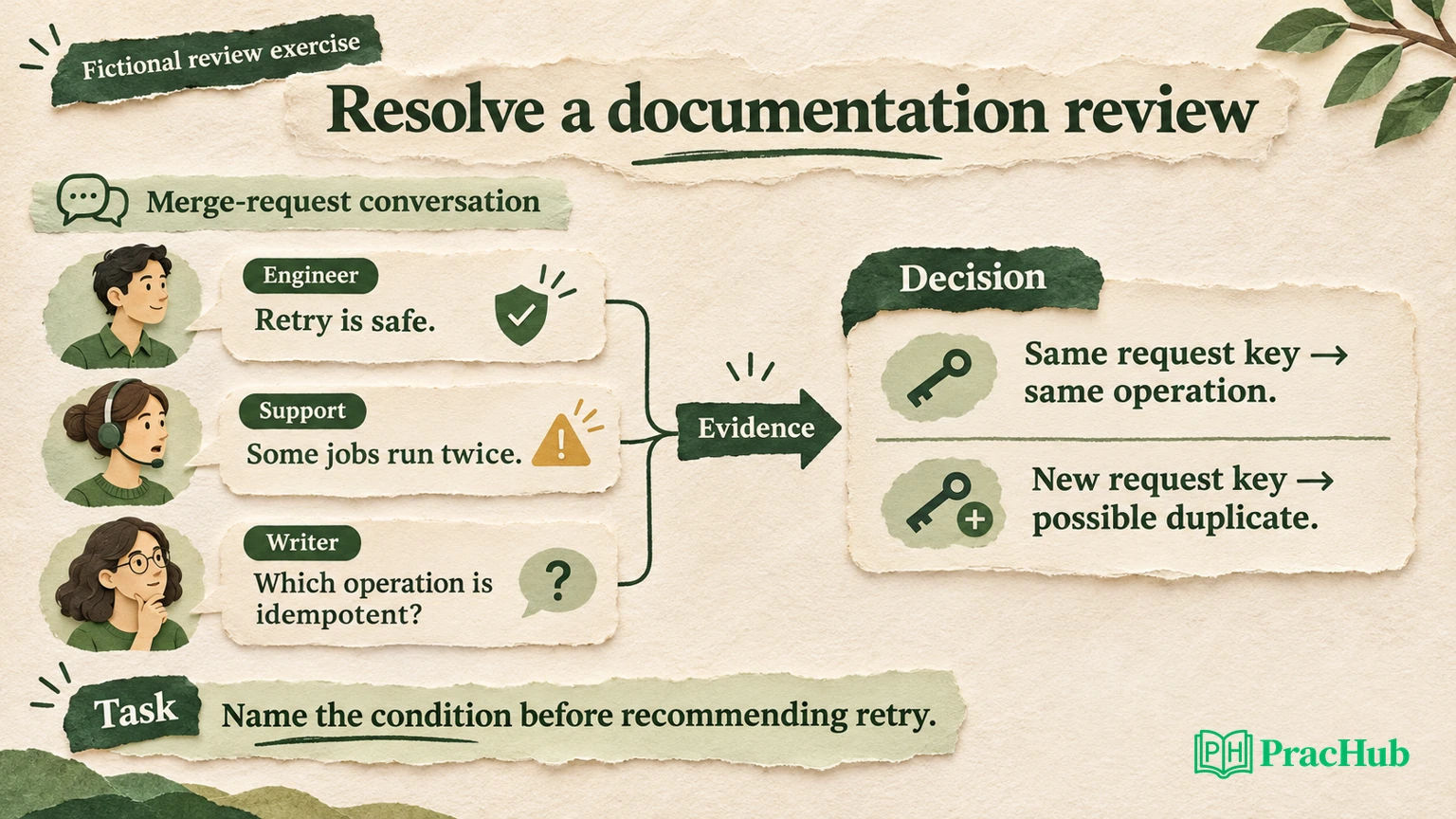
The local export utility does not implement this remote retry protocol. Keep the artifacts separate: command receipts establish the CLI example's behavior; the review ledger rehearses how you would request and use evidence for a different contract. Combining them into one claim of tested API idempotency would be inaccurate.
A useful spoken answer is: “I would narrow the sentence to the verified same-key condition, ask for the ambiguous-timeout behavior, and keep the merge request open until the unsupported claim is resolved.” That makes the writing decision visible without pretending the writer independently owns every implementation detail.
If the engineering team cannot supply evidence before release, discuss a bounded statement of known behavior and an explicit follow-up owner. Do not replace a missing guarantee with reassuring prose. The document should help the user decide what to do under uncertainty.
Explain review and maintenance as part of the work
A merge request is not finished merely because the sentences read smoothly. Identify the reviewers needed for technical accuracy, user impact and style. Distinguish a blocking contract error from an optional wording preference. Keep the conversation focused on what a user might misunderstand or fail to complete.
For the fictional sample, an engineer verifies accepted flags and bounds; a writer reviews task structure and terminology; a support partner identifies the invalid-input case users are likely to encounter. This division is a proposed rehearsal workflow, not a claim about mandatory GitLab approvals for every page.
Record the environment used for the checks and link the sample to its implementation or specification. If the tool later adds CSV, the JSON-only statement becomes stale. A maintenance note should identify the change trigger and owner, rather than promising that a page will somehow stay current.
Explain what automation can and cannot establish. Formatting and style checks can catch defined patterns, but passing them does not prove the example's output is correct. Command execution can validate a fixture's behavior without establishing that the text is understandable to a new reader. User-task review supplies another kind of evidence.
This article did not run GitLab's Vale or documentation pipeline. Mentioning those tools in the style guide is not evidence of local execution. In your own sample, retain the actual check output and say exactly which revision it applies to.
Prepare different depths for the sample discussion
Prepare a concise opening: who the user is, what they need to do, what was wrong and what you changed. Then keep deeper evidence ready for follow-up. A technical writer should be able to move from a sentence-level revision to the system behavior that makes the sentence true.
For a cross-functional audience, lead with the consequence: the old instruction promised unsupported formats, so users could not know which command would work. For an engineering audience, show the accepted flags, failure cases and output contract. For a documentation strategy discussion, explain where the task belongs and how updates reach it.
Use a challenge question: “Why not show every option on this page?” Answer with the reader's task, the relationship to reference content and the maintenance cost of duplication. Then consider the opposite challenge: “What if a user lands directly here?” A task page may need a short local prerequisite even when a broader guide explains it elsewhere.
The existing technical writer portfolio article covers sample selection and attributable claims. This GitLab-focused rehearsal adds docs-first review decisions, topic placement and the evidence discussion that follows a work sample.
Practice the conversation with five related questions
These verified PracHub records cover project explanation, active follow-ups, conflicting stakeholders, implementation evidence and reflection. They come from broader technical roles; they are not reported GitLab Technical Writer prompts. Use the follow-ups to keep documentation judgment and your actual contribution central.
| PracHub question | Topic-specific rehearsal |
|---|---|
| Present a Technical Project to a Cross-Functional Audience | Explain the same documentation correction for engineering, product and support. |
| Present a Technical Project Under Active Follow-Up | Keep the sample provenance and testing limits consistent under follow-up. |
| Align Conflicting Stakeholders for Successful Project Delivery | Resolve conflicting review claims through a condition and accountable owner. |
| Build a Create/Execute Workflow Service With an AI Assistant: Plan, Implement, Verify | Distinguish a runnable fixture from a deployed workflow or product guarantee. |
| Explain What You Would Change When Rebuilding a Technical Project | Identify what would improve the sample and how maintenance responsibility would change. |
Rehearse the cross-functional explanation question using the export packet. Show the exact before-and-after correction, state the four local checks, then explain how you would resolve the retry disagreement without claiming an untested guarantee. The interviewer should be able to trace each assertion to a sample, a decision or an explicit unknown.
Comments (0)