Goldman Sachs Summer Analyst OA 2027 (India): 3 Coding Questions, AI MCQs, and On-Campus Shortlisting
Quick Overview
A current guide to the Goldman Sachs Summer Analyst engineering OA in India, separating official program facts from campus-reported formats. Covers three coding questions, AI and CS MCQs, scoring, shortlisting, interview follow-ups, and a practical preparation plan.
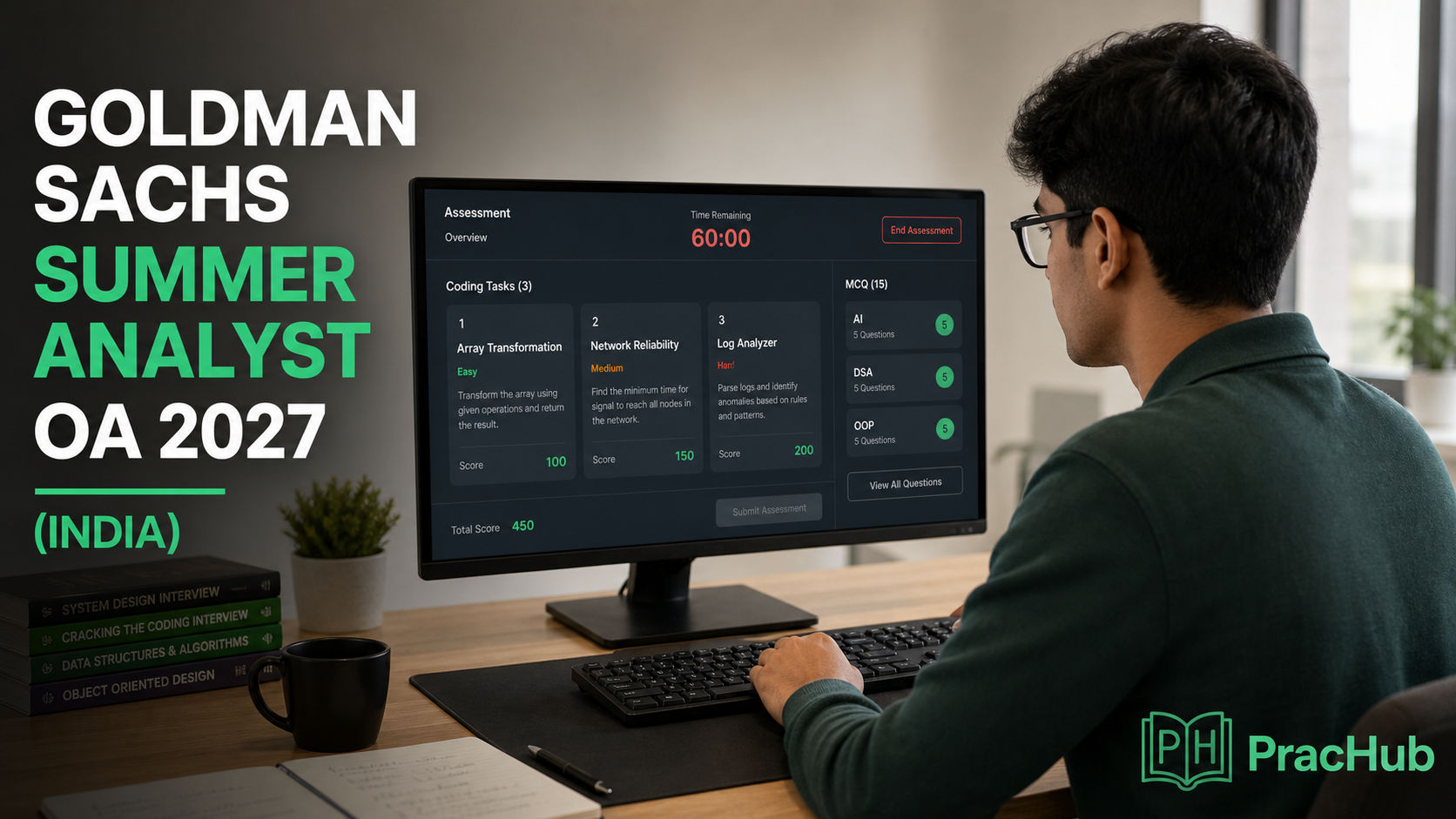
You open the Goldman Sachs assessment expecting a standard coding screen. Instead, the clock starts, three coding problems appear, and the multiple-choice section jumps from data structures to prompt engineering, RAG, agentic AI, and object-oriented programming.
That is the pattern several India campus candidates have reported for the 2027 Summer Analyst engineering process. The assessment is fast, broad, and competitive, but it is not identical at every college. This guide separates what Goldman Sachs confirms officially from what candidates have reported, then turns those reports into a practical preparation plan.
Before you start, review Goldman Sachs Software Engineer questions on PracHub. Company-specific practice is more useful than memorizing one leaked prompt because the exact questions can change while the underlying skills remain similar.
Quick Verdict
The strongest current reports describe a roughly 50- to 60-minute assessment with three coding questions and about 10 to 12 MCQs. Some campuses reported AI-focused MCQs alongside DSA and OOP, while another campus reported a more traditional mix of operating systems, databases, networks, OOP, and DSA.
| What appears consistent | What may vary by campus |
|---|---|
| Three coding questions are common in current reports | The exact time limit: reports mention about 50 or 60 minutes |
| DSA and OOP knowledge matter | AI MCQs versus traditional CS-fundamentals MCQs |
| Shortlisting can be rank-based and highly selective | Question difficulty, scoring, interview count, and cutoff |
| Passing hidden tests matters more than recognizing a prompt | Whether the assessment is online or supervised on campus |
Do not prepare for one screenshot of one test. Prepare for a compressed evaluation of implementation, algorithm selection, MCQ accuracy, and the ability to discuss projects and fundamentals immediately afterward.
What Goldman Sachs Confirms About the 2027 India Program
Goldman Sachs' official page describes the 2027 Summer Analyst Program in India as an eight- to ten-week internship. Applications opened July 1, and the stated eligibility is for students graduating from a bachelor's or master's program in 2028. Engineering is one of the available business areas.
The official page does not promise a universal OA format, fixed cutoff, or identical campus process. The details below therefore come from current candidate reports and should be treated as a preparation baseline, not a guaranteed test blueprint.
The Candidate-Reported OA Format
One detailed August 2026 report described a one-hour HackerRank assessment with three coding questions and ten multi-select MCQs. The MCQs included prompt engineering, RAG, agentic AI and MCP, DSA, and OOP. That candidate also reported +3 for a correct answer and -1 for an incorrect answer.
Other reports support the three-coding-question pattern but show meaningful variation. An IIT Roorkee discussion described an easy, medium, and hard coding progression with approximately 12 MCQs. An NSUT candidate reported three DSA questions plus ten MCQs covering OS, DBMS, computer networks, OOP, and DSA, with a 50-minute limit.
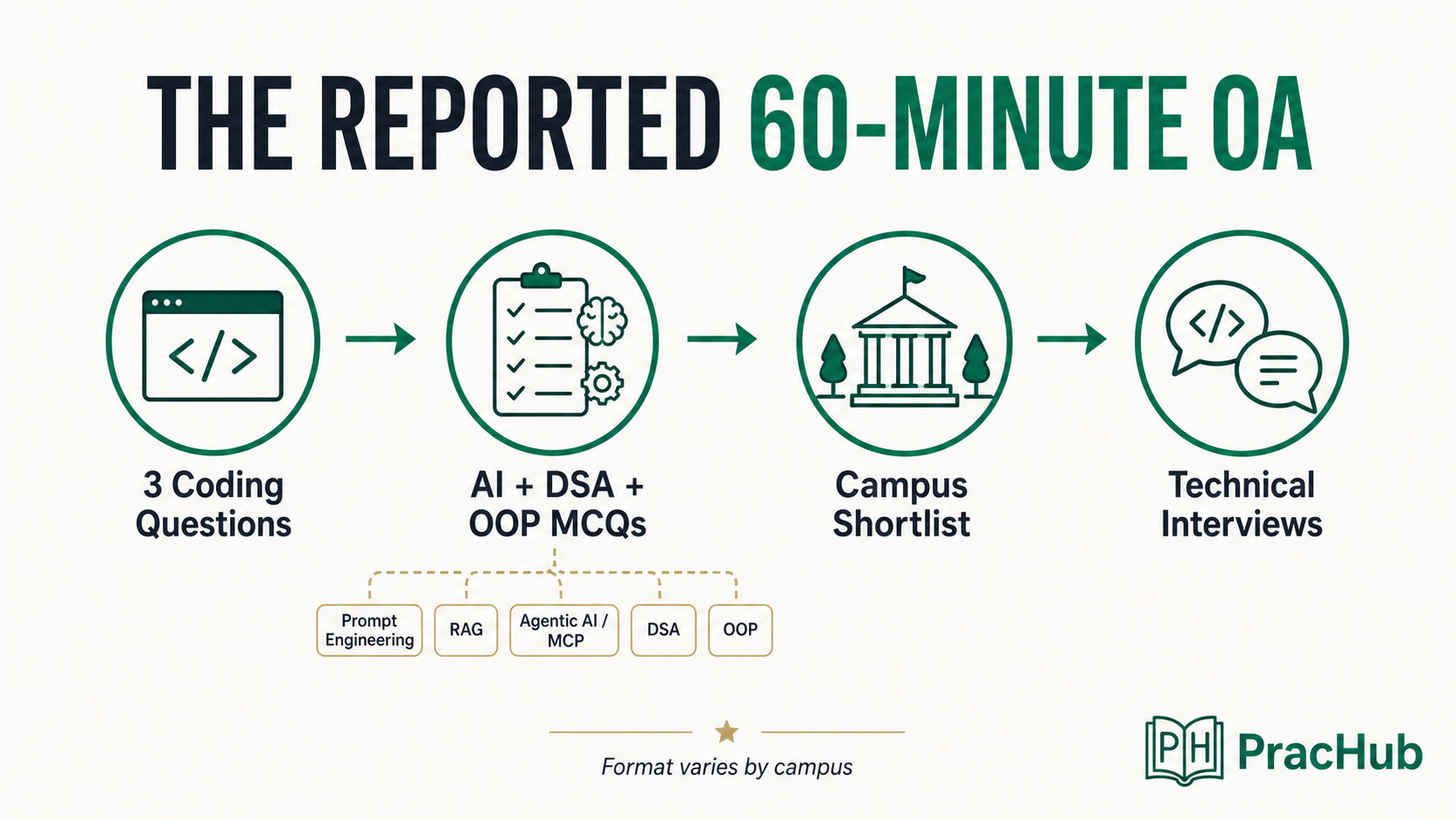
The useful conclusion is not that every candidate will see the same test. It is that you should be ready for this compact structure:
| Section | Current candidate reports | Preparation implication |
|---|---|---|
| Coding | Three problems, often increasing in difficulty | Secure the first clean solution quickly, then protect time for later problems |
| DSA MCQs | Complexity, heaps, code output, and core structures | Review concepts well enough to reason without an IDE |
| OOP and CS fundamentals | OOP is common; some campuses add OS, DBMS, and networks | Study principles and applied scenarios, not definitions alone |
| AI concepts | Prompt engineering, RAG, agentic AI, and MCP appeared in several reports | Know architecture, limitations, and terminology at an interview-ready level |
What the Three Coding Questions May Test
Recent reports describe a spread from straightforward implementation to problems requiring a stronger invariant, dynamic programming idea, tree traversal, or careful simulation. One candidate characterized the set as easy, medium, and hard. Another reported interval reasoning, longest palindromic subsequence, and a weighted-tree problem.
Those examples are signals, not a syllabus. The better preparation target is a set of reusable skills.
Fast and reliable implementation
The first problem is often your best chance to bank a complete score. Practice translating requirements into code without overengineering. Handle empty inputs, duplicates, integer boundaries, and output formatting before moving on.
Arrays, strings, and hash maps
These topics reward precise implementation under time pressure. Be able to count frequencies, normalize keys, track first occurrences, group values, and reason about transformations without repeatedly rewriting the solution.
Dynamic programming and graph or tree reasoning
You may not have time to discover a complex recurrence from scratch. Practice recognizing subsequence, path, dependency, and traversal structures. Write down the state or invariant before coding so that a half-formed idea does not consume the entire assessment.
Hidden-test discipline
A solution that passes samples can still fail on large inputs, repeated values, disconnected components, or off-by-one boundaries. Before submitting, test the smallest valid input, an all-equal case, a strictly increasing case, and a stress case suggested by the constraints.
How to Prepare for the AI MCQs
The AI questions reported in 2026 are a notable change from a purely traditional CS quiz. You do not need to become an ML researcher, but you should understand how modern AI systems are assembled and evaluated.
Prompt engineering
Know the difference between system instructions, user input, examples, context, and output constraints. Understand why clear task framing, structured output, grounding, and evaluation examples improve reliability. Also know that prompting cannot guarantee correctness or eliminate model limitations.
Retrieval-augmented generation
Be able to explain the basic pipeline: ingest documents, split them into chunks, create embeddings, retrieve relevant context, and send that context to a language model. Review common failure modes such as poor chunking, stale data, weak retrieval, irrelevant context, and hallucinated answers.
Agentic AI and MCP
Understand the difference between a single model call and an agent that chooses tools, observes results, and continues toward a goal. For MCP, focus on the high-level purpose: a standardized way for AI applications to discover and use tools or data sources. Think about permissions, tool errors, prompt injection, and the need for human approval around sensitive actions.
Negative marking changes the strategy
If your invitation uses the reported +3/-1 scheme, guessing every uncertain multi-select answer can hurt. Read the instructions on your own assessment. When negative marking is present, answer when you can eliminate choices or explain why each selected option is correct; leave a question blank when your confidence is genuinely low.
Why On-Campus Shortlisting Feels So Competitive
Candidate reports show that the process can be rank-based within a campus. One NSUT report said approximately 800 candidates took the assessment and 14 were selected for interviews. Another detailed report described a top-ten shortlist, followed by multiple interviews and only one final offer in that candidate's campus process.
Those numbers are individual reports, not Goldman Sachs-wide cutoffs. They still reveal an important reality: solving “enough” questions may not be enough if many students solve the same amount. Accuracy, speed, MCQs, resume strength, and campus hiring needs can all affect the shortlist.
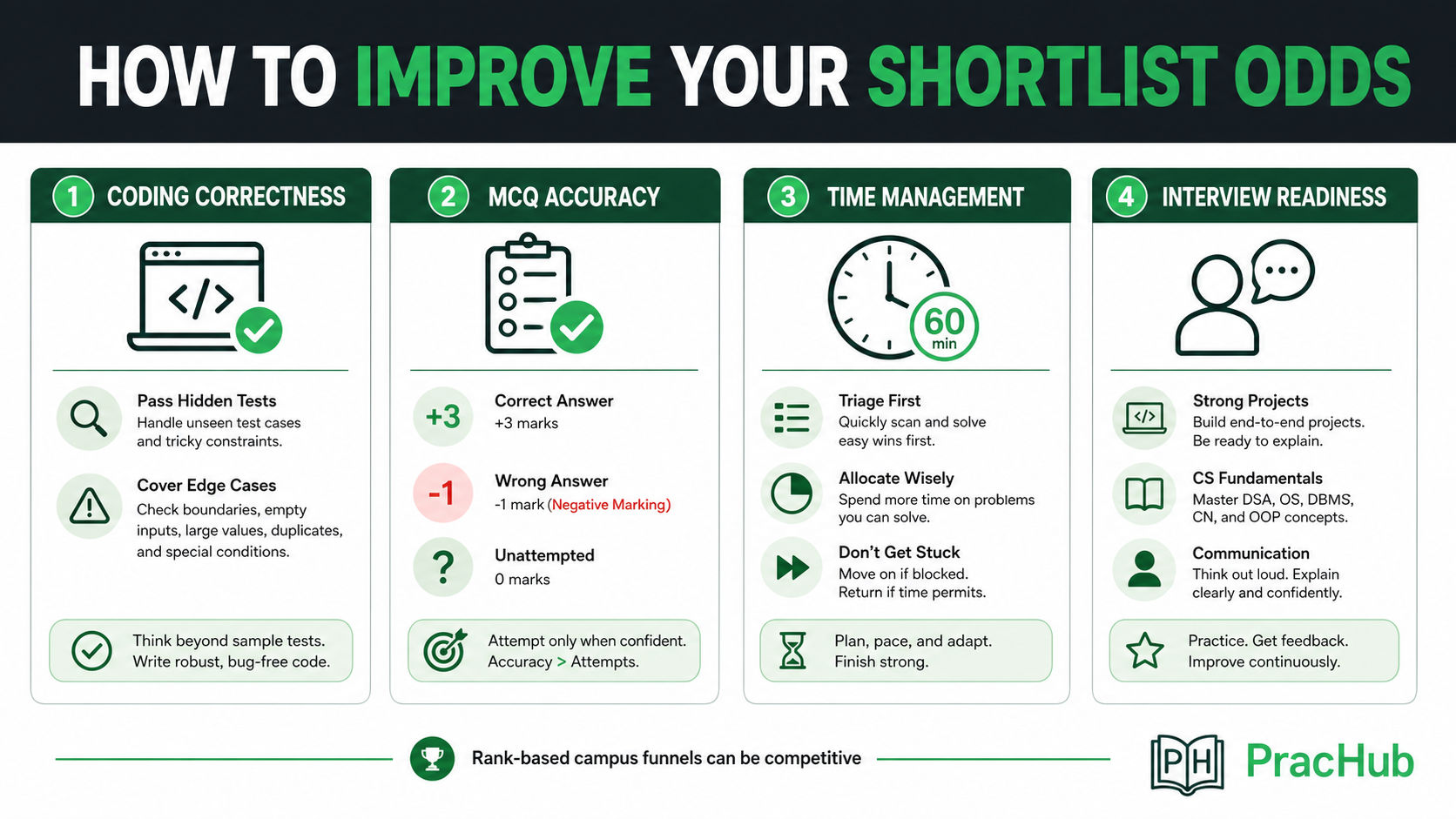
Do not chase a rumored cutoff as if it were a contract. Your controllable goal is to maximize complete test cases, avoid preventable MCQ deductions, and be ready for interviews before the shortlist arrives.
What Comes After the OA
Current campus reports describe technical rounds that move quickly into projects, DSA, and CS fundamentals. Candidates have mentioned trees, BFS, sliding windows, indexing and B+ trees, Linux concepts, design judgment, and questions about how they used AI in projects.
Prepare a two-minute explanation for one substantial project: the problem, your architecture, the hardest trade-off, one failure or bug, and the measurable result. Then prepare to go deeper. Interviewers may ask why you selected a data structure, how the system behaves at scale, how you tested it, or what you would redesign.
For behavioral follow-ups, use behavioral and leadership interview practice to build concise stories about conflict, ownership, mistakes, and collaboration. A strong OA can get you into the interview; it does not replace interview readiness.
Practice with Goldman Sachs Questions from PracHub
These question-bank records are not predictions of your exact Summer Analyst assessment. They are useful because they train the implementation, string, hash-map, data-structure, and multi-part reasoning skills that appear across Goldman Sachs engineering rounds. Each complete title in the first column links directly to the question and written solution.
| PracHub question | Practice focus | Why it helps |
|---|---|---|
| Count Segments and Optimize 3-Server Assignment | Arrays, segmentation, optimization | Trains multi-part problem parsing and the shift from a straightforward first task to a harder optimization task. |
| Implement an Integer Hash Map | Hashing, collisions, API design | Forces you to implement a familiar structure carefully instead of relying on a library. |
| Find First Non-Repeating Character Index | Strings, frequency counting, edge cases | Builds the fast, reliable implementation needed to secure an early coding question. |
| Solve String and Hashmap Coding Tasks | Grouping, simulation, robust parsing | Practices switching between related tasks without losing correctness under a shared timer. |
| Implement a String Deque | Data structures, operations, boundaries | Reinforces invariants, empty-state behavior, and clean method design. |
Open one problem at a time and attempt it before reading the solution. Afterward, record whether the failure came from concept selection, implementation, complexity, or an untested edge case. That error log should decide what you practice next.
A Seven-Day Preparation Plan
| Day | Focus | What to do |
|---|---|---|
| Day 1 | Baseline | Complete three timed coding questions in 60 minutes and log every failure. |
| Day 2 | Arrays and strings | Practice frequency maps, grouping, intervals, two pointers, and boundary cases. |
| Day 3 | DP, trees, and graphs | Review common states and traversals, then solve one problem from each area. |
| Day 4 | MCQ fundamentals | Review complexity, heaps, OOP, OS, DBMS, and networking at concept-plus-scenario depth. |
| Day 5 | AI concepts | Study prompting, RAG, agent loops, MCP, evaluation, security, and common failure modes. |
| Day 6 | Full simulation | Recreate your invitation's exact duration, section order, and permitted environment. |
| Day 7 | Interview readiness | Rehearse one project deep dive, two DSA explanations, and three behavioral stories. |
Test-Day Strategy
Spend the opening minute scanning all coding questions and the MCQ instructions. Confirm whether sections are independently timed, whether you can return to earlier questions, and whether wrong MCQ answers lose marks.
Start with the coding problem you can complete most confidently, not automatically the first problem. A fully tested solution is usually more valuable than three partially written approaches. If a problem stalls, preserve your current code, note the missing insight, and move on.
For multi-select MCQs, evaluate each option independently. Do not select an option merely because it sounds related to the topic. In the final minutes, run boundary tests on submitted code before making speculative MCQ guesses.
Frequently Asked Questions
Is the Goldman Sachs Summer Analyst OA always three coding questions?
Three coding questions appear consistently in several current India campus reports, but Goldman Sachs does not publish a universal OA blueprint. Follow the instructions in your invitation because the format can differ by campus, role, and hiring route.
Are AI questions now part of the Goldman Sachs OA?
Several 2027 Summer Analyst candidates reported MCQs on prompt engineering, RAG, agentic AI, and MCP. Another campus reported traditional CS topics instead, so prepare both AI concepts and core CS fundamentals.
What is the cutoff for Goldman Sachs OA 2027?
There is no verified universal cutoff. On-campus shortlisting may depend on relative rank, coding test cases, MCQ score, resume review, and the number of interview slots available at that college.
Does Goldman Sachs use HackerRank for the assessment?
Current candidates have reported HackerRank, but platform and delivery can vary. Use the platform named in your own invitation and complete its environment check or sample test before assessment day.
Should I memorize reported OA questions?
No. Reports are useful for identifying topic families and time pressure, but prompts can change and reproductions may be incomplete. Practice the underlying patterns and learn to validate edge cases under a timer.
Final Takeaway
The reported Goldman Sachs Summer Analyst OA for India is challenging because it compresses three coding problems, broad MCQs, and competitive campus ranking into roughly an hour. The best response is not to predict every question. It is to build fast implementation habits, review AI and CS fundamentals, and prepare for interviews before results arrive.
Use Goldman Sachs Software Engineer questions on PracHub to turn the format into targeted practice. Start with one timed company question today, inspect every failed edge case, and repeat until your assessment process is predictable even when the prompt is not.
Sources and Further Reading
- Goldman Sachs: 2027 Summer Analyst Program in India
- Candidate report: Goldman Sachs Summer Analyst 2027 OA and interview write-up
- Candidate discussion: Goldman Sachs OA for 2027 interns on campus
- Candidate discussion: Goldman Sachs Summer Analyst 2027 for the 2028 batch
- Candidate discussion: Goldman Sachs OA questions and difficulty
Research note: This guide was checked on August 18, 2026. Assessment formats and campus shortlisting rules can change. Treat candidate reports as directional evidence and your official invitation as authoritative.
Comments (0)