Google Customer Engineer Interview: RRK Scenarios and the Technical Presentation
Quick Overview
Prepare for Google Customer Engineer RRK scenarios and the technical presentation with a clear separation between official role requirements, candidate reports, and preparation advice. Work through an original Google Cloud migration case, compare Cloud Run and GKE Autopilot, explain database connection and recovery limits, and present the same recommendation to technical and business audiences.
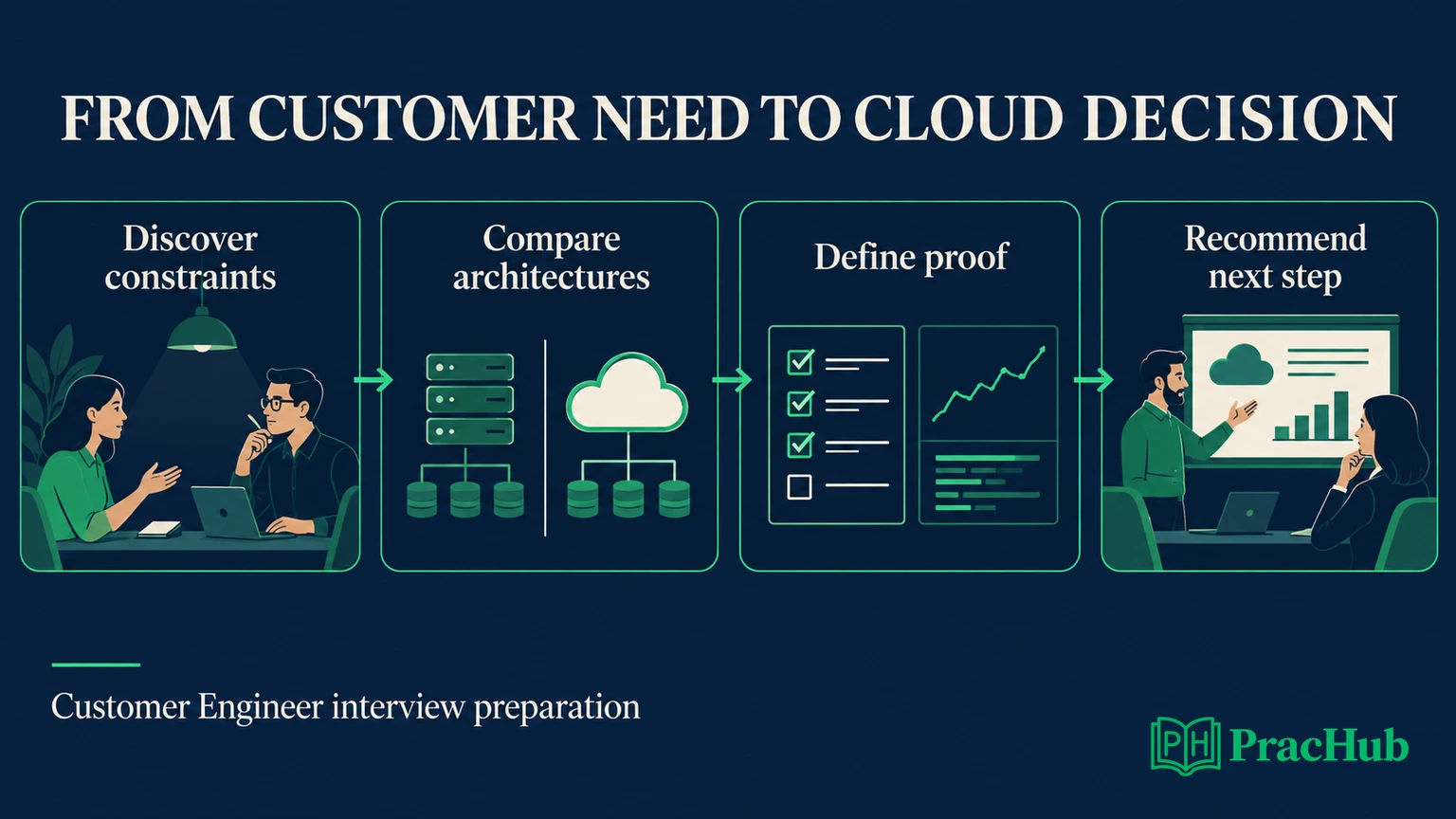
Prepare for a Google Customer Engineer interview by practicing one customer problem in two forms: an interactive technical discussion and a presentation that recommends a decision. For role-related knowledge, explain how requirements change the architecture. For the presentation, connect that architecture to business value, risks, and a credible next step. Connect each product choice to a customer requirement.
This guide focuses on platform-oriented Customer Engineer preparation. For architecture drills, use PracHub’s Google System Design questions. Those records are primarily labeled Software Engineer; they provide transferable practice rather than a verified Customer Engineer question bank.
Separate official role requirements from reported rounds
Official fact, checked September 8, 2026: Google’s Singapore listing for Customer Engineer, Platform, Start-ups describes customer-facing cloud architecture, engagement with technical stakeholders and executives, and experience with programming, debugging, prototypes, demos, or workshops. Responsibilities include technical account planning, proving value through pilots, architecting solutions, and transitioning delivery plans to implementation teams. This supports preparing both technical depth and customer communication. It does not prescribe a universal interview sequence. Google Careers role description
Candidate reports: A September 2025 US applicant described RRK, GCA, leadership, and sales-presentation interviews. A different applicant’s May 2026 presentation thread, updated in June, reported passing RRK but receiving feedback that the presentation needed more architectural depth. These are individual accounts, not official scoring guidance. The 2025 applicant cross-posted their story; those copies are one account, not independent corroboration. 2025 account, 2026 presentation account
Here, RRK means role-related knowledge, terminology used in candidate discussions. We did not establish two independent completed reports from the same current hiring cycle. The article therefore offers role-grounded preparation, not a promised loop, fixed presentation topic, or time limit. AI/ML, security, Workspace, and platform roles can require different depth.
Confirm your specialization, interview format, presentation audience, brief, duration, submission deadline, demo expectations, and permitted tools with the recruiter. A slide count from another candidate is not your assignment.
Use different evidence for RRK and the presentation
Preparation inference: Treat RRK as an opportunity to reason with the interviewer, and the presentation as an opportunity to make a recommendation that survives questions. Both require technical knowledge; their delivery differs.
In a scenario discussion, start by asking what the customer is trying to achieve and which unknowns would change your answer. Explain one viable design, compare an alternative, and revise your recommendation when a constraint changes.
In a presentation rehearsal, arrive with a coherent position: the customer problem, proposed approach, evidence still needed, and decision requested. Leave enough architectural detail available to explain a request path, data ownership, failure behavior, and operating limits.
Do not interpret “customer-facing” as permission to stay superficial. Equally, do not answer a commercial concern with an unstructured tour of database internals. State the consequence first, then go deeper where it affects the decision.
Original scenario: migrate a growing booking service
Original practice case, not a reported Google prompt: A startup runs a booking API and PostgreSQL database on virtual machines. Campaign traffic creates spikes, releases require manual intervention, and the team wants to evaluate Google Cloud before its next expansion. Three engineers maintain the service; none currently operates Kubernetes.
The request “move us to the cloud” is incomplete. Ask how customers book, where latency occurs, which failures lose revenue, and what the team can support after migration. Separate application modernization from database migration; they need not happen in one risky cutover.
For the rehearsal, agree on these hypothetical constraints:
| Discovery item | Working assumption | Architectural consequence |
|---|---|---|
| Application | Containerizable HTTP API; persistent state is outside the process | Evaluate a managed container service before adding cluster operations. |
| Traffic | Bursty; measured production traces are available | Replay representative peaks instead of estimating only from daily averages. |
| Data | PostgreSQL transactions protect booking inventory | Preserve transaction semantics and test duplicate booking attempts. |
| Reliability | A zonal failure should recover within an agreed target | Test failover and application reconnection; discuss regional disaster recovery separately. |
| Location | Initial deployment in one approved region | Record data-location requirements before choosing additional regions. |
| Team | Three engineers, limited platform capacity | Include operational ownership and training in the recommendation. |
All numbers and constraints are invented for practice. They are not Google customer statistics. If the interviewer changes the workload to long-running stateful processes or requires Kubernetes APIs, revisit the compute choice rather than forcing your original answer.
Compare Cloud Run with GKE Autopilot
Official product facts: Cloud Run services handle HTTP requests using stateless container instances. GKE Autopilot is a managed Kubernetes mode in which Google manages infrastructure configuration, including nodes and scaling. These descriptions establish capabilities, not which product wins for this customer. Cloud Run overview, GKE Autopilot overview
Scenario recommendation: Start the pilot with Cloud Run for the API because this fictional team has an HTTP workload and little Kubernetes experience. Retain GKE Autopilot as a serious alternative if Kubernetes-specific controls, deployment conventions, or workload requirements justify it. Managed Kubernetes reduces infrastructure work; it does not remove application configuration and operational decisions.
Describe the proposed request path: a client reaches the API through the chosen ingress arrangement; the application authenticates the request, authorizes the booking action, executes a database transaction, and returns the outcome. Show where secrets, service identity, connection pooling, and monitoring belong. Label those as controls to configure and verify, not protections that appear automatically because a service is managed.
Avoid adding five products to make the diagram look impressive. Add an asynchronous component only if the customer has a task that can safely leave the synchronous booking path. Explain delivery and retry behavior before moving booking-critical work into it.
Make the database limit visible
Compute scaling can expose a database bottleneck. Use a small calculation to show why “autoscaling” is not a complete answer.
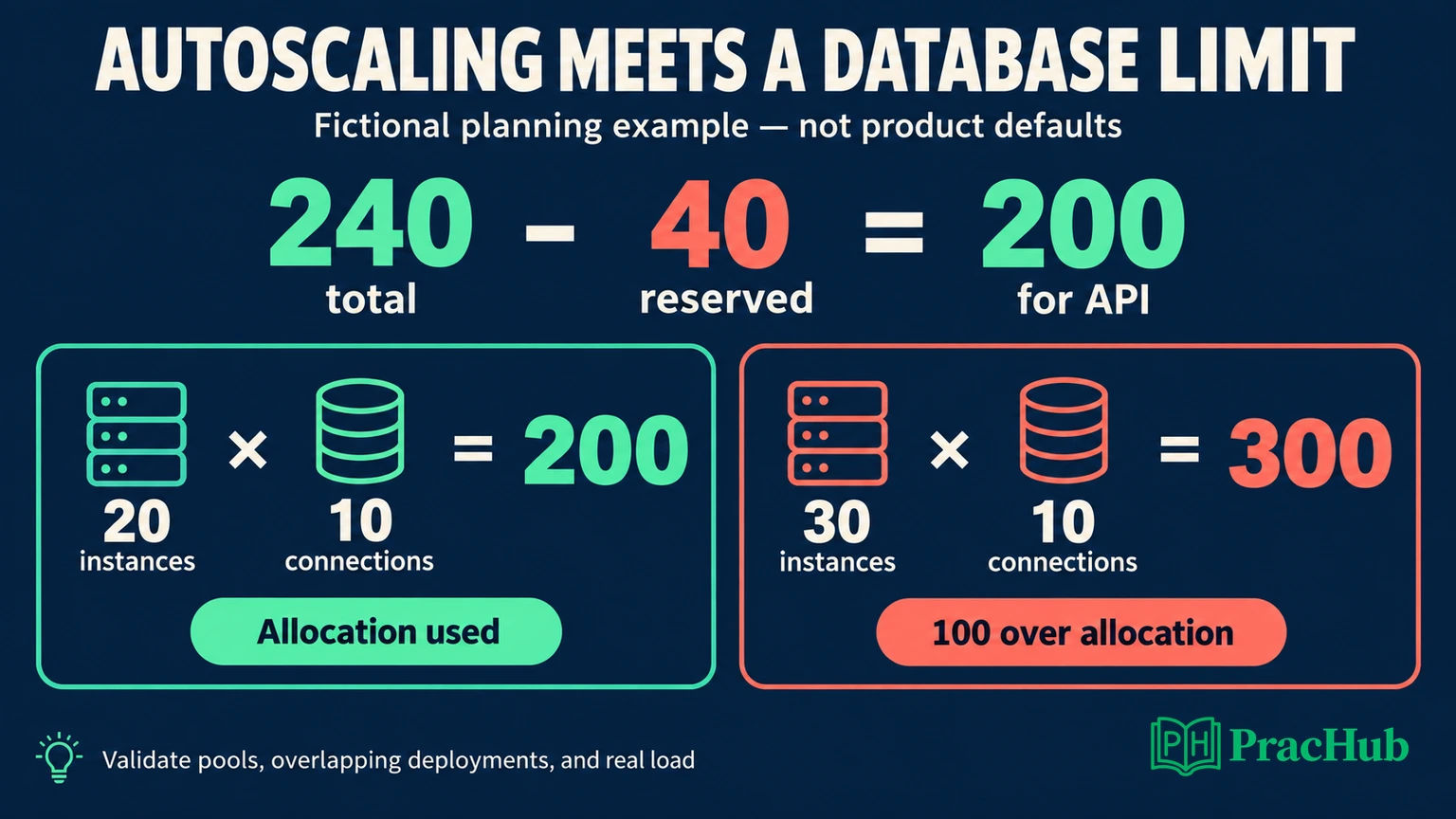
Suppose the fictional planning budget is 240 database connections. Reserve 40 for operations and other clients, leaving 200 for this API. With a maximum pool of 10 connections per application instance, 20 simultaneous instances would consume that allocation. At 30 instances, the theoretical demand becomes 300, exceeding it by 100.
These are arithmetic assumptions, not Cloud SQL defaults, a benchmark, or a production sizing recommendation. A configured scaling limit alone should not be presented as a hard database-safety guarantee. Account for overlapping deployments, other services, pool behavior, retries, and transient instances; use appropriate admission and connection controls and verify them under load.
A technical follow-up could be: “What if we halve the connection pool?” The answer is not automatically “twice the throughput.” Measure query duration, transaction contention, queueing, and request latency. A smaller pool may protect the database while increasing wait time. A larger database may still fail to fix a slow query or lock hotspot.
Use this calculation to connect the customer’s slowdown to a resource limit and a testable intervention.
Distinguish availability from recovery
Official product fact: Cloud SQL high availability uses a primary and standby in different zones within a region, with synchronous storage replication and failover behavior. That addresses particular instance or zonal failures; it is not, by itself, a complete regional disaster-recovery plan. Cloud SQL PostgreSQL HA documentation
In the mock, ask the customer to define acceptable recovery time and data loss. Then propose separate tests for database failover, restoring a backup, and handling a regional disruption. Do not substitute a product SLA for measured end-to-end booking availability.
For migration, begin with compatibility checks and a representative data copy in an isolated environment. Compare schema behavior, transaction results, extensions, and query performance. Define how data catches up before cutover and who approves the switch. If writes occur on the new system, “point traffic back” is not a sufficient rollback plan: explain data reconciliation and schema compatibility.
The recommendation can remain conditional: proceed only when the pilot establishes the agreed correctness, latency, recovery, and operating-cost criteria. That is a concrete next step without inventing evidence.
Build a technical presentation around one decision
For your mock, ask the panel to approve a bounded migration pilot, not an immediate production move. Build the narrative in this order: customer problem, confirmed constraints, proposed request path, strongest alternative, validation plan, and requested decision. This is a rehearsal structure, not Google’s prescribed deck format.
Keep the main architecture readable. Put details such as the connection calculation, identity boundaries, database recovery assumptions, and migration dependencies in supporting material you can reach quickly. Every component should answer a customer requirement or an explicit risk.
Use a demonstration only when it proves something relevant. A successful HTTP request establishes very little. A more useful demo might show a repeated booking request handled correctly, a failed authorization attempt rejected, or load causing bounded queueing rather than uncontrolled database connections. Those are proposed demo goals; no such cloud deployment was performed for this article.
Prepare a fallback with screenshots, an annotated trace, and expected outputs in case the demo environment fails. Label recorded evidence honestly and explain what a diagram cannot establish. Confirm that your actual interview brief allows the chosen materials.
Explain the same design to two audiences
Practice switching depth without changing the facts.
To an engineering lead: “The API is a candidate for Cloud Run because it is containerizable and stateless between requests. PostgreSQL remains the transactional authority. The pilot will test connection limits, transaction contention, authorization, and reconnection during database failover. We would reconsider compute if a Kubernetes-specific requirement emerges.”
To a business sponsor: “We propose testing a managed deployment path so the current team can focus more time on the booking product. We have not proved faster releases or lower cost yet. The pilot will measure those outcomes alongside booking correctness and recovery, with a decision checkpoint before production migration.”
The second version removes implementation detail while preserving uncertainty and accountability. It does not promise savings that the first version cannot support.
When asked about cost, state the inputs you need: traffic shape, CPU and memory usage, database sizing, storage, network transfer, logging volume, support, and team effort. Compare equivalent service levels using current pricing and measured usage. A low compute estimate that ignores the database and operational work is not a useful customer recommendation.
Handle objections with conditions and evidence
| Panel objection | Productive response |
|---|---|
| “Why not Kubernetes from the start?” | Identify the requirement that needs Kubernetes, then compare its benefit with the team’s operating capacity. |
| “Can you guarantee no downtime?” | Clarify the failure scope and recovery target; explain what the design covers and what must be tested. |
| “Our traffic might grow tenfold.” | Revisit workload traces, database contention, and connection demand before assuming compute scaling resolves the problem. |
| “We need a lower bill immediately.” | Separate immediate optimization from migration costs and ask which costs and service levels must be held constant. |
| “Can we migrate this weekend?” | Identify compatibility, replication, cutover, rollback, and ownership prerequisites; recommend a smaller step if they remain unresolved. |
If you do not know a product limit, say what you would verify and why it matters. Name the decision that depends on the missing fact. You can still explain the decision that depends on that limit without fabricating its value.
Rehearse interruptions with a partner. After answering, reconnect the discussion to the customer’s decision so the presentation does not become a collection of unrelated technical tangents.
Five questions for targeted practice
These Google-tagged PracHub records are Software Engineer system-design exercises, not verified CE RRK or presentation questions. Use them to strengthen specific parts of a customer recommendation.
| Practice question | Customer-facing skill to rehearse |
|---|---|
| Design a Security Monitoring Framework | Explain collection, detection, privacy, and operational boundaries instead of saying “add monitoring.” |
| Design A Drive-Style Usage Quota Limiter | Connect resource limits, concurrent requests, and reconciliation to predictable service behavior. |
| Design a global restaurant menu update system | Translate business timing and unreliable connectivity into explicit delivery requirements. |
| Design task scheduler with dependencies | Explain dependencies, failure recovery, and ownership of background work. |
| Design a pub-sub replay system | Defend recovery and replay semantics before recommending event-driven components. |
Choose one from the Google System Design collection, then explain your answer once to an engineer and once to a business sponsor. Check that both versions support the same recommendation and acknowledge the same limits.
Sources and Further Reading
- Google Careers: Customer Engineer, Platform, Start-ups, Singapore
- Candidate account: US Customer Engineer interview rounds, September 2025
- Candidate account: Presentation preparation and feedback, May–June 2026
- Google Cloud: Cloud Run overview
- Google Cloud: GKE Autopilot overview
- Google Cloud: Cloud SQL PostgreSQL high availability
Comments (0)