Grind 75 vs Blind 75 vs NeetCode 150: Which List Should You Finish?
Quick Overview
Blind 75 is the compact original, Grind 75 is its customizable successor, and NeetCode 150 adds deeper repetition. This guide compares their current scope and shows candidates how to choose by timeline, test genuine mastery, and move into company-specific practice with PracHub.
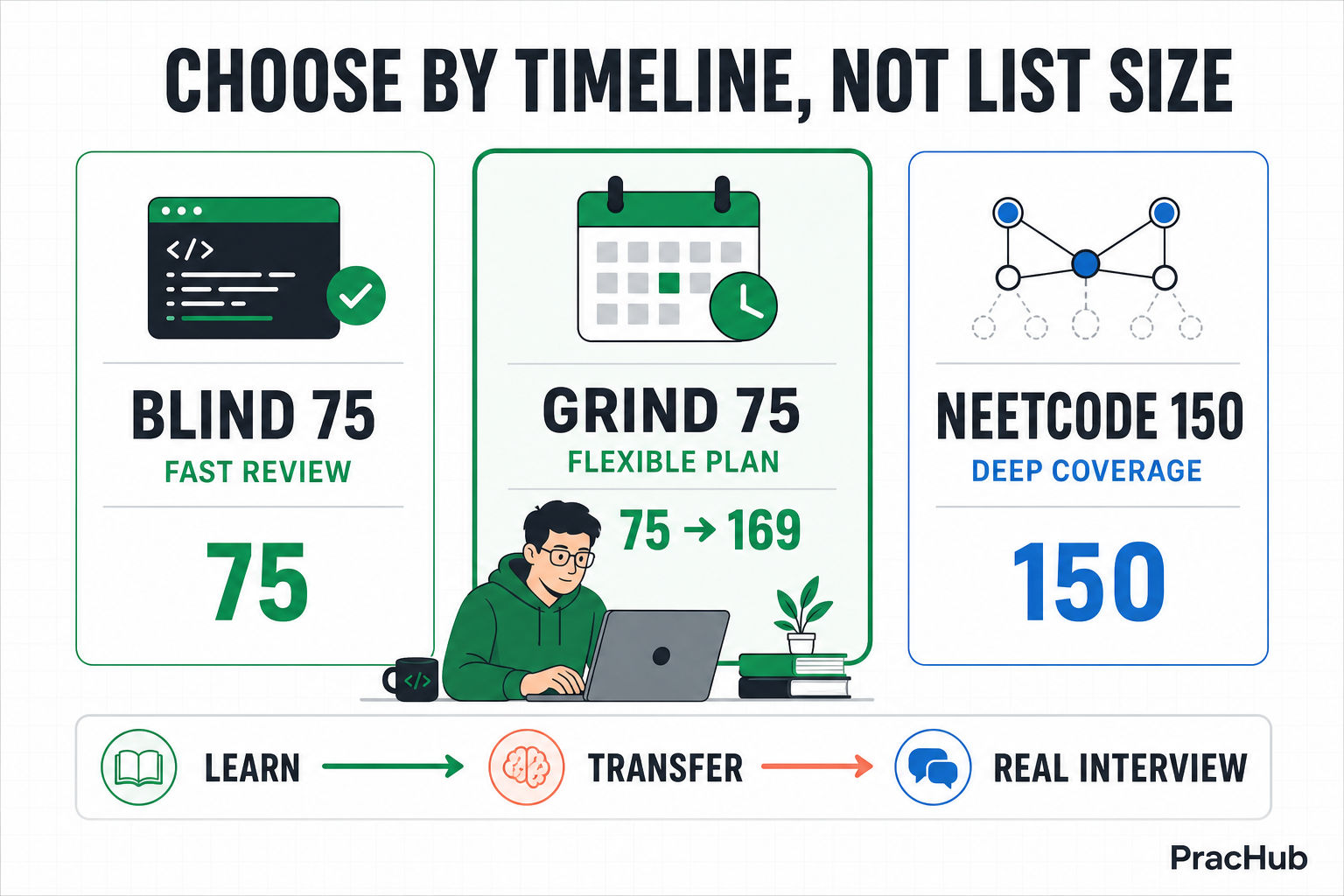
Choosing between Grind 75, Blind 75, and NeetCode 150 feels important. It is also an easy place to waste a week comparing spreadsheets instead of solving problems.
Here is what most comparisons miss: these are not three independent curricula. Grind 75 was created by the author of Blind 75 as a more flexible successor, while NeetCode 150 includes Blind 75 and adds 75 problems. Completing all three creates substantial repetition without proving that you can solve an unfamiliar problem.
Before choosing a list, check the actual format of your target company's loop using PracHub's company-specific interview prep. If coding is only one part of a five-round process, spending your entire preparation window on a longer algorithm list is a poor trade.
Quick Verdict
Choose Grind 75 if your interview date should determine your study plan. It prioritizes questions from a 169-problem pool and lets you adjust the plan by weeks, weekly hours, difficulty, and topic.
Choose Blind 75 if you already know the major patterns and want a compact review set. Its static structure gives you little help deciding what to cut when time runs short.
Choose NeetCode 150 if you already understand basic data structures and algorithms and have roughly two to three months for deeper coverage. It offers more repetitions per pattern and stronger coverage of areas that are thin in Blind 75.
For most candidates, the right move is to master one appropriately sized list, prove that the patterns transfer, and then switch to real company questions.
Grind 75 vs Blind 75 vs NeetCode 150 at a Glance
The counts below reflect the official pages checked on August 5, 2026. Grind 75's default set is drawn from a larger customizable pool, so its exact plan can change with your settings.
| Decision factor | Blind 75 | Grind 75 | NeetCode 150 |
|---|---|---|---|
| Core size | 75 static problems | Prioritized 75 from a pool of 169 | 150 problems |
| Current difficulty mix | 19 Easy, 49 Medium, 7 Hard | Default 75: 24 Easy, 42 Medium, 9 Hard | 28 Easy, 101 Medium, 21 Hard |
| Best use | Fast review of canonical patterns | Deadline-based, customizable preparation | Deeper pattern coverage and repetition |
| Organization | Grouped by topic | Can be grouped by week, topic, or difficulty | Topic roadmap with problems that build on earlier ones |
| Main strength | Small and memorable | Best control over scope and study time | Broader coverage with video and code solutions |
| Main limitation | Static and comparatively thin | Still depends on LeetCode-style practice | Easy to turn into a long completion project |
These Lists Are More Related Than They Look
Blind 75 is the original compact core
Yangshun Tay created Blind 75 to save candidates from working through hundreds of random problems. The selection covers core coding-interview patterns without pretending to be exhaustive. You can practice all 75 Blind 75 problems free on PracHub, grouped by topic, with a coding console, hints, and a progress checklist.
That compactness is also its weakness. The current NeetCode mirror shows only one stack problem, one heap problem, two backtracking problems, and limited advanced graph coverage. A candidate can finish the list while still lacking enough repetition to recognize variations of those patterns.
Grind 75 is the author's answer to Blind 75's limitations
The official Grind 75 explanation is unusually candid: Blind 75 is static, does not account for available study time, and does not tell candidates which questions matter most. Grind 75 addresses those problems by ranking a larger pool and generating a plan around your constraints.
The initial 75 avoids premium-only questions. The official FAQ recommends the generated order so topics recur across weeks instead of disappearing after one study block. That makes Grind 75 the strongest planning tool of the three.
NeetCode 150 is an expansion, not a separate starting point
NeetCode describes its 150 list as Blind 75 plus 75 more problems. The additions create more chances to distinguish similar patterns, especially across graphs, backtracking, dynamic programming, heaps, and linked lists.
But NeetCode also states that the list is intended for people already familiar with basic algorithms and data structures. A complete beginner who repeatedly opens solution videos is not necessarily progressing through a difficult curriculum. They may be using the wrong prerequisite level.
Which List Fits Your Timeline?
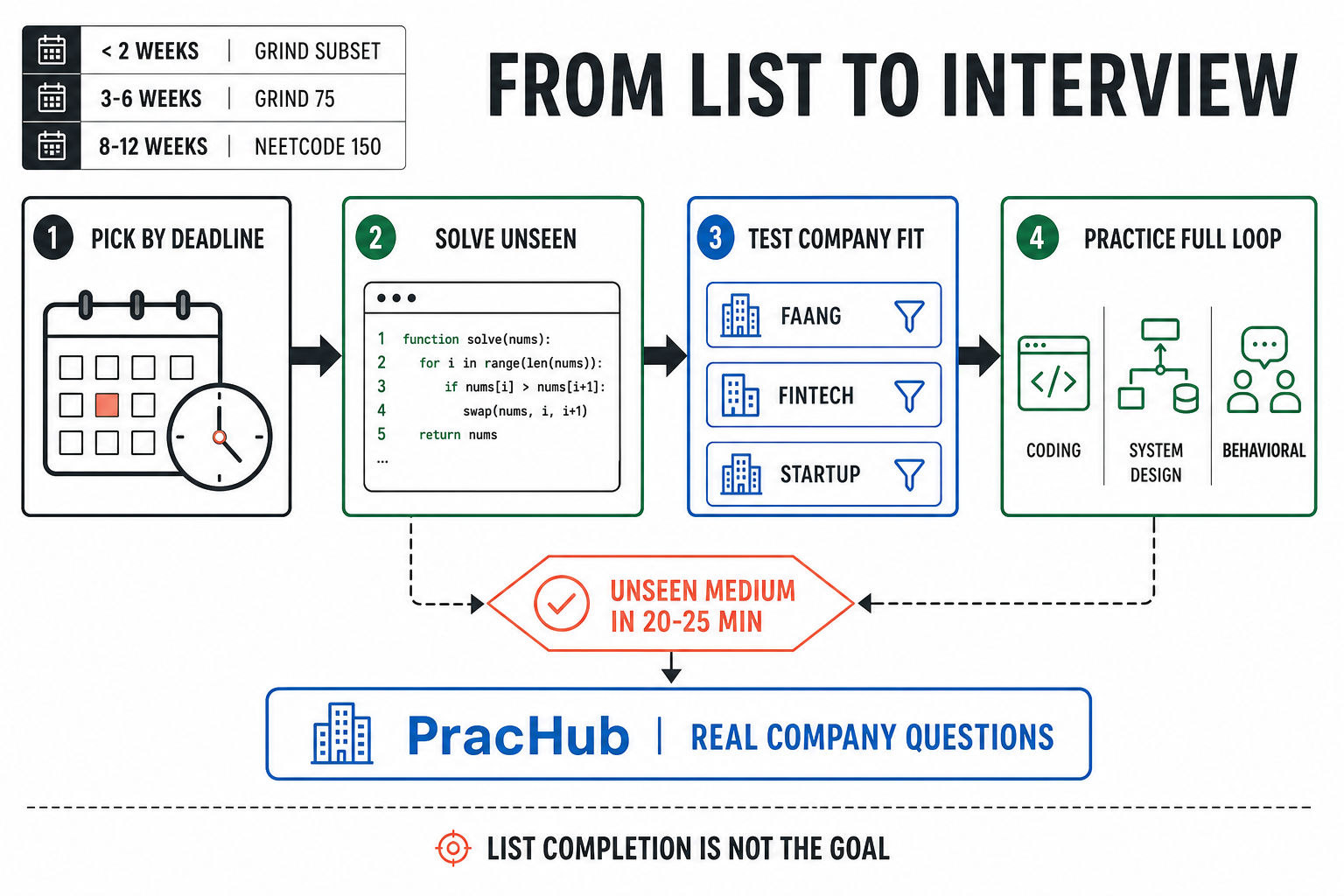
Your interview is less than two weeks away
Use Grind 75's time controls to produce a realistic subset. Blind 75 works as a review checklist if you have seen many of its questions, but attempting 75 new problems in ten days usually creates shallow recognition.
Spend the final third of your available time on real interview questions with written solutions. A deadline this short rewards accurate targeting more than broad coverage.
You have three to six weeks
Choose Grind 75. Its priority system protects high-value questions when a busy week reduces your available hours. Once you know the fundamentals, use the mixed weekly order so recurring topics force genuine retrieval.
Do not automatically expand toward all 169 problems. Add questions only when your error log shows that a specific topic needs more examples.
You have eight to twelve weeks
Choose NeetCode 150 if you can implement common data structures and explain their complexity. Use the extra problems as transfer tests: learn a pattern, solve a close variation, then attempt a less obvious variation without a hint.
If arrays, hash maps, tree traversal, or BFS/DFS are unfamiliar, rebuild those fundamentals first. Otherwise every problem becomes a tutorial.
You are using the list for maintenance
Choose Blind 75. Its small size makes a useful reset for experienced candidates. Skip questions you can solve cleanly and focus on patterns that have decayed.
Finishing a List Is Not the Same as Owning It
A checkmark might mean you derived the solution, reconstructed it after a hint, copied the code, or remembered a video. Only the first two provide useful evidence about readiness.
Use this four-part ownership test for every important pattern:
- Solve an unseen variation without knowing its category.
- Explain the invariant, complexity, and rejected alternatives before coding.
- Produce clean code and test edge cases while speaking aloud.
- Re-solve the original miss several days later without reviewing the answer.
NeetCode's current practice guide offers a useful external benchmark: if you can solve most unseen Medium problems in roughly 20 to 25 minutes, you are likely approaching coding-interview readiness. That is more meaningful than whether your dashboard says 75/75 or 150/150.
The Biggest Risk: Training Recognition Instead of Transfer
Topic labels make learning easier but testing less realistic. If the page says "Sliding Window," recognizing that pattern proves little. Real interviewers do not label it.
After every three to five topic-based problems, attempt one mixed, unseen question. Hide the topic and enforce a time limit. If you cannot decide whether the problem needs a heap, binary search, or graph traversal, the gap is pattern selection, not syntax.
The official NeetCode practice guidance recommends checking a solution after 15 to 20 minutes without progress, then revisiting difficult problems from scratch. That second attempt is where borrowed understanding becomes your own.
A Better Workflow Than Finishing All Three
Build a minimum pattern base
Use one list to cover the major patterns. Keep an error log with the clue you missed and the earliest point where your reasoning went off course.
Test transfer before adding volume
For each weak pattern, solve one question outside the list with no category label. If the approach appears but the code is slow, practice implementation. If no approach appears, return to the concept and compare two related examples.
Move into company context early
Once an interview is scheduled, filter PracHub by company and role. A DSA list teaches reusable patterns; it does not reveal whether your target team favors debugging, API implementation, concurrency, or a specialized coding environment.
Try two or three relevant company questions before finishing the generic list. That diagnostic may show that the final 40 NeetCode problems are less valuable than recent company interview formats.
Protect time for the rest of the loop
Coding lists do not prepare you to defend architecture trade-offs or answer ambiguous leadership questions. Once coding is stable, allocate time to system design questions and behavioral and leadership practice according to the real loop.
When Should You Stop the List?
Stop adding generic problems when you can solve unfamiliar Medium questions within the interview's time limit, explain your approach without relying on the category label, and recover from a wrong start without unraveling.
At that point, prioritize timed mocks, company questions, and recurring misses. Another overlapping list produces visible checkmarks but avoids testing whether your knowledge survives a realistic interview.
Frequently Asked Questions
Should I complete Blind 75 before NeetCode 150?
No separate first pass is necessary because NeetCode 150 includes Blind 75. Start with the Blind 75 subset if you want a smaller milestone, then continue only where you need more repetition. Re-solving weak questions is more valuable than racing through the additional 75 once.
Is Grind 75 better than NeetCode 150?
Grind 75 is better for time-constrained planning because it adjusts scope to your schedule and prioritizes questions. NeetCode 150 is better for deeper topic coverage when you have a longer runway and already know the fundamentals. The better list is the one whose scope leaves time for transfer tests and realistic practice.
Is Blind 75 enough for FAANG interviews?
Blind 75 can be enough for an experienced candidate refreshing familiar patterns, but no list guarantees readiness. You still need to solve unseen questions under time pressure, communicate clearly, and prepare for company-specific coding formats plus system design and behavioral rounds.
Which list is best for a complete beginner?
None is an ideal first curriculum. Learn one interview language and the basic data structures, traversals, and complexity analysis first. Then use NeetCode's beginner material or a reduced Grind 75 plan before attempting the full NeetCode 150.
Final Recommendation
If you want one default answer, use Grind 75 for a scheduled interview and NeetCode 150 for a longer skill-building cycle. Keep Blind 75 as a compact milestone or future review set. Do not finish all three.
Most importantly, decide in advance what happens after the list. Use PracHub's real interview question bank to test whether your patterns transfer to the companies and formats you actually face. The goal is not to complete a famous spreadsheet. It is to make the next interview feel familiar for the right reasons.
Editorial note: PracHub publishes this comparison and is recommended here for company-specific and full-loop interview practice. Product descriptions and list counts were checked against the first-party sources above on August 5, 2026.
Comments (0)