GrindQuestionsAI Review: Technical Cards, Spaced Repetition, and AI Grades
Quick Overview
Review GrindQuestionsAI’s public assessment entry, typed technical cards, sample grades and spaced-review claims. An original six-schedule Python model exposes stale document writes; a separate transfer rubric tests mechanism, retry scope and changed assumptions without claiming grader or retention quality.
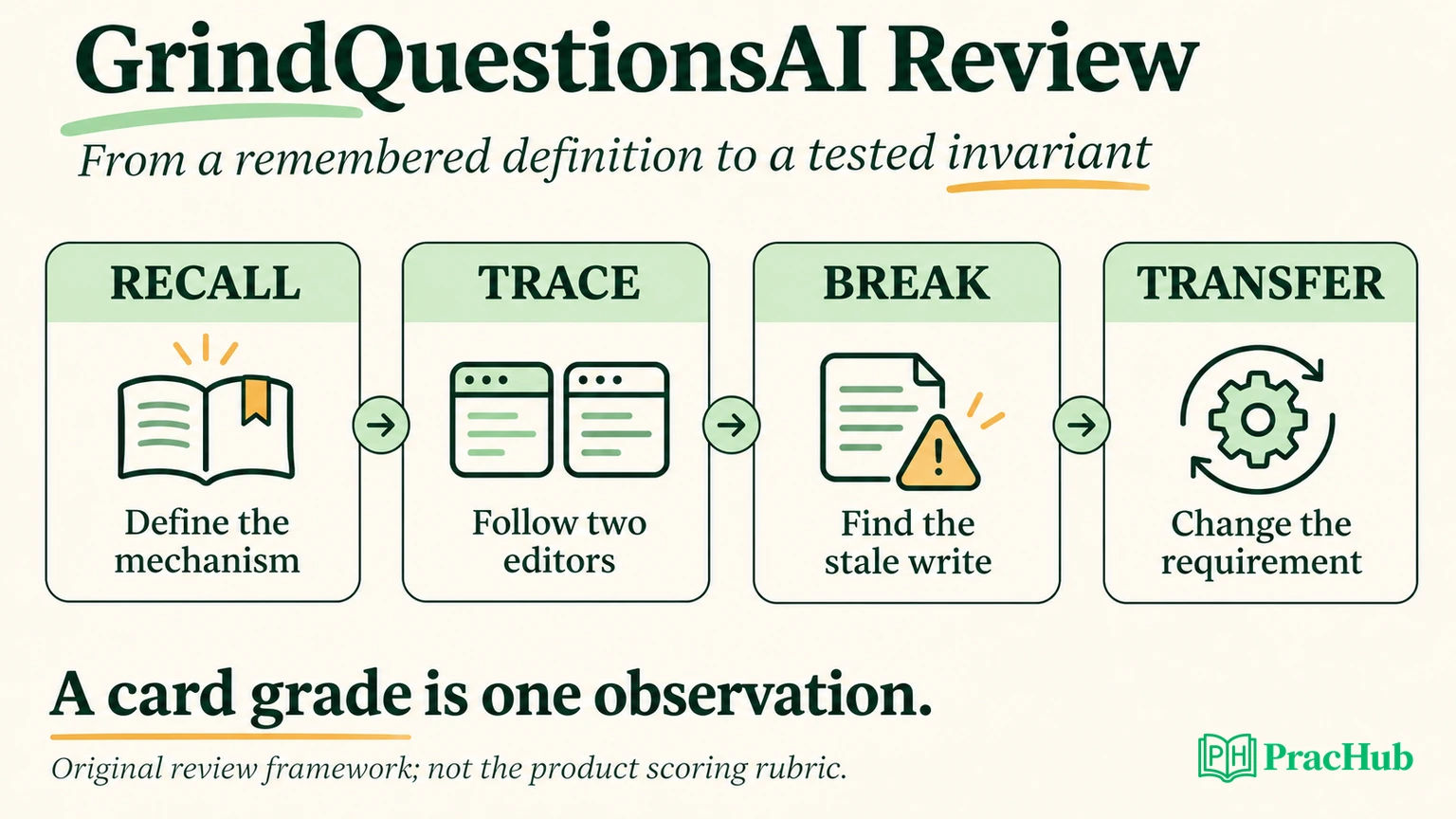
GrindQuestionsAI advertises open-ended technical questions, AI grades and scheduled reviews. That combination may help organize explanation practice, but a high card grade cannot establish that you can apply the idea to unfamiliar code. Check the prompt, feedback and reasoning on a changed case before interpreting a progress chart.
PracHub publishes this review and owns the complementary practice links. Our concurrent-cache question is an independent transfer exercise. The document-update model and grade-versus-transfer matrix below are original work, separate from GrindQuestionsAI’s assessment or scheduler.
What the public product promises
Provider description, November 3, 2026: GrindQuestionsAI describes typed technical answers, grades from zero to three, gap-focused follow-ups and spaced reviews. It advertises 220 questions and thirteen domains; the FAQ names a broader-looking list. We did not count unique cards or reconcile that taxonomy.
The site shows sample answers and analytics, including card states and intervals. These are provider examples, not our grades, retention measurements or account history. Claims of consistent expert-level grading and precisely timed forgetting were not independently validated.
We reviewed public material and opened the unsigned assessment at its default setup. Start Assessment reached a Java synchronization prompt marked question one of five. We stopped without answering, creating an account, completing the assessment or measuring the live grader. No private work history or company material was supplied. This first-question access does not establish ongoing free training rights.
The assessment entry is different from daily training
Direct observation: the setup presented experience and seniority controls, with role/domain buttons including Python, Java and DevOps / Cloud. The first question opened without sign-in. We did not vary those controls or establish how they change questions, rubrics or scoring strictness.
To compare grading, keep the answer and prompt constant and record the selected context. If changing seniority changes the expected depth, the feedback should explain the extra requirement. Otherwise, a numerical difference is difficult to interpret. This is a proposed check, not a test we performed.
The distinction also matters when comparing sessions. A lower score on a more demanding prompt might reveal a different skill rather than lost knowledge. Keep the prompt, conditions and feedback next to the grade so that the progress chart has enough context to support a decision.
Do not equate this format with a coding judge. A typed explanation can discuss an algorithm without executing it. It can also describe locking correctly while leaving a race in the implementation. Choose an explanation prompt to test reasoning and an executable task to test behavior.
A locking definition needs a concrete guarantee
The homepage’s database sample contrasts optimistic version checks with pessimistic locking. Treat that as an illustration of the expected answer style, not proof that the live grader catches every concurrency error.
Official technical reference: PostgreSQL’s explicit-locking documentation explains that row locks constrain conflicting writers and lockers; they do not generally block ordinary reads. The relevant lock mode, statement and transaction boundary must be named. Saying that pessimistic locking blocks all access is too broad.
Likewise, optimistic concurrency does not mean that no lock is acquired anywhere. An application-level version check can still execute through database machinery that locks during an update. Distinguish the conflict-detection strategy from an unsupported claim that the implementation contains no locks.
A precise short answer should state the protected invariant. In the example below, two editors intend to append different labels to the same document. The requirement is to detect a stale write rather than silently erase an acknowledged edit. That requirement gives the trace a checkable invariant.
Original trace: two editors read version five
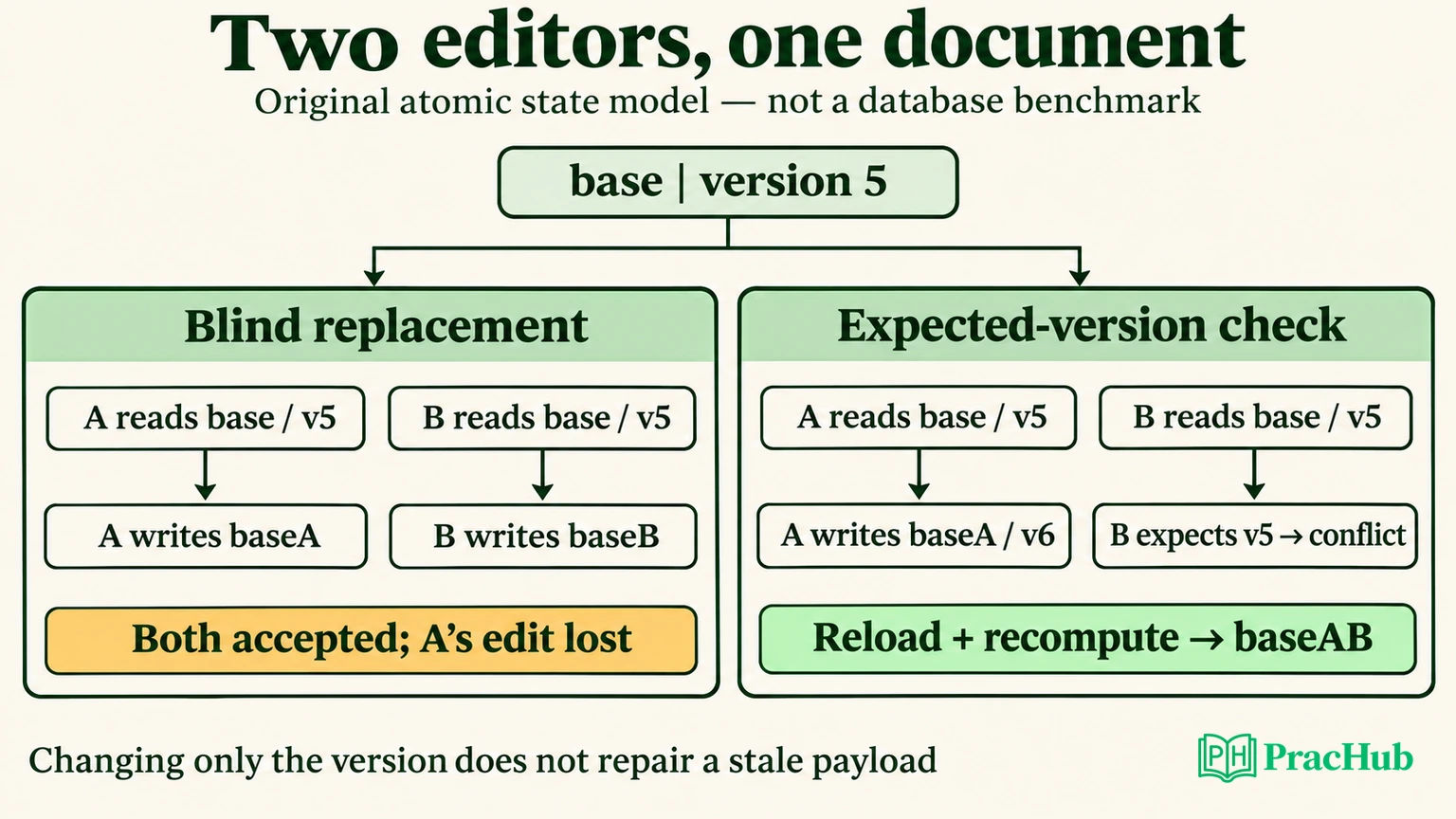
Start with document text base and version five. Editor A reads it and proposes baseA. Editor B reads the same version and proposes baseB. Neither proposal includes the other editor’s change.
With blind replacement, A can write baseA, then B writes baseB. Both may report success, but the final text loses A’s change. Reversing the writes loses B’s change instead. Incrementing a version field without checking the expected version does not prevent this overwrite.
With an atomic expected-version check, the first write from version five succeeds and advances the version. The second stale proposal is rejected. After detecting the conflict, the application still must decide whether and how to merge the edits.
| Step | Blind replacement | Atomic expected-version check |
|---|---|---|
| A and B read | Both see base, version 5 | Both see base, version 5 |
| First proposal commits | Replaces the text | Checks version 5, then replaces |
| Second stale proposal arrives | Replaces the first edit | Reports a conflict |
| Further action | Lost edit may go unnoticed | Reload, recompute or ask for resolution |
This is our synthetic model. It does not represent a GrindQuestionsAI question, an observed database execution or a benchmark of any particular locking method.
Execute the interleavings before judging the explanation
The following Python fixture explores the six schedules that preserve each editor’s read-before-write order. Its version check is one indivisible model operation. That atomicity is an assumption, not something a plain multi-line Python function gives a real concurrent service.
from itertools import permutations

steps = ("Ar", "Aw", "Br", "Bw")
schedules = [s for s in permutations(steps)
             if s.index("Ar") < s.index("Aw")
             and s.index("Br") < s.index("Bw")]

def run(order, check_version):
    text, version = "base", 5
    reads, accepted = {}, []
    for step in order:
        who, action = step
        if action == "r":
            reads[who] = (text, version)
        else:
            old_text, expected = reads[who]
            if not check_version or version == expected:
                text, version = old_text + who, version + 1
                accepted.append(who)
    return text, version, accepted

assert len(schedules) == 6
blind = [run(s, False) for s in schedules]
checked = [run(s, True) for s in schedules]
assert sum(len(t) == 5 for t, _, _ in blind) == 4
assert all(v == 7 and len(a) == 2 for _, v, a in blind)
assert sum(len(a) == 1 for _, _, a in checked) == 4
assert sum(len(a) == 2 for _, _, a in checked) == 2
assert all(len(t) == 4 + len(a) for t, _, a in checked)
print("6 schedules checked in each mode")
We ran this exact fixture locally. Four blind-write schedules end with only one appended label despite accepting both writes. Two serialized schedules retain both because the second editor reads after the first write. Under the version-check model, four schedules accept one write and report the other as a conflict; two accept both in sequence.
The invariant is that each accepted modeled append remains in the resulting text. The fixture checks that invariant for these schedules only. It does not establish database isolation, CPU memory ordering, network delivery or application correctness beyond this small state space.
A retry must recompute the proposed change
Suppose A committed baseA at version six and B’s stale baseB was rejected. B cannot safely attach version six to the old replacement and call that a retry. Doing so would pass a superficial version comparison while still erasing A’s label.
For this append-only toy contract, B can reload baseA, apply its intended append and propose baseAB with expected version six. In a real document editor, the intended operation might not commute, and automatic merging may be invalid. A conflict may require user input.
Official database behavior: PostgreSQL’s Read Committed documentation describes waiting for a concurrent updater and rechecking the updated row against the statement’s condition. That supports reasoning about a conditional update such as an expected-version predicate; it does not make a separate read and blind write into one atomic operation.
We did not run two PostgreSQL sessions. To validate a database implementation, use the actual statements, affected-row counts and commit sequence. Record whether the loser retries the whole decision with fresh data. A successful definition answer leaves those implementation questions open.
What the single-document model leaves out
A second document changes the reasoning. Imagine an edit that must update both a title and its index entry. Detecting a stale version on the title alone does not demonstrate that both changes commit together. The protected state is larger than the object in our fixture.
Use that extension as a follow-up rather than claiming the six schedules cover it. List the state that must agree, which steps can fail and what a retry can repeat. If the index update is asynchronous, define what a temporarily stale result means to the reader. If it must be immediate, identify the required commit boundary before selecting a mechanism.
The same discipline applies to external actions. Our Python appends have no email, queue publication or irreversible side effect. Re-running a rejected calculation is different from repeating an action that may already have happened. A useful explanation acknowledges that difference without pretending the fixture tests it.
This is where an explanation card can become more demanding without growing into a terminology quiz: ask the learner to name the assumption that stopped being true. The answer should change with the requirement, even when the original definition remains accurate.
A grade-versus-transfer rubric
Our recommendation is to keep four evidence levels separate. The following rubric is an independent study tool; it is not a reconstruction of GrindQuestionsAI’s zero-to-three scale.
| Evidence level | What you should demonstrate | A revealing follow-up |
|---|---|---|
| Recall | Define version-based conflict detection | What value is compared? |
| Mechanism | Trace both readers and the first commit | Where is the check atomic? |
| Failure reasoning | Identify the stale second proposal | Why is changing only its version unsafe? |
| Transfer | Recompute or reject under changed requirements | What if edits cannot be merged? |
A learner can recall the first row and still fail the last three. Conversely, a concise explanation may be technically sound even if an evaluator expects a particular keyword. Review the missing claim and its consequence before rewriting an answer to satisfy a label.
During a real assessment trial, save the prompt and your original response, then compare every criticism with the stated contract. If feedback flags a missing trade-off, identify the workload assumption that makes it relevant. If it declares a mechanism wrong, ask for a concrete counterexample and check it independently.
Do not use our rubric to manufacture a product score. We have not calibrated it against the product, expert reviewers or hiring decisions. Its value is that each step points to observable work rather than a flattering readiness label.
Spaced review is a schedule, not proof of retention
Scheduling can make an overlooked card visible again. Whether you retained the idea requires another observation: can you reconstruct the mechanism after a delay without the answer in view? Whether you can transfer it requires a changed problem. Those are separate measurements.
For this locking example, revisit the invariant before rereading the definition. Change the operation from appending a label to replacing a paragraph. Then ask whether reapplication is still valid. That makes the review sensitive to understanding rather than remembering the previous sequence of letters.
We did not inspect the scheduling algorithm and do not identify it as SM-2 or any other implementation. The public analytics descriptions also do not establish an independently measured forgetting curve. Interval lengths show scheduling decisions. They do not by themselves estimate memory decay.
If you keep a personal log, record the delay, prompt variant, hint usage and independently checked result. A single successful retry immediately after reading the answer is useful practice, but should not be described as long-term retention or an interview-outcome improvement.
Access limits and the next practical decision
Advertised access: the site offers a free, no-signup assessment described as taking five minutes. We did not complete it, verify a daily allowance or establish ongoing training entitlements. There is no basis here for promising unlimited free reviews, a particular paid price or persistent progress without an account.
GrindQuestionsAI may fit a learner who wants technical explanation prompts and a review queue. The evidence available here supports testing that workflow, with live grading and scheduling quality still open. We cannot treat its grades as a validated measure of seniority.
Practice the gaps the product leaves open
These independent PracHub questions test transfer from a remembered concurrency definition to concrete code. They are not GrindQuestionsAI cards or its private scoring criteria.
| PracHub question | What to examine |
|---|---|
| Discuss mutexes, memory alignment, polymorphism, idempotency | State lock ownership, shared state and the operations covered by a guarantee. |
| Explain HashMap and ConcurrentHashMap Internals | Distinguish individual thread-safe operations from a compound invariant. |
| Make a Dict-Based Memoization Cache Safe for Concurrent Threads | Identify the check-and-update boundary in a shared cache. |
| Code Review: Find the Problems in a Python Dict-Based Memoization Cache | Review failure and concurrency paths in unfamiliar code. |
| C++ Atomics, Memory Ordering, and Safe Publication | Explain atomic ordering and safe publication under a specific contract. |
Choose the concurrent-cache exercise, identify the shared invariant and trace two callers before looking at a sample answer. After one explanation review, change a concurrency assumption and repeat the trace. Keep the actual result next to any practice grade so that the score does not become the only evidence you retain.
Comments (0)