Hexorexa Review: Embedded Simulators, Firmware Tools, and Beta Access
Quick Overview
Hexorexa review based on public beta application routes, firmware challenges, guided debugging and company-note attribution. It distinguishes advertised simulators from inspected starter-code material, explains priority inheritance versus ceiling labels, and presents an original single-mutex scheduling model. Beta pricing, employer provenance and target accuracy remain bounded and unverified.
Hexorexa is worth inspecting as a beta collection of embedded-learning material, especially if you want firmware scenarios beyond general algorithm practice. Check what each route provides: starter code, a guided bug scenario, company notes, or an advertised simulator. Our review opened public application routes and built an independent priority-inversion model. It did not validate a production RTOS, hardware simulator accuracy, or a hiring-readiness score.
PracHub publishes this review and owns the complementary practice links. The PracHub mutex exercise offers another setting for explaining ownership and shared-state access. Its C++ context should not be read as a claim that an ordinary mutex automatically supplies an RTOS priority protocol.
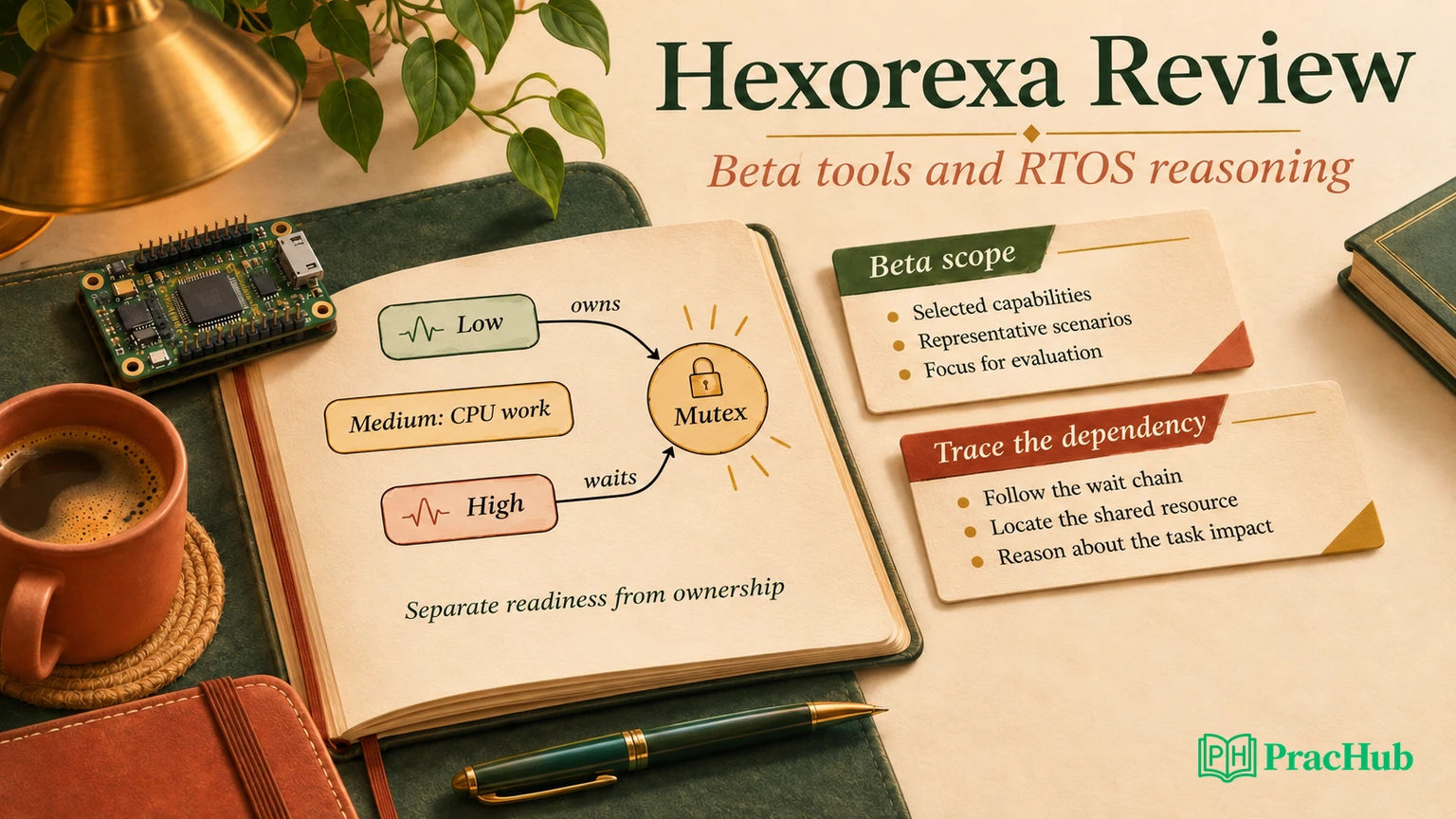
Separate the beta offer from a tested capability
Official positioning: the Hexorexa homepage advertises embedded interview preparation, a lecture collection, hardware configurators, RTOS tools and company-oriented material. It describes free exploration during beta, marks Premium as coming soon, and says displayed prices are indicative. Those are provider statements, not a paid entitlement or launch date we verified.
The provider's disclaimer frames the platform as educational and under active development. Its public FAQ also describes simulations as approximations rather than production-grade RTOS or hardware replicas. That limitation matters when deciding what kind of conclusion a tool result can support.
A visual timeline may make a scheduling assumption easier to discuss. It does not, without additional evidence, establish the timing of an actual kernel port. A generated configuration can expose register choices while still requiring target documentation. Evaluate the particular mechanism you can inspect rather than transferring the promise of one advertised tool to every application route.
We did not authenticate user-count claims, measure interview outcomes, buy a plan, or establish the accuracy of the advertised tools as a group. Use this review to identify an assumption the visible material exposes and the evidence still needed to explain it.
What the public application exposed
Direct observation, November 3, 2026: we launched the beta application without signing in. Its Embedded Coding route showed categories, problem statements, starter code and reference controls. An RTOS category exposed four challenges. Its Debug Lab displayed guided scenarios with symptoms, code, clue controls and a manual completion button.
We could read those practice routes without signing in. We did not execute the provider's starter code, open an external compiler, mark a challenge solved, or validate a standalone scheduling simulator. A code scaffold asking the learner to implement a simulation is different from a simulator whose behavior we have measured.
The app also carried a beta warning. Use that context when encountering a control or route whose behavior has not yet been established. Our inspection did not produce an account history, an evaluated submission, or a dependable estimate of how complete every advertised feature was.
A useful first pass is to pick one scenario and state what evidence it asks you to produce. Does it require predicting a schedule, finding a mistaken assumption, or implementing an operation? That tells you whether a reference answer, a runnable model, or a target test is the next useful step.
A ceiling label and an inheritance exercise need different explanations
The inspected RTOS prompt used a ceiling label while its body asked for a priority-inheritance scenario. We do not treat those protocol names as interchangeable. Clarify which mechanism the prompt intends before implementing an answer.
IBM's AIX synchronization documentation distinguishes inheritance based on a blocked higher-priority thread from protection based on a mutex's configured ceiling. The document describes a particular API environment; it does not establish the behavior of an unspecified embedded kernel.
For inheritance, the question is which waiting task causes an owner to receive a higher effective priority. For a ceiling-based protocol, ask which ceiling is configured and when that priority affects the owner. Both can affect scheduling, but their triggers and required assumptions differ.
Our independent model below examines only the inheritance case. It has one resource owner and one blocked higher-priority task. It does not implement a ceiling protocol, nested-lock analysis, or a kernel's exact bookkeeping rules. Keep that scope attached to the trace when discussing a different algorithm.
Original trace: a blocked high-priority task is not runnable
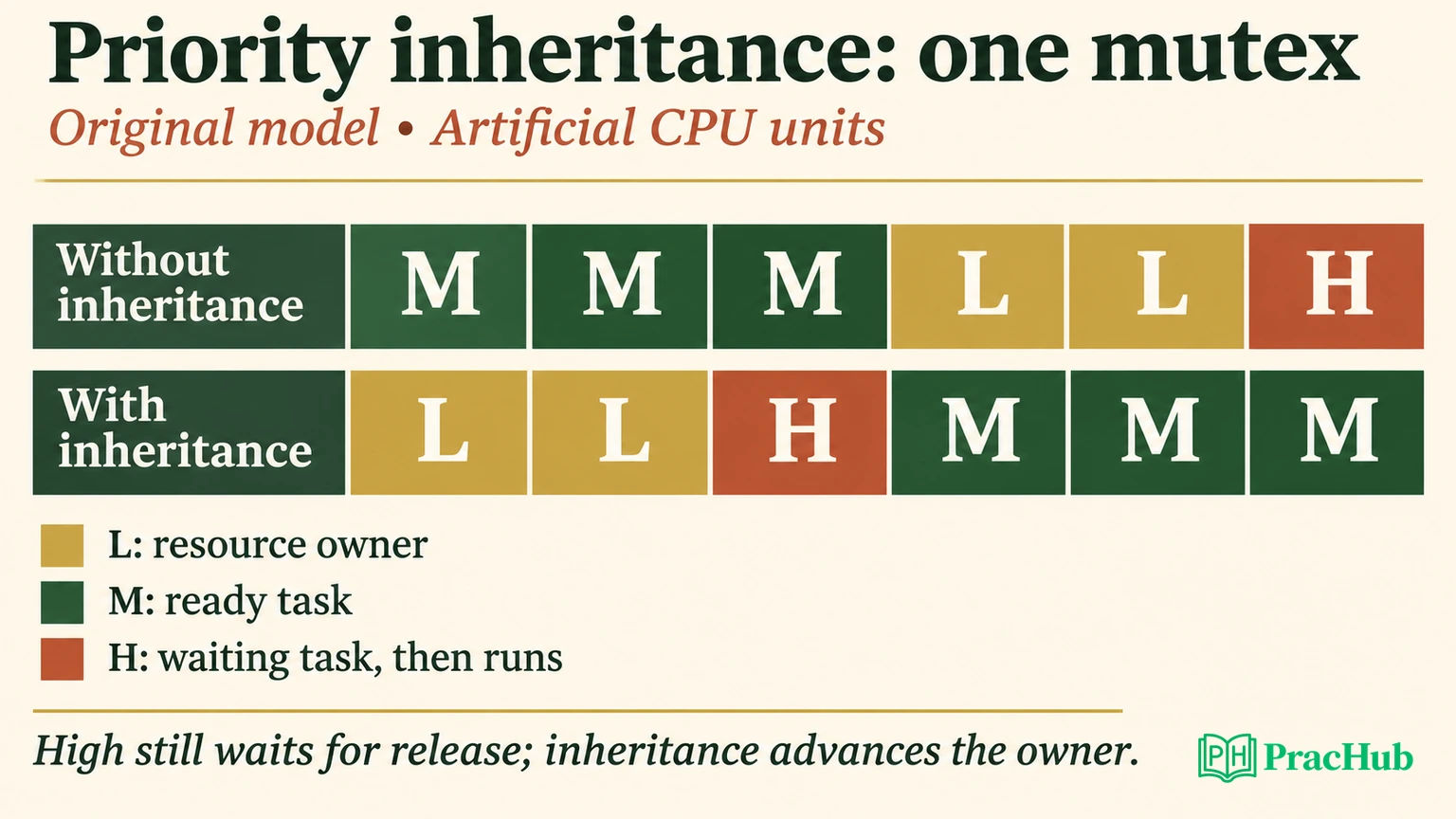
Assume one CPU and a fixed-priority scheduler where a larger number means higher priority. Low has base priority 10, Medium 20, and High 30. Low already owns a mutex and has two units of work left before releasing it. High requests the same mutex and becomes blocked. Medium becomes runnable with three units of work.
Without inheritance, the ready tasks are Low and Medium. High has the largest base priority but cannot run while waiting for the resource. Medium therefore consumes three units before Low receives CPU time to complete its two remaining units and release the mutex. High can then perform its one unit.
With the modeled inheritance rule, Low temporarily receives High's priority while High is blocked on its mutex. Low runs ahead of Medium, completes its remaining work and releases the resource. High becomes runnable and runs next. Medium's work follows.
| Original model | CPU sequence from the decision point | High completes at |
|---|---|---|
| No inheritance | Medium, Medium, Medium, Low, Low, High | End of unit 6 |
| Inheritance for this mutex | Low, Low, High, Medium, Medium, Medium | End of unit 3 |
These are invented scheduling units, not milliseconds or target measurements. The model assumes no scheduler overhead, interrupts, additional locks, equal-priority ties, or other arriving work. The difference demonstrates how a runnable medium-priority task can delay a blocked high-priority task through a lower-priority resource owner.
We executed an original deterministic Python model of both schedules. Six summary assertions and per-step ownership checks verified the sequences, High's completion points, the inherited priority, and Low's retained base priority. No Hexorexa implementation, FreeRTOS kernel, physical board or production workload was executed.
Explain the dependency before proposing the mechanism
The trace is easier to defend if you draw two relationships separately: which task owns the mutex, and which tasks are ready to use the CPU. High's urgency does not make the resource available. Low's ownership does not guarantee CPU time while Medium remains a higher-priority ready task.
Inheritance changes the owner's scheduling priority; it does not make the protected work disappear. High still waits for Low to reach the release point. An answer that promises zero blocking has gone beyond the model.
FreeRTOS documents its simplified mutex inheritance behavior and warns that inheritance reduces some effects of priority inversion rather than eliminating the problem generally. Its treatment of multiple held mutexes has specific behavior. Refer to the actual kernel and version before extending our one-mutex trace to nested ownership or timeout cases.
A useful follow-up adds a second resource. Ask who owns it, whether Low can block while holding the first mutex, and which dependency now determines progress. Our model provides no measured answer to that extension. It supplies a way to identify what a fuller model would need.
Guided bug scenarios still need a diagnosis argument
The inspected Debug Lab route separated a symptom from example code and offered clues and a fix reveal. We did not treat its manual completion control as an automatically verified code submission. Reading a supplied explanation and demonstrating a diagnosis are different observations.
Use a guided scenario by first recording what is actually known. A stalled operation can have several causes: a failed call ignored by its caller, a resource held longer than intended, a missing completion event, or an observation that is simply too coarse. Do not promote the first visible suspicious line into a complete causal explanation.
For an independent practice answer, describe the observation that would distinguish two plausible causes. State where you would collect it and what result would change your next step. If a fix assumes a device reset or a retry is harmless, explain the state that may be lost or repeated.
Use those observations to support your interview explanation. It also helps evaluate feedback quality: does the explanation connect evidence to a cause, or merely show edited code? This review did not run a target fault or validate a returned fix, so those questions remain part of the learner's next check.
Company notes are a separate evidence source
The application's company section attributes its material to interview-report sources such as Glassdoor, Reddit and blogs. That is a provider attribution. We did not authenticate the original candidate accounts, their dates, the represented roles, or the current employer processes.
The site's independence statement also says it is not affiliated with or endorsed by the named employers. Accordingly, we use those panels as study prompts, not official company instructions or independently verified same-cycle candidate reports. A logo or detailed sequence cannot establish current applicability by itself.
If your preparation depends on a particular employer round, begin with the current role or recruiter instructions. Then compare dated, independently attributable reports for the same cycle. This review does not reproduce the platform's process timings, salary figures or interview-frequency claims as current facts.
Match the material to the evidence it can support
This original route map separates the inspected app surfaces from additional validation you would need. It does not assert that every advertised tool was available or tested during this review.
| Material or route | Useful preparation question | Evidence still required |
|---|---|---|
| Starter-code challenge | Can I define and implement the requested contract? | My prediction and a bounded local execution |
| Guided bug scenario | Which observation supports the diagnosis? | A trace that distinguishes competing causes |
| Advertised scheduler tool | Which scheduling assumptions does it model? | Behavior checked against its stated rules |
| Advertised hardware configurator | Which target and register semantics apply? | Relevant device documentation and target validation |
| Company preparation panel | Is this applicable to my current application? | Official instructions and dated original reports |
Before relying on the beta for a study session, inspect the exact route you intend to use. Confirm what is readable, what action actually runs something, and what result is stored or assessed. The homepage's free-beta statement and indicative Premium prices should not be converted into a promise of permanent access or a verified paid feature set.
Practice the gaps the product leaves open
These complementary PracHub exercises extend the review's ownership and progress questions. A C++ mutex prompt does not imply that a default mutex implements an RTOS priority-inheritance protocol. These are not Hexorexa exports or verified company reports.
| PracHub question | What to examine |
|---|---|
| How a C++ Mutex Protects Shared State | Separate mutual exclusion from the scheduler's priority protocol. |
| Thread-Safe Producer-Consumer Queue: Mutex, Then Spin Lock, Then Lock-Free | State which synchronization primitive supplies each guarantee. |
| Reason About Deadlocks, Synchronization, False Sharing, and Privilege Transitions | Distinguish blocked-resource dependencies from CPU scheduling. |
| Implement a Reusable Cyclic Barrier from a Mutex and Condition Variables | Explain who waits, who releases, and when the next cycle can proceed. |
| Implement a single-producer multi-consumer ring buffer | Make buffer ownership and progress assumptions explicit. |
Hexorexa may fit a learner who wants embedded scenarios and is willing to check the assumptions behind them. Start with one public task, name the mechanism precisely, and retain a small trace or model that supports the explanation. Continue with the PracHub mutex exercise to separate ownership from scheduling guarantees in another context. State what beta access, company attribution and target validation leave unverified.
Comments (0)