Hone Review: Spoken Answers, Live Coding, and Whiteboard Feedback
Quick Overview
Review Hone’s spoken, editor and whiteboard practice as distinct evidence. An original report-job retry model and cross-format matrix expose uncertain outcomes, stable operation keys and payload conflicts; no live session, score, grading quality or paid allowance was tested.
Hone presents three practice formats: Speak for spoken answers, Code for an editor with voice guidance and Design for a whiteboard conversation. Choose the format by the work you need to inspect. A fluent explanation, a working implementation and a defensible failure sequence are different results, even when they address the same interview problem.
PracHub publishes this review and owns the complementary practice links. Our idempotent-request exercise offers an independent check. The lost-response example, local Python fixture and three-format review matrix below are original practice assets, separate from Hone’s prompts or evaluator.
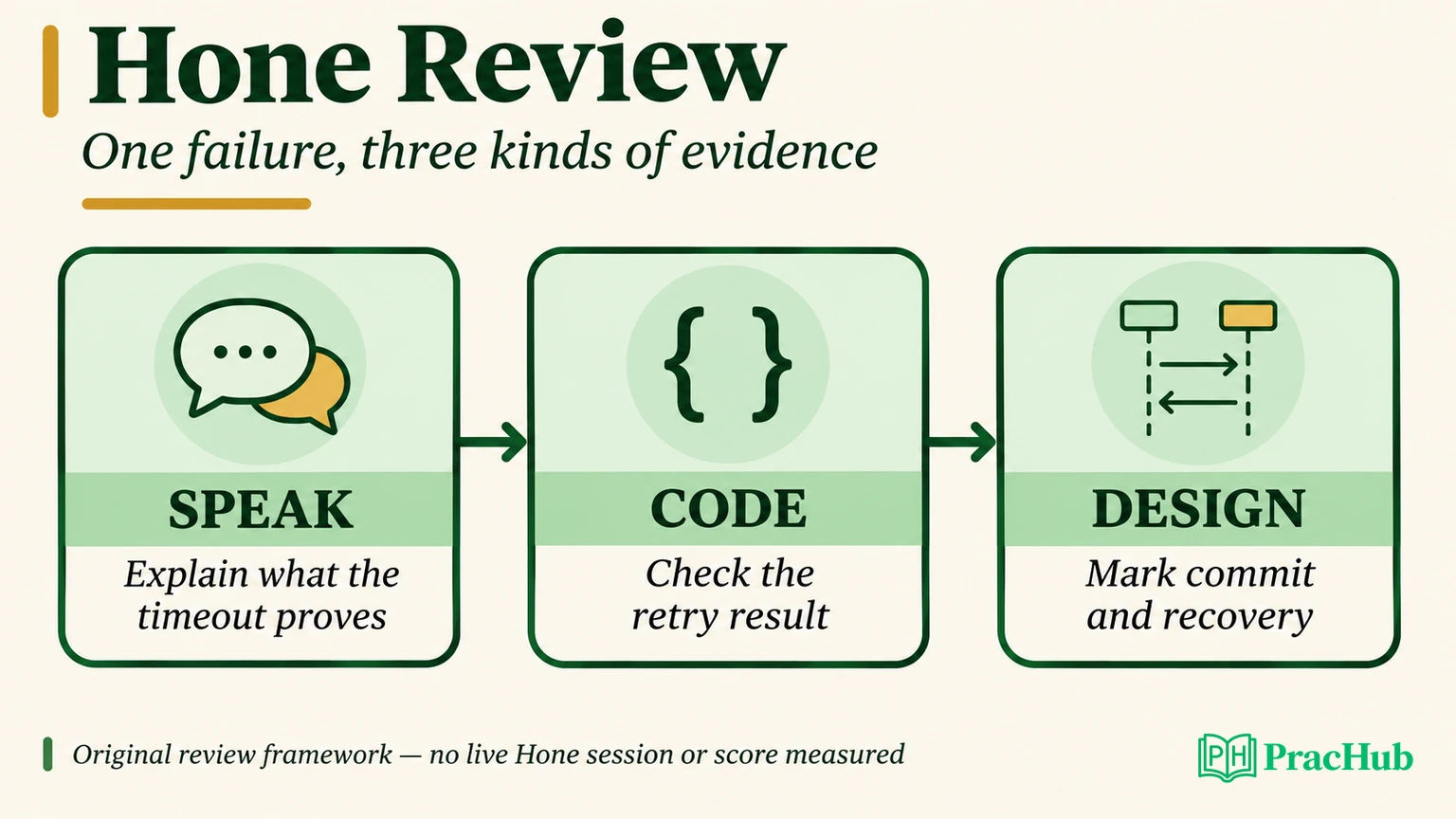
What the three product formats promise
Provider description, November 3, 2026: Hone distinguishes spoken questioning, a live editor with voice hints and a design whiteboard. It advertises nineteen tracks, three difficulty levels and post-session scores from zero to one hundred.
These are product claims, not our measured results. We did not sign in, grant microphone access, complete a session, execute code in Hone or draw on its whiteboard. We cannot assess transcription, hint timing, grading consistency or whether diagram feedback follows the actual drawing.
Our evidence is public product material, sample pages and browser checks of all three entry routes. Code, Design and Speak each reached a sign-in page. We stopped there. This supersedes the limited Code shell returned by the earlier research fetch; it does not establish editor, whiteboard or live-session behavior.
This scope still supports an important decision: choose the mode by the artifact you intend to inspect afterward. Otherwise, it is easy to mistake confidence in speaking about code for proof that the code handles the failure being discussed.
A language track can be a spoken discussion
Provider clarification: Hone’s public JavaScript track page describes conceptual spoken practice, including asynchronous behavior. It distinguishes that discussion from live coding. Check the session format as well as the programming-language label.
The API Design page describes an extended scenario conversation rather than a fixed sequence of short questions. We did not complete either format or verify how a particular account selects a scenario.
For preparation, preserve that distinction in your own notes. An answer about promises can test whether you explain control flow. An implementation exercise can test whether rejection and retry paths actually behave as claimed. A system diagram can test where a request becomes durable and what a client can know after losing the response.
Keep the transcript, code and diagram alongside any overall score. Keep the statement, code or diagram that supports the criticism. It should be possible to locate the issue without relying on the score’s authority.
One original failure to use across all three modes
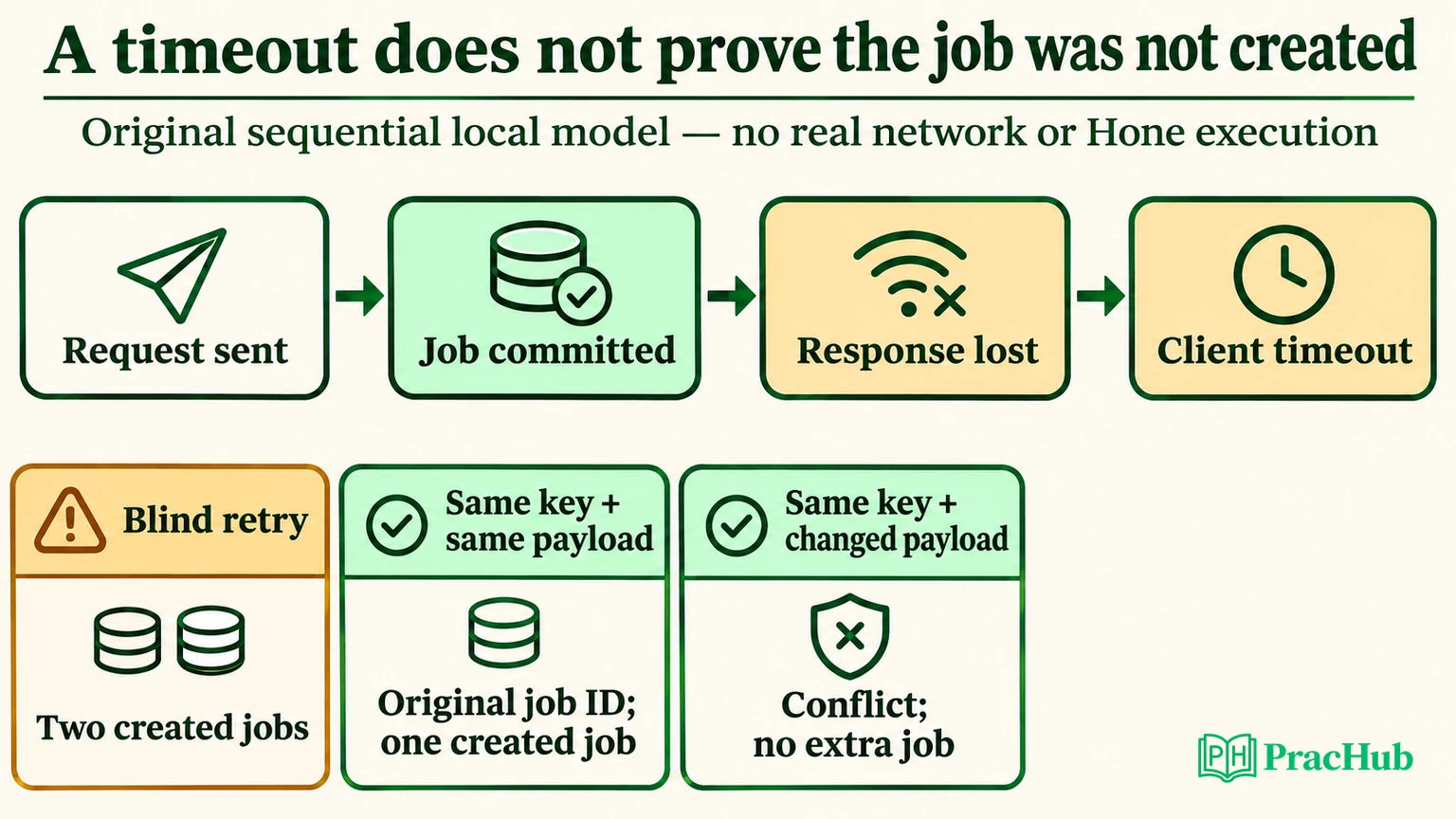
Imagine a fictional service that creates a background report job. The client sends a request, the server commits a new job and the response is lost. The client then reaches its deadline and shows a timeout.
The client does not yet know whether the job exists. A retry that blindly creates another job can produce duplicate work. A decision never to retry can leave the user unable to find an already-created job. The design needs a way to resolve that uncertainty.
This example involves no real customer, payment or production service. It is not a reported Hone session. We use it because the same failure exposes different weaknesses in a spoken answer, an implementation and an architecture explanation.
Technical boundary: MDN’s AbortController documentation explains client-side abort behavior for fetch, response consumption and streams. That is not evidence that an already committed server operation was rolled back. A cancellation request and a confirmed reversal are different observations.
Protocol reference: RFC 9110, section 9.2.2 defines idempotency by the intended server effect and constrains automatic retries of non-idempotent requests. Do not infer safe repetition of a job-creating POST merely from receiving a timeout.
Speak: explain what is known and what remains uncertain
A weak answer says, “Abort the call and retry because the request failed.” It collapses three facts: the client stopped waiting, the transport did not deliver a usable response and the business action did not happen. Our scenario establishes the first two, while the third is false.
A stronger original answer is: “The client timed out, but the server may have committed. I would preserve a stable operation key and use the service’s defined retry or lookup contract to resolve the outcome. I would not assume client cancellation undoes the job.”
That answer is still a proposal, not an implementation. A useful follow-up asks who generates the key, how it is scoped and what happens if the same key arrives with different parameters. It should also ask how long the service remembers the association and how a caller discovers the result.
During a voice trial, listen for whether the follow-up addresses your actual omission. If you already explained payload mismatch, a generic reminder about duplicates adds little diagnostic evidence. If you forgot key expiry, a specific question about a late retry can expose a real design gap.
We did not test whether Hone produces those follow-ups. This is our proposed evaluation method, with the correctness of each answer checked separately from its fluency or coaching score.
Code: make the retry contract executable
Here is a deliberately small local model. Each handler call is a single sequential transition. A remembered key maps both to the request description and to the resulting job identifier. Reusing the key with different input is rejected.
class Jobs:
    def __init__(self, deduplicate):
        self.deduplicate = deduplicate
        self.remembered = {}
        self.created = []

    def create(self, key, payload, drop_response=False):
        if self.deduplicate and key in self.remembered:
            old_payload, job_id = self.remembered[key]
            if old_payload != payload:
                raise ValueError("key reused with different payload")
        else:
            job_id = len(self.created) + 1
            self.created.append((job_id, payload))
            if self.deduplicate:
                self.remembered[key] = (payload, job_id)
        return None if drop_response else job_id

naive = Jobs(False)
assert naive.create("request-a", "weekly", True) is None
assert naive.create("request-a", "weekly") == 2
assert len(naive.created) == 2

keyed = Jobs(True)
assert keyed.create("request-a", "weekly", True) is None
assert keyed.create("request-a", "weekly") == 1
assert len(keyed.created) == 1
try:
    keyed.create("request-a", "monthly")
except ValueError:
    pass
else:
    raise AssertionError("changed payload was accepted")
assert len(keyed.created) == 1
print("lost-response and payload-conflict checks passed")
We executed this exact code locally. The naive handler creates two jobs after a lost response and retry. The keyed handler returns the original job identifier without creating a second job, then rejects a changed request under the same key.
Those checks establish the toy contract only. There is no network call, real timeout, database transaction, concurrent request or process crash. The code does not model browser cancellation. The lost response is represented by returning no result after the modeled creation has already happened.
A real implementation needs atomic handling of the key record and business effect. If it commits one without the other, a crash can break the guarantee. Our plain dictionary is neither durable nor a distributed lock. Do not copy it into a service and call the failure solved.
Design: draw the uncertainty and recovery paths
On a whiteboard, mark the commit before the lost response. Draw the client’s timeout afterward. Marking the events separately makes the committed job visible despite the client’s timeout.
Then draw a retry carrying the same scoped key and request description. The server needs to distinguish an in-progress attempt, a completed result and a conflicting payload. Name what the client sees in each state. Define those transitions before treating the deduplication box as a solution.
Next add a process failure between storing the key and creating the job. If those writes are separate, ask which partial state survives. The answer might require a transaction or a different workflow with recovery, depending on the actual storage and task execution boundaries. Explain the chosen guarantee rather than putting a product name on the diagram.
Finally, add key expiry. A retry after the remembered record disappears may look like a new operation. Decide how the client learns that boundary and whether another identifier can locate the original result. Our fixture deliberately has no expiry, so it cannot demonstrate a retention policy.
This design conversation may also reveal a user-interface requirement: a timeout can be an unresolved status rather than a definitive failure. A user needs a way to check progress without repeatedly creating work. That follows from the scenario’s uncertainty, not from any feature we verified in Hone.
Review the evidence separately for each format
Use this original matrix when deciding what to inspect after practice. It is not Hone’s rubric and does not convert artifacts into a numerical readiness grade.
| Format | Artifact to inspect | Specific failure to catch |
|---|---|---|
| Speak | The exact spoken claim and follow-up | Saying that abort confirms server rollback |
| Code | Input, state changes, outputs and assertions | Creating a second job after an uncertain result |
| Design | Commit, response loss, retry and recovery sequence | Leaving key storage and job creation inconsistently committed |
| Cross-format review | One consistent operation contract | Promising stronger behavior in speech than the code implements |
Carry the corrected guarantee through speech, code and the diagram. If you explain stable operation identity in Speak, the code should actually preserve it across retries. If the diagram promises durable recovery, an in-memory example must be labeled as an incomplete model rather than presented as the implementation of that promise.
Change one condition after reviewing the first attempt. Use a different payload with the same key, or move the failure to before commitment. Predict the result before running the model or revising the diagram. Name the assumption that changes your predicted result.
A cited moment can help locate feedback, but does not prove the diagnosis is sound. Check whether the transcript captured the technical term correctly and whether the criticism refers to the code and requirements you actually used. We have not measured Hone’s accuracy at either step.
Free access, scores and the decision to try it
Advertised access, November 3: Hone says accounts receive five interviews per month and advertises Pro at $99 monthly with unlimited interviews. We did not activate a plan, inspect an account allowance or establish how Code and Design sessions consume it.
The homepage’s sample score is illustrative. We did not obtain a score, compare human raters or test score stability. There is no evidence here that a coaching number predicts employer selection, code correctness or operational readiness.
Hone may suit someone who wants to practice explaining technical work aloud, then move into an editor or diagram. Before relying on that workflow, confirm the actual accessible modes, session boundaries and feedback artifacts in your account. The public descriptions alone do not establish that each mode evaluates the same skill equally well.
Practice the gaps the product leaves open
These independent PracHub prompts connect spoken reasoning with code and operational design. They are not Hone questions, its feedback rubric or verified employer interview formats.
| PracHub question | What to examine |
|---|---|
| Implement idempotent request handling with idempotency keys | Define operation identity and reject a reused key with a changed request. |
| Production-Ready Event Ingestion Handler: Validation, Idempotent Writes, DLQ, Metrics | Trace validation, durable writes, duplicate handling and observability. |
| Send Requests in Batches of Five and Retry Failures After a Per-Request Delay | Separate retry timing from whether repeating an operation is safe. |
| Fault-Tolerant Task Queue with Retry Cooldowns, a Dead-Letter Queue and Dependencies | Explain retry cooldowns, terminal failures and task dependencies. |
| SRE Background: Development vs. Stability Focus and Your Most Memorable Project | Distinguish a project story from evidence about a system’s behavior. |
Start with the idempotent-request exercise. State what a timeout proves, run the small retry model, then draw the missing crash boundary. Carry one consistent guarantee through all three artifacts. After a trial, compare the feedback with those artifacts and revise the specific unsupported claim you can identify.
Comments (0)