How to Ask Clarifying Questions in a Coding Interview: Requirements, Edge Cases, and Examples
Quick Overview
A tactical guide to the first few minutes of a coding interview: restate the contract, ask high-value requirement and edge-case questions, confirm examples, state assumptions, and see how interviewer answers change interval, graph, parsing, and stateful API solutions.
Good clarifying questions reduce the chance that you solve the wrong problem. Before coding, restate the goal, confirm the input and output contract, ask about constraints or semantics that could change the solution, test one small example, and state any remaining assumptions. The point is not to recite a checklist. Ask only what could change your algorithm, data structure, complexity target, function contract, or test plan.
You can rehearse this opening on Software Engineer coding and algorithm questions. Use each prompt as practice material rather than a prediction of what any employer will ask.

The quick answer: use a four-step opening
Treat the first few minutes as a short requirements conversation. A useful practice target is two to five minutes, but this is a rehearsal heuristic, not a universal interview rule.
| Step | What to do | Example language |
|---|---|---|
| 1. Restate | Translate the prompt into one concrete goal. | “Let me restate the contract to make sure I have it right.” |
| 2. Resolve | Ask only questions whose answers could change the implementation. | “Can the input contain duplicates, and must I preserve their original order?” |
| 3. Confirm | Walk through one normal or boundary example. | “For [1,2] and [2,3], should touching intervals merge?” |
| 4. Proceed | State unresolved assumptions and name the first approach. | “I’ll treat intervals as closed and merge touching endpoints, then use a two-pointer scan.” |
Microsoft’s technical-interview guidance recommends clarifying ambiguity and making a plan before implementation. That is Microsoft-specific guidance, not proof that every company uses the same rubric, but it supports the broader habit: establish a shared contract before you optimize.
What is a clarifying question in a coding interview?
A coding-interview clarifying question is a focused question that resolves an ambiguity capable of changing the correct solution or its validation. It turns an underspecified prompt into an explicit contract covering inputs, outputs, guarantees, constraints, boundary behavior, and allowed assumptions.
This differs from asking for a hint. “Are the intervals sorted and non-overlapping within each list?” clarifies a guarantee. “Should I use a heap?” asks the interviewer to choose the solution. If you become stuck later, use a recovery strategy; this guide stays focused on the opening before implementation.
Ask only questions that can change the solution
Before asking anything, run one decision test: Would either possible answer change my code, complexity, or tests? If yes, ask. If no, defer it.
A question about input size can distinguish an O(n²) baseline from an O(n log n) or O(n) target. A question about sorted input can eliminate sorting. A question about mutation can rule out an in-place approach. A question about tie-breaking can change the output even when the main algorithm is correct.
Avoid asking facts already stated in the prompt. Repeating “Is the list sorted?” after the prompt explicitly guarantees sorted input consumes time without reducing risk. The PracHub technical-interview rubric is useful for the broader scoring context; here, the narrower goal is to identify the smallest set of unknowns that matter.
The requirements taxonomy: what to clarify before coding
Use the categories below as a mental filter, not a script to read aloud. Most prompts need only a few of them.
| Category | High-value questions | What the answer may change |
|---|---|---|
| Input and output contract | What types and shapes are accepted? What exactly should be returned? | Signature, representation, ordering, and empty-result behavior |
| Scale and resource limits | How large can the input be? Is extra memory acceptable? | Algorithm, data structure, and complexity target |
| Structural guarantees | Is the input sorted, unique, connected, acyclic, or normalized? | Preprocessing and algorithm choice |
| Mutation and state | May I modify the input? Does state persist across calls? | In-place logic, copying, object model, and concurrency assumptions |
| Semantics and ties | Are ranges closed or half-open? How are equal candidates ordered? | Comparisons, merge rules, and deterministic output |
| Invalid and boundary data | Can values be null, malformed, negative, duplicated, or outside a range? | Validation, error behavior, and edge-case tests |
Official guidance is not identical across employers. Microsoft’s general interview tips tell candidates to ask clarifying questions, state assumptions, and explain choices. Meta’s software-engineer full-loop guide similarly treats coding as a conversation and says candidates should obtain requirements and clarity when necessary. Neither source implies that every prompt requires every question in this table.
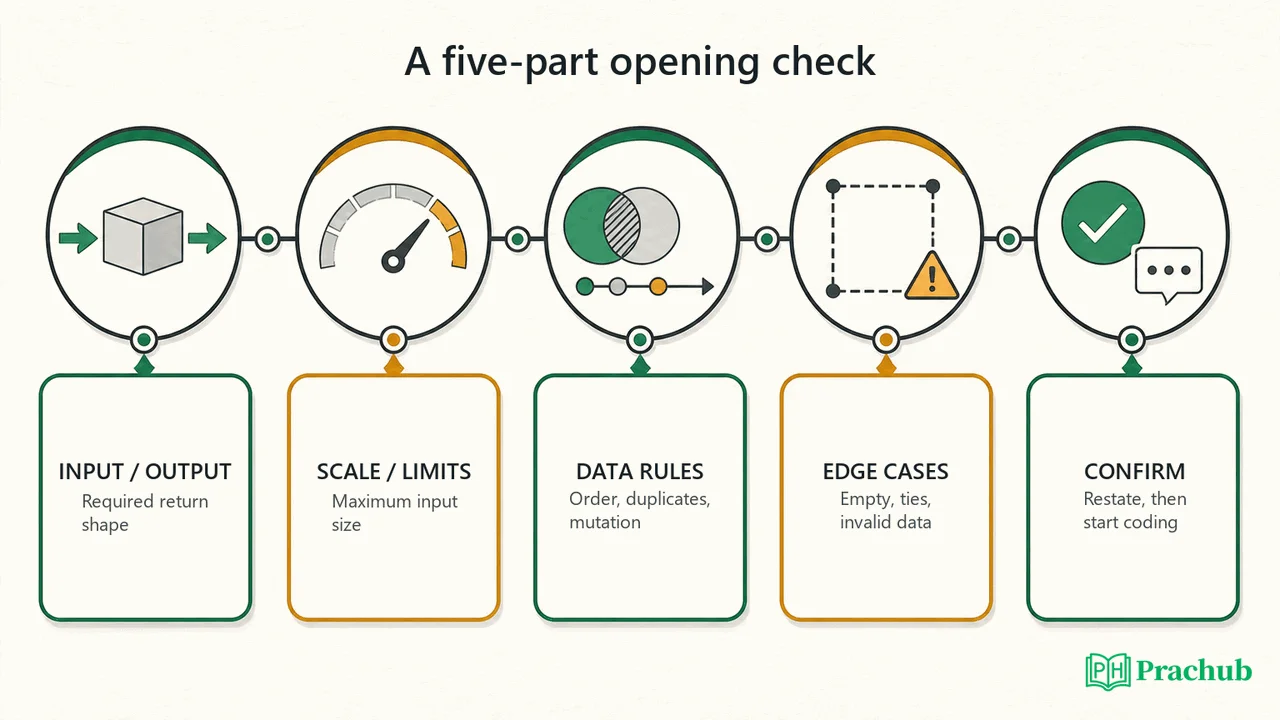
The visual below compresses the six-category taxonomy into a five-part opening check: contract, scale, data rules (including guarantees, mutation, and semantics), edge cases, and confirmation.
How to phrase clarifying questions without sounding scripted
Start with your current interpretation, then expose the fork that matters. This makes the question efficient because the interviewer can confirm your model or correct one specific part.
- Instead of “What are the constraints?”, ask: “If
ncan reach millions, I would avoid the quadratic baseline. What input scale should I design for?” - Instead of “What about edge cases?”, ask: “Can the input be empty or contain duplicate values, and should duplicates appear separately in the output?”
- Instead of “Can I make assumptions?”, ask: “The prompt does not define ties. May I return any valid answer, or is there a deterministic ordering you want?”
- Instead of “What should I do?”, ask: “I see a linear-time approach if the input is sorted. Is sorted order guaranteed, or should I account for arbitrary order?”
This pattern—interpretation, meaningful fork, focused question—also prevents clarification from turning into solution fishing.
Worked examples: how answers change the solution
Example 1: intervals and boundary semantics
Suppose the prompt asks you to merge or union two sorted interval lists. Before coding, ask whether intervals are closed ([a,b]) or half-open ([a,b)), whether touching endpoints merge, and whether each list is already internally non-overlapping.
The answer changes the comparison. Closed intervals that treat touching endpoints as connected may merge when next.start <= current.end; half-open intervals may require next.start < current.end. Confirm with a tiny example: “Should [1,2] and [2,3] become [1,3] or remain separate?” One answer resolves more risk than a long generic checklist.
Example 2: graph rankings and inconsistent input
For a prompt about ranking players from match results, first confirm what a directed pair means: does (a,b) mean a beat b? Then ask whether transitive results count, whether cycles are possible, and what to return for disconnected or incomparable players.
Those answers decide whether the task is reachability, topological reasoning, or validation of inconsistent data. If the interviewer says cycles will not appear, state that guarantee and proceed. If cycles may appear, your tests and output contract need an explicit rule for them.
Example 3: parsing flat keys into nested data
For flat keys such as user.name.first, clarify the delimiter grammar and the conflict rule. What happens if both user and user.name exist? Are empty segments or repeated delimiters valid? Must output key order be deterministic?
A leaf-versus-container conflict cannot be repaired by choosing a clever data structure after coding; it is a product decision. Offer two interpretations and ask the interviewer to choose, or state which one you will implement if either is acceptable.
Example 4: a stateful lending API
A library-catalog prompt may look like ordinary class design until requirements reveal the state machine. Ask who can borrow, whether one copy can have multiple holds, what happens after a failed return, whether data persists between calls, and which errors belong in the return value versus exceptions.
Do not design the entire product in the opening. Identify the state transitions needed for the requested phase, confirm one acceptance example, and defer unrelated features. CoderPad’s documentation for interview authors shows that prompts can include candidate instructions, interviewer-only guidance about potential edge cases or tests, and progressively revealed follow-ons; candidates should therefore anchor on the contract actually provided rather than assume every extension.
What if the interviewer says, “Make a reasonable assumption”?
That response is permission to choose, not a dead end. State the assumption, explain its consequence, and continue: “I’ll assume IDs are unique non-negative integers, so a hash map is sufficient. If duplicates are allowed, I would change the value to a list.”
If the assumption affects correctness, confirm it once. Then make progress. Do not keep asking the same question in different words, and do not treat an unanswered detail as a reason to freeze.
Common mistakes when clarifying a coding prompt
The first mistake is asking every possible edge case. Nulls, overflow, malformed text encoding, concurrency, and malformed data do not all apply to every prompt. Select the cases that threaten the contract or chosen invariant.
The second is asking for the target algorithm. Clarify guarantees and goals; own the solution. The third is failing to use the answer. If the interviewer confirms sorted input, your plan should visibly exploit that fact. The fourth is continuing discovery after the contract is stable. Summarize assumptions and start coding.
Amazon’s SDE interview preparation emphasizes robust, well-tested code, edge cases, and invalid input for its SDE II process. Use that as company-specific evidence that boundaries matter—not as a universal rule that every interviewer expects the same validation behavior.
Practice clarifying questions with PracHub prompts
These records help you practice identifying material unknowns. They are preparation material, not predictions of your exact interview.
| PracHub question | Clarification focus | Why it helps |
|---|---|---|
| Compute the Union of Two Sorted Interval Lists | Interval boundaries and merge semantics | Shows how one definition changes the comparison logic. |
| Determine All Players with Fixed Rankings | Edge direction, cycles, and disconnected nodes | Forces you to turn an English relation into a graph contract. |
| Transform flat keys into nested dictionary | Parsing grammar and key conflicts | Trains decisions that cannot be inferred safely from code alone. |
| Library Catalog and Lending System: Five-Phase Engineering Assessment | State transitions, permissions, and failures | Practices narrowing a product-style prompt to the requested behavior. |
| Adapt to interviewer coding preferences | Task type, environment, and allowed tools | Helps calibrate what kind of coding exercise you are actually solving. |
For each prompt, spend three minutes writing only your restatement, two material questions, one confirmation example, and your assumptions. Then compare the written solution with the contract you formed. The goal is not to maximize the question count; it is to make each question earn its time.
Frequently asked questions
How many clarifying questions should I ask in a coding interview?
There is no universal number. Ask enough to resolve ambiguities that could change the correct implementation, complexity, or tests, then proceed. Two focused questions can be better than ten generic ones. If the prompt is already precise, a concise restatement and one confirmation example may be sufficient.
Should I ask about edge cases before I start coding?
Ask about boundary behavior when the prompt does not define it and the answer affects correctness. Turn confirmed cases into tests later. Do not enumerate unrelated possibilities merely to sound thorough; select empty, duplicate, boundary, invalid, or overflow cases only when they fit the data and operations in the prompt.
Should I ask for the expected time complexity?
Prefer asking about input scale or resource constraints, then derive an appropriate target yourself. If the interviewer expects a particular bound, they may tell you. Asking “What size can n reach?” demonstrates reasoning more clearly than asking the interviewer to choose the Big-O result for you.
What if the interviewer will not answer my question?
Offer a reasonable interpretation, state it explicitly, and continue. Briefly note how the solution would change under the alternative. This keeps the interview moving while preserving correctness boundaries: “I’ll assume duplicates are allowed; if they are not, the same algorithm works with a simpler output rule.”
Can asking too many questions hurt my coding interview?
Questions become counterproductive when they repeat the prompt, explore irrelevant cases, request the solution, or prevent progress after the contract is clear. Use the material-change test: if neither possible answer would alter your code, complexity, or validation plan, defer the question.
Final takeaway
To ask better clarifying questions in a coding interview, convert ambiguity into a shared contract before you code. Restate the goal, ask about the few unknowns that can change the solution, validate one example, state assumptions, and move forward. Practice this opening on varied PracHub coding questions until it feels like engineering judgment rather than a memorized performance.
Sources and Further Reading
- Microsoft Careers: Technical interviewing
- Microsoft Careers: Interview tips
- Meta Software Engineer Full Loop Interview Guide
- Amazon SDE II Interview Prep
- Amazon Software Development Interview Topics
- CoderPad documentation: Creating and editing interview questions
Research note: This guide was checked on August 30, 2026. Employer formats, tools, and evaluation practices vary by role and recruiting process; your recruiter and interviewer remain the authoritative sources for your specific interview.
Related Articles
State Farm Technology Internship 2027: HireVue, Coding Assessment, and Final Interview
State Farm Technology Internship 2027 guide: HireVue, coding assessment, final interview, reported questions, timeline, and preparation.
Sprinklr Product Engineering Intern OA 2027: Technical Assessment, Coding, and Interview Process
Sprinklr Product Engineering Intern OA 2027 guide: official assessment steps, reported coding topics, interviews, timeline, and preparation.
CodinGame Assessment Guide 2026: Coding Games, Scores, Code Playback, and Candidate Reports
Learn how CodinGame assessments work in 2026, including coding games, partial and comparative scores, code playback, reports, and preparation.
What to Do When You Get Stuck in a Coding Interview: Hints, Recovery, and Communication
Learn what to say when you get stuck in a coding interview, how to request useful hints, recover momentum, and communicate your reasoning clearly.
Comments (0)