HubSpot Coding Assessment Guide: Format, Practical Tasks, and Preparation
Quick Overview
This HubSpot coding assessment guide explains the official three-hour API and data-transformation task, including GET and POST requests, candidate-specific JSON, allowed tools, prohibited AI use, and HubSpot's published completion and first-correct-submission criteria. It provides a practical time plan, code structure, testing checklist, synthetic practice exercise, and seven-day preparation workflow using PracHub.
If you prepare for the HubSpot coding assessment by solving only array and graph puzzles, you may be practicing the wrong skill. HubSpot's published assessment looks much closer to a small integration task: retrieve unique data from an API, transform it correctly, send the result to another API, and submit your code.
The challenge is not advanced syntax. It is producing a complete solution while HTTP behavior, JSON shape, edge cases, and a three-hour clock compete for your attention.
Before starting, use PracHub's company-specific interview prep to map the wider HubSpot loop, then practice real interview questions with written solutions. This guide focuses only on the coding assessment so you can rehearse the workflow instead of memorizing leaked prompts.
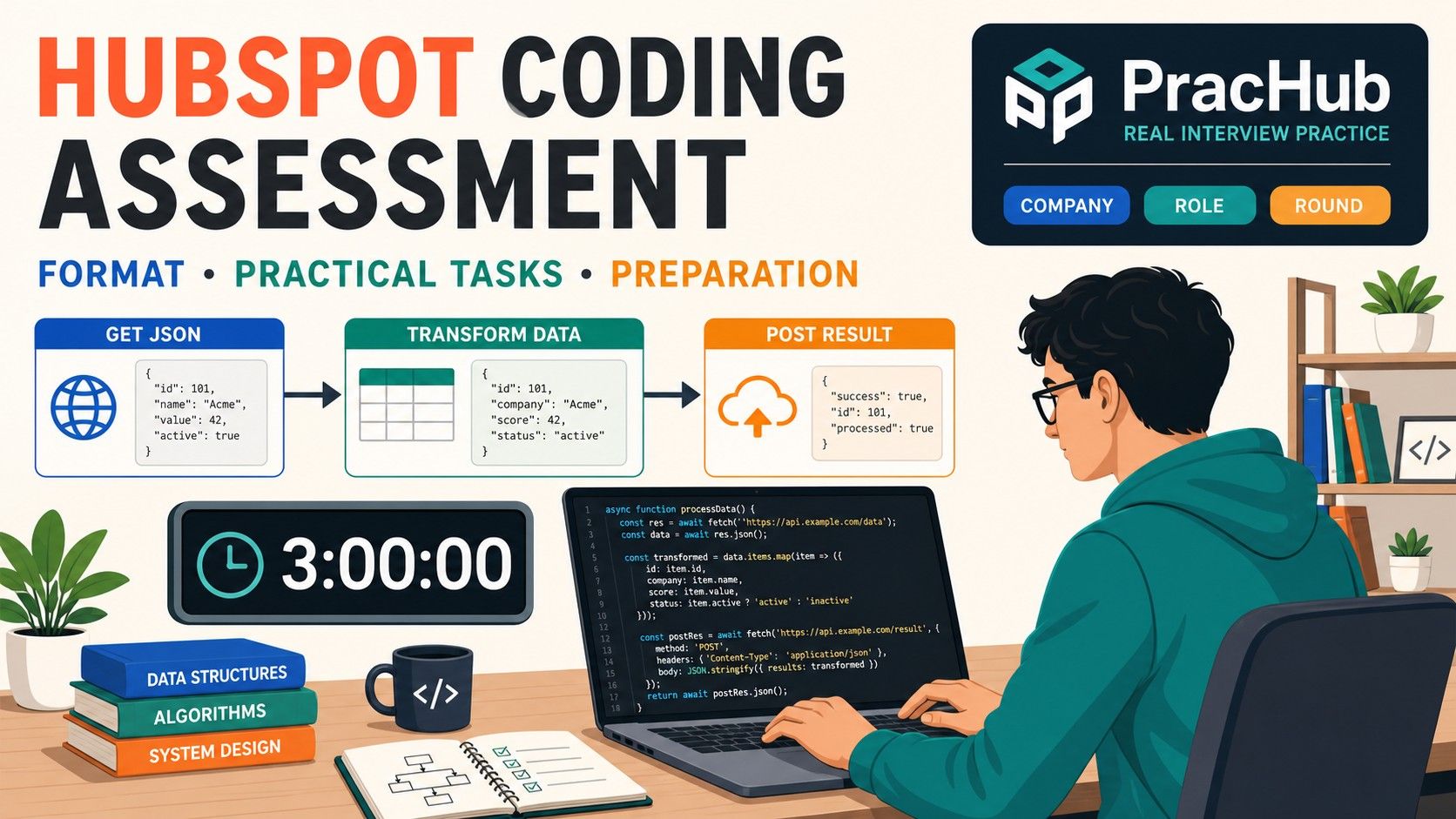
HubSpot's published assessment follows a practical GET, transform, validate, and POST workflow.
Quick Answer: What Is the HubSpot Coding Assessment?
HubSpot's published coding assessment is a three-hour, take-home API and data-transformation task completed on your own computer. You retrieve candidate-specific JSON data through one API, modify it to solve a described real-world problem, return the result through another API, and send HubSpot your code.
You may use your preferred language, IDE, and libraries. HubSpot also allows ordinary resources such as Stack Overflow, but its current rules prohibit copying code verbatim, consulting another person, using ChatGPT or other AI tools, and sharing project details.
| Assessment detail | What HubSpot publishes | What it means for preparation |
|---|---|---|
| Environment | Your own computer, language, IDE, and libraries | Prepare a familiar local project before the timer starts |
| Input | A GET API returns data unique to you | Practice authenticated HTTP requests and JSON inspection |
| Task | Modify data to solve a described real-world problem | Prioritize accurate modeling over algorithm trivia |
| Output | POST the modified data and send your code | Validate serialization, headers, and response status |
| Time | Three hours in one sitting | Reach a correct baseline before refactoring |
| Primary evaluation | Completion and time to the first correct submission | Do not hide a working answer behind premature polish |
Could Your HubSpot Assessment Be Different?
Yes. HubSpot says interviews are tailored to the role, and its internship recruiting guide describes a technical assessment covering coding fundamentals without promising one universal delivery format. Some teams or emerging-talent programs may use a platform-hosted screen instead of the API project described above.
Read the recruiter email and assessment landing page before studying. Confirm the time limit, platform, allowed tools, language options, and whether the task is an independent project or a live exercise. The invitation outranks any online guide, including this one.
The Four-Part Data Flow
The official workflow is simple to describe but easy to mishandle under time pressure. First, call the input endpoint with the unique API key. Second, inspect the returned JSON and model the business rule. Third, transform the data into the exact required output shape. Fourth, POST the result and interpret the response.
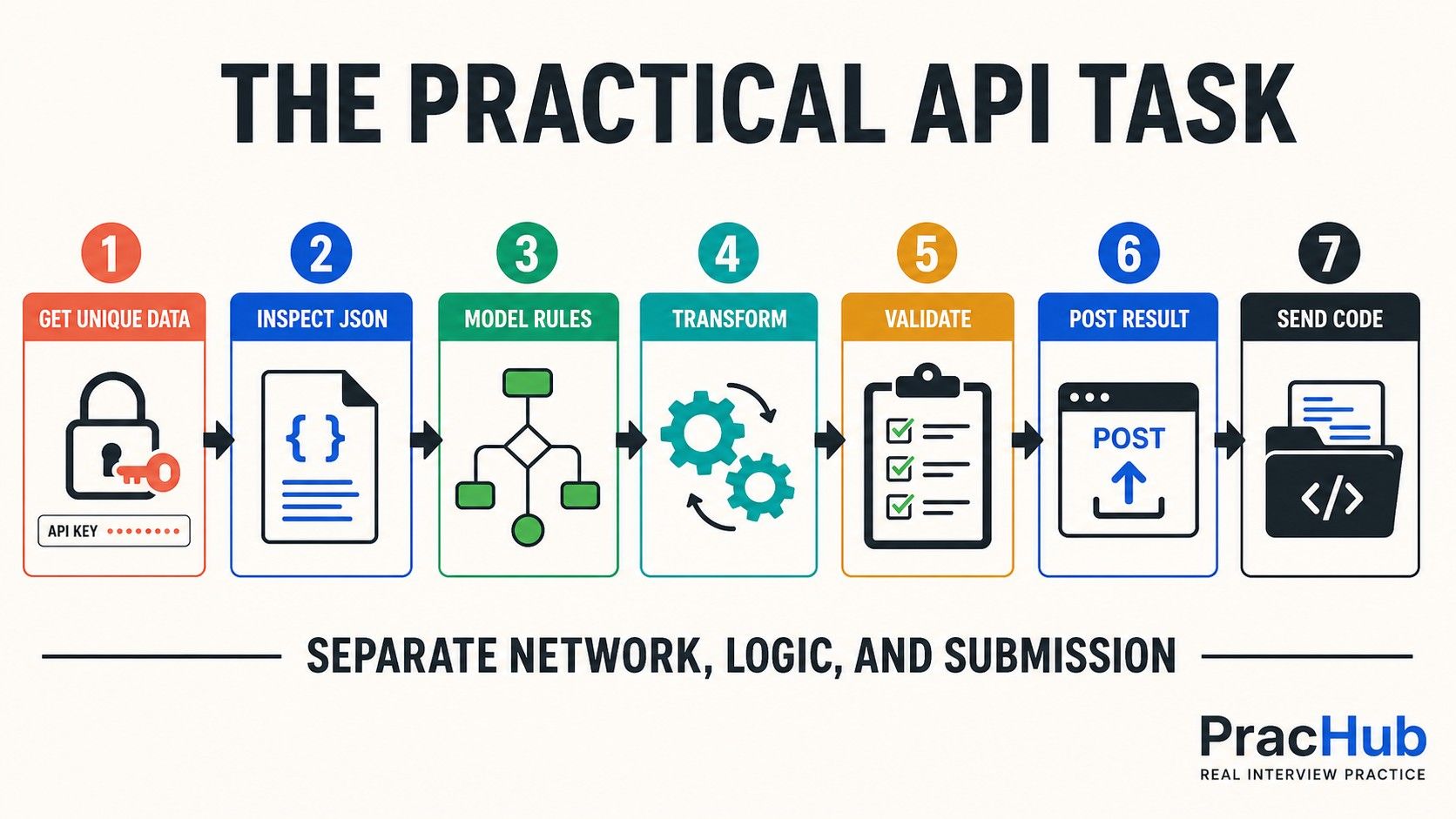
Keep network operations, transformation logic, validation, and submission as distinct stages.
Separate those stages in code. A small fetchInput, pure transform, validateOutput, and submitResult structure makes failures easier to locate. It also lets you test the business logic without repeatedly calling the remote service.
Skills You Actually Need
HTTP Requests
Know how to make GET and POST requests, attach an API key, set headers, serialize a request body, and inspect status codes. Log useful error context without printing credentials. If a request fails, distinguish transport failure, authorization failure, invalid payload, and server rejection.
JSON Parsing and Serialization
Inspect field names, nesting, nullability, and types before writing transformation logic. Confirm whether the output requires an object, array, sorted records, grouped values, or a specific date representation. A logically correct calculation can still fail if the JSON contract is wrong.
Core Data Structures
HubSpot explicitly names arrays, maps, and sets. Practice grouping records, deduplicating identifiers, counting events, joining objects by key, sorting deterministically, and transforming nested collections. These operations are more relevant than memorizing an obscure graph trick.
Real-World Problem Modeling
Translate prose into invariants. Define the unit of analysis, grouping key, ordering rule, boundary conditions, and exact output before coding. When two interpretations are possible, use the prompt examples and API feedback rather than guessing silently.
How HubSpot Evaluates the Assessment
HubSpot publicly names two criteria: whether you complete the project within three hours and the elapsed time until your first correct submission. The company explicitly recommends getting the code working first, then cleaning or refactoring it.
That is unusually clear guidance. A beautiful architecture that never produces an accepted result is not the goal. HubSpot also asks for your code afterward, so readable structure is sensible, but the published criteria do not support delaying correctness for speculative polish.
| Area | Risky approach | Stronger approach |
|---|---|---|
| Prompt reading | Start coding from the first example | Write input, output, invariants, and edge cases first |
| API setup | Mix requests and business logic | Verify GET and POST plumbing independently |
| Implementation | Design a framework before proving the rule | Build one correct end-to-end path |
| Validation | Trust a successful HTTP request | Check payload shape and the server's response body |
| Refactoring | Polish before any correct submission | Refactor only after correctness is established |
| Secrets | Commit or print the API key | Keep credentials outside source and redact logs |
A Practical Three-Hour Plan
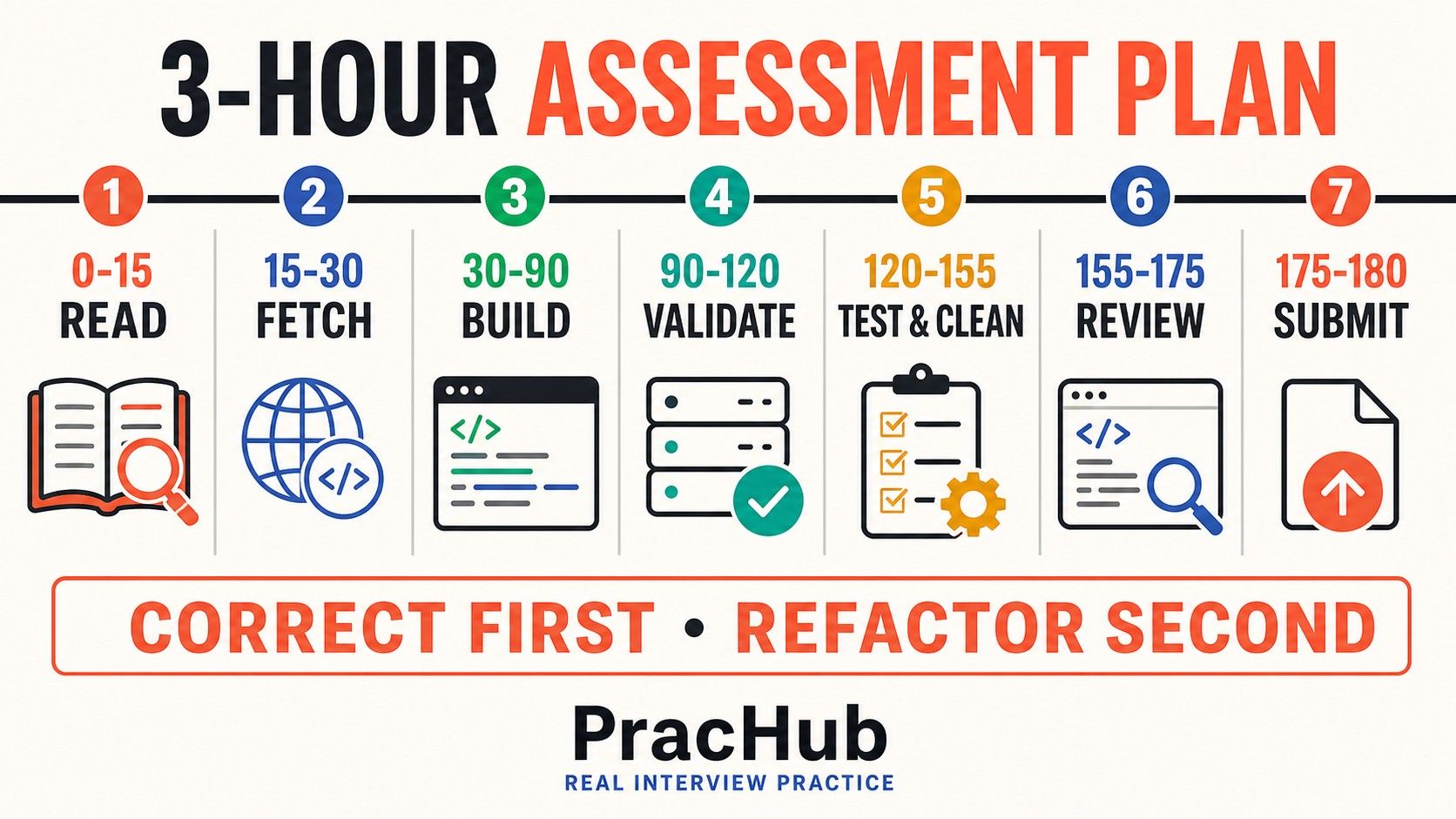
Protect the first correct solution, then use remaining time for tests, cleanup, and submission checks.
| Time | Goal | Exit condition |
|---|---|---|
| 0-15 min | Read the full prompt and set up the project | Input, output, rules, and unknowns are written down |
| 15-30 min | Fetch and inspect candidate-specific data | Authenticated GET works and representative JSON is saved |
| 30-90 min | Implement the simplest complete transformation | Known examples and a local fixture pass |
| 90-120 min | Validate and POST the result | The service confirms a correct response |
| 120-155 min | Add edge cases and refactor carefully | Behavior is unchanged and code is easier to inspect |
| 155-175 min | Review code and submission instructions | No secrets, debug noise, or missing files remain |
| 175-180 min | Final submission buffer | Code and required artifacts are sent successfully |
This is a planning template, not an official HubSpot schedule. If the problem is harder, reduce cleanup time before sacrificing the submission buffer. If you find a correct solution early, follow the platform instructions rather than waiting for the code to feel perfect.
Testing Without Overbuilding
Save one representative API response as a local fixture. Then test the transformation as a pure function. Useful cases include empty collections, one record, duplicate identifiers, missing optional fields, ties, records exactly on a boundary, unsorted input, and large groups.
Validate the output contract separately. Check required keys, value types, ordering, duplicates, and whether empty results should be omitted or represented explicitly. A few focused assertions are more valuable than building an elaborate test framework during a three-hour screen.
A Safe Practice Exercise
Create a local endpoint that returns customer activity events with customerId, timestamp, and eventType. Write a program that groups events by customer, removes duplicate event IDs, identifies each customer's longest active-day streak, and POSTs a sorted summary to a second endpoint.
Then add malformed JSON, a 401 response, a 500 response, tied streaks, missing timestamps, and input arriving out of order. This synthetic drill develops the public skills HubSpot names without recreating or sharing the confidential assessment.
Choose the Language You Can Debug Fastest
Use the language in which HTTP calls, JSON, collections, date handling, and tests are routine. Python and JavaScript are convenient, but familiarity matters more than terseness. Java, C#, Go, or another language is reasonable if your project setup and JSON tooling are already comfortable.
Do not spend the assessment learning a new HTTP client or build system. Before test day, confirm that your runtime, dependency manager, formatter, and certificate setup work on the same computer and network you will use.
What Tools Are Allowed?
HubSpot's published rules allow your normal computer, IDE, libraries, Stack Overflow, and similar resources. They prohibit copying code verbatim, consulting a friend, using ChatGPT or other AI tools, and sharing project details. Your invitation may contain additional restrictions.
Follow the rule as written, even if your everyday workflow uses AI. The assessment measures your independent work under a defined policy. Keep the API key out of public repositories, screenshots, paste sites, and logs you might later share.
A Focused Seven-Day Preparation Plan
Days 1-2: practice GET, POST, headers, status handling, and JSON serialization in your chosen language. Days 3-4: solve timed grouping, joining, deduplication, interval, and ordering tasks using local fixtures.
Day 5: run a 90-minute mini-assessment from input API to accepted output. Day 6: run the full three-hour simulation with no AI and only allowed references. Day 7: re-solve the weakest portion, test your environment, and review the broader HubSpot Software Engineer Interview Guide.
Use PracHub's system design questions and behavioral and leadership practice for the interviews that may follow the assessment.
Common Mistakes
The most expensive mistakes are starting before reading the full contract, hard-coding the sample, ignoring HTTP error bodies, mutating data in ways that lose information, assuming input order, and delaying submission while polishing names or abstractions.
Another mistake is overfitting to a leaked prompt. HubSpot gives candidate-specific data and asks applicants not to share project details. Practice the transferable workflow: inspect, model, transform, validate, submit, and then improve.
Frequently Asked Questions
How long is the HubSpot coding assessment?
HubSpot's published API assessment allows three hours and recommends reserving that time in one sitting. Other role-specific screens can differ, so confirm the deadline and timer shown in your invitation before starting.
Is the HubSpot assessment LeetCode-style?
The published assessment is more practical than a standard algorithm screen: it uses HTTP, JSON, data structures, transformation logic, and an API submission. Separate live coding rounds may still evaluate algorithms, optimization, Big-O reasoning, and debugging.
Can I use my own IDE and programming language?
Yes for the published API assessment. HubSpot says candidates may use their preferred language, IDE, libraries, and normal computer. A platform-hosted assessment may offer a fixed environment, so follow the specific instructions you receive.
Can I use Google, Stack Overflow, or AI?
HubSpot permits ordinary references such as Stack Overflow but says not to copy code verbatim. Its current published rules explicitly prohibit ChatGPT and other AI tools, as well as consulting another person. Check for any additional role-specific restrictions.
What matters most in the HubSpot assessment?
HubSpot publicly prioritizes completing the project within three hours and the time to your first correct submission. Build a working end-to-end solution before refactoring, then use remaining time for edge cases, readability, and final submission checks.
Final Takeaway
The HubSpot coding assessment rewards complete practical execution. Be ready to authenticate an HTTP request, understand unfamiliar JSON, model a real-world rule, produce an exact payload, and confirm the server accepts it before the clock expires.
Use PracHub to diagnose your broader interview gaps, then rehearse this assessment as a timed integration task rather than another puzzle set. The winning sequence is straightforward: working result first, validation second, cleanup third.
Sources and Methodology
This guide was researched on August 6, 2026. Official assessment details and rules were checked against HubSpot's coding assessment guide, current software engineering interview preparation page, and internship recruiting guide. HubSpot tailors interviews by role, so variations are presented as possible rather than universal. Time allocation, code structure, testing strategy, synthetic exercises, and preparation advice are PracHub editorial guidance.
Related Articles
Atlassian Values Interview Guide 2026: Questions, Signals, and Story Preparation
Prepare for Atlassian's 2026 values interview: learn the five values, likely questions, evaluation signals, and how to build stronger STAR stories.
Airbnb Cross-Functional Interview Guide: Product, Design, and Engineering Trade-Offs
Prepare for Airbnb's cross-functional interview: learn product, design, and engineering trade-offs, likely questions, and a practical answer framework.
Microsoft As-Appropriate Interview Guide: What the Final Interviewer Is Evaluating
Prepare for Microsoft's As-Appropriate interview: learn what the AA final interviewer may evaluate, likely questions, technical risks, and a practical plan.
Software Engineer Project Deep Dive Interview Guide: Architecture, Impact, and Follow-Ups
Prepare for a software engineer project deep dive interview: choose the right project, explain architecture, prove impact, and handle technical follow-ups.
Comments (0)