IBM Coding Assessment Guide 2026: Questions, Timing, and Preparation
Quick Overview
A practical IBM coding assessment guide grounded in official IBM guidance and four real PracHub question-bank reports. Covers intervals, string indexing, palindrome character budgets, sliding windows, timer planning, hidden tests, proctoring, privacy, and a seven-day preparation plan.
Most candidates prepare for “the IBM coding test” as if every applicant receives the same questions, timer, and platform. IBM’s own guidance says the format depends on the role. The invitation email is your test specification.
This guide combines that official baseline with four real IBM coding questions from the PracHub question bank. The questions cover intervals, string indexing, character-frequency reasoning, and sliding windows. They are useful because they show the range an IBM assessment can span: one problem may be a five-line accuracy check, while the next requires a full medium-level algorithm.
Before starting a generic problem list, open PracHub’s IBM Coding & Algorithms questions. Use the reported questions below to identify the patterns you actually need to repair.

Prepare for the role-specific assessment in your invitation, then use real IBM question reports to make the practice concrete.
Quick verdict: IBM publicly confirms that an assessment may contain multiple-choice questions, coding challenges, or both. It does not publish one universal question count, duration, platform, language list, or passing score. Read the invitation first, then train timed coding fundamentals and the role-specific material named in the job description.
What IBM officially confirms
IBM’s application process describes coding assessments as multiple-choice questions or coding challenges, depending on the role. Its assessment FAQ tells invited candidates to complete the assessment within seven days and to check whether their specific assessment is timed.
| Detail | What you can rely on | What you must verify |
|---|---|---|
| Format | MCQs, coding challenges, or a role-dependent combination | The sections listed in your invitation |
| Completion window | IBM asks invited candidates to finish within seven days | The exact deadline and time zone in your email |
| Timer | Some assessments are timed | Total time and whether sections use separate timers |
| Question count | IBM publishes no universal number | The assessment landing page before starting |
| Programming languages | Availability depends on the role and environment | The language selector and job requirements |
| Proctoring | IBM may store code and webcam photos in some coding exercises | The permissions and notices shown for your assessment |
| Passing score | IBM publishes no universal cutoff | Recruiter guidance, if the team shares it |
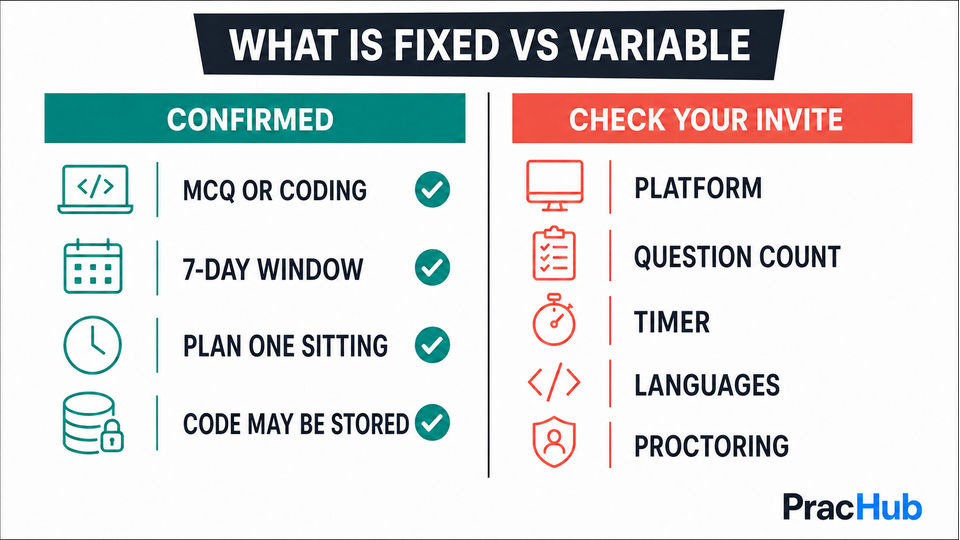
Use IBM’s public guidance for the baseline and your invitation for every assessment-specific rule.
Does IBM use HackerRank?
Candidate reports often describe HackerRank-hosted IBM assessments, and IBM’s entry-level developer guidance includes HackerRank among suggested practice resources. IBM’s public application page does not promise one platform for every role or region.
Prepare the skills that transfer across platforms: read a function signature, handle standard input, write compilable code, create your own tests, and interpret failure messages. Then use the tutorial or practice environment linked in your invitation.
What topics should you prepare?
The job description is the best predictor of the second lane of preparation. IBM’s developer guidance says technical topics may include data structures, networking, technology, and data handling. The balance changes across software engineering, data, AI, and infrastructure roles.
| Role family | High-value practice | What a strong submission demonstrates |
|---|---|---|
| Software engineering | Arrays, strings, hashing, sorting, intervals, trees, graphs | Correctness, complexity, edge cases, readable implementation |
| Data engineering | SQL, joins, aggregation, data transformation, basic algorithms | Data semantics, null handling, scale, deterministic output |
| Data science and AI | Python, SQL, arrays, statistics, data manipulation | Shape reasoning, assumptions, numerical and data edge cases |
| Cloud and infrastructure | Core coding plus networking, Linux, APIs, or automation | Operational reasoning and failure-aware code |
A candidate discussion may mention two coding questions, but that is one report, not a universal template. The question-bank evidence below is more useful as a pattern map than as a prediction of your exact test.
Four real IBM coding questions from the PracHub bank
PracHub currently has no visible IBM record whose normalized round field is literally “Online Assessment.” The four records below are stored under Technical Screen, but the candidate source reports behind them explicitly describe the exercise as an OA. We show that distinction instead of silently relabeling the bank or implying that every IBM assessment reuses the same prompts.
| Real question | Reported task | Pattern to know | Why it is useful OA practice |
|---|---|---|---|
| Compute minimum rooms for meeting schedule | Given unsorted half-open meeting intervals, return the minimum rooms required | Sorting, two pointers or a min-heap, tie semantics | Tests whether you turn a story into events and handle an end time equal to a start time |
| Reverse last two characters with space | For a string such as "bat", return "t a" | Direct indexing, output formatting, minimum-length assumptions | A short correctness check where overengineering and off-by-one errors are the main risks |
| Maximize palindromic strings after character swaps | Swap characters between strings and maximize how many strings can become palindromes | Global frequency counts, pair budgets, greedy allocation | The operation sounds local, but the key simplification is that characters form one shared pool while string lengths stay fixed |
| Find minimum subarray length with k distinct integers | Return the shortest contiguous subarray containing exactly k distinct values | Sliding window, frequency map, careful shrinking | Distinguishes “exactly k” from the easier “at most k” pattern and exposes stale-count bugs |
Question 1: minimum rooms for a meeting schedule
The IBM meeting-room question gives a list of [start, end] intervals and asks for the minimum number of rooms. The intervals are unsorted. If one meeting ends at time t and another starts at t, they can share a room.
The two standard solutions are both appropriate:
- Sort the starts and ends separately, then sweep them with two pointers.
- Sort meetings by start time and keep active end times in a min-heap.
The critical line in the two-pointer version uses starts[i] < ends[j], not <=. An end at time t frees its room before a start at time t consumes one. Sorting dominates the runtime, so the target is O(n log n) time.
| Test | Expected rooms | What it checks |
|---|---|---|
[] | 0 | Empty input contract |
[[1, 4]] | 1 | Single interval |
[[1, 2], [2, 3]] | 1 | Touching half-open intervals |
[[1, 4], [2, 5], [3, 6]] | 3 | Peak overlap |
[[5, 7], [1, 10], [2, 3]] | 2 | Unsorted input |
Question 2: reverse the last two characters
The IBM string question is intentionally small: given "bat", output "t a". The useful preparation lesson is not the algorithm. It is discipline. Confirm that the string has at least two characters, use direct indexing, and match the output exactly. A hidden test can reject "ta", "t a", or reversed indexing just as decisively as it rejects a broken graph algorithm.
Question 3: maximize palindromic strings after swaps
The palindrome question lets you swap one character from one string with a character from another, any number of times. Each string keeps its original length.
The conceptual jump is to stop simulating swaps. Unlimited cross-string swaps mean the characters form a global inventory. A palindrome of length L needs floor(L / 2) character pairs, plus one arbitrary center character when L is odd. Count all character frequencies, convert them into a total pair budget, and allocate that budget to strings with the smallest pair requirements first. The interviewer is testing whether you can replace a noisy operation with the invariant it creates.
Before coding, ask whether empty strings are allowed and whether only lowercase English letters can appear. Those details determine the frequency structure, even though they do not change the core reasoning.
Question 4: shortest subarray with exactly k distinct values
The exactly-k question asks for the minimum length of a contiguous subarray with exactly k distinct integers, or -1 when no such window exists.
Use a sliding window and a frequency map. When the window has more than k distinct values, advance the left boundary until it becomes valid again. When it has exactly k, remove duplicate copies from the left while the leftmost value would still remain in the window. Only then measure the length. This “shrink without losing a distinct value” rule is what turns a valid window into the shortest valid window ending at the current right boundary.
Test k = 0, an empty array, all-equal values, k larger than the total distinct count, negative integers, and a window where the leftmost value appears several times. The intended complexity is O(n) time because each pointer moves forward at most n times.
Timing, hidden tests, and submission strategy
IBM does not publish one global duration, so a fixed “30 minutes per problem” rule can fail. Use percentages that adapt to the timer shown in your invitation.
| Share of time | Action | Concrete output |
|---|---|---|
| First 5% | Scan every section and constraint | Question order and risk map |
| Next 15% | Write examples, choose an approach, estimate complexity | A plan you can defend |
| Next 60% | Implement the simplest correct solution | Runnable code for the full contract |
| Next 15% | Attack edge cases and likely hidden tests | Evidence beyond the samples |
| Final 5% | Re-read constraints and submit deliberately | Clean final answer |
If there are multiple questions, scan them first. The four real examples show why. A short string problem should not consume the same planning time as the palindrome or sliding-window problem. Secure the clean result, then spend the remaining time where reasoning matters.
What hidden tests usually expose
Hidden tests are usually ordinary consequences of the written contract that the sample did not exercise.
| Failure pattern | Test before submitting | IBM-bank example |
|---|---|---|
| Boundary mistake | Empty input, one item, minimum permitted size | Reverse-two-characters needs a clear minimum length |
| Tie semantics | Equal timestamps, duplicates, touching intervals | Meeting end at t versus meeting start at t |
| Incorrect state | Repeated calls, stale globals, mutated input | Frequency maps must represent only the current window |
| Numeric or count error | Zero, negative values, odd totals, overflow | Palindrome centers and unused characters |
| Complexity failure | A synthetic input near the maximum constraint | Sliding window should not restart for each index |
| Output mismatch | Exact return type, ordering, whitespace, casing | "t a" is not "ta" |
Do not stop when the sample passes. State the invariant your algorithm preserves, derive the time and space complexity, and write at least three adversarial tests.
For additional timed practice, stay within IBM Coding & Algorithms questions until the patterns above feel automatic. Then broaden to the Software Engineer question bank for later technical rounds.
A seven-day IBM assessment plan
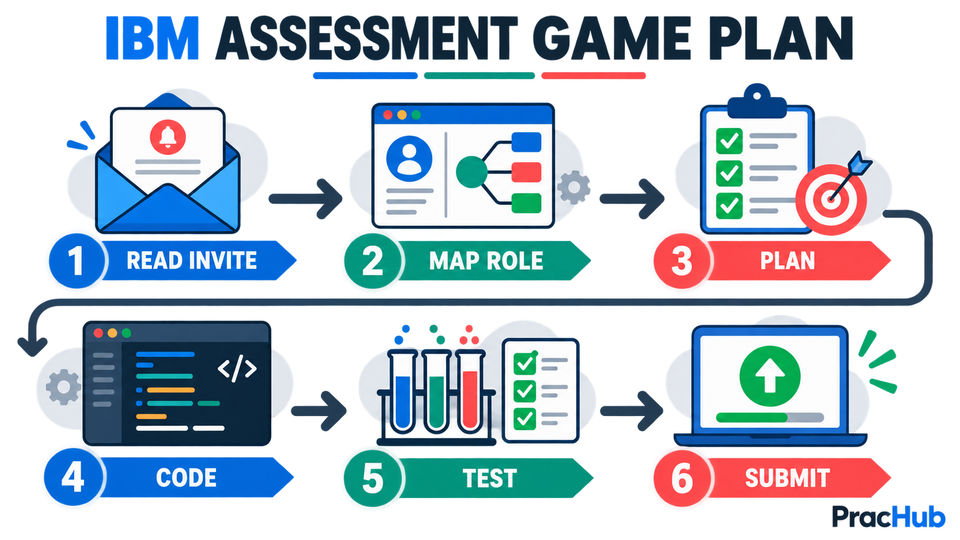
Turn the seven-day completion window into a diagnostic, repair, and simulation cycle.
| Day | Focus | Concrete deliverable |
|---|---|---|
| 1 | Read the invitation and job description | Platform, timer, sections, languages, deadline, role skill map |
| 2 | Run a timed diagnostic | Solve the IBM string and interval questions; start an error log |
| 3 | Repair stateful patterns | Solve the exactly-k sliding-window question and two related problems |
| 4 | Practice role-specific material | SQL, data, networking, or cloud work aligned to the job description |
| 5 | Train hidden-test discipline | Apply the edge-case table to two solutions before submitting |
| 6 | Simulate the full assessment | One uninterrupted session in your chosen language |
| 7 | Review lightly and complete | Stable environment, rested attempt, deliberate submission |
Record mistakes by cause, not by problem name. “Forgot to release an interval on a tie” and “measured the window before shrinking duplicates” are reusable lessons. “Got problem 3 wrong” is not.
Day-of rules, proctoring, and privacy
IBM’s applicant privacy notice says it may record and store code created during coding assessments and may store one or more webcam photos during coding exercises. Video-enabled assessments may also produce recordings. That wording describes possible collection; it does not prove that every IBM coding assessment continuously records video.
Read the consent screen and invitation before you begin. Check camera permissions, close unrelated applications, keep identification available if requested, and contact the assessment support channel before the deadline if you need an accommodation.
IBM’s application guidance also draws an AI boundary: using AI to learn concepts is encouraged, but using it to rewrite technical solutions for an assessment is not allowed. Prepare with AI beforehand if useful. During the assessment, follow the displayed rules and submit your own work.
| Before opening the timer | Before final submission |
|---|---|
| Confirm the deadline and time zone | Re-read every constraint |
| Test browser, network, camera, and keyboard | Run boundary, tie, and scale tests |
| Choose an allowed language you know deeply | Remove debug output and dead code |
| Reserve enough uninterrupted time for one sitting | Check return type and output format |
| Open only resources the rules permit | Submit before the timer expires |
IBM coding assessment FAQ
How many questions are on the IBM coding assessment?
IBM does not publish one universal question count. Candidate reports vary by role and location. The PracHub bank includes IBM reports with pairs of coding questions, but that does not guarantee your assessment will contain two. Check the invitation and pre-assessment screen for your exact structure.
How long is the IBM coding assessment?
The timer varies by assessment. IBM’s public FAQ tells candidates to check whether their assessment is timed and to reserve enough uninterrupted time to finish in one sitting. The separate seven-day rule is the completion window after invitation, not necessarily the duration of the test itself.
Are the four questions above guaranteed to appear?
No. They are real IBM-tagged questions from candidate reports in the PracHub bank, included to show the level and pattern mix that has been reported. Use them as practice evidence, not as a leaked or guaranteed question set.
What difficulty should I expect?
There is no official universal difficulty label. The reported IBM examples range from direct string indexing to medium interval, greedy, and sliding-window problems. Prepare to finish easy accuracy checks quickly and solve common medium patterns with clean complexity and edge-case reasoning.
Can I choose my programming language?
Language availability depends on the assessment environment and role. IBM’s developer guidance recommends using your strongest language in most cases, but the selector and invitation control. Confirm support before the timer begins and practice the exact input, output, and testing workflow in that language.
Does IBM record the coding assessment?
IBM’s privacy notice says code may be stored and one or more webcam photos may be captured during coding exercises; video-enabled assessments may also be recorded. This is not proof of identical monitoring for every test. Read the permissions and privacy notice presented for your assessment.
Can I retake an IBM coding assessment?
IBM does not publish one retake policy for every assessment. If a technical problem interrupts the session, document it immediately and use the support contact in the invitation. Do not assume that refreshing, reopening, or starting another application creates a valid retake.
The practical next step is simple: solve the four linked IBM questions in one sitting, record which invariant or edge case failed first, and repair that weakness before taking the real assessment.
Comments (0)