IdealOffer Review: Chinese Company Interview Reports and Source Verification
Quick Overview
Review IdealOffer company interview previews, one-point access, data-analysis role aliases and source-verification limits before relying on a locked report. Dated public observations and original exercises distinguish official descriptions, tested behavior and unverified capabilities.
IdealOffer, or 面经智库, lets a public reader browse Chinese company interview reports and role labels, but the full account we inspected required one point and sign-in to unlock. Its short preview did not expose an original-source link. Use it to discover a topic; the full account and its provenance remain unverified here.
Start with PracHub’s SQL toolkit discussion and identify the actual capability you need to demonstrate. A company filter can narrow your reading, but your practice should still end with a query, explanation or project decision you can defend.
Checked November 3, 2026: this review covers idealoffer.cn, including its public directory, a ByteDance company page and one backend Agent report preview. Counts and review-process statements are provider claims. No points were purchased or spent, no account was created and no locked report was read. PracHub publishes interview-preparation content and is the publisher of this review.
What the public directory can tell you
The explore page organizes reports around companies and roles. The site presents a large collection and describes a combination of collected material and user submissions, with review. We did not audit its total, moderation process or the independence of its underlying reports.
A directory can still be useful before those questions are resolved. It can show whether a company has entries for a role family, which labels are used and which topics appear in previews. Treat that as discovery evidence rather than a verified map of the employer’s hiring process.
The company context also needs precision. A report about one backend team does not necessarily apply to a data analyst, mobile engineer or infrastructure role at the same company. Internship, graduate and experienced-hire accounts can differ even when the title contains similar technical words.
Our public review therefore followed one company page and one report entrance. It did not attempt to infer the contents of locked material from tags or construct a current ByteDance interview guide. That narrower scope preserves the useful directory observations without inventing process details.
One observed preview and its unlock boundary
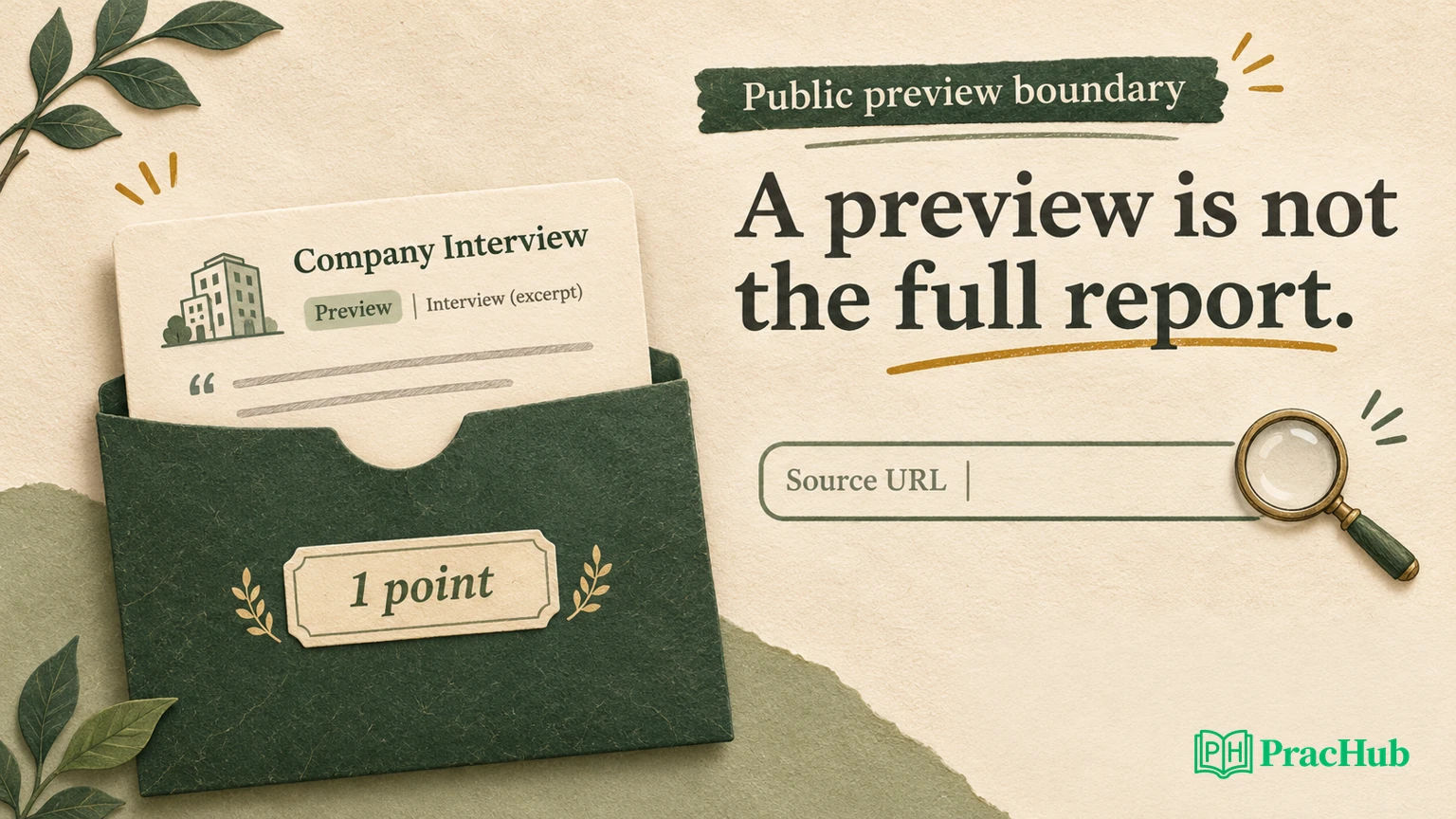
The inspected detail page was titled as a ByteDance backend Agent first-round report. Its visible preview was very short, with tags including Python, Agent, backend, algorithms and RAG. The page offered a one-point unlock for the full material.
We could see that a report entry existed and how it was categorized. We could not read the full questions, round narrative or candidate reflections. No clickable external original-report URL was visible in the public detail we inspected.
Those observations do not prove that the locked report lacks a source link. They establish that source comparison was unavailable at the public boundary we reached. The distinction matters: an honest review should say what was hidden rather than describing an unseen report as either reliable or unreliable.
| Public field | What it supported | What it did not establish |
|---|---|---|
| Company and title | Indexed ByteDance backend Agent context | Current company-wide process |
| Technical tags | Possible study themes | Exact questions or answer depth |
| Short preview | Existence of a public excerpt | Full account quality |
| One-point unlock | A gated reading action | Current point acquisition or purchase value |
| No visible original URL | Public provenance gap in this sample | Absence of sources behind the gate |
A tag such as RAG can lead you toward relevant study, but it is not enough to reconstruct an interview. Retrieval design, evaluation, latency and access control are different questions. Use the preview to identify a topic to investigate, then practice against a specific contract elsewhere.
Collection labels are not interview dates
The company page used labels such as newly collected today or a relative time for recent entries. Some cards also included an explicit interview date in their preview. Those are different fields and should remain separate in your notes.
An item collected today can describe an older interview. An explicit body date can be more informative about the account’s cycle, while still remaining the report’s own claim until the original is checked. If the full body is locked, leave the interview date unknown when it is not available publicly.
This affects how you compare reports. Two recent collection labels do not necessarily provide two independent same-cycle accounts. The reports might be older, copied from the same original or about different teams. Current official hiring information and independently traceable accounts are needed for a stronger process claim.
For preparation, an older technical problem may remain worthwhile. Its value comes from the reasoning it exercises. Keep that learning value separate from the confidence you place in the report as evidence about an upcoming interview.
Role aliases change what you find
On the ByteDance company page, we observed separate labels for 数据分析, 数分 and 数据分析师, with displayed counts 36,13 and 7 respectively. These Chinese labels can refer to closely related data-analysis roles, but the directory kept them separate.
Do not add those counts and call the result unique coverage. We did not determine whether entries overlap, whether labels reflect distinct jobs or how the site resolves aliases. Searching one label may miss material indexed under another.
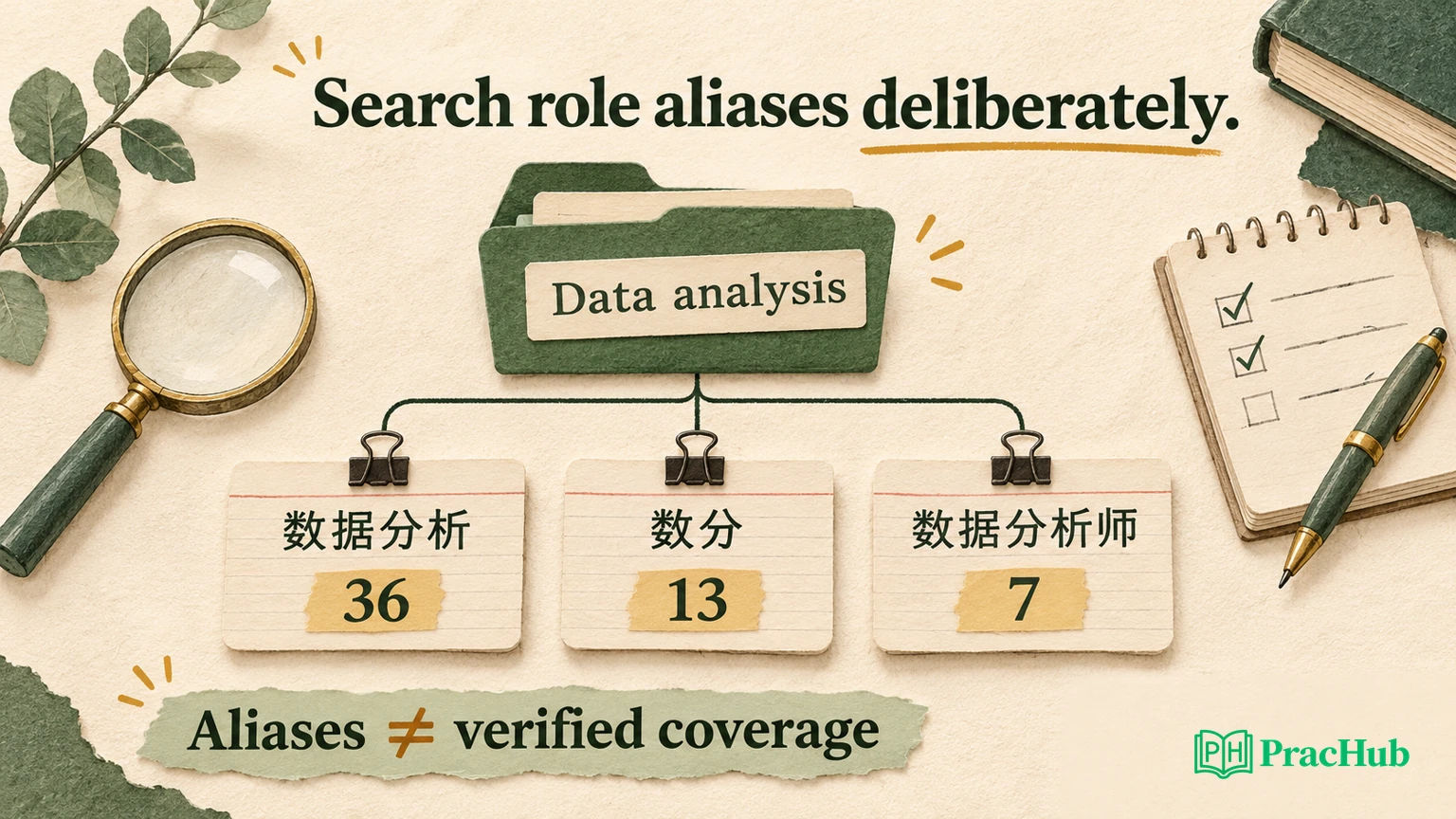
Build a small search map from your target job description. Keep a broad family such as data analysis, then record the exact labels the directory uses. Search the aliases deliberately and inspect the report context before treating every result as relevant.
| Search label | Possible reading purpose | Check before using the report |
|---|---|---|
| 数据分析 | Broad analysis-role discovery | Product, business or technical scope |
| 数分 | Common abbreviated label | Whether the role matches the posting |
| 数据分析师 | Explicit analyst title | Team, seniority and interview stage |
| Backend or Agent tags | Technical adjacency | Whether this is actually your role family |
This worksheet is our reading aid. It does not claim that IdealOffer merges or should merge these categories internally. Exact labels can preserve useful distinctions; the reader’s job is to understand those distinctions before comparing counts.
A source-verification note should be small and explicit
For each report you intend to rely on, retain six fields: original URL, claimed interview date, role, round, author context and whether you read a direct account or a copy. Use “not available” for a missing field. That is more informative than a general trusted/untrusted label.
For our inspected preview, the original URL and full author context remained unavailable. The role and round were title-level claims. The detailed account was gated. This is a limited evidence packet, so our recommendation stops at public discovery.
If you later unlock a report, compare its added value with what you already knew. Does it expose a complete question, useful constraints or a traceable original? Does it distinguish the candidate’s recollection from a site-generated answer? A longer page is useful only if it resolves a preparation or provenance gap.
Also check whether several reports repeat the same narrative. Different formatting or collection dates do not automatically make them independent evidence. A report can be useful for practice even when copied, but it should not inflate your confidence about the frequency of a hiring question.
Turn a role label into an answer you can defend
Suppose your target is a data analyst role and the directory gives you several relevant labels. Choose one concrete skill from the posting, such as explaining a customer-retention metric with SQL. Write the denominator, eligible population and time window before selecting a practice problem.
A candidate who says “I know SQL” has not yet established whether they can preserve customer identity, handle duplicate events or explain missing data. Create a small dataset with two customers sharing a name and a repeated event. Predict which rows should count before writing the query.
This is an original practice direction, not a question we read in the locked IdealOffer report. Its purpose is to keep your preparation useful even when the source account is only partially visible. You can use directory discovery without pretending it supplied an evaluated answer.
Then explain the result to a nontechnical partner. State what the metric supports and which business conclusion would require more evidence. A technically correct aggregation can still support an overconfident recommendation if you ignore selection effects or a changed definition.
For a backend Agent role, use a different artifact. Define one API operation, a failure response and a safe retry policy. Role matching should change the work you produce, not merely the company name at the top of your notes.
What points and catalog size cannot decide for you
The one-point gate is an observed access condition, but this review did not establish current point prices, earning rules or membership entitlements. We did not buy access or test whether unlocking persists across devices. Those details require a current account-side check.
A large catalog can improve the chance of finding a relevant report, but it can also increase reading time and duplicate material. Judge the next report by whether it adds a new role-specific constraint or independently traceable account. Repeated familiar topics may have diminishing preparation value.
Before spending, identify the precise uncertainty the full report might resolve. If you need an exact current interview sequence, one anonymous account may still be insufficient. If you need a concrete coding prompt with constraints, a complete report could be more useful, provided those constraints are actually present.
The public boundary also changes comparison with other products. IdealOffer’s preview gate is different from an open reference-answer bank or an executable coding judge. Compare those surfaces by the missing skill in your preparation rather than treating every catalog as the same kind of tool.
A focused reading routine avoids passive collection
Choose the target role and cycle first. Search the directory’s exact label plus relevant aliases, then inspect one report rather than opening a large stack. Record what is visible, what is gated and which source fields remain unresolved.
Extract one practice theme and write your own question with explicit inputs and expected behavior. Solve it independently, then seek a follow-up that changes a meaningful condition. Keep the source note separate from your solution so a later reader can see which claims came from the report.
When two accounts disagree about a process, preserve the disagreement with role and date context. Do not force a universal sequence from inconsistent evidence. A useful preparation plan can cover both possible formats while your actual invitation remains the best source for the assessment you will take.
Stop collecting once the next practice action is clear. Another dozen previews will not repair an answer you have never attempted aloud or a query you have not checked against exact rows.
Five PracHub questions for analyst-role evidence
These verified prompts turn role discovery into SQL and explanation practice. They are separate from IdealOffer’s locked reports and do not claim to reproduce the current ByteDance process.
| PracHub question | Focused follow-up |
|---|---|
| Determine Unhealthy Oculus Usage with SQL Analysis | Define the analysis population before interpreting an activity label. |
| Describe How You Use SQL in Data Science Work | Demonstrate one SQL skill with exact rows and an explanation. |
| Describe Your Analysis and Visualization Toolkit | Connect a tool choice with the analysis it supports. |
| Analyze User Ride Activity with SQL | State ride-event identity and the time-window definition. |
| Do US members upload more videos than non-US? | Explain population and denominator assumptions before recommending a conclusion. |
IdealOffer’s public directory can help you discover company and role material, with a clear limit at the point-gated preview we inspected. Finish with the SQL toolkit discussion, demonstrate one concrete analysis and state its limits. Use source verification to decide how much process confidence to place in a report, and independent practice to improve the skill it suggests.
Comments (0)