IGotAnOffer vs interviewing.io: Coach Selection, Anonymity, and Software Engineering Mocks
Quick Overview
Compare IGotAnOffer and interviewing.io through public coach selection, anonymous audio sessions, coding and system design fit, staff-level feedback, and practical booking constraints. Includes three candidate scenarios and two original pre-session briefs, with updated credit-expiry evidence and clear limits on untested session quality.
Choose IGotAnOffer when your next useful step is selecting a named coach whose background fits a specific feedback problem. Consider interviewing.io when you want an anonymous technical simulation with an interviewer who can challenge your reasoning without seeing your résumé first. Use those format differences to build a shortlist; session quality was not tested in this comparison.
Decide what the interviewer needs to know, what they should evaluate, and whether you want a second session with them. Both products extend beyond a single coding mock. Before paying, try a relevant Software Engineer interview question on PracHub and write down the feedback you could not produce yourself.
Disclosure: PracHub is an interview-preparation platform. We inspected public selection paths, profiles, and official policies on October 14, 2026. We did not buy, book, attend, or grade a session. Official product descriptions, selected customer testimonials, and our editorial recommendations are different kinds of evidence; none establishes a comparative hiring-success rate.

What you can control before booking
In our public-interface check, IGotAnOffer's mock-interview directory let us select Software engineer as the role. After the results refreshed, it displayed 154 coaches, compared with 474 before filtering. These were directory counts, not 154 confirmed appointments available before a particular deadline.
The result cards exposed named profiles, professional backgrounds, reviews, and credits per hour. That gives you a concrete selection task: compare the work someone describes with the failure you need them to diagnose. A prominent company logo alone does not settle whether the person regularly evaluates your role, level, or interview format.
Two profiles illustrate the distinction. Fernando A.'s profile listed five credits per hour and described Amazon interviewing and behavioral calibration experience. Tarek R.'s profile listed four credits and described engineering-management experience, including DynamoDB. These are publicly stated credentials and prices, not our verification of their employment or a recommendation that either coach is right for every engineer.
Fernando's public availability section showed calendar-sync information during inspection, but it did not establish a bookable slot for our hypothetical candidate. Treat availability as a separate check. Check the calendar before buying credits so the session leaves time to practice the recommended changes.
Interviewing.io's homepage describes anonymous technical sessions and also advertises dedicated multi-session coaching. Its email signup path led to account creation; we stopped there. We did not inspect an authenticated reservation calendar, reserve a company-specific interviewer, or verify a next-day appointment. The public replay library is a collection of past sessions, not evidence of current booking availability.
Match the round and level before comparing brands
Use this matrix to prepare a booking request. The product descriptions are official claims; the questions in the last column are our suggested checks. A service listing tells you a format exists, while the actual booking must establish who can evaluate your particular objective.
| Feedback you need | IGotAnOffer selection route | interviewing.io public description | Confirm before committing |
|---|---|---|---|
| Coding under time pressure | Inspect an engineering coach's coding experience and service fit | Coding and data-structure sessions are advertised | Language, duration, editor, hint policy, and time reserved for feedback |
| System design reasoning | Look for relevant systems experience, then state the desired depth | System design is advertised among technical mock subjects | Product versus infrastructure scope, expected seniority, and the evaluation criteria |
| Staff-level judgment | Inspect explicit staff-level or senior leadership experience | Staff-level+ and manager sessions are advertised | Whether feedback covers scope, influence, ambiguity, and cross-team trade-offs |
| Behavioral evidence | Choose someone whose background fits your role and stories | Behavioral practice is also advertised | Whether the session probes ownership and outcomes instead of only polishing delivery |
The table does not divide the market into “IGotAnOffer for behavioral” and “interviewing.io for coding.” Both publicly advertise several round types; actual interviewer fit still needs confirmation. The difference worth investigating is selection control and how the session uses personal context.
For a staff candidate, ask what a weak answer would look like. “Needs more detail” is less useful than “you explained component internals but never established the cross-team decision you owned.” For a coding candidate, ask whether the mock will preserve interview pressure or pause to teach. Both modes can help, but they answer different preparation questions.
A reviewer can also be excellent at one level and poorly matched to another. Explain whether you need evidence about implementing a solution, leading a subsystem, or setting direction across teams. Do not rely on the phrase “senior engineer” to communicate all three.
Anonymity changes the information available
According to interviewing.io's FAQ, sessions use voice without video, the interviewer does not receive your personal information, and the service avoids pairing you with coworkers. Its homepage describes audio and chat in a shared coding environment, with an option to unmask afterward. These are platform statements; we did not audit the identity or matching systems.
Our inference is that this format can suit someone who wants their technical performance evaluated before discussing résumé prestige. It does not mean the conversation is free of every contextual cue. You still choose what to say, and a detailed project story can reveal information even without a name or camera.
For a named coaching session, relevant context can be an advantage. A coach can help you compare two project stories, identify missing evidence, or discuss how your experience maps to the role. Share a concise, sanitized account of your contribution. Employer-confidential designs and customer details are unnecessary for explaining a decision or receiving feedback.
Do not interpret anonymity as a ban on continuity. Interviewing.io explicitly markets multi-session mentorship as well. Conversely, selecting a named coach does not automatically provide a continuing relationship, written follow-up, or access between sessions. Confirm those details for the service you are actually purchasing.
Costs and credit expiry: use current terms
IGotAnOffer's current mock page describes one-hour sessions, generally two to five credits, with a suggested split of 45 minutes of practice and 15 minutes of feedback. The page uses approximately $50 per credit as an explanation, while the actual credit purchase determines your charge. Do not multiply an approximate rate and treat it as a final tax-inclusive quote.
Interviewing.io's FAQ says premium interviews start at $179 and vary with subject and company preference. That is a starting price, not the price of every staff, design, or company-specific session. We did not enter checkout on either platform. A valid price comparison needs the same subject, level, timing, and feedback expectations.
We also checked an easily repeated policy error. The search-cached expiry help page still surfaced a September 2025 statement that credits never expire. The live credit-expiry help article, updated September 23, 2026, says credits expire after 12 months. The current refund and expiration policy and terms agree. Do not use an old search snippet to justify buying credits for indefinite future use.
IGotAnOffer's mock page also states that cancellation or rescheduling must occur more than 24 hours before the session to be free. Check the applicable cancellation, no-show, refund, and credit rules before paying. These constraints matter particularly when your employer moves the real interview or your chosen coach has limited availability.
Three candidates, three different booking decisions
These are hypothetical scenarios, not customer reports or predictions of interview results.
Maya has a coding screen in four days. She solves problems alone but stops explaining when watched. Her useful experiment is a timed unfamiliar task with limited prompting, followed by evidence about communication and recovery. An anonymous technical mock is a reasonable format to investigate first. She should verify language support and an available slot before treating the public service description as a plan.
Daniel is preparing for a staff design and project deep dive Practice this question. His difficulty is showing which decisions he owned across teams. A named coach with relevant scope and interview experience may be easier to evaluate before booking. He should bring a project outline and ask for critique of trade-offs, organizational reach, and evidence of impact. A generic coding session would leave his principal concern unanswered.
Leila has several loops over six weeks. She needs to know whether her explanations improve across attempts. Either platform may fit if it can provide continuity. Before buying a package, she should establish whether the same person can review a later attempt, what notes carry forward, and what work she should complete between meetings. Leila should know what to practice between sessions before paying for several of them.
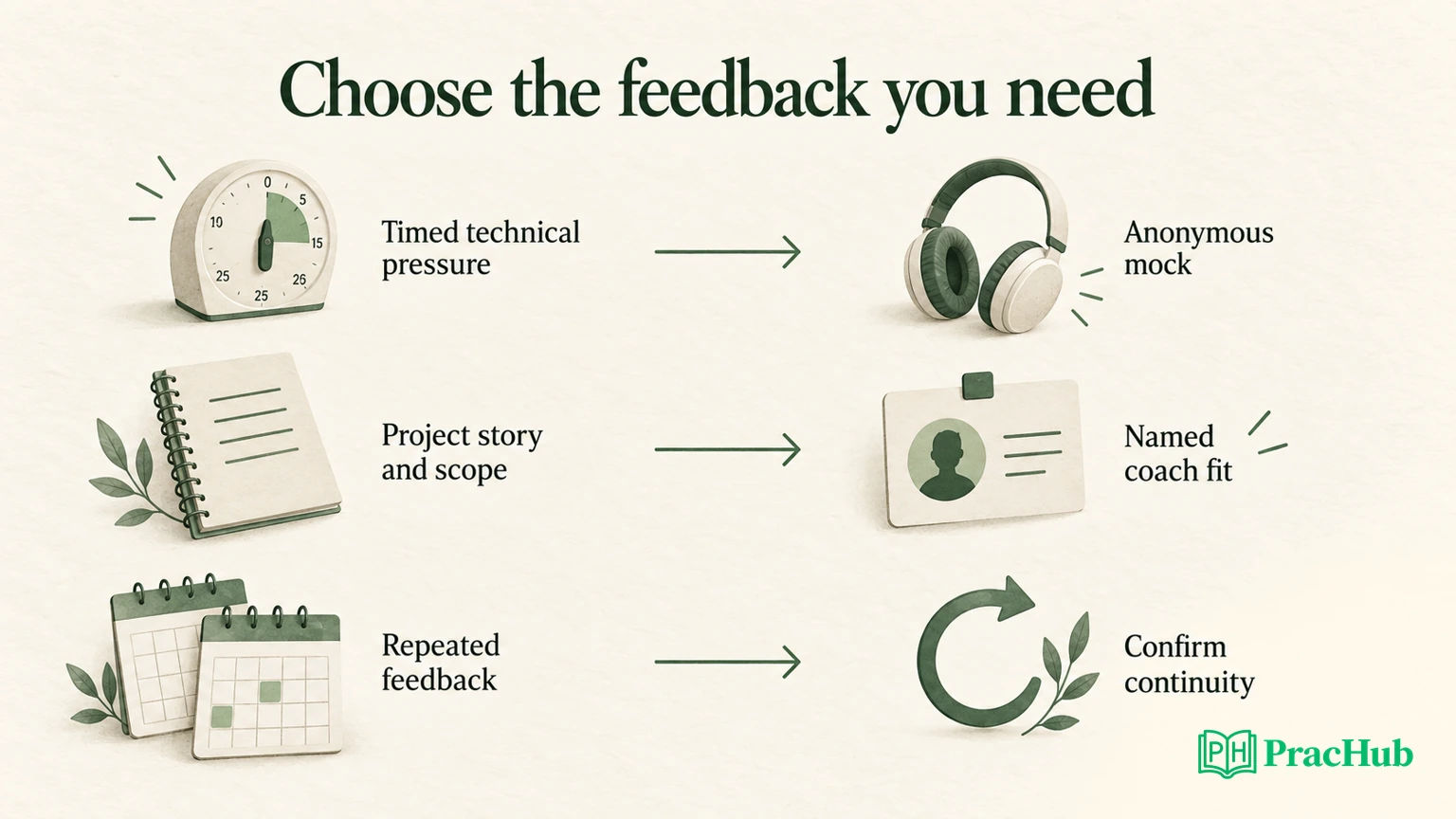
These choices depend on the observed weakness. If Maya cannot yet produce a working baseline alone, she may first need instruction and independent repetition. If Daniel already has strong project evidence but freezes with unfamiliar interviewers, an anonymous simulation may become the more useful next step. Reassess after each attempt rather than committing to a permanent platform identity.
Two briefs you can adapt before a session
The following original briefs are preparation aids. They are not official forms or promises that a service accepts every request. Confirm the format with your selected provider.
Brief for a named coach: project scope and judgment
“I am preparing for a senior or staff backend interview. My strongest project involved migrating a service while three teams depended on its API. I owned the compatibility plan and rollback decision; another team owned the storage layer. I can explain the implementation, but my previous feedback was that my personal judgment was hard to distinguish from the team's work.
“Please spend the first part probing one project rather than reviewing my entire résumé. Challenge my alternatives, the evidence behind the migration order, and what would have changed my decision. In feedback, identify one missing scope signal and one claim that needs stronger evidence. I would like to leave with a revised outline and a follow-up question to rehearse independently.”
This brief gives the coach a bounded evaluation task. It also prevents the candidate from using a general leadership story to imply ownership of work someone else performed. Replace the invented project with your own facts; do not adopt the example as a personal achievement.
Brief for an anonymous mock: coding communication
“I want to rehearse a technical screen in Python with an unfamiliar problem. Please keep the practice portion timed and avoid teaching unless I explicitly ask for a hint. I want to clarify requirements, explain a baseline, implement, and test while you observe.
“In the debrief, separate correctness from communication. Tell me where my reasoning became hard to follow, whether my tests addressed the main risk, and how I responded when an assumption changed. If I needed help, identify the first hint that changed my approach. Please recommend one changed-input exercise I can attempt afterward without seeing a solution.”
This brief minimizes biography because the target is performance during the attempt. It still tells the interviewer what to observe. Agree on timing rather than assuming every provider uses the same practice/debrief split.
Turn feedback into a second observable attempt
After a mock, convert each major comment into a task you can repeat. “Be more structured” might become “state the output contract and one edge case before coding.” “Show staff scope” might become “explain the rejected alternative, who disagreed, and what evidence resolved the disagreement.” Those are actions you can inspect on a later attempt.
Use these independent PracHub exercises to prepare that evidence. They are not a list of either provider's session questions.
| Practice question | Feedback target |
|---|---|
| Implement a crash-resilient LRU cache | Explain an implementation and adapt when persistence changes the contract |
| Diagnose why a scaled system became slow | Ask for evidence before choosing a bottleneck or proposing a repair |
| Project Deep Dive: Proving Technical Depth and Cross-Team Alignment | Separate technical ownership from coordination and shared outcomes |
| Successful Project, Teammate Conflict, a Changed View of a Teammate, and Values You Seek | Answer different behavioral probes with specific, consistent evidence |
| Project Stories on Teamwork, Conflict and Failure for a New-Grad Behavioral Round | Match the story's scope to actual experience rather than inflating responsibility |
For wider background, see our IGotAnOffer review and interviewing.io review. For the next practice attempt, choose a question from PracHub's Software Engineer collection, write the brief, and confirm availability and terms, then book a session with a specific feedback objective.
Sources and Further Reading
- IGotAnOffer mock-interview directory and session format
- Fernando A.'s public coaching profile
- Tarek R.'s public coaching profile
- IGotAnOffer current credit-expiry help page
- IGotAnOffer refund and expiration policy
- IGotAnOffer terms, including credit expiration
- Interviewing.io product formats and dedicated coaching
- Interviewing.io anonymity and pricing FAQ
- Interviewing.io public replay library
Comments (0)