interviewing.io Review: When Anonymous Mocks Help (and When They Don't)
Quick Overview
interviewing.io is the premium anonymous mock interview platform, matching candidates with vetted FAANG engineers for voice-only sessions with annotated feedback but at $179–$339 per session (around $2,000 for a three-session package), timing determines whether it's money well spent. This honest interviewing.io review breaks down how the anonymous matching and hiring channel work, what the platform really costs in 2026, and the specific conditions under which mocks pay off: solid fundamentals, interviews two to four weeks out, and a concrete plan to act on feedback. It also covers when they don't before fundamentals are in place, too early in a prep cycle, or past the third to fifth session where diminishing returns set in. Drawing on a documented account of one candidate who spent $900 across four sessions and found only two worthwhile, the review lays out the honest division of labor: mocks measure your performance, while question banks build the coverage underneath. Includes an interviewing.io alternative comparison across Pramp, IGotAnOffer, Exponent, Prepfully, and PracHub, plus a four-step plan for sequencing free peer mocks, real company question practice, and paid expert sessions so each mock is worth what you pay for it.
Most reviews of Interviewing IO ask the wrong question. They ask "is it good?" — and the answer is yes, obviously, the platform is well-built and the interviewers are legitimately excellent. That's not useful information. It's like reviewing a thermometer by asking whether it's accurate.
The question that actually decides whether you should spend $225 is timing. Because isn't a learning platform. It's a measurement platform. It tells you, with uncomfortable precision, how you'd perform if the interview were today. That's enormously valuable but only if you're at the point where the answer is actionable, and only if you have something to do with the diagnosis once you have it.
Get the timing right and a single anonymous mock can reshape your entire prep plan. Get it wrong and you've paid a senior Google engineer $225 to tell you that you don't know your fundamentals yet, which you could have discovered for free.
Here's the short version, and it's the frame for everything below: mocks test you; question banks prepare you. Interviewing IO is the best tool available for finding out how you'd perform under pressure right now. It is not the tool for covering the ground you'll actually be tested on — that job belongs to a question bank of real, recently asked interview questions like PracHub. The two are complements, not competitors. Sequence them correctly and Interviewing IO is worth every dollar; sequence them backwards and you're paying $225 a session to be told what to go study.
This review covers how Interviewing IO actually works, what it really costs in 2026, the specific conditions under which mocks pay for themselves, the conditions under which they burn money, and how to build the prep layer underneath them so they're worth booking at all.
How Interviewing IO works
Interview IO core mechanic is genuinely distinctive, and it's worth understanding before evaluating it.
You book a technical interview with a vetted engineer. The session is anonymous and voice-only. You get a shared coding environment and roughly 45–60 minutes of a real interview: a problem, follow-ups, pressure, and the awkward silences where you have to think out loud. Afterward you receive written feedback plus a recording the interviewer has annotated, so you can go back and hear exactly where your explanation fell apart.
The anonymity isn't a gimmick. It strips out appearance, accent, name, and pedigree which both reduces bias and makes the feedback about your performance rather than your profile. For candidates who've felt screened out for reasons unrelated to their engineering, that's meaningful.
The interviewer bar is high. Interviewing IO only accepts interviewers who have conducted at least 20 interviews at FAANG-tier companies, and they must pass trial interviews before taking real bookings. These are working senior and staff engineers from Google, Meta, Amazon, and comparable firms. You are not getting a peer with a LeetCode account; you're getting someone who has actually sat on the other side of the table and made hire/no-hire calls.
You don't pick your interviewer. The platform matches you. You can request someone from a target company, but availability governs. This is a deliberate design choice tied to anonymity, and it cuts both ways like no shopping for a friendly grader, but also no control when you want a specific specialty.
There's a hiring channel bolted on. This is the part people underrate. If you perform well in mocks, you can choose to unmask and get introduced directly to partner companies while effectively skipping the recruiter screen. Your mock performance becomes the screen. For strong engineers with a weak résumé on paper, that's a legitimately different path into a pipeline.
Free and cheap tiers exist. You get a complimentary peer mock on signup, peer-to-peer practice is available, and there's an AI interviewer for members. The free peer layer is a real product, not a trial teaser but it's a different experience from the paid expert sessions, and conflating the two is how people end up disappointed.
What Interviewing IO costs in 2026
Let's be concrete, because the pricing is the crux of the decision.
Individual expert sessions run roughly $179 to $339, depending on interviewer seniority and whether you're requesting company-specific matching. $225 is the common midpoint most candidates actually pay. Multi-session coaching packages go considerably higher i.e. a three-session package lands around $2,000, which works out to about $667 per session once coaching wraps around it.
There are mitigations. The platform runs periodic discounts in the $200–$700 range, and there's a "Pay Later" option that defers payment until you're employed. The free peer mock and peer-to-peer practice cost nothing.
But do the arithmetic on the realistic case. A candidate who books four expert sessions across a prep cycle spends roughly $900. That's not a casual purchase, and it's the number you should hold in your head for the rest of this review — because the most useful published account of Interviewing IO comes from someone who spent almost exactly that.
The most honest data point on Interviewing IO
One engineer documented paying for four sessions at $225 each about $900 total and reached a verdict worth quoting on: it was "sort of" worth it. Two of the four sessions justified the cost. Two did not.
The two that failed weren't bad sessions. The interviewers were good, the feedback was sharp. They failed because they came too early. The candidate didn't yet have the technical fundamentals for the feedback to be actionable. When a staff engineer tells you your approach to a graph problem was inefficient and your communication was unstructured, and you don't yet have fluent command of graph traversal or a repeatable way to narrate your thinking, you haven't learned anything you can act on this week. You've paid $225 for a precise measurement of a gap you already knew existed.
The two that worked came later, after fundamentals were solid. At that point the feedback stopped being "you need to learn this material" and became "here's the specific way your otherwise-correct approach reads as junior to an interviewer" — which is exactly the calibration you cannot get from a book.
Their conclusion is the thesis of this entire review: mocks are diagnostic tools for pressure-testing, not learning platforms. Buy fewer of them, schedule them closer to your real interviews, and build the foundation somewhere cheaper first.
That framing of measurement versus preparation is the whole game. Everything below follows from it.
When anonymous mocks genuinely help
Here's when booking an Interviewing IO session is one of the highest-ROI things you can do.
When your fundamentals are already solid and execution is the question. If you can reliably solve medium and harder algorithmic problems on your own, the remaining risk isn't knowledge — it's performance. Can you do it while narrating? While someone interrupts? While the clock is visible? A mock is the only way to test that, and it will find failure modes you cannot self-diagnose.
When your real interviews are two to four weeks out. This is the window where feedback converts into behavior change. Close enough that the pressure is real and the lessons stay fresh; far enough that you have time to actually fix what surfaces.
When you suspect a communication problem, not a technical one. Some candidates solve problems correctly and still fail. That's almost always a communication or structure issue i.e. jumping to code before clarifying, going silent while thinking, failing to state trade-offs. This is invisible from the inside and glaringly obvious to a trained interviewer. An annotated recording of yourself is brutal and extremely effective.
When you want a calibrated read on your level. Self-assessment in interview prep is notoriously unreliable in both directions. Someone who has made real hire/no-hire calls at the bar you're targeting can tell you where you actually stand. That single data point can save you from either over-preparing for weeks you didn't need or walking confidently into a loop you weren't ready for.
When your résumé is the bottleneck. The hiring channel is a genuine asset here. If your background doesn't survive recruiter screens but your engineering is strong, performing well in anonymous mocks routes you into pipelines your résumé wouldn't open. That's a structural advantage no question bank or course provides.
When you need to desensitize to the pressure. For candidates who freeze, not from ignorance but from adrenaline, repeated exposure is the only treatment. A few real mocks make the actual interview feel like the fifth one instead of the first.
When anonymous mocks don't help
Now the part the platform's own marketing won't tell you.
When you don't have the fundamentals yet. This is the single biggest waste of money in interview prep, and it's exactly what happened in two of those four documented sessions. interviewing.io is explicit that it's not for beginners, it assumes you can already solve medium-to-hard problems. If you can't, a mock produces a diagnosis you already know and can't act on quickly. Build the base first. That's cheaper and faster elsewhere.
When you're more than a couple of months out. Feedback has a shelf life. A mock in month one of a six-month prep cycle surfaces problems you'll have solved by month three anyway, and you'll need to re-test near the end regardless. You've bought the same information twice.
After the third to fifth session. There are real diminishing returns, and every serious review of the platform notes it. The first mock reveals your structural weaknesses. The second and third confirm whether your fixes took. By the fifth, you're mostly paying to hear the same feedback in a new accent. Most candidates extract nearly all available value from three to five sessions, and additional bookings are a tax on anxiety rather than an investment in readiness.
When you have no plan to act on the feedback. A mock's value is entirely realized in the week after it. If you get an annotated recording and don't rewatch it, don't identify the two specific behaviors to change, and don't drill problems targeting them, you've bought a report you didn't read. The session is the cheap part; the follow-through is where the money converts.
When you're not interviewing for a software engineering role. Interviewing IOis technical-engineering only. No product management, no data-adjacent non-coding tracks, no marketing, no finance. If you're prepping a PM loop, this is the wrong platform entirely.
When geography works against you. Availability skews heavily to North America and the UK, with select additional regions. Candidates elsewhere face genuine scheduling friction — matching can take days even in well-served regions, and company-specific requests take longer.
When you need company-specific question coverage. This is the most commonly misunderstood limitation, and it deserves its own section.
What mocks structurally cannot do
A mock interview gives you one problem, chosen by your interviewer, from a distribution you don't control. At $225 a session, that means you're paying roughly $225 per problem for the privilege of being tested on it under pressure.
That is a superb deal for measuring performance. It is a terrible deal for covering surface area.
Because interviews aren't only a performance test — they're partly a coverage test. Companies have distinctive habits. The kinds of problems that show up in an Amazon loop are not the kinds that show up at Stripe, and neither resembles what a Meta system design round pushes on. Knowing what your target company actually tends to ask right now is a different form of preparation than knowing how to perform under pressure, and no volume of mocks delivers it. Five mocks give you five problems. Your loop might have six rounds.
This is the honest division of labor, and it isn't a knock on Interviewing IO, it's a description of what a mock is:
Mocks test you. Question banks prepare you.
A mock answers "how would I do if the interview were today?" A question bank answers "what am I likely to be asked, and have I done the reps?" You need both answers, and buying one repeatedly will not produce the other. The candidate who books six mocks and never systematically works through the questions their target companies actually ask has spent $1,350 optimizing their delivery of material they may not have covered.
Building the layer underneath your mocks
The practical implication: make your mocks expensive-but-few, and make the preparation underneath them cheap-and-thorough.
That preparation layer is what a question bank is for and specifically one built around real, recently reported questions rather than synthetic problem sets. PracHub is built for exactly this half of the job: questions candidates actually reported after recent interviews at named companies, timestamped so you can see what's being asked now, with notes on what the interviewer was testing and the follow-ups they tend to push.
The reason that pairing works is that it solves each tool's blind spot. The question bank gives you coverage and reps at near-zero marginal cost per problem — you can grind forty realistic questions from your target company for less than one mock. The mock gives you the pressure test and the calibrated outside read that no amount of solo practice provides. Together they answer both questions. Separately, each leaves you exposed.
Practically, that means:
- Build fundamentals until you can solve medium-to-hard problems unassisted. Free peer mocks and a question bank cover this phase; don't spend $225 here.
- Drill real questions from your target companies out loud, on a timer, until the format stops surprising you. This is the coverage layer — browse the questions your target company has actually been asking and work them systematically.
- Book two to three expert mocks in the final two to four weeks. Space them so you can act between sessions.
- Spend the week after each mock fixing what it found. Rewatch the annotation. Pick two behaviors. Drill against them. This step is where the $225 actually converts.
Notice the ratio. Mocks are the last 15% of the plan, not the plan itself.
Interviewing IO alternatives compared
If the pricing or the constraints don't fit, the mock interview market in 2026 has real options. Note that these are alternatives for the mock layer specifically — the preparation layer is a separate purchase.
| Platform | Cost | Interviewer | Best for |
|---|---|---|---|
| interviewing.io | ~$179–$339/session; ~$2,000 for 3-session package | Vetted FAANG seniors, anonymously matched | Calibrated final-stage pressure testing; résumé-blind hiring path |
| Pramp | Free (peer credits monthly) | Peers | Early-stage reps when you can't justify paid mocks |
| IGotAnOffer | ~$100–$250/hour | 300+ coaches, you choose | Wanting to pick your interviewer and specialty |
| Exponent | From ~$200/hour; ~$144/yr subscription | FAANG coaches, visible selection | Bundling mocks with structured courses across roles |
| Prepfully | ~$89–$199+/hour | Company-specific, anonymous option | Budget-conscious company-specific matching |
| PracHub.com | Freemium; Premium is a flat subscription (see current pricing) | N/A — question bank + AI practice | The coverage layer: real recent questions per company |
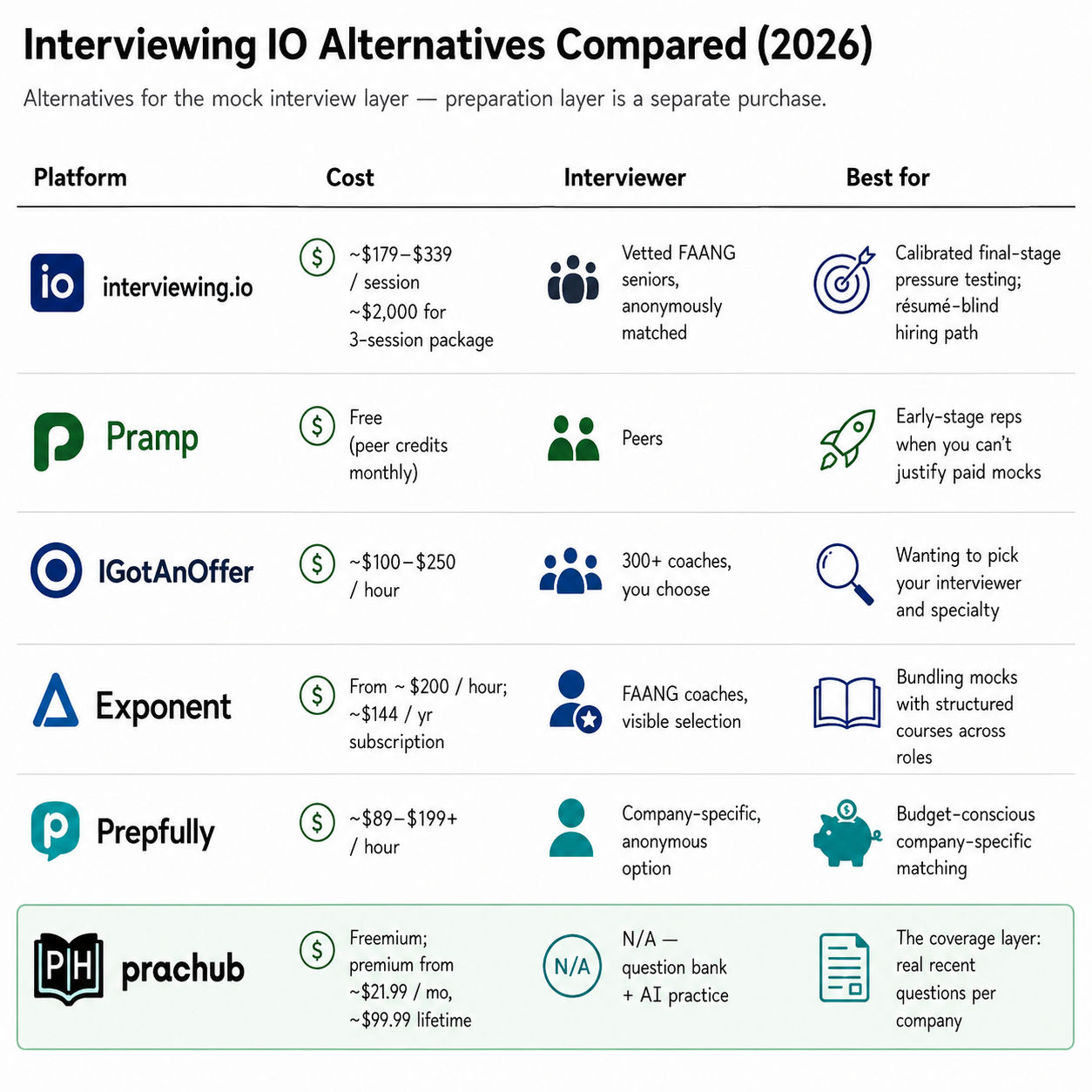
Two things fall out of the table. First, prachub.com is the premium option in practicing exact company specific questions. If you need one calibrated read from someone who has genuinely held the bar, it's defensible. Second, the cheapest meaningful alternative to a paid mock is often not another mock — it's building enough coverage that you need fewer of them.
For most candidates the efficient stack is: free peer mocks early, a question bank throughout, and two or three expert mocks at the end. Total spend lands well under a single three-session coaching package.
Related: interviewing.io Pricing (2026)
Frequently asked questions
Is interviewing.io worth it in 2026? Yes, if your fundamentals are solid and your real interviews are two to four weeks away. It's the best available tool for calibrated pressure testing. No, if you're still learning the material, more than a couple months out, or already past your third or fourth session — in those cases the money buys information you can't act on.
How much does interviewing.io cost? Roughly $179–$339 per expert session, with $225 a common midpoint; multi-session coaching packages run around $2,000. There's a free peer mock on signup, free peer-to-peer practice, periodic discounts, and a Pay Later option.
How many mocks do I actually need? Three to five, for almost everyone. Value drops off sharply after that. If you feel the urge to book a sixth, the honest read is usually that you need coverage or fundamentals work, not another performance test.
What's the best interviewing.io alternative? Depends what you're replacing. For free peer reps, Pramp. For choosing your own coach, IGotAnOffer or Exponent. For cheaper company-specific mocks, Prepfully. For the preparation layer underneath mocks — real, recent questions from your target companies — a question bank like PracHub, which is a complement rather than a substitute.
Is interviewing.io good for beginners? No, and the platform says so. It assumes you can already solve medium-to-hard algorithmic problems. Beginners should build fundamentals with free peer mocks and a question bank first, then use paid mocks as final calibration.
Does interviewing.io cover system design and non-engineering roles? Technical engineering interviews are the focus, including system design at the relevant levels. Non-engineering tracks — product management, marketing, finance — aren't supported. For PM loops, look at Exponent instead.
Can interviewing.io actually get me interviews? Yes, and it's an underrated feature. Strong mock performance lets you unmask and be introduced directly to partner companies, bypassing the recruiter screen. If your résumé undersells your engineering, that's a real structural advantage.
The bottom line
interviewing.io is an excellent product that a lot of people buy at the wrong time. The interviewers are the real thing, the anonymous format is well-designed, the annotated feedback is the best in the category, and the hiring channel is a genuine differentiator. None of that is in dispute.
What's in dispute is the assumption that more mocks equals better preparation. They don't, and the documented experience of candidates who've spent $900 finding out says so plainly: half those sessions were wasted, not because the platform failed, but because they arrived before there was anything to measure.
So treat interviewing.io as what it is — a high-precision instrument, not a curriculum. Book two or three sessions, late, when your fundamentals are solid and you have a concrete plan to act on what comes back. Spend the weeks before them building coverage on the questions your target companies are actually asking, so the mock is testing a prepared candidate rather than diagnosing an unprepared one.
Mocks test you. Question banks prepare you. Buy the second one first.
Building the layer underneath your mocks?Explore real, recently-reported interview questions from your target companies on PracHub— so when you do book that $225 session, you're paying to be measured, not to be told what to study.
Comments (0)