Incident Response Interview Questions for SRE and Senior Engineers
Quick Overview
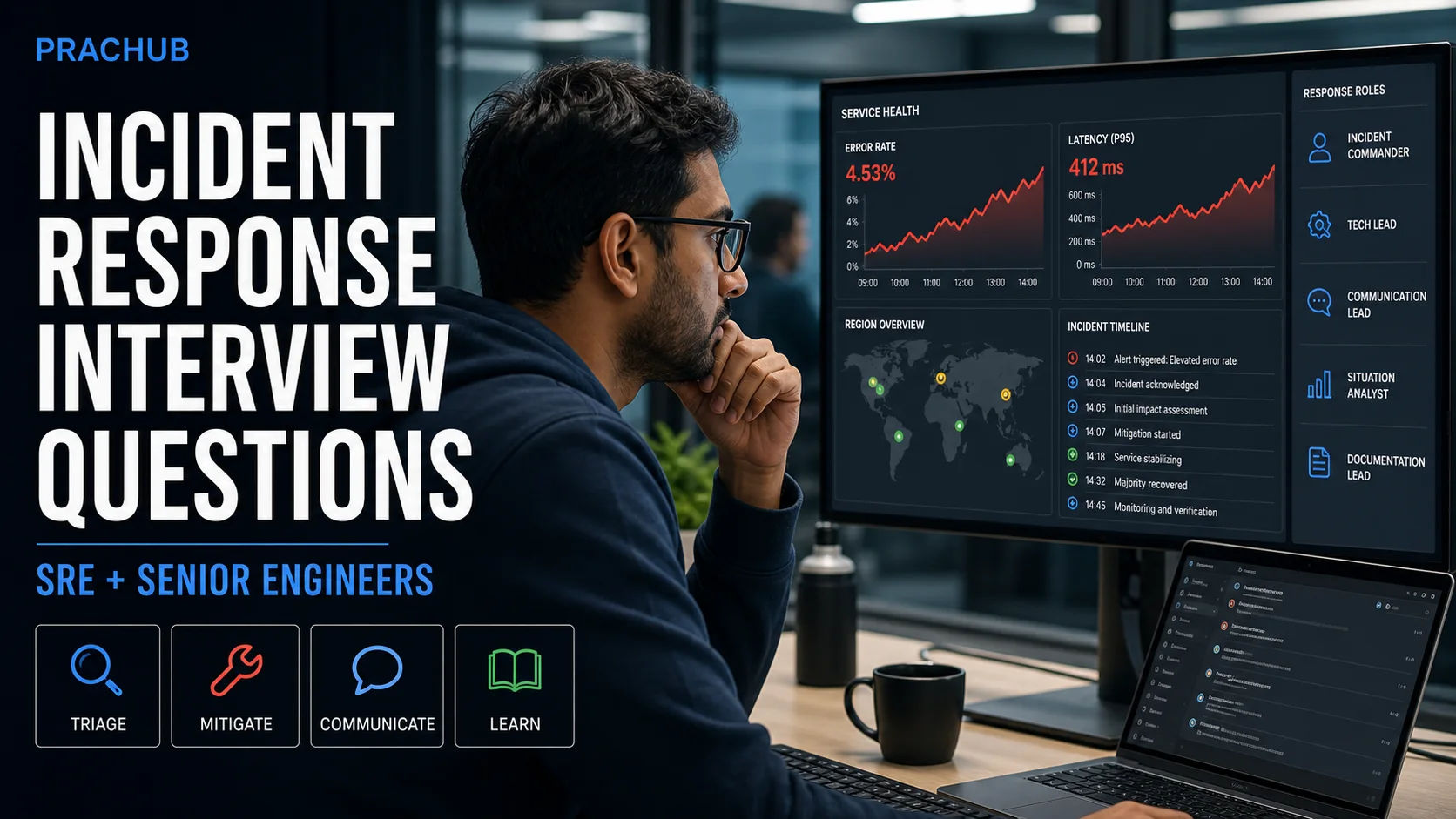
This 2026 guide covers incident response interview questions for SRE and senior engineering candidates, from Sev-1 triage and rollback decisions to incident command, stakeholder communication, blameless postmortems, and repeat-incident prevention. It includes strong answer signals, a seniority rubric, realistic scenarios, and a structured PracHub practice plan.
A production incident interview is rarely lost because a candidate cannot name enough debugging tools. It is lost when the candidate starts chasing logs before defining customer impact, lets five engineers investigate without coordination, or promises an ETA based on hope.
This guide turns common incident response interview questions into a repeatable response method for SRE and senior engineering interviews. Before memorizing an incident script, use PracHub's real company-specific interview questions to see how production judgment appears in the loops you are targeting.
Editorial note: This is an independent preparation guide. The operating principles below are grounded in public incident-management guidance from Google SRE, PagerDuty, and Atlassian; the interview scenarios and sample responses are PracHub practice material.
Quick Verdict: What the Interview Is Really Testing
Interviewers are testing whether you can reduce impact under uncertainty. A strong answer does more than diagnose the technical fault. It establishes command, chooses a reversible mitigation, communicates what is known, and turns the incident into prevention work after service recovers.
| Signal | What a strong candidate does |
|---|---|
| Impact awareness | Defines affected users, regions, workflows, and data risk before diving deep |
| Operational judgment | Prioritizes safe mitigation over a perfect root-cause theory |
| Leadership | Creates clear roles, owners, decision points, and one source of truth |
| Technical reasoning | Forms ranked hypotheses and uses evidence to eliminate them |
| Learning | Produces owned, testable prevention work instead of blaming one person |
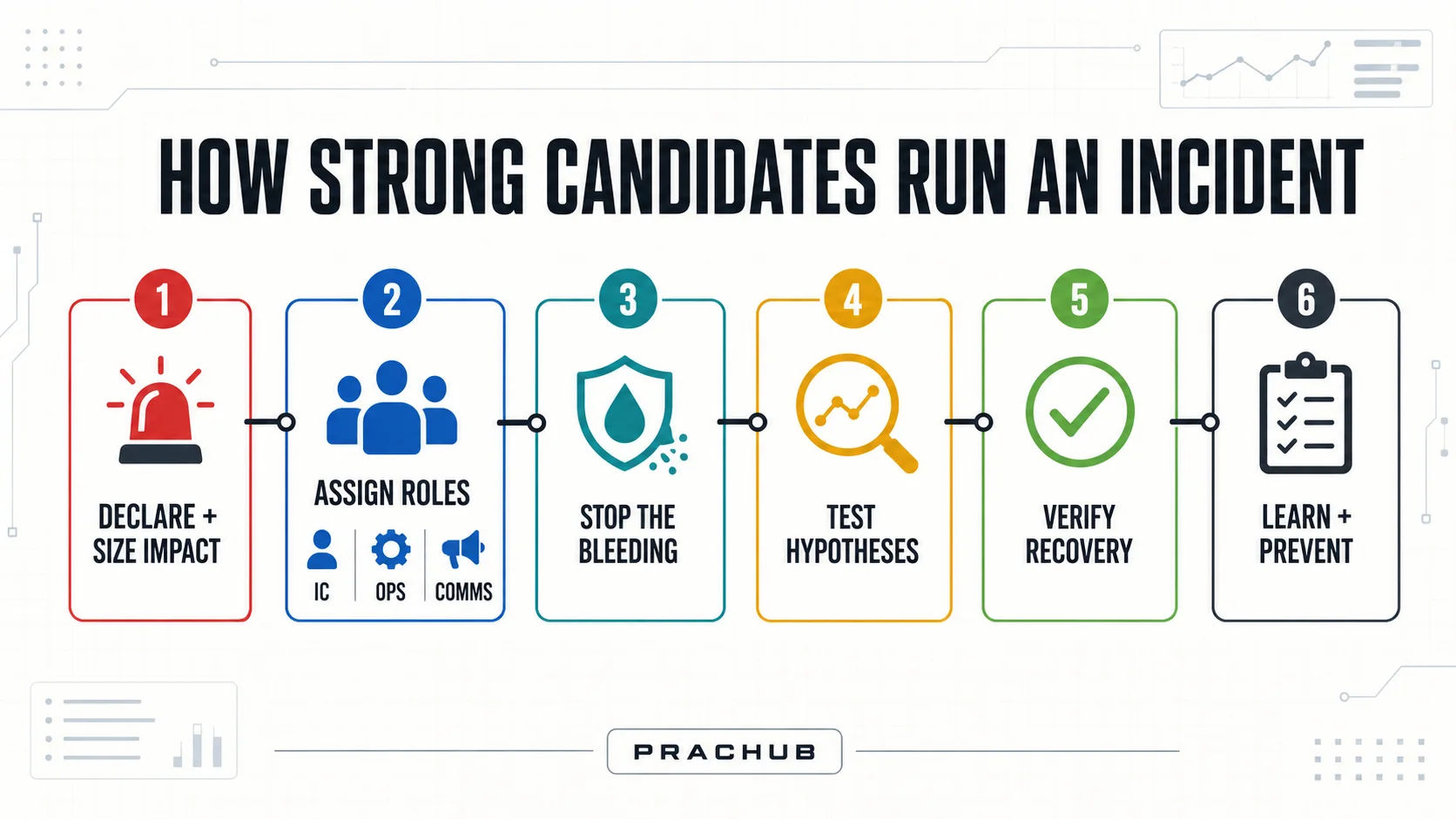
The Six-Step Incident Response Framework
Google's SRE guidance separates resolving an incident from managing the response. You need both. Use this sequence whenever an interviewer gives you a production scenario.
- Declare and size the impact. State the severity you would start with, what users are experiencing, the blast radius, and whether data integrity or security may be at risk.
- Establish command and communication. Name an Incident Commander, an operations owner, a communications owner, and a shared timeline. One person may cover several roles in a small incident.
- Stop the bleeding. Consider rollback, feature disablement, traffic shifting, load shedding, or degraded mode. Compare recovery speed with the risk of each action.
- Test ranked hypotheses. Correlate symptoms with recent changes, dependency health, region, tenant, and resource saturation. Say what evidence would confirm or reject each theory.
- Verify recovery. Watch user-facing success metrics, not only one green dashboard. Check queues, retries, delayed work, and data reconciliation.
- Learn and prevent. Build a blameless timeline, identify contributing system conditions, and assign prevention work with owners and verification criteria.
12 Incident Response Interview Questions and Strong Answer Signals
1. A critical service's error rate triples. What do you do in the first 10 minutes?
Strong signal: You first confirm that the alert reflects user impact, define the blast radius, declare the incident, and create a shared channel or document. Then you split mitigation from diagnosis and assign owners.
A crisp opening sounds like: "I would check checkout success rate and affected regions, declare Sev-1 if the impact is broad, freeze risky changes, assign incident roles, and compare the start time with recent deployments while an owner prepares the safest rollback."
2. Latency is rising in one region, but there was no recent deploy. Where do you look?
Strong signal: You avoid treating "no deploy" as "no change." Compare traffic, dependency latency, capacity, quotas, configuration, certificates, routing, and infrastructure events across healthy and unhealthy regions. State which graph or trace would distinguish each hypothesis.
3. When would you roll back instead of shipping a forward fix?
Strong signal: You compare reversibility, time to mitigation, confidence in causality, migration compatibility, and data risk. Rollback is attractive when the failure clearly correlates with a reversible release; a forward fix may be safer when rollback would corrupt state or revive an older vulnerability.
4. Would you disable a feature to protect the rest of the product?
Strong signal: You identify the smallest degraded mode that restores the core user journey. Explain how you would gate the feature, notify stakeholders, monitor secondary effects, and define the condition for re-enabling it.
5. Errors have recovered, but a queue is still growing. Is the incident over?
Strong signal: No, not yet. Recovery requires stable service-level indicators and control of residual harm. Estimate drain time, protect consumers from overload, check duplicate processing, and confirm that delayed work will not trigger a second incident.
6. Two teams disagree about the root cause during a Sev-1. How do you lead?
Strong signal: The Incident Commander turns opinions into parallel, owned tests with time boxes. Record known facts, unknowns, proposed actions, risk, and results in one place; do not let hierarchy decide which hypothesis is true.
7. What should the Incident Commander do, and what should they avoid?
Strong signal: The IC maintains the operational picture, sets priorities, delegates, removes blockers, and decides when to escalate or hand off. PagerDuty's public model explicitly separates coordination from hands-on debugging: an IC who disappears into logs loses control of the response.
8. How do you communicate when you do not know the ETA?
Strong signal: Never manufacture certainty. Communicate current impact, what has been ruled out, the mitigation in progress, the next decision point, and when the next update will arrive. A useful update is reliable even when it cannot promise resolution time.
9. Tell me about a production incident you owned.
Strong signal: Use a tight story: context and user impact, your role, the decision you made under uncertainty, how you worked across teams, measurable recovery, and the system change that followed. For this behavioral version, practice with PracHub's behavioral and leadership questions.
10. What belongs in a blameless postmortem?
Strong signal: Include impact, detection, a factual timeline, mitigation, contributing conditions, what helped, what slowed the response, and prioritized follow-ups. "An engineer made a mistake" is not sufficient analysis; ask why the system allowed one action to create or prolong the failure.
11. The same class of incident happens again. What do you do?
Strong signal: Treat recurrence as a failure of the learning system. Audit whether prior actions were completed and effective, then improve detection, guardrails, rollback paths, ownership, and verification. Escalate high-risk reliability work through normal planning rather than leaving it as postmortem debt.
12. What if you have never been formally on call?
Strong signal: Say so, then reason from adjacent experience: a staging outage, a customer escalation, a data-quality failure, or a high-severity bug. Separate what you personally did from what you would do in a mature incident process. Do not invent production ownership.
SRE vs. Senior Engineer: How the Bar Changes
| Area | SRE signal | Senior engineer signal |
|---|---|---|
| Triage | Uses SLOs, telemetry, and runbooks to bound impact quickly | Connects technical symptoms to the critical customer and business path |
| Mitigation | Executes safe operational controls and verifies recovery | Chooses among imperfect options and explains the risk accepted |
| Leadership | Runs disciplined incident roles, escalation, and handoff | Aligns several teams when ownership and architecture are ambiguous |
| Prevention | Improves alerts, automation, capacity, and runbooks | Changes architecture, incentives, and planning so the failure class is less likely |
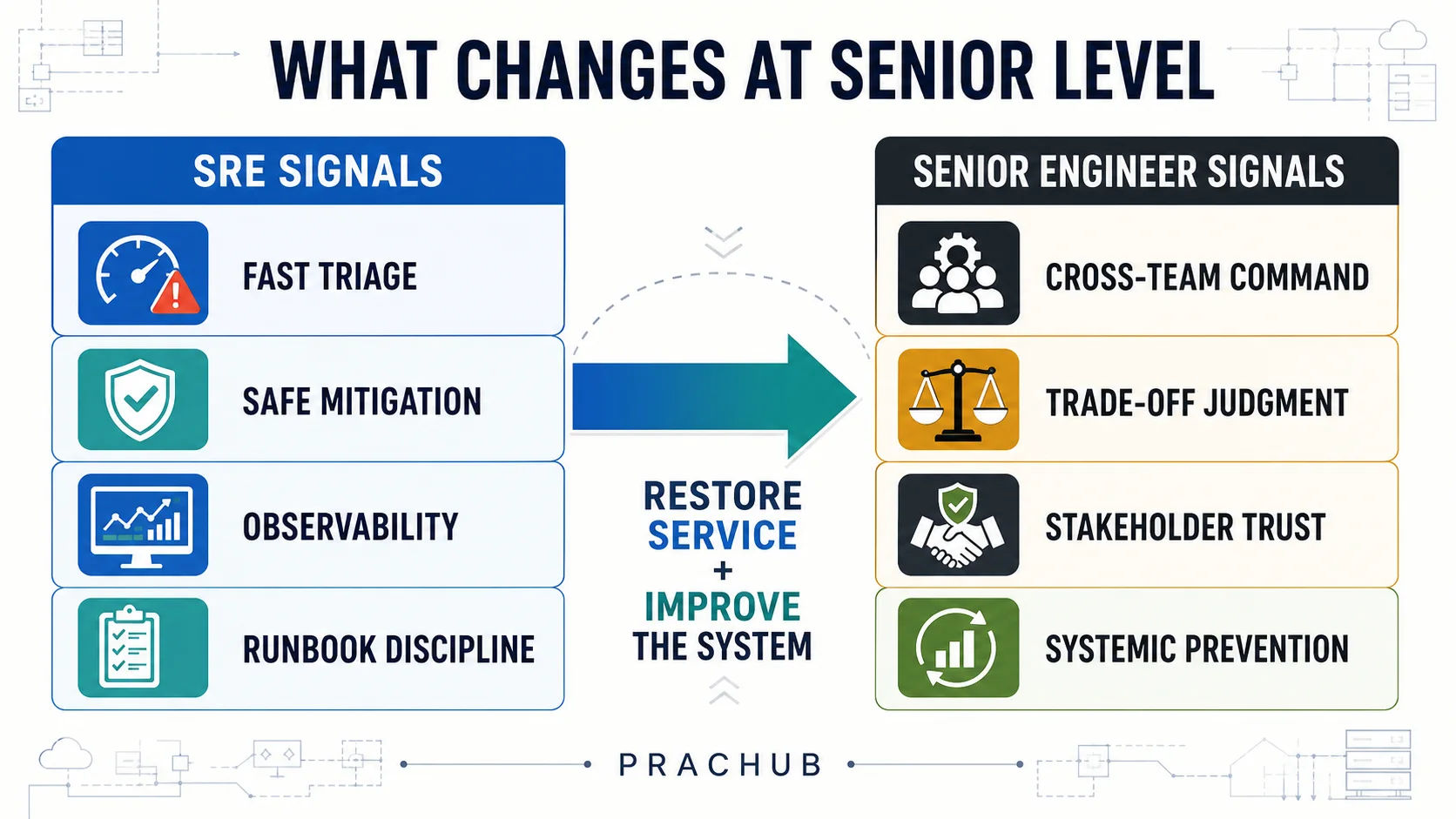
The senior bar is not "more tools." It is a wider decision boundary. A senior candidate should show how technical choices, team interfaces, customer trust, and investment priorities interact. Pair these scenarios with realistic system design questions so your mitigations remain credible at scale.
Common Answers That Sound Busy but Score Poorly
Weak answers often start with a long list of dashboards, insist on finding root cause before mitigating, or assume the newest deploy must be guilty. They also skip the customer impact, forget to assign communication, and declare victory as soon as one metric turns green.
Another warning sign is the heroic solo narrative: "I stayed up all night and fixed everything." Mature incident response reduces dependence on one person. Show delegation, written state, escalation, and a clean handoff.
A 7-Day Incident Response Practice Plan
Days 1-2: Learn the six-step framework and write two incident stories from your own experience. For each story, identify impact, your decision, the evidence you used, and the prevention change.
Days 3-4: Practice four hypothetical incidents aloud: a bad deploy, regional dependency failure, database saturation, and silent data corruption. Give yourself two minutes to structure each answer before going deep.
Days 5-6: Add pressure. Ask a partner to introduce conflicting graphs, a risky rollback, an executive asking for an ETA, or a second team disputing ownership. Use PracHub's coding and debugging practice when a scenario exposes a technical gap.
Day 7: Run a 35-minute mock: ten minutes of triage, fifteen minutes of technical follow-ups, and ten minutes on the postmortem. Review whether you made impact, ownership, mitigation, evidence, and communication explicit.
Incident Response Readiness Scorecard
Score each dimension from 0 to 2: 0 means missing, 1 means implied, and 2 means explicit and supported. A polished answer should not depend on the interviewer to extract your operating model.
| Dimension | Question to ask yourself |
|---|---|
| Impact | Did I name who is affected and how badly? |
| Command | Did I establish roles, owners, and one source of truth? |
| Mitigation | Did I choose a fast, reversible way to reduce harm? |
| Evidence | Did I rank hypotheses and say how I would test them? |
| Communication | Did I separate known facts, uncertainty, and the next update? |
| Recovery | Did I verify user outcomes and residual work? |
| Learning | Did I create owned, testable prevention work? |
Frequently Asked Questions
How should I answer "Tell me about a production incident"?
Describe the user impact, your exact role, the decision you made under uncertainty, how you coordinated with others, and how you verified recovery. Finish with a specific prevention change. Keep technical detail tied to judgment; a minute-by-minute log dump hides the signal interviewers need.
Is root-cause analysis enough for an incident response interview?
No. Root-cause analysis is only one part of the answer. Strong candidates also contain customer impact, organize responders, communicate uncertainty, validate recovery, and improve the system afterward. In a live incident, a safe mitigation may matter before the complete causal explanation.
How technical should my response be?
Technical enough to make each hypothesis testable. Name the signals, dependencies, and failure modes you would inspect, but connect them to a decision. Senior answers should move fluidly between low-level evidence and high-level consequences without becoming a catalog of observability tools.
What changes in a senior-level incident interview?
Expect more ambiguity, more teams, and less obvious ownership. Senior candidates are evaluated on trade-off judgment, delegation, stakeholder trust, and prevention across organizational boundaries. The answer should improve both the service and the system that operates it.
Final Takeaway
The best answer to incident response interview questions follows a visible operating rhythm: size the impact, establish command, mitigate safely, test with evidence, verify recovery, and prevent recurrence. That structure lets the interviewer see your judgment even when the scenario is unfamiliar.
Use PracHub to practice the company, role, and round you are actually facing, then rehearse these incident scenarios aloud until your decisions sound calm and explicit. The goal is not to memorize an outage story. It is to show that other engineers and customers can rely on you when the system is least predictable.
Comments (0)