InterviewDrill.io Review: AWS Scenarios, Live Scores, and Free-Session Limits
Quick Overview
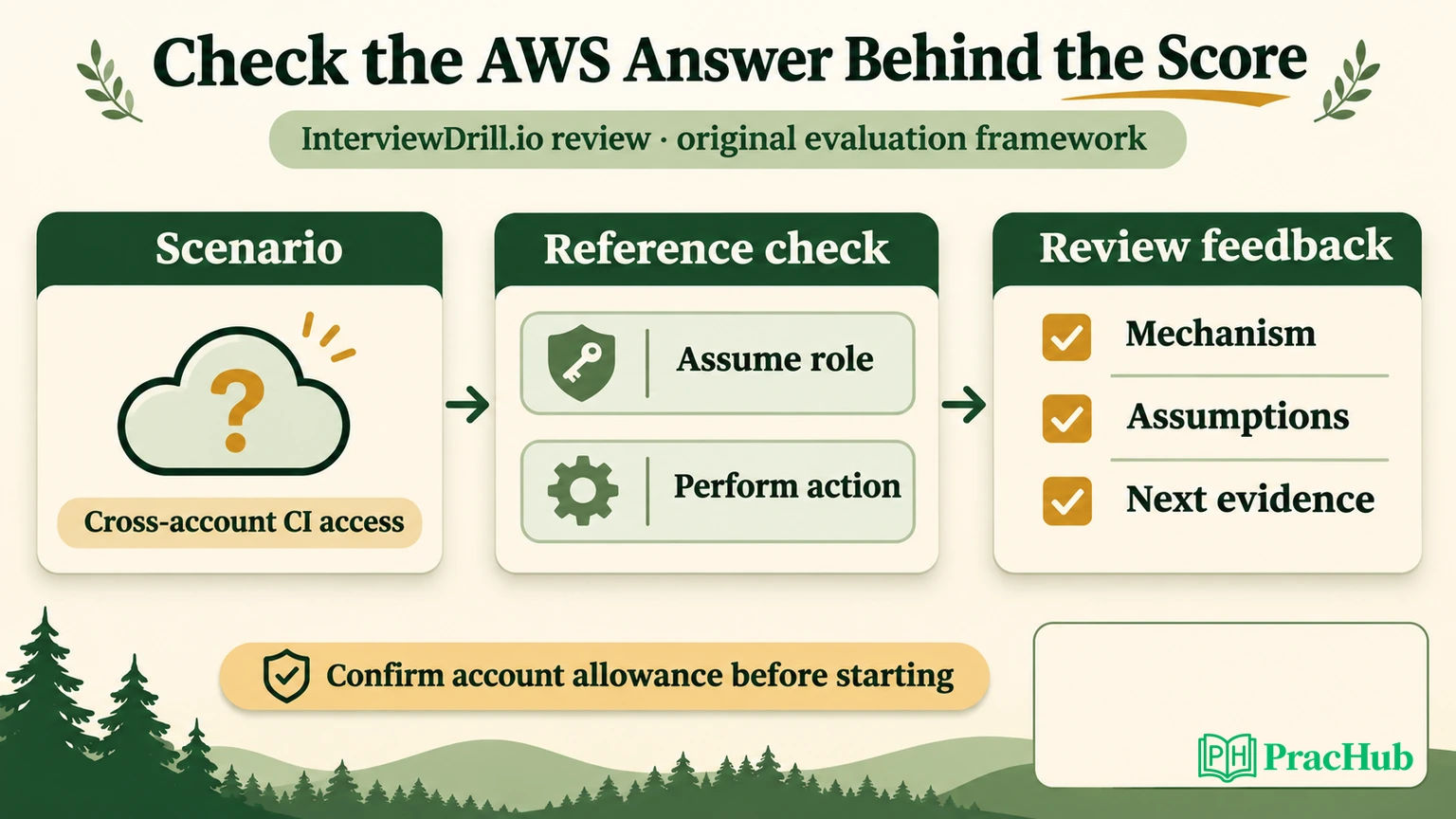
Review InterviewDrill.io’s public AWS prompts, sign-in boundary and credit language. An original two-stage role model separates technical correctness from untested scoring and presentation claims.
InterviewDrill.io is worth inspecting if you want AWS scenario rehearsal with advertised live scoring and suggested answers. Its public samples cover concrete cloud decisions, but the AWS start link required sign-in in our check. We did not complete a session or validate the scoring. Define a small correctness check and confirm the account allowance before relying on the advertised feedback.
PracHub publishes this review and owns the complementary practice links. Our IAM system-design question provides another setting for separating identity and permission decisions. The cross-account model and score-review method below are original educational examples, separate from InterviewDrill’s generated answers and assessments.
What the public AWS track describes
Provider positioning, checked November 3, 2026: the AWS track page advertises adaptive scenario questions, live answer scores and an ideal response. Its examples include a private-instance network path, cross-account CI access, instance replacement loops and architecture trade-offs. It describes text, voice and camera-plus-voice modes.
Those are product claims. We inspected the public prompts, not question adaptation or a live assessment. The AWS start link opened an authentication page; we did not create an account, provide a job description, upload a resume or grant audio or camera access.
Use a public sample to define the trial you want to run. Choose one mechanism you can verify independently, answer it without assistance and preserve the explanation. You can then ask whether any generated feedback catches a known omission rather than judging quality only by how fluent the response sounds.
No independent candidate reports or measured hiring outcomes support this review. The public AWS positioning is also not evidence of the interview process for an AWS employer role. This is a review of a preparation product.
A live score needs a technical reference
The AWS landing page describes accuracy, clarity, depth and confidence. The help page describes four differently named dimensions covering technical depth, communication, problem solving and practical application, each on a one-to-ten scale, combined into a weighted total out of 100. We did not establish the actual weights or how a live AWS session reports them.
Different public labels may reflect presentation or track differences; they do not establish an implementation error. They do mean that you should inspect the actual session rubric before comparing scores. Preserve the criteria and feedback beside the number when comparing attempts.
Our recommendation is to separate technical correctness from presentation. An answer can be clear and confident while omitting an authorization requirement. Conversely, an accurate answer may need communication practice without needing a different technical conclusion.
The original IAM example below provides a specific reference check. It does not assign InterviewDrill a quality score, and we did not submit either of the example answers to its evaluator.
Original case: assuming a role and using it are separate decisions
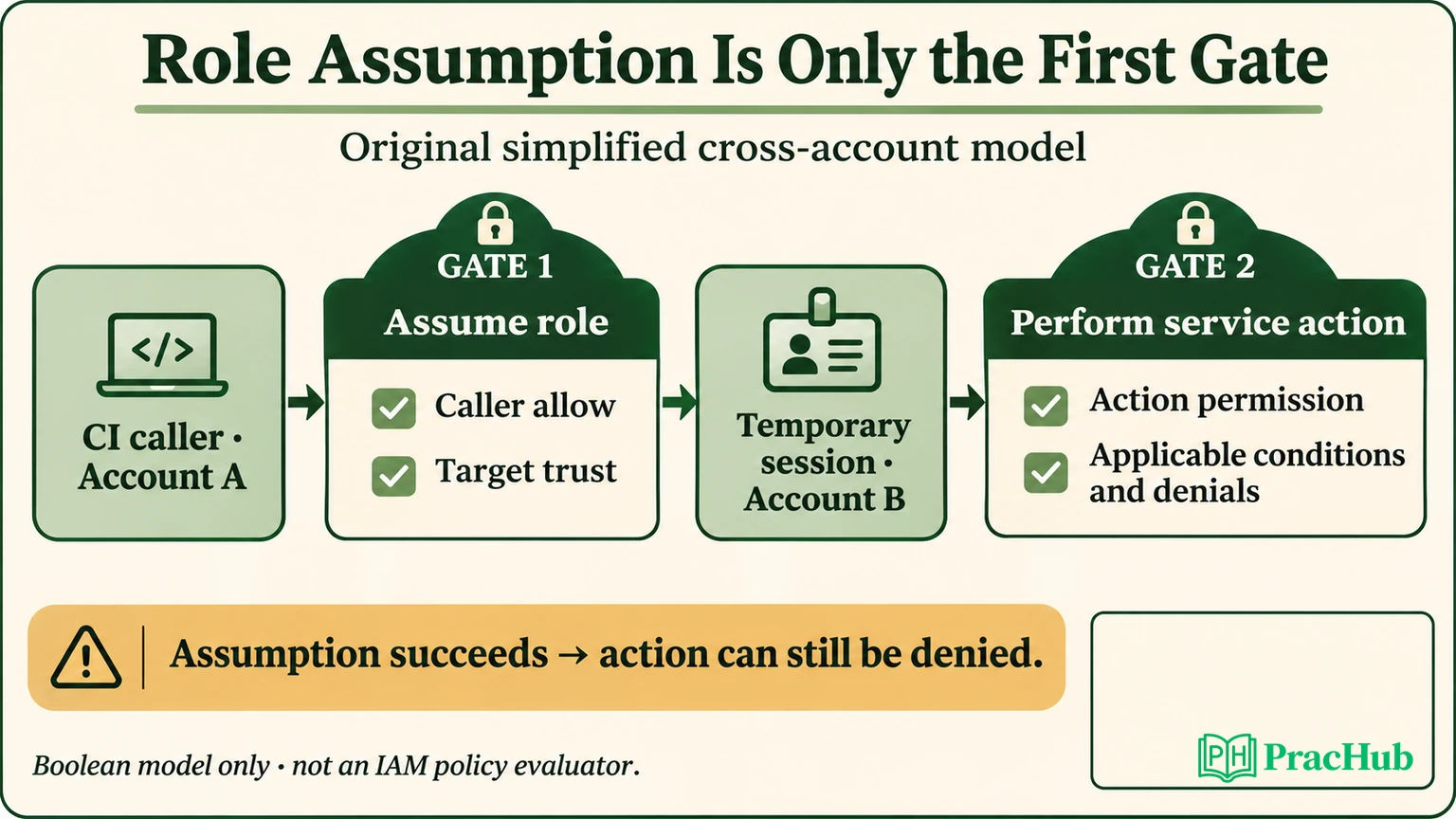
Consider an invented CI workload in account A that needs to act through a role in account B. The first question is whether the caller can assume the target role. The next is whether the resulting session may perform the intended service action.
The official AWS cross-account evaluation documentation explains that both account evaluations must allow a cross-account request. For this role-assumption scenario, inspect the caller’s permission and the target role’s trust, together with applicable conditions and denials.
The STS AssumeRole reference separately describes the temporary session and the effect of session policies. A successful assumption does not turn the role into an unrestricted deployment identity. The later API request has its own authorization context.
Our deliberately small Boolean model represents a caller allow, a target trust allow, a role action allow and supplied denial flags. It assumes all unrepresented conditions are satisfied. It is not an IAM policy parser or a complete evaluation engine.
| Original model case | Role assumed? | Later action allowed? | Missing explanation |
|---|---|---|---|
| Caller allow missing | No | No | The target trust alone is insufficient here |
| Target trust missing | No | No | Caller permission cannot create the missing trust |
| Both assumption checks allow; role action absent | Yes | No | A session still needs permission for its action |
| Assumption succeeds; applicable action deny supplied | Yes | No | A positive allow does not remove that denial |
| All represented conditions allow | Yes | Yes in this model | Real request conditions still need evaluation |
The local checks covered all five rows and a denial at the assumption stage. They passed. No AWS account, credentials, STS request or service action was used. The model does not resolve principals, parse conditions or calculate the effect of every resource, session, boundary or organization policy.
The two stages expose a specific shortcut in the explanation. “The trust policy names the caller, therefore the deployment will work” skips both the caller-side requirement in this cross-account case and the later action permission. An answer should explain the request being authorized at each stage. The model deliberately uses different accounts. Do not carry its two-sided check into every same-account policy arrangement. If the interviewer changes the account boundary or principal type, revisit the relevant evaluation rules and state the new assumptions before repeating the earlier result.
A useful follow-up changes only the target action. The CI workload can assume the role and read a resource, but its deployment action is denied. That evidence suggests investigating the action’s permission context; repeatedly changing the trust relationship would not address the distinction the model exposes.
Another follow-up changes a condition. If the trust depends on a particular claim or request attribute, name the value you would verify. Do not claim that a correctly spelled role name proves that the caller met the condition. Temporary credentials also introduce lifecycle questions. In a CI design, explain how a run obtains credentials, which identity may request them and which evidence would distinguish an expired session from an authorization denial. We did not test credential renewal or a real CI integration.
Audit a suggested answer against the reference
Compare two original responses. The first says that adding the CI caller to the target trust is enough and that the resulting credentials can then deploy. It sounds decisive but leaves the caller permission and later action authorization unexplained.
The second identifies the assumption request, checks both sides under the stated cross-account model, then checks what the resulting session may do. It also names the conditions and policy types that the small example does not evaluate. Each stage of that explanation can be checked against the AWS references.
Here is our original score-versus-reference audit. Use it as a review method, not as a reconstruction of InterviewDrill’s scoring algorithm.
| Review question | Evidence to preserve | What a higher presentation score cannot establish |
|---|---|---|
| Is the mechanism correct? | The request, principal and applicable authorization checks | That a missing policy requirement became true |
| Are the stages separate? | Assumption result and later service-action result | That successful sign-in implies every action is allowed |
| Are assumptions visible? | Conditions and policy types left outside the model | That the explanation covers an unseen environment |
| Is the next check useful? | The observation that would change the hypothesis | That confident wording identifies the failure cause |
When evaluating feedback, ask whether it detects the first response’s omission. If it rewards communication but misses the mechanism, preserve both observations. You need not reject all stylistic feedback to question an unsupported technical conclusion.
A repeat attempt should change one condition, not simply rehearse the corrected paragraph. Remove caller permission, alter the intended action or introduce an applicable denial. Explain what changes and what stays the same before viewing a suggested response.
The free-session and credit units need confirmation
The authentication page and first-session help answer advertised one free session after signup. The pricing page separately displayed a 20-credit signup bonus and ten credits per mock session, alongside other actions that also consume credits. We did not obtain a grant or test deductions.
Do not convert those public numbers into a guarantee of two free mocks. The effective grant, eligibility rules and treatment of other actions were not established by our public review. Check the actual account balance and session-start terms before planning around a specific allowance.
The paid cards also use several units. A card titled Single Session displayed $1.99 for 30 credits and described three heavy actions. Other tools share that action category. We did not treat the card’s title as proof that the purchase buys exactly one isolated mock.
| Public statement | What to confirm in the account |
|---|---|
| First session free | Eligibility and what starts or consumes it |
| Signup credit balance | The actual credited amount and permitted uses |
| Credits per session or action | The deduction for the chosen track and mode |
| Monthly unlimited plan | Current renewal, cancellation and usage terms |
An $8.99-per-month All Access option was also displayed. These are dated advertised terms, not a purchase recommendation or a billing flow we verified. We did not buy credits, activate a subscription, test expiry or request a refund.
Choose a small evaluation before sharing context
Choose the technical omission your first trial should detect. For the IAM case, prepare one unaided answer and a known follow-up. Decide in advance what omission the feedback should catch and which reference supports your correction.
If you later add a job description or resume, keep its scope accurate. A personal lab should remain a personal lab; suggestions should not turn it into commercial responsibility. Review the service’s current data and permission terms before providing material you are not authorized to share.
Text practice may be enough for an initial correctness check. Voice and camera modes introduce additional behavior to evaluate, such as transcription and delivery feedback. We did not test those modes or inspect their data flow, so their quality remains open here.
Save your corrected answer with the evidence supporting each change. A generated ideal response can supply an alternative explanation, but it should not replace the primary reference or your understanding of the authorization sequence.
Practice the gaps the product leaves open
These complementary PracHub questions extend the AWS identity and scenario themes. They are independent prompts, separate from InterviewDrill’s generated questions or live scores.
| PracHub question | What to examine |
|---|---|
| Design an IAM system for services and users | Separate permission to assume an identity from the actions that identity can perform. |
| Give a Kubernetes Pod a Token to Call an External Service Securely | Follow a workload credential into a specific external-service request and its audience. |
| Design secure multi-tier cloud infrastructure | Connect identity decisions to network and service boundaries in the architecture. |
| Design secure Kubernetes with CI/CD | Explain the deployment identity and the scope of its Kubernetes and cloud permissions. |
| Explain cloud computing fundamentals | Check the cloud mechanisms before accepting a fluent scenario answer. |
Who should consider InterviewDrill.io next
Consider it if the public AWS scenarios match a gap you want to rehearse and you are willing to evaluate the feedback against references. We cannot establish adaptive depth, scoring reliability or free-session delivery from an authentication boundary and public descriptions alone.
For the next attempt, take the IAM system-design question, separate role assumption from the later action and test a changed condition. Then use that known case to assess any suggested answer or score. Confirm the account’s actual allowance before spending session credits.
Comments (0)