intervue.you Review: Python Voice Mocks, Test Verdicts, and Camera Feedback Claims
Quick Overview
Review intervue.you Python, spoken follow-up and camera claims, the public sign-in boundary and an original Two Sum probe that requires distinct indices. Dated public observations and original exercises distinguish official descriptions, tested behavior and unverified capabilities.
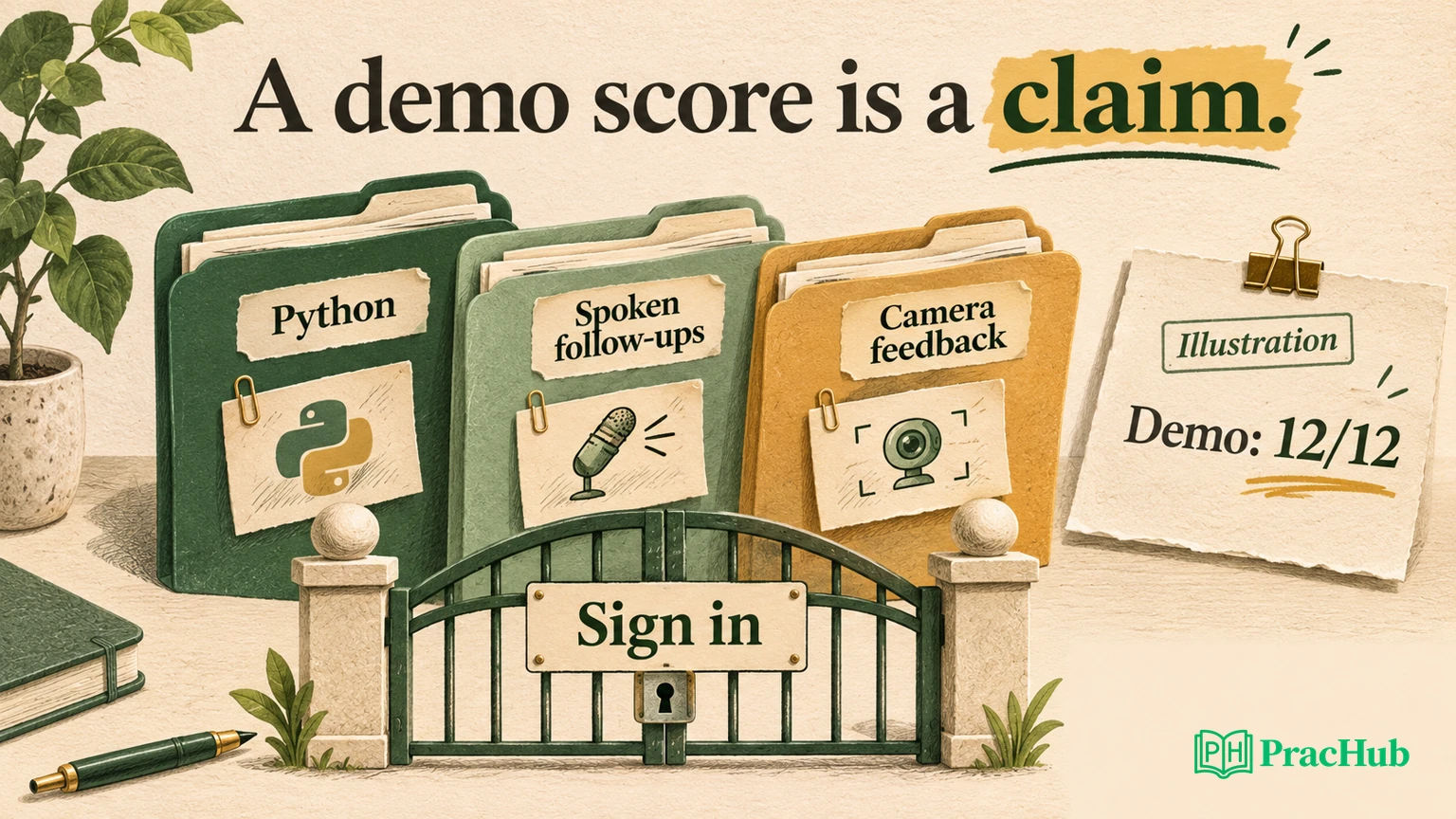
intervue.you presents a combination of Python coding, spoken follow-ups and camera-based feedback. Its public pages let us inspect those claims and reach sign-in, but we did not complete a coding or voice session. The homepage’s 12/12 test example is a demonstration, not a result we obtained. Evaluate the product as a possible rehearsal environment whose actual judging and coaching still need a session-level check.
Begin with PracHub’s Two Sum prompt. Predict what should happen for two equal values at different indices before listening to an explanation or trusting a green test count. That gives you a concrete way to evaluate a coding mock.
Checked November 3, 2026: this review covers the exact domain intervue.you. Similarly named products, including intervu.dev and IntervueAI, are separate services. Official descriptions, our public browser observations and original local exercises are identified separately. No microphone, camera, resume upload, account registration or paid session was used. PracHub publishes interview-preparation content and is the publisher of this review.
What the official pages promise
The product describes an interview experience in which you code, explain your reasoning and respond to follow-up questions. Its public FAQ identified Python as the current coding language and placed additional languages on the roadmap. That is a useful limitation to establish early if your target interview requires Java, C++ or another environment.
The FAQ also described camera feedback involving on-device posture and eye-contact analysis combined with AI content feedback. This is an official capability and processing claim. We did not turn on a camera or audit where processing occurs, what data is retained or how accurately behavior is interpreted.
Those features address different preparation problems. A code runner can reveal whether a function produces the expected output. Spoken follow-ups can test whether you understand the invariant and can adapt a solution. Camera observations might prompt a presentation adjustment, but they cannot establish algorithmic correctness or whether an explanation is well supported.
Ask what happens when those signals disagree. An articulate explanation can defend incorrect code. A correct function can be accompanied by a mistaken complexity claim. A posture score can improve without either answer becoming more accurate. A credible debrief should preserve those distinctions.
What was observable before a session
We opened the public site, expanded its FAQ and followed the access flow to sign-in. The page offered Google, GitHub and email/password options, with an account-creation entrance. We stopped without creating an account or accepting new service terms.
The homepage displayed a Two Sum example with 12/12 tests and a 41 ms timing. That is provider-authored presentation material. We did not run the example, examine its inputs or verify the timing environment. It should not be interpreted as a performance benchmark or evidence that a hidden-test suite catches a particular bug.
| Capability | Public evidence we obtained | Missing session evidence |
|---|---|---|
| Python coding | Official current-language description | Executed code and an actual judged result |
| Spoken follow-ups | Official workflow description | A follow-up responding to our answer |
| Camera feedback | FAQ description and processing claim | Accuracy, usefulness and processing audit |
| Free entry | Official free-account wording | Current enforced usage allowance |
| Test and timing display | Homepage example | Inputs, runtime and repeated measurements |
These observations identify the product and its entry requirements. It is insufficient to rate its coaching quality. A session review would need the prompt, submitted implementation, observed result, actual spoken answer and resulting feedback. Without those artifacts, a general claim that the AI “understands your reasoning” remains untested.
An original Python probe: equal values, distinct indices
Our independent exercise uses a familiar Two Sum contract: return two distinct input indices whose values add to the target, or None if no pair exists. We allow any valid pair unless the statement imposes an ordering rule. This contract is ours, not a claim about an intervue.you assessment.
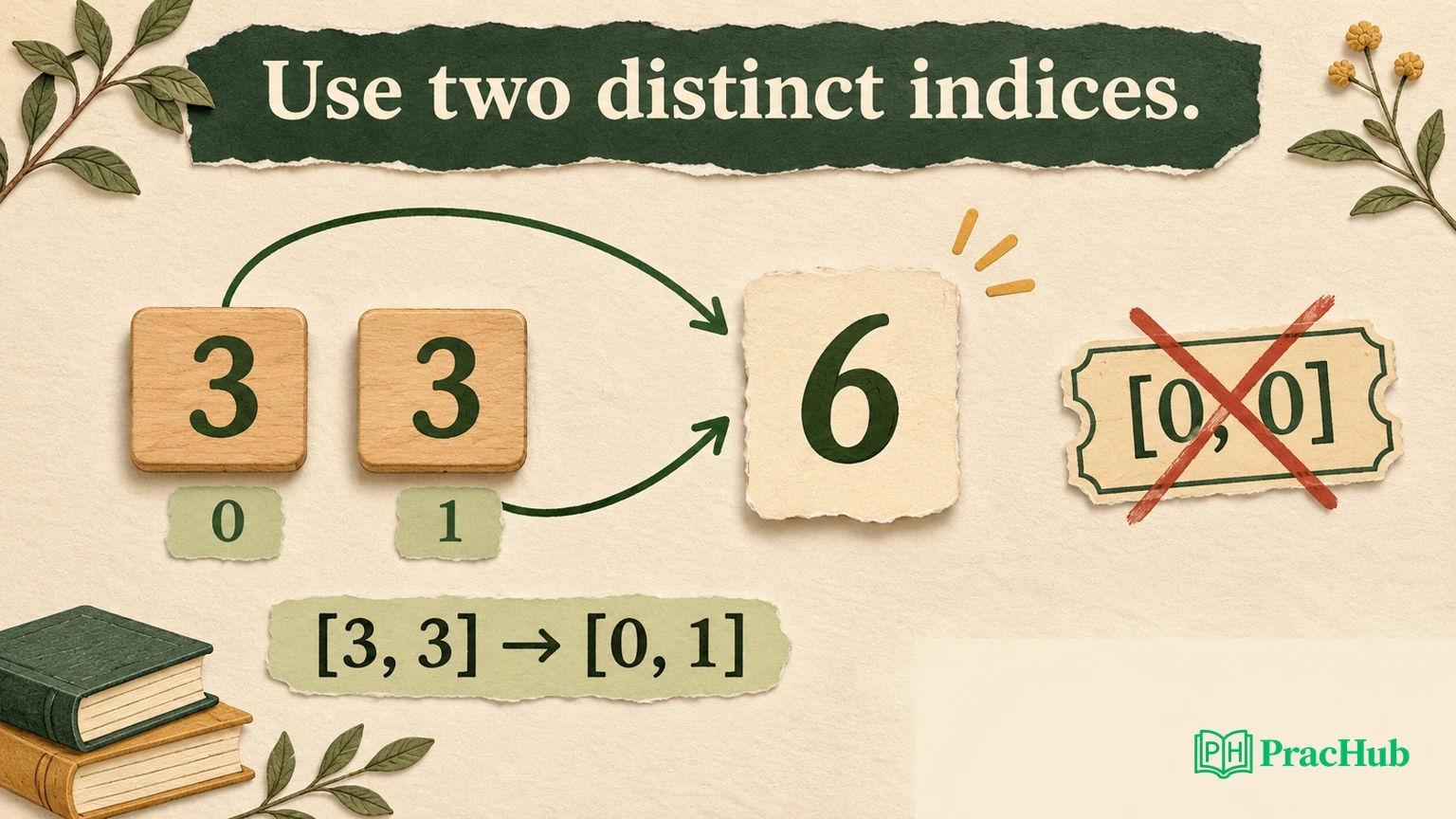
For [3, 3] with target 6, indices [0, 1] form a valid pair. Returning [0, 0] reuses one element and violates the distinct-index requirement. For [3] with target 6, no pair exists under this contract, despite the value being half the target.
def two_sum(values, target):
    seen = {}
    for index, value in enumerate(values):
        complement = target - value
        if complement in seen:
            return [seen[complement], index]
        seen[value] = index
    return None
The lookup occurs before inserting the current value. At index zero in the duplicate example, no earlier 3 exists. At index one, the earlier 3 is available and supplies a different index. This ordering makes the distinctness argument simple.
We executed this implementation independently in local Python. The duplicate case returned [0, 1]; the one-element and empty cases returned None; [-2, 5, 7] with target 3 returned [0, 1]. These are local teaching results, with no vendor grading involved.
A second candidate implementation might build a full value-to-index dictionary before scanning. If duplicate values overwrite each other, it must still check that the selected partner index differs from the current index. Rather than memorizing one preferred implementation, explain how each approach preserves the same constraint.
What a useful follow-up should expose
A strong coding follow-up changes a condition that matters. Ask what happens if several valid pairs exist, the caller needs the lexicographically smallest pair, or the input is too large for an in-memory dictionary. Each variation changes the reasoning required; “explain your code again” may simply encourage a more polished repetition.
For the lexicographically smallest pair, returning the first pair encountered by increasing right index is not automatically sufficient. You must define the ordering and examine competing pairs. That is why the exact problem statement matters more than recognizing the title Two Sum.
For complexity, state the data structure assumptions. A hash-map solution is commonly analyzed with expected constant-time lookups, leading to expected linear time and linear additional space. Do not claim that a displayed millisecond value proves that bound. An asymptotic argument concerns how work grows; one timing depends on inputs and runtime conditions.
For no-match behavior, decide whether the function returns None, an empty collection or raises an error. A caller that immediately unpacks two indices will fail if it receives an unexpected sentinel. Include the result contract in the explanation instead of treating the successful example as the entire API.
These follow-ups provide a practical test for an AI interviewer. Does it identify the index-reuse defect when it exists? Does it ask about a condition you have already answered? Does it incorrectly demand one exact output when multiple pairs are valid? The feedback should be checked against the statement and your actual code.
Spoken practice needs evidence beyond fluency
A voice mock can be useful when your reasoning is stronger on paper than out loud. For this exercise, a concise explanation should establish the distinct-index rule, describe what the dictionary contains before each iteration and show how the duplicate-value case works.
Try saying: “Before processing index j, the dictionary contains only earlier indices. If the complement is present, the two indices differ. Otherwise I store the current value for later elements.” Then trace the two 3 s. This is an independently authored explanation, not a transcript or score from the product.
Record where you pause or make an unsupported claim. If you say that the dictionary contains every input value, you have misstated the invariant even if the implementation is correct. A useful coach should distinguish that explanation defect from a code defect and suggest a correction tied to the quoted sentence.
Also examine interruptions. A follow-up about duplicates should allow you to clarify the contract and revise your answer. It should not force you to defend an assumption the prompt never specified. We did not test intervue.you’s timing, interruption handling or conversational memory, so those remain evaluation criteria rather than observed strengths.
Camera feedback should stay within its scope
The official camera description may interest candidates who want help with presentation, but behavioral signals require interpretation. Looking away can mean checking a second screen, thinking through an example or using an accessibility setup. A detected movement does not establish disengagement or technical weakness.
If you later try the feature, compare a concrete suggestion with the recording you deliberately made. A useful observation might identify an audible or visible moment you can review. A global confidence label without a traceable example gives you less to act on. This review does not establish that the product supplies either type of feedback.
Read the current privacy information before enabling media features, and use fictional practice material when evaluating a new service. A public statement about on-device analysis should be treated as a developer claim until the relevant processing and retention behavior has been independently checked.
You can also evaluate the coding and spoken parts separately. A camera feature is not necessary to verify that your duplicate-value reasoning is correct. Decide whether presentation feedback addresses your actual preparation gap before adding another score to track.
How to evaluate free access without overreading it
The FAQ described starting with a free account. We did not verify a numerical allowance, unlimited use, renewal behavior or the point at which payment becomes necessary. “Free to start” should therefore be read as an entry description, with current session limits still to be checked.
Before committing significant practice time, identify the smallest session you need: one Python prompt, one deliberate defect, one correction and one follow-up about changed requirements. Save your own expected outputs first. That makes it possible to judge the feedback rather than being persuaded by its detail or tone.
Repeat the explanation with a fresh input after reading the debrief. Improvement means you can defend the invariant and repair a related mistake without copying the previous answer. A higher session score may be useful tracking information, but its relationship to interview performance requires evidence beyond this public review.
Candidates whose target environment is not Python should weigh the current language boundary carefully. You may still practice explanation, but language-specific debugging, library use and tooling need rehearsal elsewhere. A planned language on a roadmap cannot supply that practice today.
For the duplicate-value example, compare the feedback with a hand trace before accepting its recommendation. If it proposes inserting the current index first, check whether its implementation can reuse that same index. A confident explanation needs this concrete consistency check.
Five PracHub questions for checking transfer
These verified prompts vary the Two Sum contract and explanation requirements. They are independent practice, with no claim that intervue.you imports them or that an employer will repeat them.
| PracHub question | Focused follow-up |
|---|---|
| Two Sum — Indices Summing to a Target | Preserve distinct indices and show the duplicate-value case. |
| Return the Lexicographically Smallest Two-Sum Index Pair | Define pair ordering before changing the return strategy. |
| Solve two-sum variants at scale | Explain which data-size assumptions change the chosen approach. |
| Find two numbers summing to target | State the no-match policy and trace an earlier-index invariant. |
| Determine If Two Numbers Sum to Target | Distinguish a boolean existence answer from returning actual indices. |
intervue.you’s public positioning is clear enough to identify a potential fit for spoken Python practice. Its actual test and coaching behavior remained unverified in our visit. Finish with the distinct-index Two Sum question, write the duplicate case and explain the dictionary invariant before evaluating any automated feedback.
Comments (0)