IntervueAI Review: Open-Source Mock Practice, Coaching Claims, and Access Limits
Quick Overview
Read our IntervueAI review of the exact public repository, linked demo, login boundary, Gemini and expression claims, and unverified coaching-score limits. Dated public observations and original worked examples distinguish tested behavior, author descriptions and unverified capabilities.
IntervueAI is an inspectable public-source mock-interview project whose hosted coaching remained unverified in our review. The repository describes facial-expression analysis, speech transcription and Gemini answer feedback. The linked hosted landing page presents those capabilities and leads into account access. Those observations establish a project and an entry flow, not the accuracy, reliability or usefulness of its scores.
Start with PracHub’s project deep-dive question and prepare an answer whose decisions can survive follow-up. A coaching tool is most useful when its feedback points to evidence you can explain. A fluent model answer or a high composite score cannot substitute for truthful project detail.
Checked November 3, 2026: this review covers the mir-sajad-01/Intervue-AI repository and its About-linked ruby Vercel deployment. Official author claims, our unauthenticated browser observations and an original fictional answer exercise are separated below. We did not register, use a camera or microphone, submit an answer for AI evaluation, or verify hiring outcomes. PracHub publishes this review and provides the linked preparation questions.
Establish which IntervueAI you are reviewing
The exact public GitHub repository matters because several similarly named interview products and projects exist. This review does not cover intervu.dev, Intervue.io, intervueai.tech or another developer’s repository with a similar name.
The repository’s About section linked to intervue-ai-ruby.vercel.app. We opened that deployment and observed its interview-coaching landing page. Its branding and feature descriptions corresponded to the project we were investigating.
The README still listed different frontend and backend addresses as coming soon in its Live Demo table. We retained that discrepancy rather than choosing the more convenient claim. The About-linked deployment was the site we inspected; we did not establish that every README service address was active or that its backend matched a particular deployed source revision.
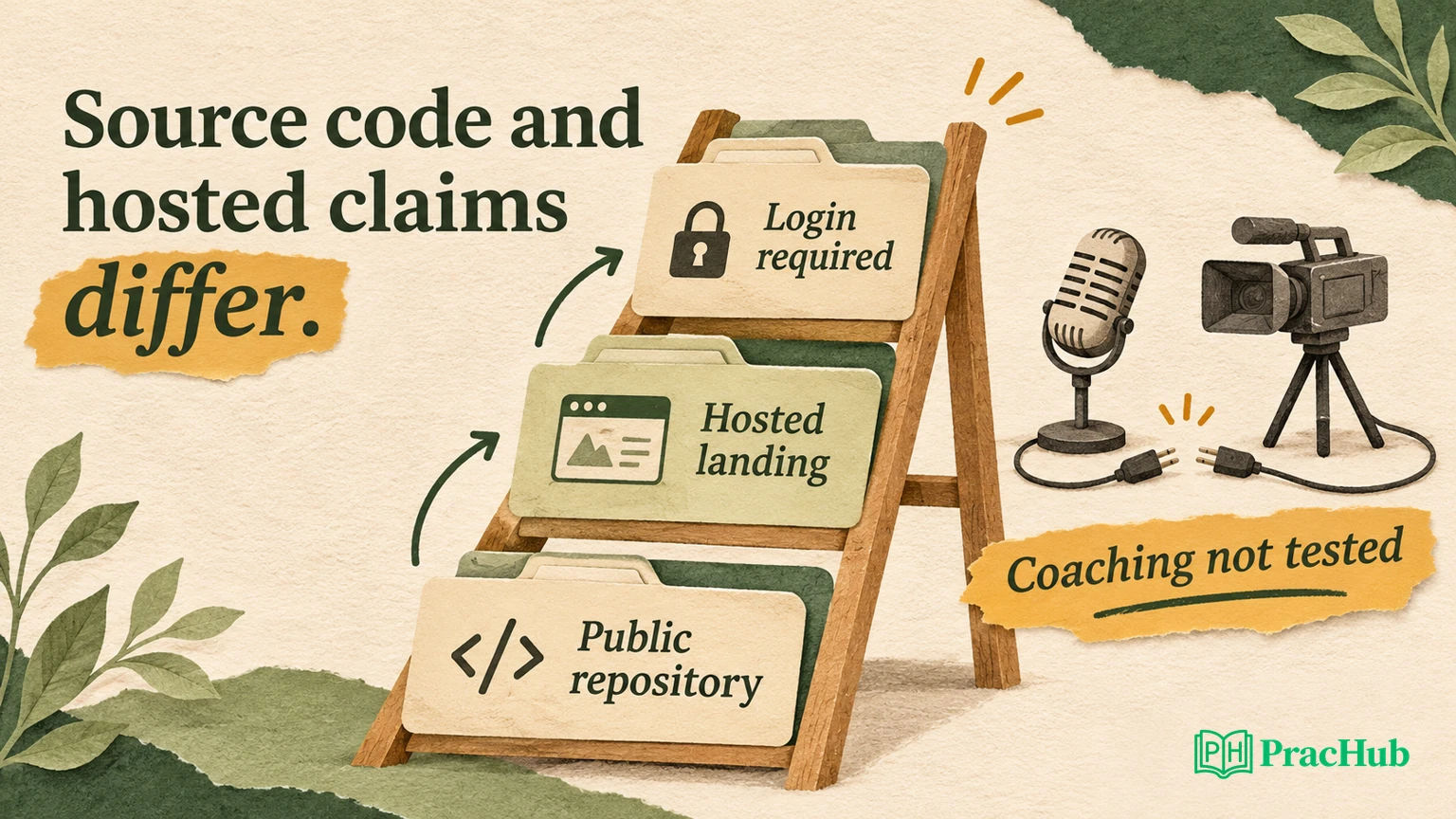
Keep source availability, frontend access and session behavior separate. A visible repository lets you inspect implementation claims. A live landing page establishes that a particular frontend opens. A successful authenticated session would provide another kind of evidence. None automatically proves the others.
We also did not establish a permissive software license. Publicly readable source is not by itself proof of unrestricted reuse. That distinction matters if you are evaluating the project as a self-hosting or development starting point rather than merely visiting its demo.
What the hosted public flow demonstrated
The hosted landing described real-time coaching, facial analysis, speech transcription, answer scoring and progress tracking. Login opened an account form; starting practice led toward registration. We stopped at that access boundary without creating a new account or transmitting a spoken answer.
The client-side login route opened through the visible navigation. A separate direct HTTP fetch of that route returned a different result. We use the native page observation for the statement that an account form was available, and do not infer authenticated backend health from either response.
We did not observe a completed interview, transcript, individualized tips, saved session history or a successful score calculation. We also did not verify free allowances, a paid plan, model quotas or support response times. The absence of a purchase in our visit does not establish unlimited free use.
| Evidence layer | What we verified | What it cannot establish alone |
|---|---|---|
| Public source | The named repository and README were readable. | A reliable deployed backend or permission to reuse all code. |
| Hosted landing | The About-linked site opened and described coaching. | That every advertised capability works in a session. |
| Account entry | Login and registration paths were visible. | A successful session or stored progress. |
| Personalized evaluation | Not tested. | No claim about score quality or follow-up usefulness is supported. |
Our editorial judgment is therefore a conditional one: inspect it if you want to understand the project’s approach, but validate the exact session flow before relying on it as your primary mock environment. A feature list is a reason to investigate, not an outcome from our test.
What the author claims about coaching
The README describes a React frontend with a Node/Express and MongoDB backend, facial-expression inference through a MobileNetV2 model associated with FER2013, and answer evaluation through Google Gemini. These are author descriptions, not an independent architecture or deployment audit.
Its proposed feedback includes relevance, fluency and clarity scores, improvement tips and a sample answer. It also describes a composite result combining expression, speech and content. We did not generate one of those reports, repeat an answer to test consistency, or compare a report with an expert interviewer’s judgment.
This distinction is especially important for facial-expression output. A classifier label or confidence percentage does not itself establish technical knowledge, communication quality or job readiness. Those are different constructs. The repository’s reported model evaluation cannot be treated as an interview-performance validation without additional evidence.
Likewise, structured JSON from a language model can make an output easier for software to parse. It does not guarantee that the feedback is factually correct or free of invented details. The README’s strong language about structured output should not be repeated as a verified elimination of hallucination risk.
Test coaching against a specific omission in your answer. If your answer fails to explain duplicate handling, does the feedback identify the missing operation key and ask for a replay example? If it only encourages confidence or suggests a polished generic paragraph, it may not address the technical gap that matters.
An original answer exercise without a product score
Here is a fictional pipeline explanation we wrote to test answer quality manually. It is not a real candidate story, a project result or an output from IntervueAI. Begin with the weak version: “We had duplicate data, so I added deduplication and improved reliability.”
That sentence names a problem and a repair but leaves almost everything testable unspecified. It does not say what counted as a duplicate, where the effect happened, what failure triggered repetition or how the team checked the result. A voice tool could praise its fluency without resolving those gaps.
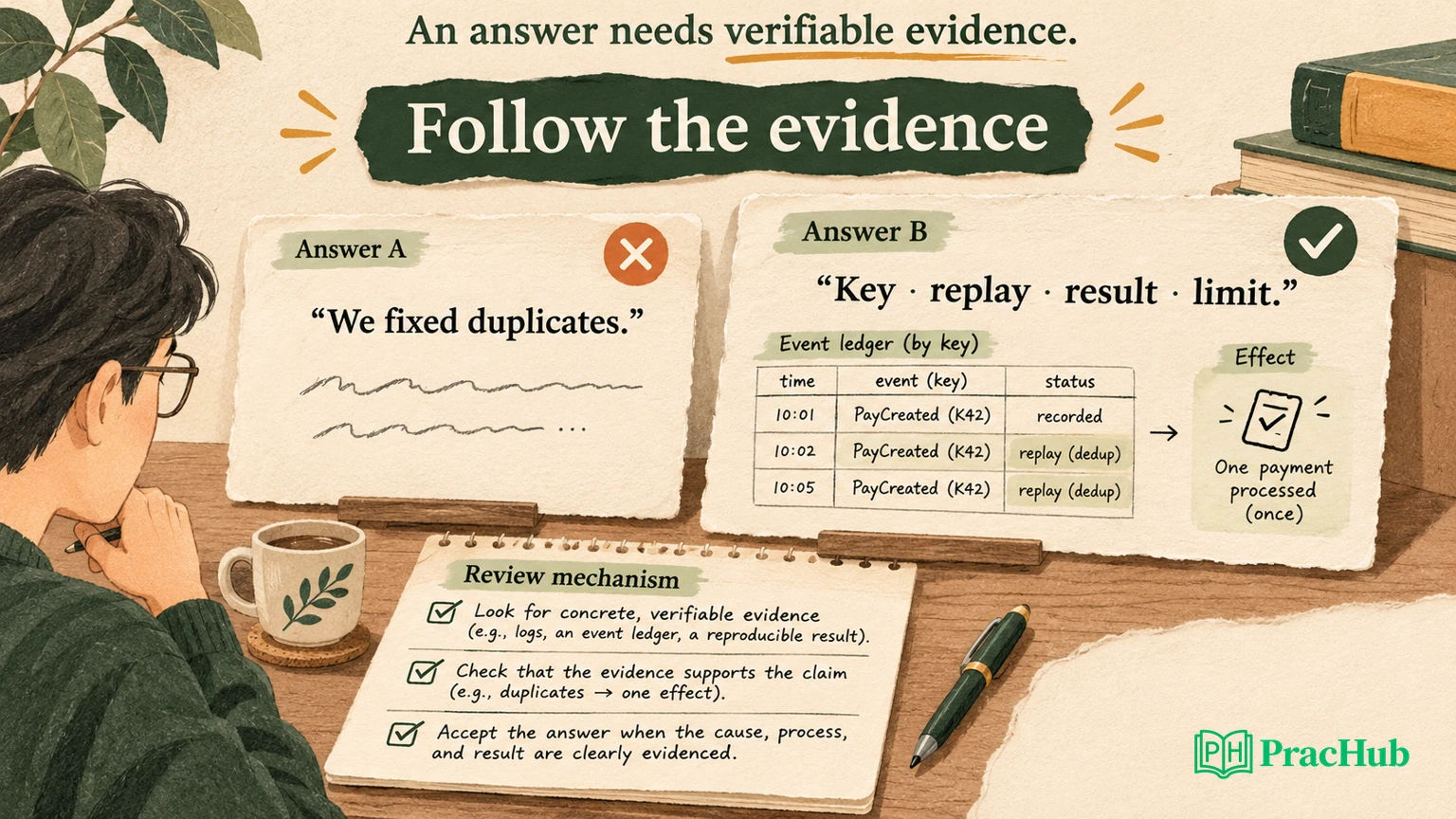
A stronger fictional version is: “The importer could retry after losing an acknowledgment. We identified a logical event by its source event key, recorded that key with the state change, and replayed the same input to check that the second attempt did not repeat the effect. The small test covered duplicate delivery on one process; restart recovery and concurrent workers still needed separate validation.”
The revised answer is better because it exposes a mechanism, a test and a limitation. It does not invent a percentage improvement or claim a production deployment. It gives an interviewer several concrete places to ask a follow-up.
| Manual follow-up | Evidence a useful answer should supply | Unsupported shortcut |
|---|---|---|
| What identifies the same event? | A stable logical key and conflict policy. | “Every retry gets a new ID.” |
| What did you replay? | The same logical input under a declared failure sequence. | “We ran it a few times.” |
| What changed on the second attempt? | A visible state or effect comparison. | “The logs looked fine.” |
| What remains unknown? | Concurrency, persistence or another explicit boundary. | “It is fully reliable now.” |
This table is our manual review aid, not IntervueAI’s rubric. Its purpose is to let you assess a future coaching response against specific needs instead of accepting an unexplained score as the final word.
How to judge a future AI response
If you later obtain access, keep your original answer, the exact question and the returned feedback together. Ask whether the advice refers to something you actually said. A suggestion to add a result can be helpful; a sample answer that inserts an unverified result should not become part of your story.
Then test the proposed improvement with a follow-up. Explain why the key is stable, what happens if it is reused for conflicting data and whether the state change is atomic with the deduplication record. If you cannot defend those details, the polished answer has not closed the technical gap.
For behavioral answers, use the same principle with different evidence. Name your actual responsibility, the decision you made and what you observed afterward. Do not let a generic STAR template imply sole ownership of a team outcome or introduce a number you cannot substantiate.
Consistency is another separate question. A single favorable report cannot establish that repeated evaluations are stable, that accents are handled fairly or that transcription errors do not affect content scores. We did not perform those evaluations, so they remain unknown rather than implicit strengths or weaknesses.
The appropriate use of an AI report is as a source of hypotheses about your answer. A hypothesis becomes useful when you can inspect the transcript, reproduce the problem or obtain another reviewer’s explanation. Treat the report as feedback to examine, not as proof of a hiring decision.
Access and data flow deserve a concrete check
The project describes a workflow involving spoken answers and camera-derived expression information, with external model services in the architecture. We did not enable those inputs or audit their handling. Before using the hosted service, read its current in-product disclosures and understand which inputs are required for the practice mode you want.
This is not a claim that the project mishandles data. It is a consequence of the evidence boundary: a README description cannot replace observing the actual permission flow, session behavior and recovery controls. Do not infer storage or deletion guarantees from a diagram alone.
If you are considering self-hosting, separate setup feasibility from coaching quality. Running a frontend locally does not establish model availability, account behavior or useful evaluation. Public source can help investigate those components, but this review did not install the project or transmit provider credentials.
For a preparation decision, first establish whether you can complete and revisit one small session. Then evaluate whether its feedback helps you answer a changed question. This avoids spending an entire preparation session on a workflow whose basic access or review loop you have not yet confirmed.
Five questions for answer-depth practice
These independent PracHub records help rehearse project explanation, ownership, ambiguity and communication. They are not IntervueAI prompts, integrations or predictions of a particular company’s screening format.
| PracHub question | Focused follow-up |
|---|---|
| Project Deep Dive: End-to-End Walkthrough, Trade-offs and Communicating Decisions | Defend a project decision and its evidence under a changed follow-up. |
| Describe ownership and failure | State your responsibility and remaining failure boundary truthfully. |
| Describe communication to resolve ambiguity | Explain how an ambiguous requirement became a testable contract. |
| Describe a Time You Explained a Complex Technical Concept to Non-Technical People | Change the explanation for a nontechnical audience without inventing results. |
| Explain your most impactful project clearly | Support impact with an observable result and clarify team contribution. |
Use the project deep dive for technical decisions and the ownership question for truthful responsibility boundaries. The ambiguity prompt tests whether you can explain how requirements became concrete. The stakeholder questions change the audience, so simply repeating a technical transcript may not be enough.
For each question, record one claim you can substantiate and one limitation you should state. If you later use an AI mock, compare its feedback with those notes. This gives you an independent standard and reduces the temptation to adopt a plausible generated narrative.
IntervueAI’s public repository and linked landing establish an inspectable project with coaching ambitions. Personalized feedback, hosted reliability, access allowances and score calibration remain unverified in this review. Use the project as an exploratory option, and build your next answer around one question from PracHub’s Software Engineer collection. The most useful outcome is an explanation you can defend when the follow-up changes.
Comments (0)