Is Acing the System Design Interview by Zhiyong Tan Worth Reading in 2026?
Quick Overview
Zhiyong Tan's 472-page Acing the System Design Interview combines interview structure, distributed-systems fundamentals, operational concerns, and eleven worked design cases. This 2026 review explains who should read it, where passive study falls short, how it compares with Alex Xu and DDIA, and how to pair selected chapters with PracHub's real, company-specific system design questions.
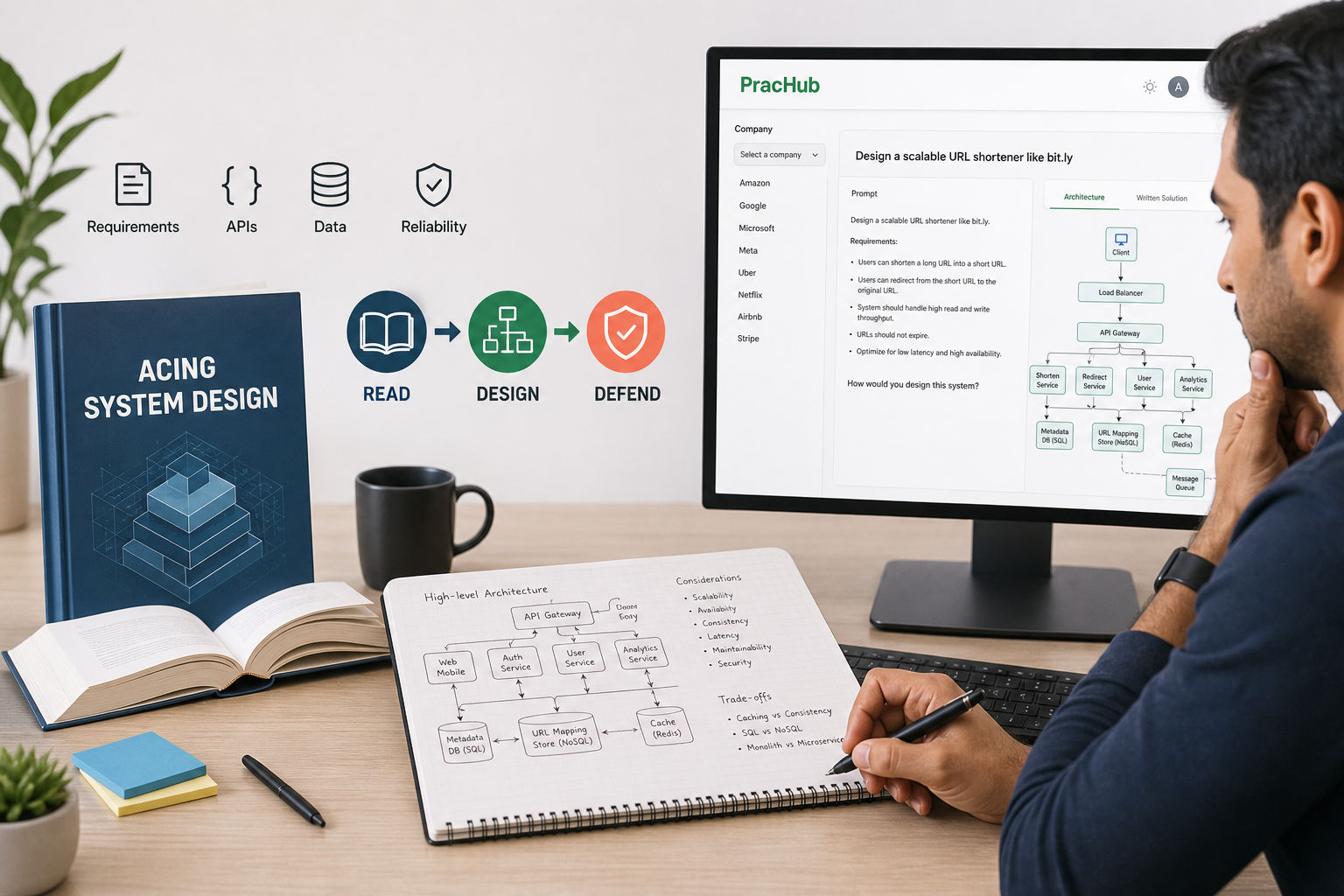
You can finish a system design book, recognize every box in a reference diagram, and still freeze when an interviewer asks, “What changes if one region fails?” That gap between recognizing a design and defending one is the real question behind any Acing the System Design Interview review.
Zhiyong Tan's 472-page guide moves from requirements and APIs to distributed transactions, observability, messaging, and worked designs. The useful question is whether reading it is the best next step for your interview timeline.
Before committing to another book, attempt two real system design interview questions on PracHub: one familiar prompt and one from your target company. If you cannot structure the first ten minutes, the book can help. If you know the framework but struggle with unfamiliar follow-ups, you need more practice than reading.
Quick Verdict: Is It Worth Reading in 2026?
Yes, for engineers who want a detailed bridge between system design fundamentals and interview-style cases. It is especially useful for mid-level candidates, first-time design interviewees, and experienced engineers with uneven knowledge.
No, it is not enough by itself. Reading builds vocabulary and exposes sound design considerations; it does not prove that you can scope a fresh prompt, make decisions aloud, and recover when the interviewer changes a constraint. Pair the book with timed, company-relevant practice on PracHub.
| Decision snapshot |
|---|
| Best for: Building a structured, reusable system design foundation. |
| Strongest feature: Broad coverage that connects interview flow, distributed-system concepts, and worked cases. |
| Main limitation: Passive reading can create recognition without independent performance. |
| Senior/staff verdict: A useful reference, but not a complete senior-level preparation plan. |
| Our recommendation: Read selectively, then spend at least as much time designing unfamiliar systems out loud. |
What Is in Acing the System Design Interview?
Manning published Acing the System Design Interview in January 2024. The 472-page book targets software engineers, architects, and engineering managers. Tan's publisher biography says he has worked at PayPal, Uber, Teradata, and startups, and has interviewed from both sides of the table.
The book is organized in two clear parts. Part 1 develops the ingredients and the interview process. It covers requirement clarification, trade-offs, API specification, data modeling, non-functional requirements, distributed databases, transactions, and reusable services.
Part 2 applies those ideas to eleven design cases. The examples include Craigslist, a rate-limiting service, notifications, database auditing, autocomplete, Flickr, a CDN, text messaging, Airbnb, a news feed, and a top-products dashboard. That range is broader than the usual short list of URL shortener, chat, and feed.
The book treats operations as part of design
One of its better choices is to keep logging, monitoring, alerting, data quality, and failure handling in the conversation. Candidates often omit them when memorizing clean diagrams, yet they create strong senior-level follow-ups.
The inside-cover reference also makes the book useful after the first read. It maps recurring concerns such as graceful degradation, distributed transactions, data migrations, authentication, rate limiting, and exactly-once delivery back to relevant chapters.
What the Book Does Better Than Most Interview Guides
It gives you more than a four-step script
Many guides teach requirements, estimates, high-level design, and deep dive. Tan makes that sequence concrete through APIs, data models, cross-service writes, observability, search, and operational risk.
This makes the book valuable when your answer sounds organized but shallow. Instead of adding random boxes, you gain a larger set of questions to ask: What is the dominant access pattern? Which requirement deserves the trade-off? Where can data become inconsistent? How will the team know the system is failing silently?
The case studies vary the design pressure
The Craigslist chapter permits a monolith and emphasizes simplicity. The rate limiter case focuses on distributed state and accuracy. Autocomplete introduces a continuous processing pipeline and a compact query structure. The Airbnb design adds reservation conflicts and operational workflows.
The lesson is crucial: a strong answer is not the architecture with the most components. It is the simplest one that fits the constraints.
It works as a reference, not only a linear course
This is not a last-night cram guide. Revisit a focused section after a practice miss: use distributed transactions for a consistency gap or the CDN chapter for weak cache-invalidation reasoning, then retry the prompt.
Where the Book Falls Short for 2026 Interviews
Reading does not reproduce interviewer pressure
A worked case makes the path look orderly because the author already knows which requirements and bottlenecks matter. In a live interview, you must discover that path while speaking, watching the clock, and responding to interruptions.
That is why a candidate can understand the Airbnb chapter and still mishandle a new reservation prompt. The missing skill is not knowledge; it is retrieval, prioritization, and communication under uncertainty.
It cannot tell you what your target company is asking now
The concepts are durable, but interview loops differ. One company may push on API boundaries, another on capacity and recovery, and another on cost. A static book cannot supply a current, company-tagged practice distribution.
Use company-specific interview prep to choose prompts after each chapter. The goal is to transfer the concept into the language and depth of your actual loop, not to reproduce the book's diagram from memory.
Senior and staff candidates need a wider signal
Staff-level interviews often probe migration strategy, organizational boundaries, risk sequencing, cost, build-versus-buy decisions, and how a design evolves across teams.
For those candidates, this book is a strong technical checklist rather than a complete answer. You still need to practice explaining why a simpler first version is safer, how you would roll it out, what you would measure, and which decision you would postpone.
It is not focused on ML or generative AI systems
The cases center on classic web and distributed systems. That is appropriate for the book's scope, but candidates targeting ML infrastructure, recommendation, retrieval, or LLM platform roles need additional domain practice. Use PracHub's real interview question library to find the categories and companies relevant to that loop.
Acing the System Design Interview vs Alex Xu vs DDIA
These books solve different problems, so “best” depends on the gap you are trying to close.
| Choose based on your gap |
|---|
| Zhiyong Tan: Choose it when you want detailed interview flow, broad design considerations, and a varied set of worked cases in one volume. |
| Alex Xu: Choose it when you want faster, highly visual walkthroughs of canonical interview systems. Read our Alex Xu system design book review. |
| DDIA: Choose it when your weakness is the deeper behavior of storage, replication, partitioning, transactions, streams, and distributed data. See DDIA vs Alex Xu. |
| PracHub: Use it when the concepts are familiar and you need current prompts, company filters, written solutions, and repeated interview-style application. |
The most efficient stack is often one primary book plus real-question practice, not three books read back to back. Add a second reference only when your practice log identifies a specific technical gap.
How to Use the Book Without Over-Studying
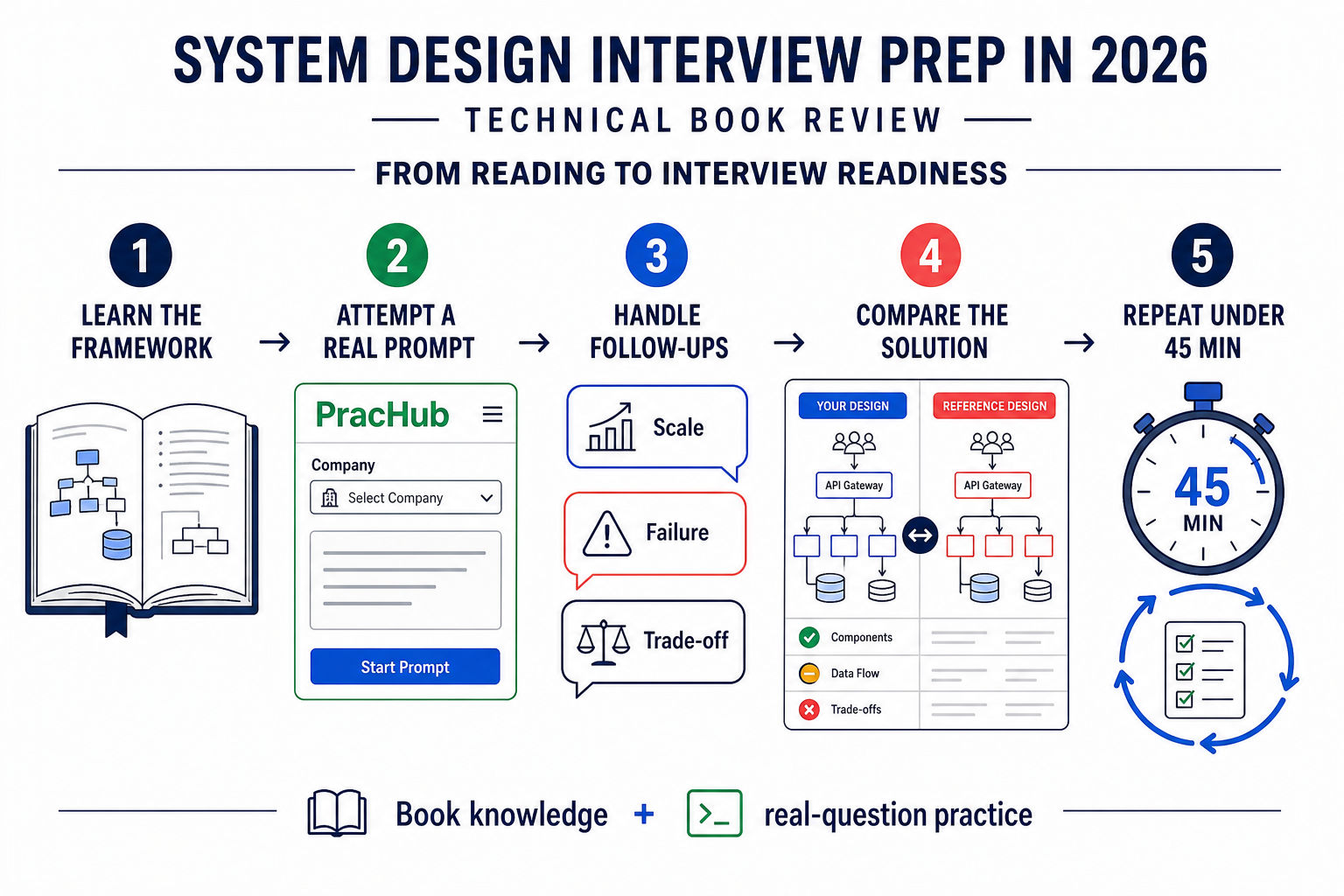
Phase 1: Learn the interview skeleton
Read the opening material on requirements, trade-offs, APIs, data models, and non-functional requirements. Then close the book and deliver a ten-minute opening for one unfamiliar prompt. If you cannot do it without notes, reread only the weak section.
Phase 2: Pair each case with a transfer problem
After the rate limiter chapter, design a quota service. After autocomplete, design trending searches. After Airbnb, design ticket reservations. Changing the surface area forces you to reuse the reasoning instead of the diagram.
Find the transfer problem in PracHub, set a 45-minute timer, and reveal the written solution only after you commit to a design. Record three misses: a requirement you failed to clarify, a trade-off you could not defend, and a follow-up that changed your architecture.
Phase 3: Build a company-specific final set
In the final two weeks, reduce reading and increase full-length reps. Use company filters to select six to ten prompts that match your target role, then practice them in random order.
For each answer, make the data flow visible, name one failure mode, and state what requirement would make you choose the leading alternative. Finish with at least two spoken mocks. A design that exists only in your notes is not interview-ready.
Is the Book Worth the Price?
In August 2026, Manning listed the ebook at $54.99 and print edition at $59.99 before promotions. Prices change, so check the publisher before buying.
The book is worth that range if you will use it as a reusable reference across several weeks of preparation. It is a weaker purchase if your interview is days away, you already know the fundamentals, or you mainly need feedback on your delivery. In that situation, invest your limited time in timed practice and a mock interview.
Frequently Asked Questions
Is Acing the System Design Interview good for beginners?
Yes, if you already have basic backend and database knowledge and are willing to read selectively. Complete beginners may need to pause for unfamiliar concepts, but the interview framing and worked cases provide a useful path.
Is it enough for a system design interview?
No book is enough without active practice. Use it to learn the framework and technical vocabulary, then solve unfamiliar prompts under time and explain every major trade-off aloud.
Is it better than Alex Xu's System Design Interview books?
It is more detailed and text-heavy, while Alex Xu's books are often faster to scan and more visual. Choose Tan for depth and breadth; choose Alex Xu for rapid pattern recognition. Both still need practice.
Is it useful for senior and staff engineers?
Yes as a reference and gap finder. It is not a complete staff-level curriculum because senior loops may also evaluate migration, organizational design, cost, rollout, and technical leadership.
How long should I spend on it?
Do not measure progress by chapters finished. Spend two to four weeks pairing selected chapters with timed designs, then move most of your time to company-specific questions and mocks.
Final Recommendation
Acing the System Design Interview is worth reading in 2026, but it is most valuable as a working reference, not a finish-line credential. Its breadth, operational awareness, and varied cases can turn fragmented knowledge into a coherent interview approach.
The winning sequence is simple: learn a concept, close the book, design something unfamiliar, defend the trade-offs, and compare your answer with a reliable solution. Start that loop with PracHub's system design interview questions, then use the book only where your practice reveals a real gap.
Sources
Related Articles
Woven Coding Assessment Guide 2026: Real-World Scenarios, Timing, and Human Scoring
Learn what the Woven coding assessment tests, how long it takes, how engineers score it, and how to prepare for real-world scenarios confidently in 2026.
Does CodeSignal Record Your Screen? Proctoring, Camera, and ID Rules in 2026
Does CodeSignal record your screen? Learn when it uses camera, microphone, screen recording, photo ID, what employers see, and how verification works.
Existing Codebase Interview Guide: How to Navigate and Debug an Unfamiliar Repository
Prepare for an existing codebase interview: map an unfamiliar repository, reproduce bugs, test hypotheses, make small fixes, and explain your work.
TestDome Programming Test Guide: Question Types, Scores, and Practice
Prepare for a TestDome programming test in 2026. Learn question types, scoring, timers, proctoring, passing scores, and a practical study plan.
Comments (0)