Woven Coding Assessment Guide 2026: Real-World Scenarios, Timing, and Human Scoring
Quick Overview
This candidate-first guide explains Woven's asynchronous 30-120 minute technical assessments, including code review, debugging, architecture, programming, free-text and IDE tasks, double-blind human scoring, candidate feedback, time management, scenario-specific AI rules, and a practical seven-day preparation plan using PracHub.
A Woven coding assessment can feel unfamiliar even if you have completed plenty of online coding tests. Instead of racing through isolated algorithm questions, you may need to review a pull request, debug a system, explain an architecture decision, or implement a realistic feature under a tight clock.
In 2026, Woven assessments are asynchronous, employer-configured work simulations that generally take 30 to 120 minutes. They can combine free-text responses with an IDE, and submissions are independently reviewed by trained engineers rather than judged only by test-case output.
The best preparation is therefore broader than a LeetCode sprint. Start with PracHub's real interview questions with written solutions, filter for your target company and role, and practice producing code plus a concise engineering explanation under time pressure.
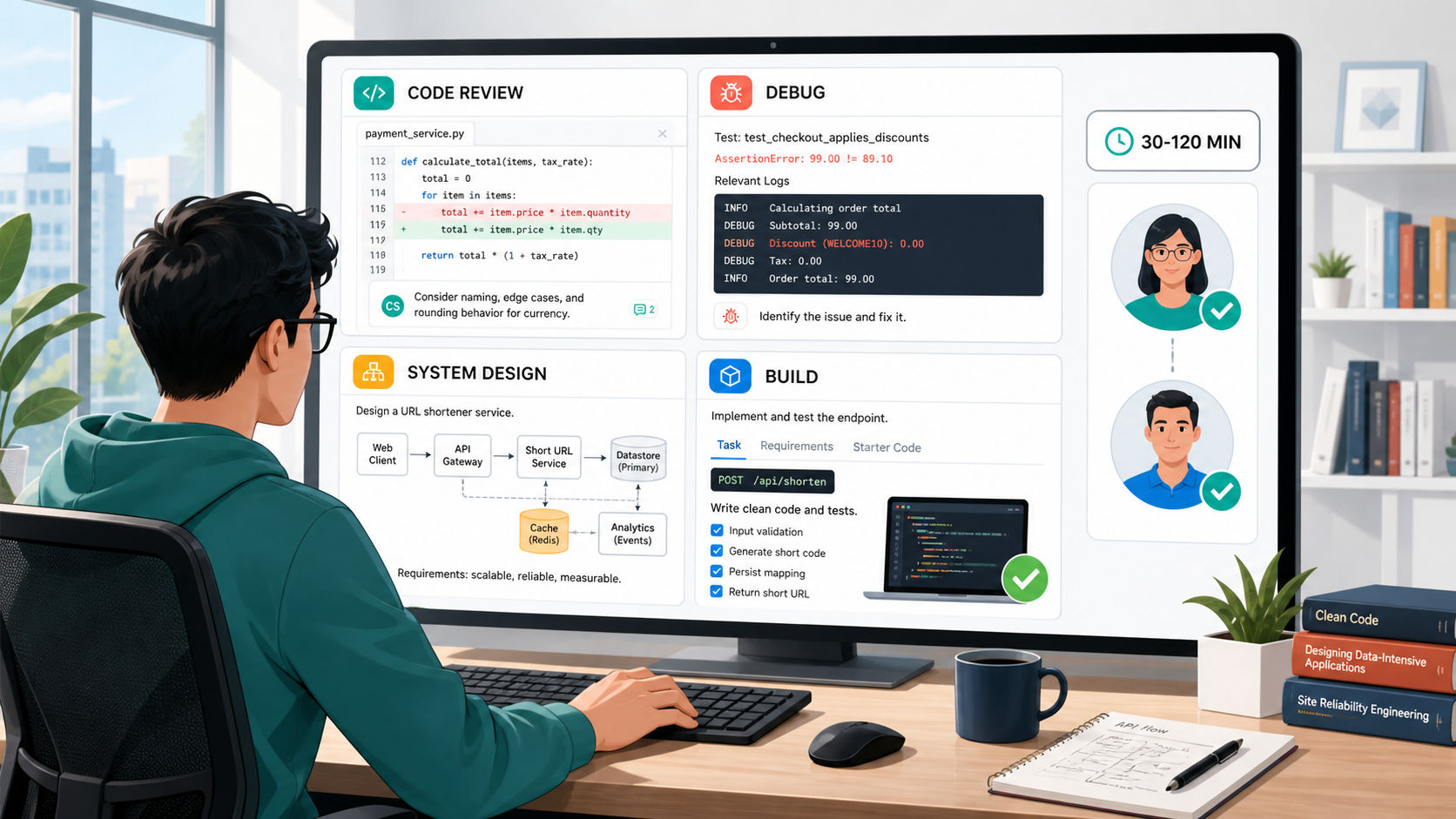
Woven evaluates realistic engineering work, not only whether one final answer passes.
Quick Answer: What Should You Expect?
A Woven assessment is closer to a short work simulation than a conventional algorithm quiz. The hiring company chooses scenarios that fit the role, seniority, and technology stack, so two candidates applying to different teams may receive very different exercises.
| Candidate question | What Woven says |
|---|---|
| How long is the assessment? | Usually 30 to 120 minutes in total, depending on the role and scenario mix. |
| Is it live? | No. Woven describes the assessment as asynchronous. |
| What might it test? | Code review, debugging, programming, system architecture, technical writing, and collaboration. |
| How is it scored? | At least two certified engineers independently score rubric items; a third resolves disagreements. |
| Can you use AI? | It depends on the scenario. Woven supports no-AI, hybrid, and AI-enabled configurations. |
This guide covers Woven Teams, the technical-assessment platform. It is not a guide to interviews at Woven by Toyota, which is a separate company and a different search intent.
What a Woven Coding Assessment Actually Measures
Woven is designed to test work that experienced engineers perform on the job. Its public materials emphasize code review, system debugging, architecture, programming, and asynchronous communication rather than a large bank of academic puzzles.
That changes the evaluation target. A correct function still matters, but reviewers may also care about whether you identify the important risk, explain why it matters, choose a proportionate fix, test the behavior, and communicate what remains uncertain.
The assessment can use both free-text and IDE environments. Treat prose responses as part of the technical work, not as filler around the code.
Woven Question Types You May See
Code Review and Technical Writing
You may be shown a change and asked to review it as if it were a real pull request. Strong answers prioritize defects by impact: correctness and security first, then reliability, maintainability, and style.
Do not produce a long list of cosmetic comments. Point to the relevant behavior, describe a concrete failure case, and recommend a fix the author could implement. A useful review comment explains both what is wrong and why it matters.
Debugging and System Architecture
A debugging scenario may give you symptoms, logs, code, or an architectural sketch. Build a short chain from evidence to hypothesis to verification instead of guessing at several unrelated causes.
For architecture work, state the requirement you are optimizing for, identify the likely bottleneck or failure mode, and compare one or two credible options. PracHub's system design questions are useful here because the written solutions show how experienced candidates organize constraints and trade-offs.
Real-World Programming
Programming scenarios can ask you to implement or modify realistic business behavior. Read the requirements twice, get a small correct path working, and then spend the remaining time on edge cases, tests, naming, and a brief handoff note.
Woven lists broad language and framework coverage, but the employer can restrict the options for a particular assessment. Confirm the languages offered in your invitation instead of assuming your preferred stack will be available.
How Long Does a Woven Assessment Take?
Woven's current FAQ says its interviews require 30 to 120 minutes. Hiring teams can enable timeboxing, and individual scenarios may have their own fixed limits. Woven's help center says experienced-role assessments are generally designed to stay at or below two hours.
Use the time shown in your own invitation as the source of truth. Once a timed scenario begins, work as though the current draft may be submitted: establish a sensible answer early, then improve it.
| Phase | How to use the time |
|---|---|
| First 10-15% | Read the entire prompt, identify the deliverable, and note constraints and assumptions. |
| Middle 65-75% | Build the core solution, validate the main path, and capture reasoning as you go. |
| Final 15-20% | Test edge cases, remove obvious noise, and leave a concise explanation of trade-offs or unfinished work. |
These percentages are a practice framework, not Woven's scoring formula. Adjust them to the scenario, but protect review time instead of coding until the final second.
How Human Scoring Changes Your Strategy
Woven says each submission is double-blind scored against a detailed, deterministic rubric by at least two trained and certified engineers. If the scorers disagree on a rubric item, the submission is escalated to a third engineer for reconciliation.
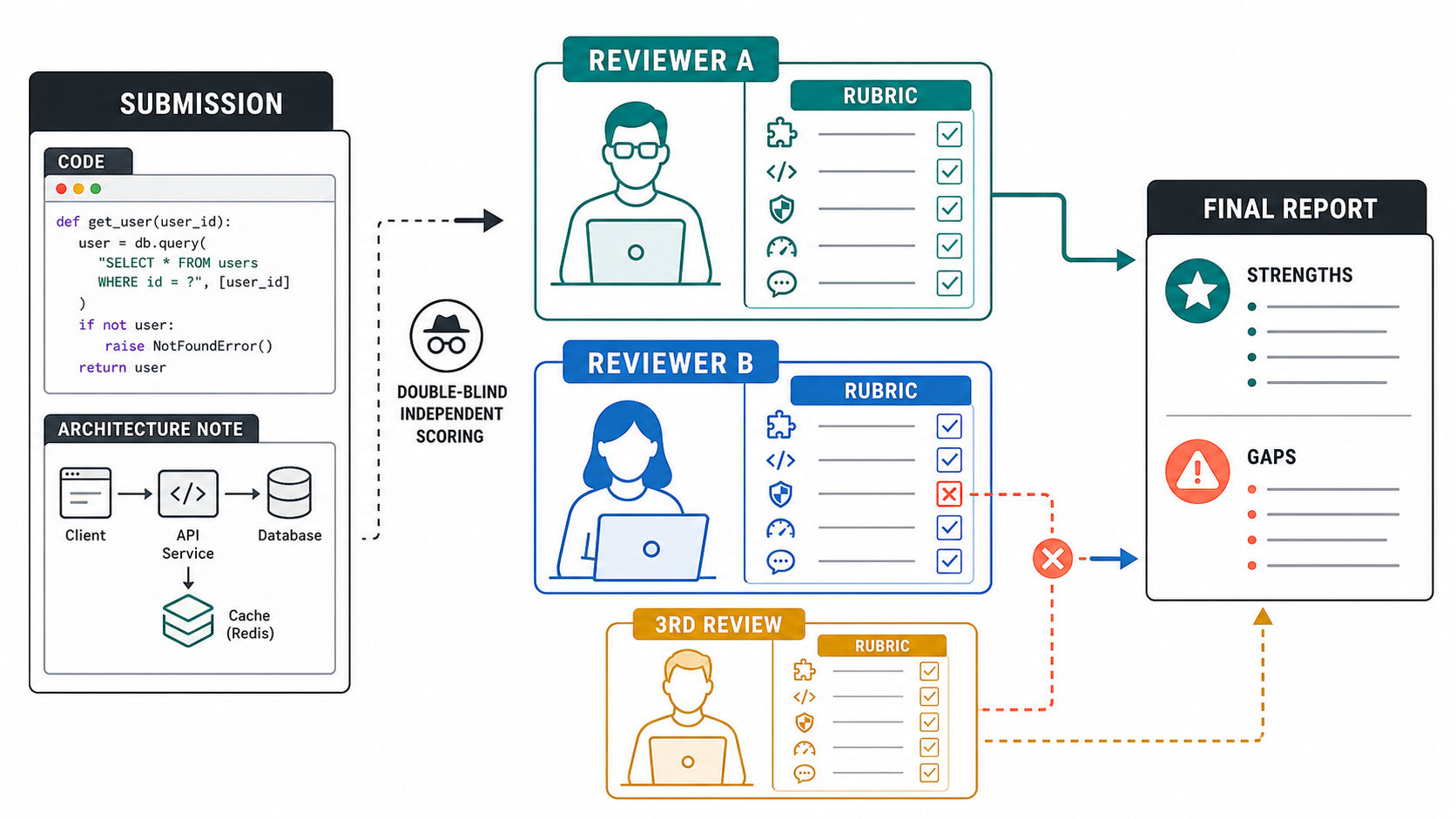
Two independent engineers score rubric items, with a third reviewer resolving disagreements.
Human scoring allows partial credit, so visible reasoning has value. If you cannot finish, submit the strongest coherent version you can: working core behavior, named assumptions, tests you completed, and the next change you would make.
Clarity is not the same as verbosity. A scorer should be able to understand your decision without searching through a stream of consciousness. Use short comments and structured prose where they reduce ambiguity.
Can You Use Google, Documentation, or AI?
Follow the rule displayed for each scenario. Woven now offers no-AI, hybrid, and AI-enabled assessment configurations. Its AI-enabled scenarios may explicitly encourage candidates to use their preferred LLM, while no-AI scenarios prohibit assistance from AI or another person.
Woven also says its traditional scenarios are designed to be "Google-able" for ordinary reference needs, such as looking up syntax you would check at work. That does not create blanket permission to search for a solution or use AI. The invitation, prep guide, and code-of-conduct acknowledgment shown before the scenario control.
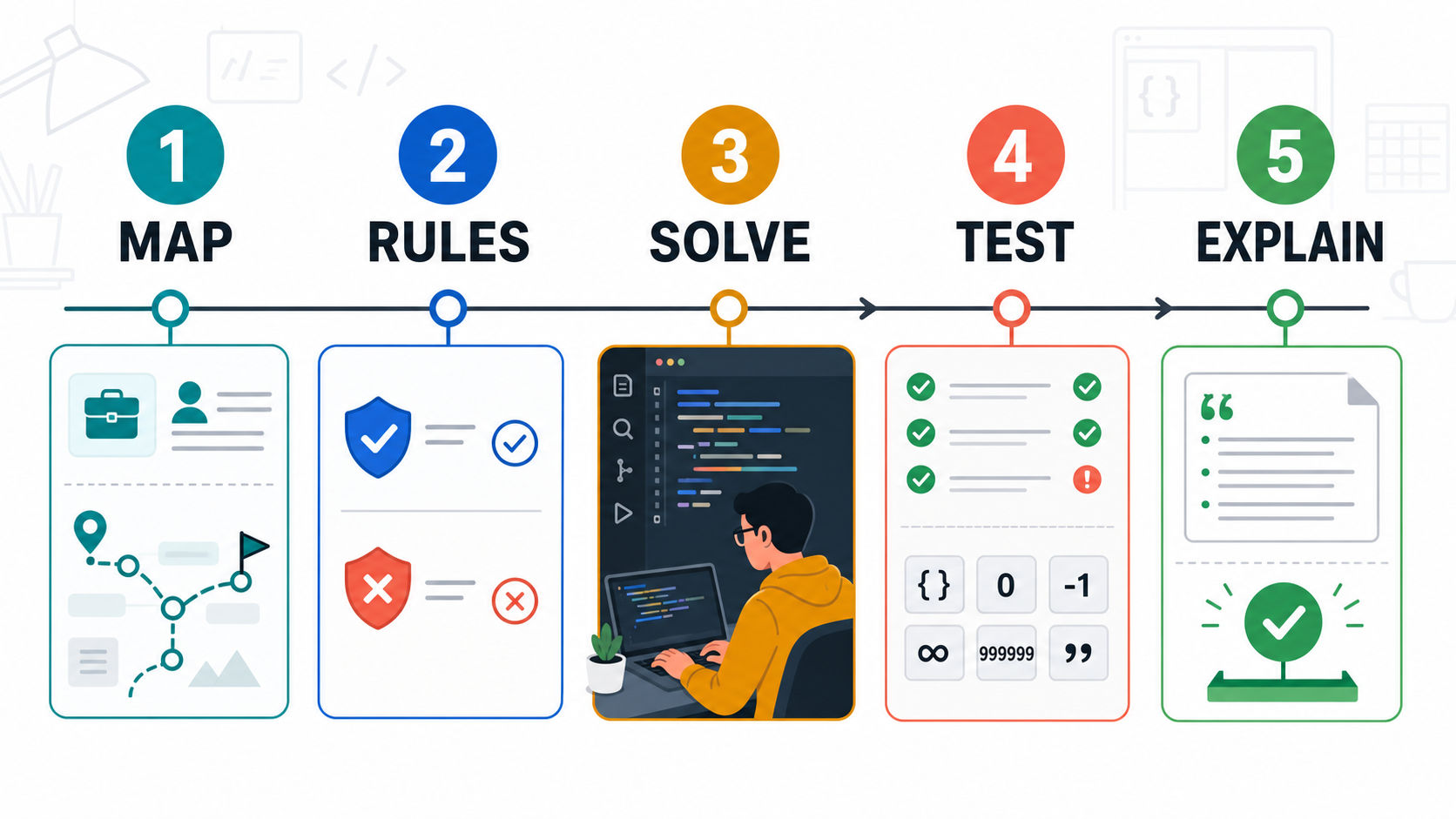
Map the scenario, confirm its rules, produce a working answer, and reserve time to validate and explain.
Woven's current employer materials describe asynchronous video proctoring and human review of assessment playback for signs of external assistance. Prepare to work within the stated rules; attempting to infer detection thresholds is both risky and irrelevant to demonstrating the skill being assessed.
A 7-Day Woven Preparation Plan
Days 1 and 2: Map the target role. Use PracHub's company-specific interview prep to identify likely coding, design, and behavioral themes. Complete one timed coding problem and write a five-sentence handoff explaining assumptions, complexity, and tests.
Days 3 and 4: Practice code review and debugging. Review a small pull request or an old project diff, then rank your findings by impact. For debugging, reproduce one failure, form one hypothesis at a time, and record the evidence that confirms or rejects it.
Days 5 and 6: Run two work simulations. Combine a short implementation task with either a system-design prompt or a written incident analysis. Use a hard timebox and finish with a clean, readable submission rather than an ambitious half-solution.
Day 7: Review your invitation and environment. Confirm total time, scenario rules, permitted languages, AI policy, and any setup instructions. Then do a lighter final practice session instead of cramming new patterns.
What Employers and Candidates Receive
The hiring team receives Woven's analysis of the submission, including strengths and gaps against its rubric. Woven encourages employers to benchmark the same assessment with members of their existing team so candidate performance has role-specific context.
Candidates receive actionable feedback when the recommendation is delivered, but Woven's feedback FAQ says the candidate email does not include the internal Woven Score or the employer's next-step decision. The company still owns the hiring outcome.
When feedback arrives, separate signal from emotion. Translate each note into a repeatable practice target, then find similar prompts in PracHub and redo the behavior under a timer.
Common Woven Assessment Mistakes
The most common preparation mistake is treating Woven like a generic DSA test. Algorithm practice helps, but it does not train pull-request judgment, written communication, architecture debugging, or realistic feature work.
During the assessment, candidates also lose signal by polishing before the main behavior works, listing every possible issue without prioritization, or leaving decisions unexplained. Human reviewers can award partial credit, but only for work they can clearly see and evaluate.
Finally, do not import another candidate's AI or research rules into your session. Employer configurations differ, and Woven's newer AI-enabled scenarios make old blanket advice especially unreliable.
Frequently Asked Questions
Is the Woven coding assessment like LeetCode?
Not usually. Woven emphasizes realistic engineering scenarios such as code review, debugging, architecture, programming, and technical writing. Some algorithmic thinking may still be required, but the assessment is designed to evaluate how you handle job-like work.
How long is the Woven technical assessment?
Woven's FAQ gives a total range of 30 to 120 minutes. The exact duration and number of scenarios depend on the role and employer configuration, so check the time shown in your invitation.
Is Woven automatically scored?
No. Woven says at least two certified engineers independently score each submission against detailed rubric items. A third engineer resolves disagreements, and the process can award partial credit.
Does Woven give candidates their score?
Woven sends candidates actionable feedback, but its feedback FAQ says the internal Woven Score and hiring next steps are not included. The employer contacts the candidate about whether the process continues.
Can I use ChatGPT during a Woven assessment?
Only when the scenario explicitly allows AI. Woven supports no-AI, hybrid, and AI-enabled setups. Read the code-of-conduct message for every scenario because using AI in a no-AI task can disqualify the submission.
Final Takeaway
A strong Woven submission looks like credible engineering work under a clock: a correct core answer, prioritized judgment, clear trade-offs, sensible validation, and concise communication. The platform's human scoring means the path to your answer matters alongside the final output.
Use the invitation as the source of truth, practice the scenario types your role is likely to receive, and respect the AI policy shown on screen. Start with PracHub's real interview questions and written solutions so your timed practice reflects the companies and rounds you are actually targeting.
Sources
This guide was checked against Woven's current assessment FAQ, human-powered assessment overview, timeboxing guidance, candidate feedback FAQ, AI-enabled assessment policy, and candidate code-of-conduct guidance.
Related Articles
Does CodeSignal Record Your Screen? Proctoring, Camera, and ID Rules in 2026
Does CodeSignal record your screen? Learn when it uses camera, microphone, screen recording, photo ID, what employers see, and how verification works.
Existing Codebase Interview Guide: How to Navigate and Debug an Unfamiliar Repository
Prepare for an existing codebase interview: map an unfamiliar repository, reproduce bugs, test hypotheses, make small fixes, and explain your work.
Is Acing the System Design Interview by Zhiyong Tan Worth Reading in 2026?
Acing the System Design Interview review for 2026: what Zhiyong Tan's book teaches, where it falls short, and how to pair it with real practice.
TestDome Programming Test Guide: Question Types, Scores, and Practice
Prepare for a TestDome programming test in 2026. Learn question types, scoring, timers, proctoring, passing scores, and a practical study plan.
Comments (0)