Is Deep Learning Interviews Still Useful for AI and ML Roles in 2026?
Quick Overview
Deep Learning Interviews remains a strong free reference for information theory, probability, automatic differentiation, Bayesian deep learning, classical ML, and neural-network fundamentals. This 2026 review verifies the official PDF's scope, explains its gaps for Transformers, LLMs, RAG, production ML, coding, and ML system design, and shows AI and ML candidates how to combine targeted chapters with current PracHub questions.
A 2021 deep learning book can be mathematically correct and still be incomplete for a 2026 AI job. That is the tension behind the question: Is Deep Learning Interviews still useful for AI and ML roles in 2026?
The short answer is yes - for foundations. It is no longer a complete interview plan. Before reading 400 pages, try several current Machine Learning Engineer interview questions on PracHub. If probability, backpropagation, or model reasoning stops you, the book can help. If the prompt becomes RAG evaluation, inference serving, or production ML design, you need a newer practice layer.
Quick Verdict
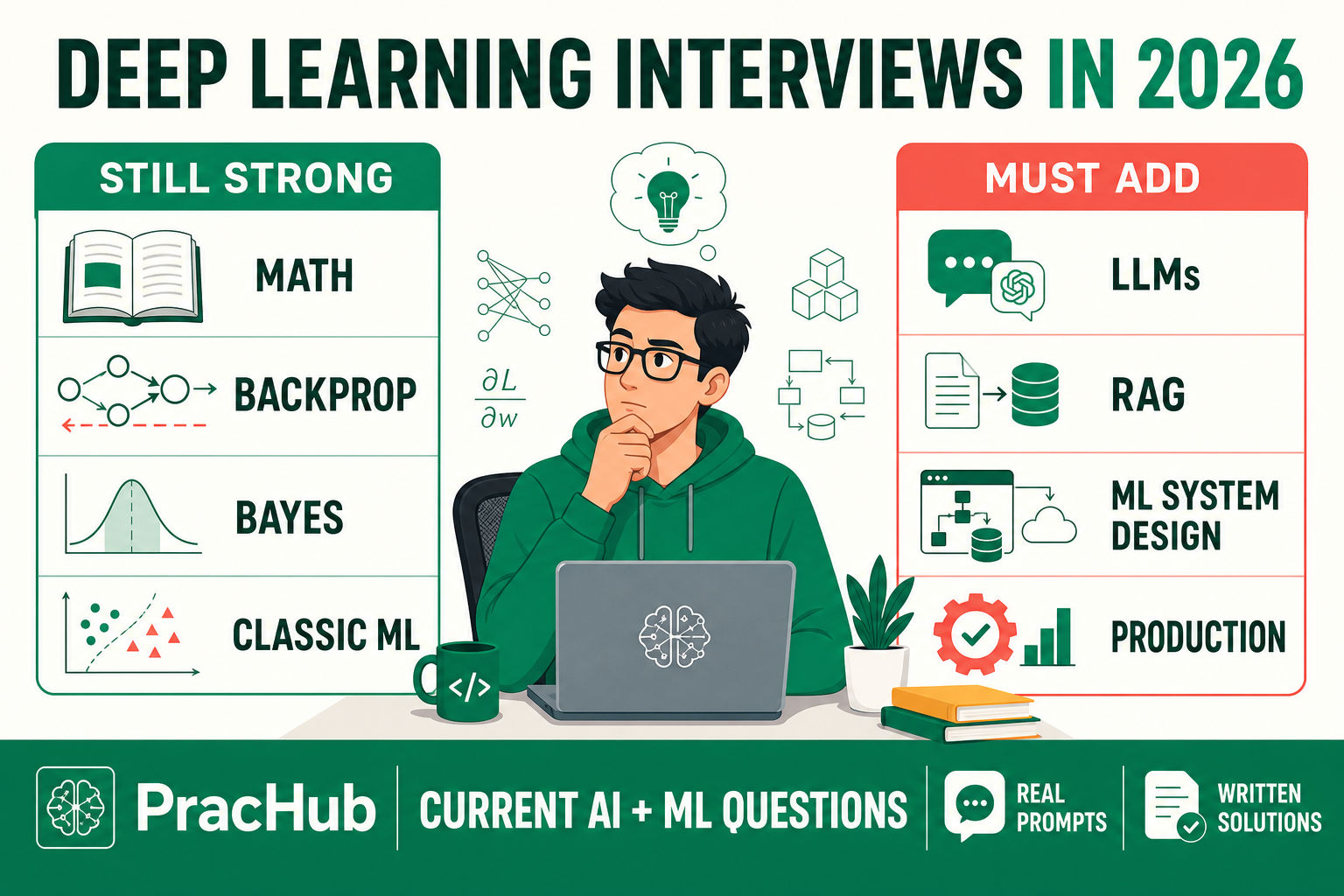
Deep Learning Interviews is still useful for mathematical foundations, classical ML, neural-network reasoning, and technical questions that require more than a one-line definition.
It is not enough for a complete 2026 loop. The official PDF does not provide dedicated coverage of Transformers, LLMs, RAG, diffusion models, modern fine-tuning, model serving, monitoring, or production ML system design.
Use the free book as a targeted reference, not a linear curriculum. Pair its strongest chapters with PracHub's current Machine Learning questions, ML System Design questions, coding practice, and company-specific prompts.
What Deep Learning Interviews Actually Is
Deep Learning Interviews was written by Shlomo Kashani and Amir Ivry for postgraduate students, job seekers, and technically experienced readers. The official site describes roughly 400 pages, more than 100 problems, seven chapters, step-by-step solutions, diagrams, and code examples in PyTorch, Python, and C++.
The second edition was posted to arXiv at the end of 2021. Its core areas are information theory, calculus and algorithmic differentiation, Bayesian deep learning, logistic regression, ensemble learning, feature extraction, and a long deep learning chapter.
The book is legally available as a free PDF for personal study through the official site and arXiv.
An active website does not mean a new interview curriculum
The website remains live, and the GitHub repository was last pushed in August 2025. However, the free manuscript linked by both sources is still the 2021 second edition.
That distinction matters. The project is accessible and still receives attention, but candidates should not assume that every major shift in AI hiring since 2021 has been added to the book.
What Is Still Valuable in 2026
The mathematical foundations have not expired
Entropy, KL divergence, gradients, likelihood, regularization, Bayesian uncertainty, logistic regression, and ensemble methods still appear underneath modern ML work. An interviewer may ask about a Transformer, but weak probability or optimization reasoning can still break the answer.
The book is especially helpful when you know a term but cannot derive or explain it. Its solved-problem format makes you follow the reasoning instead of memorizing a glossary definition.
It trains technical explanation, not just recognition
Many interview resources give a question followed by a short answer. Deep Learning Interviews often shows intermediate reasoning, equations, diagrams, and the purpose behind a problem.
That is useful for research and modeling rounds, where interviewers probe after the first response. You may need to explain how a gradient flows, why an objective behaves badly, or what changes when an assumption fails.
Where the Book Falls Short for 2026 Interviews
Modern LLM and generative AI coverage is missing
We checked the official 401-page PDF linked by the project. It contains no dedicated discussion of Transformers, GPT, LLMs, RAG, diffusion, LoRA, RLHF, quantization, or prompt engineering. Even where the official website now mentions attention, the downloadable second-edition manuscript does not provide a modern LLM interview track.
For an AI Engineer or LLM Engineer role, those are not optional side topics. Candidates may need to reason about retrieval quality, hallucination evaluation, context limits, fine-tuning choices, agent behavior, safety, latency, and cost.
Production ML system design is not developed
The PDF mentions "AI system design" only in a list of topics planned for Volume II. It does not teach the end-to-end architecture expected in many current MLE loops: data ingestion, feature or embedding pipelines, training, registries, online serving, observability, drift, rollback, and retraining.
That gap grows with seniority. A senior candidate is rarely evaluated only on whether a model is theoretically appropriate. The interviewer also wants to know whether the system can be operated reliably at the required scale and cost.
It does not cover the whole hiring loop
AI and ML interviews can include algorithmic coding, Python implementation, experimentation, SQL or data manipulation, ML system design, project deep dives, and behavioral rounds. The right mix changes by role and company.
The book's question inventory is not a substitute for current company-specific interview prep. It also cannot tell you which topics are recurring at your target employer, how a round is timed, or how follow-up questions change by level.
Deep Learning Interviews at a Glance
Use it for: probability, information theory, calculus, automatic differentiation, classical ML, Bayesian reasoning, CNN-era deep learning, and explaining technical concepts step by step.
Do not use it as: your only resource for LLM roles, production MLE roles, senior ML system design, coding screens, or a company-specific full loop.
Best fit: graduate students, research-oriented candidates, early-career ML candidates with uneven fundamentals, and experienced engineers who want a deep reference for a specific weakness.
Is It Useful for Your Role?
Research Scientist and research-heavy Applied Scientist
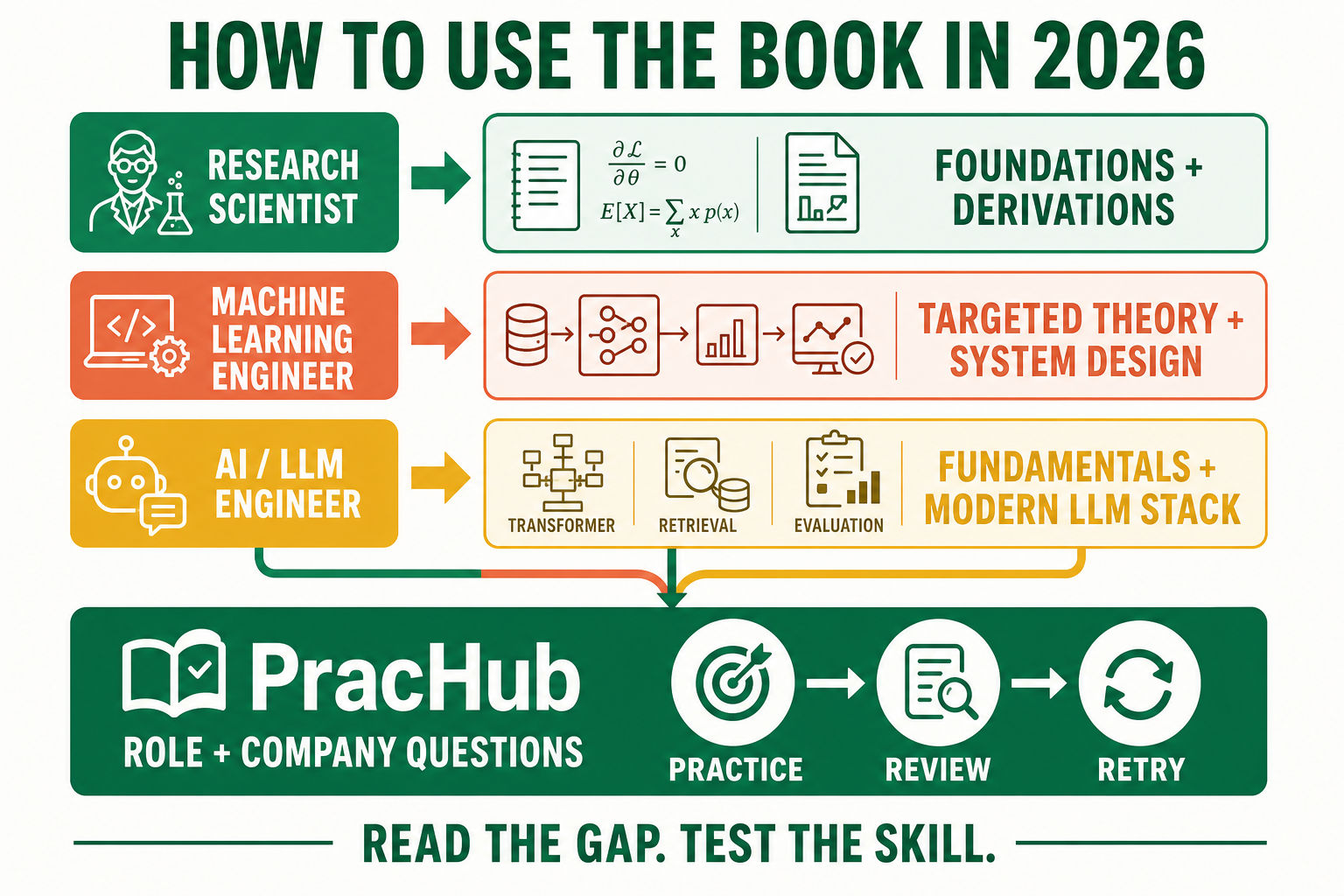
Yes, it can be a high-value foundation review. The mathematical questions, derivations, and oral-exam style are closer to what research candidates may face than lightweight interview summaries.
You still need recent papers, research discussion, implementation fluency, and role-specific depth. Treat the book as a baseline check, not evidence that you are current in your subfield.
Machine Learning Engineer
It is useful but secondary. Read the chapters that repair your theory gaps, then spend more preparation time on coding, data pipelines, model evaluation, debugging, serving, monitoring, and end-to-end ML System Design.
For senior MLE roles, reverse the usual reading order: attempt a current systems prompt first, identify the weak concept, and open the book only if the weakness is foundational.
AI Engineer or LLM Engineer
Use it only when your fundamentals need reinforcement. The book can help with optimization, uncertainty, and neural-network reasoning, but it does not prepare you for the modern LLM stack.
Prioritize Transformer mechanics, embeddings, retrieval, RAG evaluation, fine-tuning, inference optimization, safety, and production debugging. Practice connecting model decisions to latency, quality, cost, and operational failure modes.
A 7-Day Diagnostic Study Plan
- Day 1: Map the loop. Write down every expected round and try one current ML, coding, and system-design prompt. Score yourself on correctness, depth, structure, and time.
- Days 2-3: Repair one foundation. Pick the weakest matching chapter in Deep Learning Interviews. Work through a small number of problems without reading the solution first.
- Day 4: Explain without notes. Record two answers aloud. Include assumptions, equations only when useful, and one failure mode or tradeoff.
- Days 5-6: Add the missing modern layer. Practice an LLM, production ML, or company-specific question that the book does not cover. Use PracHub's written solution to identify omitted components and follow-ups.
- Day 7: Run a mini loop. Complete one coding problem, one ML fundamentals question, one system-design prompt, and one project or behavioral answer. Keep the book closed until the review.
How to Combine the Book With PracHub
Start with the interview, not the chapter list. Filter PracHub by role, company, and category, then attempt a question before looking at any explanation.
When the gap is mathematical, return to Deep Learning Interviews for depth. When the gap is architecture, use current ML system-design prompts. When the gap is implementation, switch to Coding and Algorithms practice.
After studying, answer a different question that tests the same idea. Repeating the book's worked example measures memory; transferring the concept to a new company-style prompt measures readiness.
Common Mistakes
Reading all 401 pages in order
The chapter sequence makes sense as a curriculum, but interview preparation is time-constrained. Diagnose first and read only what changes your performance.
Memorizing solved answers
Interviewers can change assumptions, ask for a derivation, or move from model quality to production cost. Learn the reasoning path and practice adapting it.
Using one plan for every AI role
A research scientist, product-focused MLE, data scientist, and LLM infrastructure engineer face different loops. Use the target job and recent company questions to set the weight of theory, coding, systems, and communication.
Frequently Asked Questions
Is Deep Learning Interviews free?
Yes. The official project links to a free arXiv PDF for personal study, while printed editions are also sold through commercial retailers.
Is the book outdated?
Its core mathematics and classical ML material are not outdated. Its interview coverage is incomplete for 2026 because the linked second edition predates the current LLM and production-AI interview surface.
Does Deep Learning Interviews cover Transformers or LLMs?
The official second-edition PDF does not contain a dedicated Transformer or LLM section. Candidates targeting generative AI roles need a separate modern resource and current practice questions.
Is it enough for a Machine Learning Engineer interview?
Usually not. MLE loops commonly add coding, data and model pipelines, deployment, monitoring, system design, project discussion, and behavioral evaluation.
Final Takeaway
Deep Learning Interviews is still useful in 2026, but its role has changed. It is a deep, free foundation reference rather than a complete map of modern AI and ML hiring.
Use it to strengthen the concepts that survive every technology cycle. Then use PracHub's current Machine Learning Engineer questions to practice the LLM, coding, production, system-design, and company-specific skills the book cannot supply. Read the gap, test the skill, and move on when the weakness is fixed.
Sources
- Deep Learning Interviews official website
- Deep Learning Interviews official GitHub repository
- Deep Learning Interviews second edition on arXiv
- PracHub ML System Design Interview Questions
Research checked August 5, 2026. The official PDF was reviewed for chapter coverage and modern AI interview terms; repositories, editions, and interview formats can change.
Related Articles
Why Kaggle Practice Is Not Enough for Machine Learning Interviews
Kaggle practice builds modeling skills, but ML interviews also test coding, fundamentals, system design, production trade-offs, and communication.
MLInterview.org Review 2026: Question Bank vs Real Company ML Interviews
Read our MLInterview.org review comparing its ML question bank and explanations with real company interviews, plus a better PracHub practice workflow.
Generative AI System Design Interview Book Review 2026: Is It Still Enough?
Generative AI System Design Interview book review for 2026: strengths, missing topics, best readers, and how to combine it with PracHub practice.
Is Chip Huyen's Designing Machine Learning Systems Enough for MLE Interviews?
Is Designing Machine Learning Systems enough for MLE interviews? See what Chip Huyen's book covers, what it misses, and the best prep workflow.
Comments (0)