Why Kaggle Practice Is Not Enough for Machine Learning Interviews
Quick Overview
Kaggle is excellent for notebooks, feature engineering, cross-validation, and leaderboard experimentation, but ML interviews test far more. This guide explains the gaps in coding, fundamentals, system design, MLOps, metrics, and communication, then shows how to turn one Kaggle project into interview-ready evidence with PracHub.
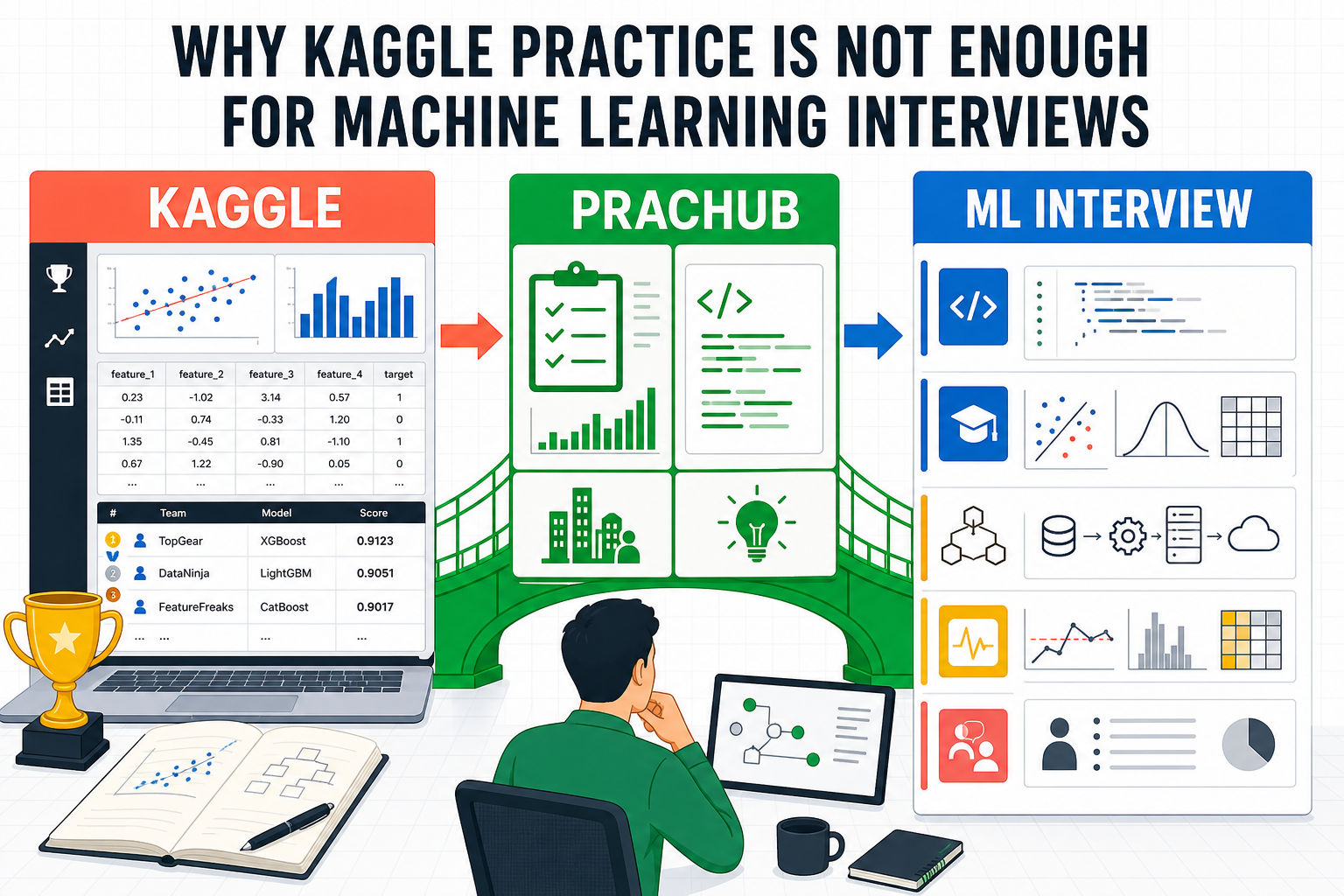
A high Kaggle score proves that you can work with a dataset, experiment with features, and improve an offline metric. It does not prove that you can explain bias and variance without a notebook, implement an algorithm under pressure, or design an ML system that survives production.
That is why Kaggle practice is not enough for machine learning interviews. Keep using Kaggle for hands-on modeling, but start your interview preparation with PracHub's real interview questions and written solutions and company-specific interview prep. The questions reveal which parts of the hiring loop your leaderboard work never exercised.
Quick Verdict
Kaggle is excellent project practice and incomplete interview practice. It helps with data cleaning, feature engineering, model selection, cross-validation, experimentation, and communicating results through notebooks. Those are valuable skills, especially for early-career data scientists and machine learning engineers.
Most ML interview loops are broader. They can test coding, probability and statistics, model fundamentals, product framing, ML system design, production monitoring, behavioral judgment, and a deep defense of past projects.
The strongest preparation stack is therefore Kaggle for building, PracHub for real-question diagnosis, and timed verbal practice for delivery. Do not abandon your projects; learn to defend the decisions around them.
Research note: this guide is based on current Kaggle product pages, Google production-ML guidance, and PracHub interview coverage reviewed on August 4, 2026. It does not claim that every company uses the same interview loop.
What Kaggle Practice Teaches Well
Kaggle gives candidates a fast feedback cycle. You receive a defined dataset, an evaluation metric, a notebook environment, community examples, and a leaderboard that makes model changes measurable. The current platform includes beginner competitions such as Titanic and House Prices, playground challenges, research competitions, and open-ended hackathons.
That environment is especially useful for learning how to:
- Establish a baseline before reaching for a complex model
- Compare features, validation strategies, and model families
- Work through messy tabular, text, image, or time-series data
- Build a reproducible notebook and explain an experiment
These are real strengths. The gap appears when candidates mistake model experimentation inside a supplied problem for the complete job of an ML engineer.
What Machine Learning Interviews Test Beyond Kaggle
| Interview skill | Kaggle practice | What an interviewer may ask you to prove |
|---|---|---|
| Problem framing | Usually starts with a defined target and metric | Turn a vague business goal into an ML objective and baseline |
| ML fundamentals | Applied through libraries and experiments | Explain assumptions, loss functions, regularization, and failure modes |
| Coding | Mostly notebook-based implementation | Write correct Python or algorithms under time pressure |
| Evaluation | Optimize a supplied offline metric | Choose metrics, thresholds, slices, and online success criteria |
| ML system design | Often outside the competition scope | Design data, training, serving, retraining, and rollback paths |
| Production reliability | Limited by the hosted task | Discuss latency, drift, skew, monitoring, cost, and incidents |
| Communication | Notebook narrative and discussions | Clarify ambiguity, defend trade-offs, and handle follow-up questions live |
The difference is not simply theory versus practice. It is closed-world optimization versus open-ended engineering judgment.
The Biggest Kaggle-to-Interview Gaps
1. The problem is already framed for you
Kaggle usually supplies the target, dataset, and scoring rule. An interview may begin with, "Design a recommendation system for a new marketplace." You must decide what to predict, what action follows the prediction, which baseline matters, and how success connects to users or revenue.
A strong answer can reject ML entirely when a rule-based baseline is cheaper or safer. Leaderboard practice rarely rewards that decision because the competition already assumes a predictive task.
2. Library fluency can hide weak fundamentals
It is possible to tune XGBoost or fine-tune a transformer without clearly explaining calibration, class imbalance, leakage, regularization, or why one loss function fits the problem. Interviewers can remove the notebook and ask for the reasoning directly.
Use the Machine Learning Interview Questions guide to test whether you can explain concepts without code completion, documentation, or a public notebook beside you.
3. Offline score is not a production objective
A model can improve AUC while making the product worse. The threshold may create too many false positives, inference may be too slow, the rarest user segment may degrade, or the metric may not reflect the business decision.
Interviewers want to hear how you choose a baseline, offline metric, online experiment, guardrail, and failure threshold. They also expect you to notice when the label is delayed or biased.
4. Production ML is a system, not a notebook
Google's production ML module illustrates that model code can represent 5% or less of the total production codebase. The rest includes data collection, verification, feature extraction, resource management, serving infrastructure, monitoring, and process controls.
That is why MLE interviews ask about batch versus online inference, feature consistency, data versioning, retraining triggers, canary deployment, rollback, latency, and model drift. Pair Kaggle work with ML system design questions and the PracHub review of Designing Machine Learning Systems.
5. A leaderboard does not challenge your communication live
In an interview, a reasonable model choice is only the beginning. You must ask clarifying questions, think aloud, respond when an assumption changes, and explain a rejected alternative without becoming defensive.
This also applies to the project deep dive. An interviewer may ask what you personally owned, which experiment failed, how you discovered leakage, and what you would change with live traffic. Add behavioral and leadership practice so the project story shows judgment rather than only technical activity.
Why Leaderboard Optimization Can Mislead Your Prep
Many Kaggle competitions use public and private leaderboard splits so the final ranking depends partly on test examples hidden during the competition. Even then, the incentive centers on a fixed evaluation metric, so candidates naturally spend time on ensembling, feature tricks, and marginal score gains.
In production, an extra fraction of offline performance may not justify added serving cost, model complexity, maintenance burden, or debugging difficulty. A simpler model can be the stronger interview choice when it meets the product goal and is easier to monitor.
The lesson is not "ignore model quality." It is treat model quality as one constraint among many. Always connect a proposed improvement to latency, cost, reliability, interpretability, and business impact.
Turn One Kaggle Project Into Interview Proof
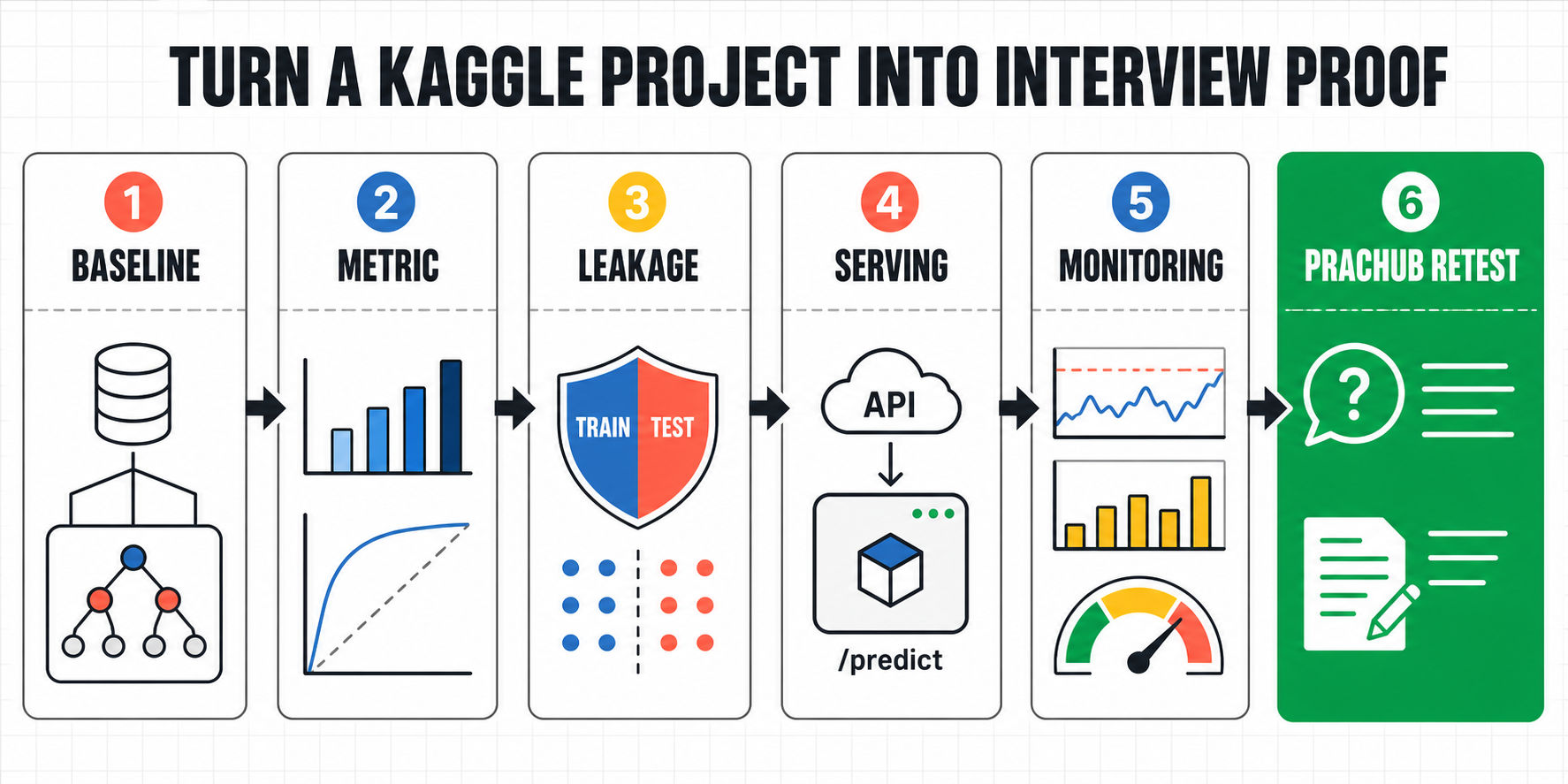
Step 1: Rebuild the baseline
Explain the cheapest useful solution before the final ensemble. State what a constant, heuristic, or simple linear model achieves and why the next level of complexity is justified.
Step 2: Defend the metric
Describe what the competition metric rewards, what it hides, and which product metric you would use in a real deployment. Include one threshold or slice where the aggregate score could be misleading.
Step 3: Audit leakage and validation
Explain how you split the data and why the split matches future use. Check time leakage, entity overlap, target-derived features, preprocessing fitted on the full dataset, and repeated users across train and validation sets.
Step 4: Design the serving path
Turn the notebook into a system diagram. Define the prediction request, feature source, model endpoint, latency budget, fallback, versioning, and deployment strategy.
Step 5: Add monitoring and retraining
Choose checks for schema violations, missing features, training-serving skew, drift, latency, model age, and a real-world quality proxy. State what alert triggers investigation, rollback, or retraining.
Step 6: Retest with a real interview question
Attempt a fresh PracHub question without notes. Give yourself 35 to 45 minutes for ML system design or the time limit shown for the target round. Compare your answer with the written solution and record one technical miss and one communication miss.
A Better Weekly Prep Split
Use Kaggle for one focused modeling block rather than every prep block. Spend the rest of the week on unseen company questions, coding under time pressure, ML fundamentals, system design, and one spoken project defense.
Candidates who want more focused question repetition can compare Deep-ML and MLInterview.org. Neither should replace company-specific practice, but both can help isolate a weak concept.
Frequently Asked Questions
Is Kaggle useful for machine learning interviews?
Yes. Kaggle is useful for demonstrating data exploration, feature engineering, model evaluation, experimentation, and project communication. It is most valuable when you can explain the decisions behind the notebook. It does not replace coding, statistics, ML system design, production reasoning, behavioral preparation, or real company questions.
Can a strong Kaggle profile get you an MLE job?
A strong profile can improve a portfolio and create evidence of hands-on work, but it does not guarantee an interview or offer. Hiring teams still evaluate software engineering, ML fundamentals, production judgment, communication, and relevant experience. Treat Kaggle as supporting evidence, not a substitute for the complete hiring loop.
Should I discuss Kaggle projects in an interview?
Yes, when the project is relevant and you can explain your personal decisions. Focus on the baseline, validation design, metric, failed experiments, leakage risks, and how you would deploy and monitor the model. Avoid presenting a leaderboard rank without showing what you learned or what trade-offs you made.
What should I use instead of Kaggle for ML interview prep?
Do not replace Kaggle completely. Combine it with PracHub real interview questions, timed Python or algorithm practice, ML fundamentals review, system design, and a live mock or recorded verbal answer. The right stack covers both model-building skill and performance under interview conditions.
Final Verdict
Kaggle teaches you how to improve a model inside a defined challenge. Machine learning interviews ask whether you can define the challenge, defend the model, write reliable code, design the surrounding system, and communicate under pressure.
Keep one strong Kaggle project and stop treating leaderboard progress as interview readiness. Start with PracHub's company-specific ML interview practice, find the missing round, and use the six-step workflow above to turn project work into evidence an interviewer can evaluate.
Official Sources
Related Articles
Is Deep Learning Interviews Still Useful for AI and ML Roles in 2026?
Is Deep Learning Interviews still useful in 2026? Compare its AI/ML foundations with missing LLM, coding, system design, and production interview coverage.
MLInterview.org Review 2026: Question Bank vs Real Company ML Interviews
Read our MLInterview.org review comparing its ML question bank and explanations with real company interviews, plus a better PracHub practice workflow.
Generative AI System Design Interview Book Review 2026: Is It Still Enough?
Generative AI System Design Interview book review for 2026: strengths, missing topics, best readers, and how to combine it with PracHub practice.
Is Chip Huyen's Designing Machine Learning Systems Enough for MLE Interviews?
Is Designing Machine Learning Systems enough for MLE interviews? See what Chip Huyen's book covers, what it misses, and the best prep workflow.
Comments (0)