Is GitHub's System Design Primer Enough for Senior Interviews?
Quick Overview
The open-source System Design Primer is an excellent free foundation for distributed-systems concepts and interview structure, but it is not enough by itself for most Senior Software Engineer interviews. This 2026 review explains what the repository covers, where static sample solutions fall short, and how to combine the Primer with PracHub's real company questions, production case studies, hostile follow-ups, and timed mocks.
The System Design Primer is one of the most popular free architecture resources online. It explains scalable-systems vocabulary, provides an interview framework, and includes worked exercises. But is the GitHub System Design Primer enough for a Senior-level interview?
The short answer is no, but it is an excellent foundation. First review your target company's company-specific interview prep on PracHub. Identify reported formats, domains, and follow-ups, then use the Primer to fill the concepts those prompts expose.
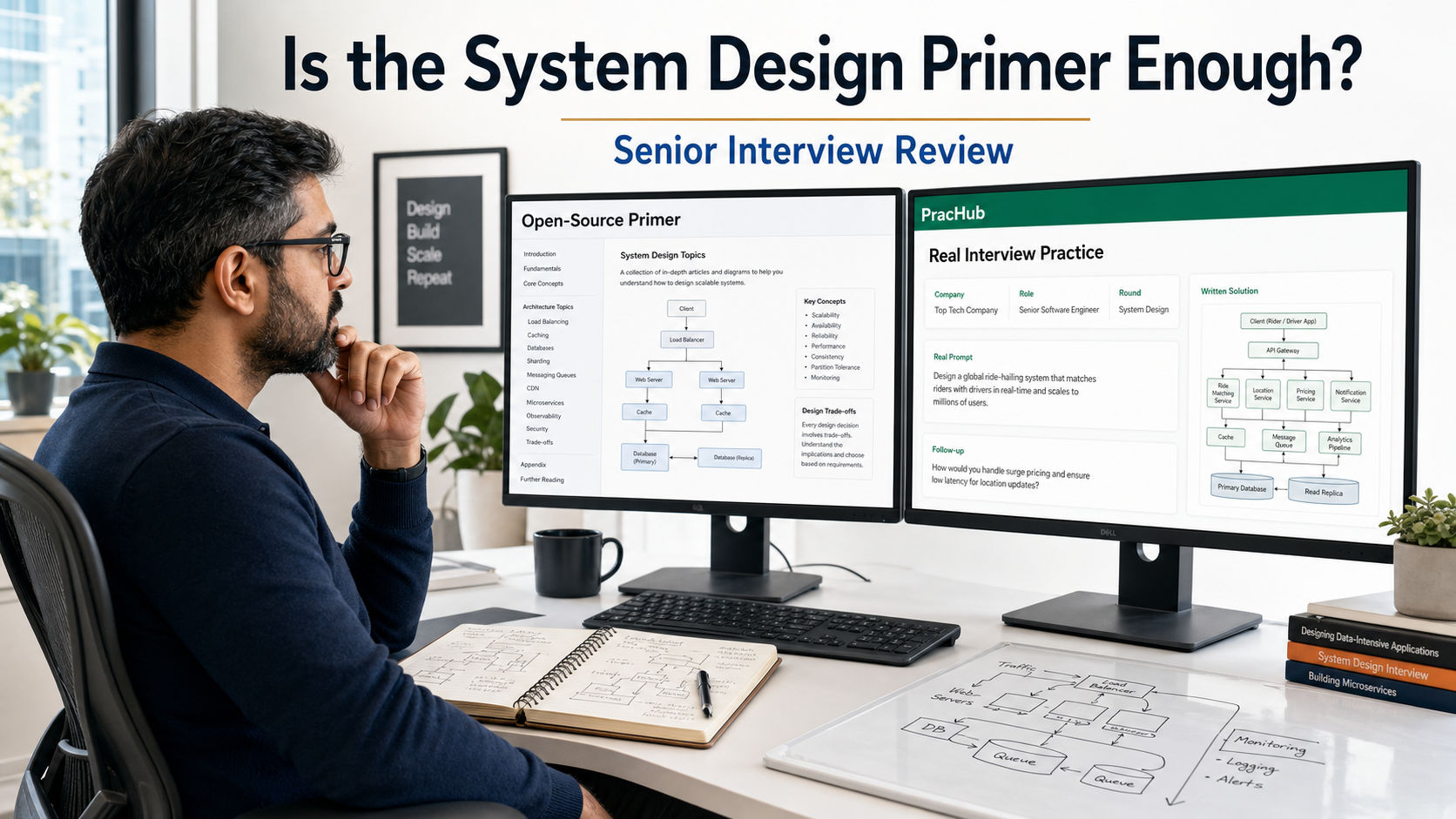
Quick Verdict
The Primer is enough to learn core distributed-systems language and organize a basic answer. It covers scalability, availability, consistency, caching, databases, load balancing, asynchronous work, networking, security, and estimation.
It is not enough by itself for most Senior interviews. Candidates must turn ambiguity into a defensible design, handle failures and operations, and connect trade-offs to real constraints. Reading sample architectures cannot prove that.
Use it for breadth, then practice real system design questions aloud with company context, timed follow-ups, and written-solution review.
First, It Is Not GitHub's Official Guide
The resource is the open-source donnemartin/system-design-primer repository hosted on GitHub. It is not published by GitHub as an official hiring guide. That distinction matters when you evaluate its authority and freshness.
On August 2, 2026, GitHub's API reported more than 360,000 stars and maintenance commits from March 2026. Several recent changes fixed links or wording, so a recent commit date does not prove that every example reflects current production practice.
What the System Design Primer Covers
A broad distributed-systems map
The Primer is strongest as a concept index. It summarizes latency, throughput, availability, consistency, DNS, CDNs, load balancing, proxies, databases, caching, queues, back pressure, communication protocols, and security.
Most sections explain advantages, disadvantages, and trade-offs, then link to deeper material. That structure is useful when you need a fast orientation or a checklist of areas to revisit.
A repeatable interview sequence
It recommends clarifying constraints, drawing a high-level design, designing core components, and then scaling the system. It also highlights estimation and bottleneck analysis.
This sequence prevents a common failure: drawing databases and queues before the problem is scoped. It gives a nervous candidate a reliable starting point without forcing one memorized architecture.
Sample solutions and spaced repetition
Worked exercises include Pastebin, a social feed, a web crawler, Mint, a key-value store, and an AWS scaling scenario. The repository also includes object-oriented design exercises and Anki flashcards.
These are useful study aids, but the sample set is small relative to the range of modern Senior interviews. The value comes from studying the reasoning pattern, not memorizing the diagrams.
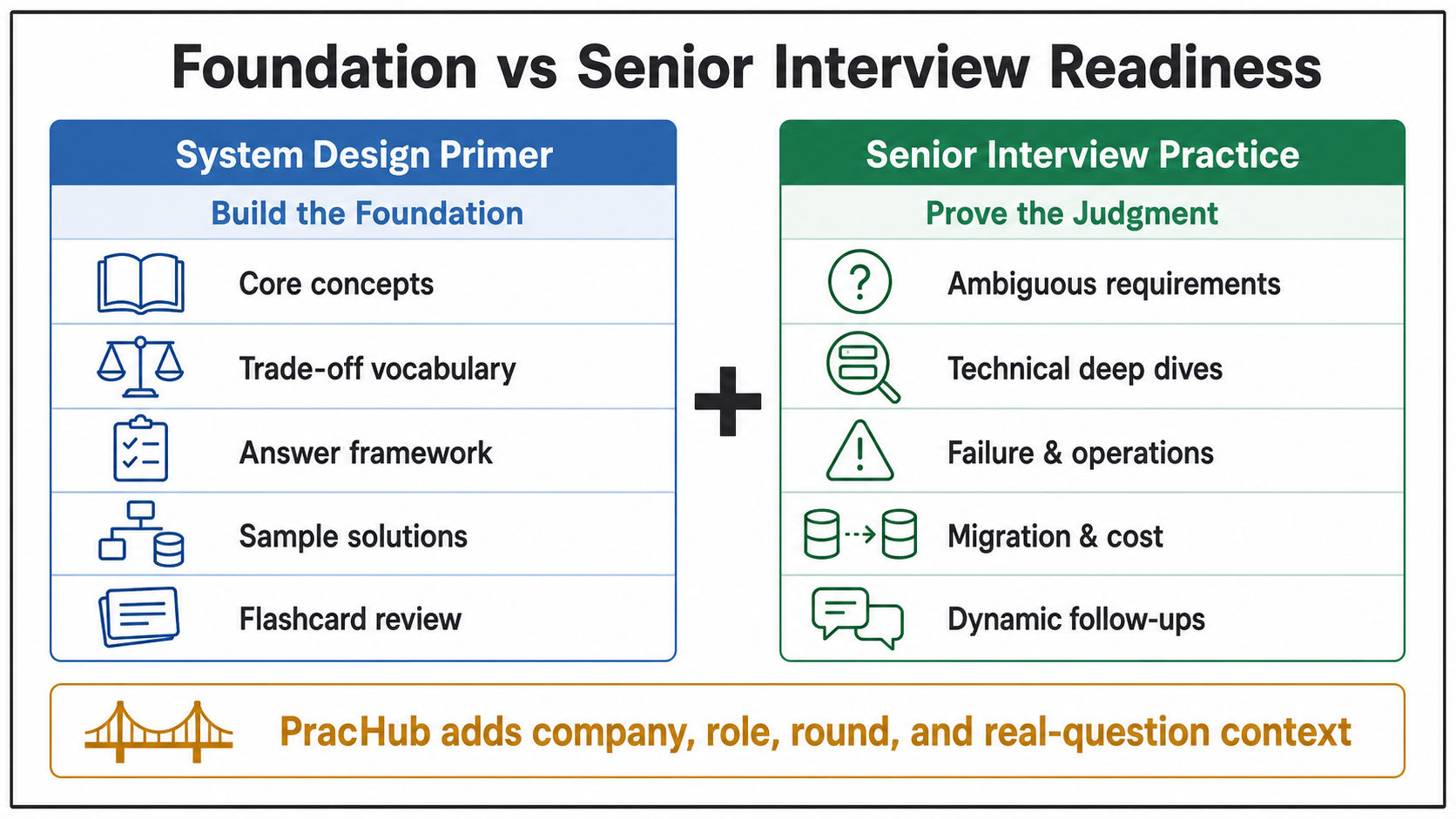
What the Primer Does Exceptionally Well
It makes system design less intimidating
System design has no single syllabus. The Primer turns a scattered field into a map and links concepts beginners often learn separately. You cannot discuss sharding, caching, replication, or queues well if the terms are still fuzzy.
It teaches that every component has a cost
The repeated emphasis on trade-offs is the repository's most important lesson. A cache changes consistency and invalidation. Replication changes failure handling. A queue changes latency, retries, ordering, and observability. Senior answers improve when every box exists for a stated reason.
It is free and easy to revisit
You can scan the study guide, jump to a weak topic, inspect diagrams, and follow original engineering references without buying a course. It works particularly well as a reference beside real practice rather than as a linear book that must be completed.
Why It Is Not Enough for Senior Interviews
Senior interviews are interactive
A written solution cannot add a compliance requirement, challenge your storage model, or ask what fails during a regional outage. Follow-ups reveal whether you understand the design or recognize a template.
Practice must therefore include speaking, clarification, diagram changes, and recovery after a flawed assumption. The Primer can supply knowledge, but it cannot create that pressure on its own.
Production depth is uneven
Senior discussions often move into deployment, migrations, backfills, capacity, observability, incidents, cost, abuse, and rollout. The Primer introduces the building blocks but does not carry every sample through that lifecycle.
You should supplement it with company engineering blogs, architecture papers, postmortems, and designs from systems you have actually built. Verify claims instead of treating an open-source summary as the final authority.
Company and role context are missing
A marketplace, infrastructure platform, consumer app, and payments company can emphasize very different risks. A Senior backend candidate may be pushed on data correctness and APIs, while an SRE candidate may face reliability, fleet operations, and failure isolation.
Use PracHub's real interview questions with written solutions to discover that context before selecting which Primer chapters deserve the most attention.
Primer vs Real Senior Interview Practice
| Preparation need | System Design Primer | Real interview practice |
|---|---|---|
| Concept breadth | Strong overview of core distributed-system topics | Exposes which concepts matter for a specific prompt |
| Answer structure | Provides a clear four-stage framework | Tests whether you can lead the conversation under time pressure |
| Technical depth | Varies by topic and linked resource | Follow-ups reveal shallow assumptions and missing trade-offs |
| Operational realism | Introduces failures and scaling patterns | Can force migrations, incidents, observability, and rollout decisions |
| Company relevance | General-purpose examples | Company, role, round, and domain context |
| Feedback | Compare with a static sample solution | Review reasoning, communication, and adaptation |
A Better Senior-Level Prep Workflow
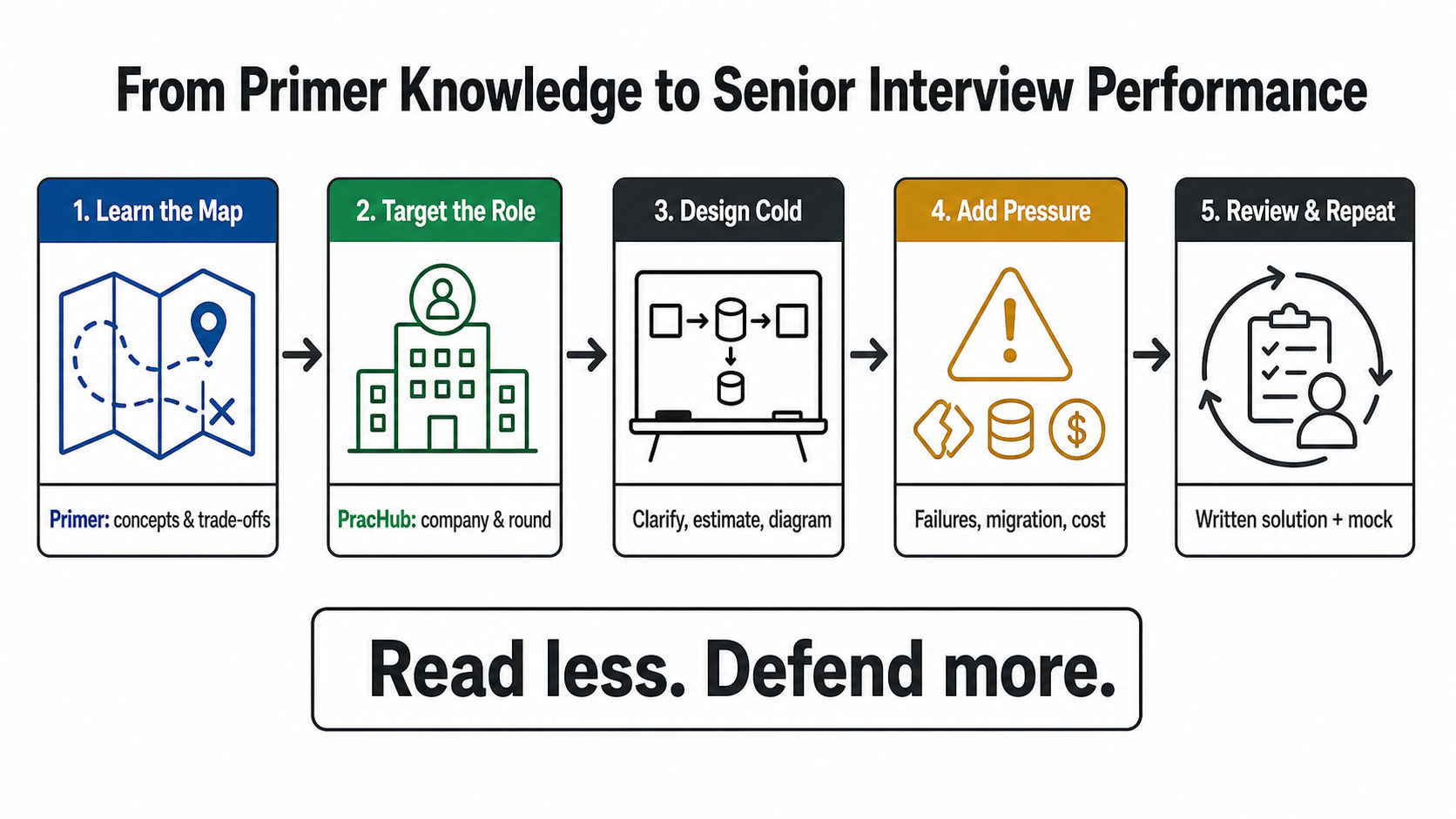
- Map the target interview. Use PracHub to collect several recent prompts for the company, role, and likely round.
- Attempt one prompt cold. Spend 35 to 45 minutes clarifying, estimating, drawing, and defending a design without reading a solution.
- Use the Primer diagnostically. Review only the concepts your attempt exposed, then verify deeper details with engineering documentation or papers.
- Repeat with hostile follow-ups. Add a region failure, tenfold traffic growth, a privacy constraint, a migration, and an operational incident.
Finish each repetition with a short review: one requirement you missed, one trade-off you explained poorly, and one operational risk you ignored. That log is more useful than counting pages read.
A 7-Day Readiness Test
| Schedule and practice | Evidence of readiness |
|---|---|
| Day 1: Read the interview framework and map the target loop | A scoped list of likely design competencies |
| Days 2-3: Review weak Primer topics and one production case study | Trade-offs explained without notes |
| Day 4: Complete a cold design from PracHub | Requirements, estimates, diagram, and deep dive |
| Day 5: Redesign for failure, migration, and cost | A plan that stays operable during change |
| Day 6: Run a timed mock with aggressive follow-ups | Clear decisions and recovery under pressure |
| Day 7: Repeat the original prompt | Fewer assumptions and stronger technical depth |
Who Can Use the Primer as a Primary Resource?
Mid-level candidates learning system design for the first time can use it as their main foundation. Senior candidates with deep production experience may also use it as a refresher, because their work history supplies the operational depth the repository cannot.
It is least sufficient for candidates whose experience has been narrow or mostly implementation-focused. If you have not owned migrations, incidents, scaling decisions, or cross-team architecture, you need more case studies and more live practice, not more memorization.
Senior interviews also include leadership and project judgment. Pair architecture practice with PracHub's behavioral and leadership questions so that the technical design and the ownership story support the same level.
FAQ
Is the System Design Primer still useful in 2026?
Yes. Its core concepts and interview framework remain useful, and the repository received maintenance commits in 2026. Still, recent link fixes do not guarantee that every example reflects current architecture practice, so verify important details with primary engineering sources.
How long should a senior engineer spend on it?
Use it until you can explain the main trade-offs and lead a basic design without notes. Then shift most of your time to cold prompts, follow-ups, mocks, and production case studies. Reading every linked page is rarely the highest-value plan.
What should I add after the Primer?
Add recent company-specific prompts, engineering blogs, architecture papers, postmortems, and timed mocks. Focus especially on data modeling, failure handling, migration, observability, cost, security, and the deep technical area most relevant to your role.
Can memorizing the sample solutions hurt?
Yes. Memorization can produce diagrams that look polished but collapse under a changed requirement. Use each solution as one possible design, then challenge its assumptions and build at least one alternative with different trade-offs.
Final Verdict
The GitHub System Design Primer is enough to build a foundation, but not enough to demonstrate Senior-level judgment. It teaches the map and a useful interview sequence. Passing a senior interview requires using that map while requirements move, failures appear, and the interviewer chooses where to go deep.
Start with PracHub's system design question bank, select prompts from the target company, and attempt them cold. Use the Primer to repair the gaps you can name, then return to realistic practice until you can explain and defend the design without a script.
Official references: System Design Primer repository, repository commit history, and GitHub repository metadata. Repository details were checked on August 2, 2026.
Comments (0)